Connecting Rod Hyundai Wholesale Sourcing Guide
Wholesale sourcing for Hyundai-fit connecting rods works best when buyers treat it as a controlled technical purchase, not a simple catalogue match. The right supplier has to prove metallurgy, machining consistency, small-end and big-end geometry, traceability, and export-ready documentation. Driventus manufactures engine and powertrain components in Taizhou, Zhejiang for aftermarket distributors, OEM/Tier-1 supply programmes, and multi-location repair chains in more than 60 countries. This article breaks down connecting rod Hyundai wholesale sourcing through practical decision points, failure modes, comparison criteria, step-by-step approval checks, and commercial terms. Driventus is an independent aftermarket manufacturer; brand names are referenced for fitment only.
The first decision: is the rod actually interchangeable?
Before price, before MOQ, and before packaging, confirm whether the connecting rod is truly interchangeable for the target Hyundai-fit engine. In wholesale buying, appearance is misleading. Rods that look similar can differ in centre distance, big-end width, pin fit, bolt shoulder shape, or cap profile.
Start with the minimum data set:
- Engine code and displacement
- Fuel type and aspiration type
- Vehicle model and production period
- Piston pin diameter
- Crankpin diameter
- Centre-to-centre length
- Rod type: bare rod, rod with bushing, or rod-and-cap assembly
If any of those points are missing, the risk shifts from sourcing to engineering. A quote can still be prepared, but it should be treated as provisional until a sample or drawing confirms geometry.
For a connecting rod Hyundai wholesale programme, the buyer should also decide early whether the main goal is replacement depth, broad catalogue coverage, or a tighter repair-chain SKU list. That choice affects every other sourcing variable, including MOQ, carton count, and how many SKUs should be held in stock.
Driventus supports buyers with structured fitment files and product-family references through our catalog, but final application approval should always be based on dimensions, samples, and the buyer’s market-specific validation process.
Where wholesale projects usually fail
Most sourcing problems do not start in production. They start in interpretation. One buyer assumes an OE-style number is enough. Another assumes a rod from a naturally aspirated engine will also work in a turbo version because the length matches. Both assumptions can create expensive returns.
Common failure modes include:
- Cross-referencing by model name instead of engine code
- Accepting a catalog image without dimensional proof
- Ignoring bolt grade or reuse policy
- Overlooking width, twist, or parallelism tolerances
- Mixing early and later production revisions in one SKU
- Ordering without confirming packaging for freight and warehouse handling
- Approving samples without a full dimensional report
The cost of a wrong rod is high because the part sits deep inside the engine. A mismatch may not appear until final assembly, or worse, until the engine is running. That makes incoming control more important than sales copy.
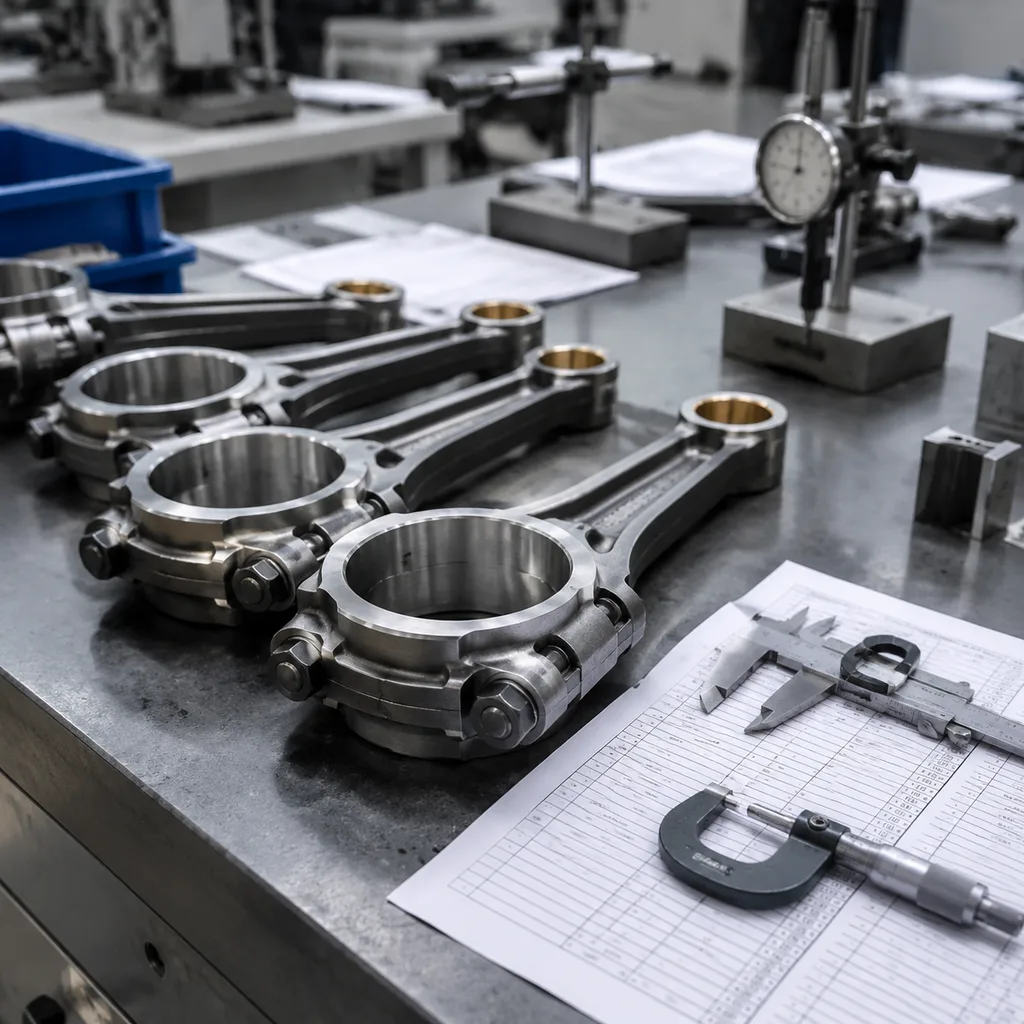
A practical safeguard is simple: insist on a sample set, a dimensional report, and a master cross-reference file before production release. For high-risk applications, request a first-article check on 5-10 pieces per SKU and reserve at least one or two pieces for destructive testing if needed.
Step-by-step approval for a wholesale order
The most reliable wholesale process is staged. Trying to approve a full programme in one step usually creates rework.
Use this sequence:
1. Confirm engine code, OE-style reference, and target application list. 2. Request sample rods with the exact packaging format expected for production. 3. Compare the sample against 10-15 critical dimensions. 4. Verify metallurgy, hardness, and any shot-peening or heat-treatment requirements. 5. Check bolt spec, torque method, and replacement policy. 6. Assemble a trial pair on a dummy or used crank if the application is sensitive. 7. Review carton labels, barcodes, and count control. 8. Release the SKU only after fit, finish, and documents all pass.
This works especially well for connecting rod Hyundai wholesale programmes that serve multiple channels at once. Distributors can start with fast-moving applications, while repair chains can focus on repeatability and label consistency. Either way, approval should happen before volume release, not after the first shipment lands.
If the project needs buyer-defined marking or packaging, custom manufacturing can be used to align the product with internal stock-control rules.

Spec details that matter in production
Once fitment is confirmed, the next question is whether the supplier can hold the right production spec at scale. For connecting rods, the critical features are mechanical, not cosmetic.
Key controls usually include:
- Centre-to-centre length tolerance
- Big-end bore roundness and cylindricity after cap assembly
- Small-end bore diameter and bushing finish where applicable
- Big-end housing width and small-end width
- Parallelism and twist between bores
- Bolt seating surface condition
- Weight range for matched sets
- Surface condition after finishing or shot peening
Typical tolerance targets depend on the application, but the buyer should ask for numeric values, not general statements. A supplier saying “within standard” has not yet defined the standard.
Material route matters too. Rods may be forged, machined, heat-treated, and shot-peened in different combinations. A single engine family may include more than one revision, especially across naturally aspirated, turbocharged, gasoline, and diesel versions. That is why the drawing, sample, or validated dimensional record should lead the approval, not the catalogue title.
For specification-controlled projects, Driventus can support buyer-defined packaging, marking, and inspection reporting through custom manufacturing.
MOQ, lead time, and order shape
Wholesale supply is not just a unit-price conversation. It is a planning problem.
A good order structure separates three stages:
- Sample approval
- Trial purchase
- Forecast-based replenishment
That sequence limits obsolete stock and gives the buyer time to check fitment, packaging durability, and label accuracy before committing to higher volume.
Typical wholesale variables are shown below.
| Sourcing item | Typical wholesale consideration | Buyer action |
|---|---|---|
| MOQ per SKU | Commonly 100-500 pcs for an existing production rod; 500-1,000 pcs if new tooling or special packaging is required | Consolidate shared geometry where possible |
| First production lead time | Often 30-45 days for stocked designs; 60-90 days when samples, new labels, or new inspection fixtures are required | Approve drawings and samples before release |
| Repeat order lead time | Often 15-30 days when forgings, bolts, and cartons are already in stock | Share rolling forecasts by quarter |
| Sample quantity | Usually 3-10 pcs | Define inspection points before shipment |
| Packaging | Anti-rust packing plus export cartons or pallets | Specify labels, languages, and carton limits |
| Documentation | Invoice, packing list, COO, inspection report, and agreed material data | Confirm customs needs early |
| Control point | Purpose | Typical record |
|---|---|---|
| Incoming steel verification | Confirms material identity, heat number, and supplier lot | Material certificate or internal check record |
| Heat-treatment monitoring | Controls strength, hardness, and fatigue behaviour | Furnace batch record, hardness data |
| Machining inspection | Confirms bore size, width, centre distance, and cap matching | Dimensional report |
| Crack inspection where specified | Screens for surface discontinuities before packing | Magnetic particle or agreed inspection record |
| Bolt verification | Confirms fastener grade, coating, and consistency | Supplier certificate or incoming inspection |
| Final audit | Confirms appearance, marking, packaging, count, and mixed-SKU control | Outgoing inspection report |