connecting rod · 2026-06-03

Connecting Rod for Honda CR-V: OE Equivalent Guide

A connecting rod for Honda CR-V applications must do more than resemble the original part. It has to match the engine’s geometry, material behaviour, bearing alignment, and fatigue performance closely enough to behave correctly under load. For procurement teams, the real test is whether a connecting rod for Honda CR-V OE equivalent supply programme can hold centre distance, big-end geometry, small-end pin fit, cap clamp integrity, and mass consistency across repeat orders. Driventus is an independent aftermarket manufacturer; Honda and CR-V names are referenced for fitment identification only. We treat the rod as a critical rotating and reciprocating engine component, with process checks aligned to IATF 16949:2016 and ISO 9001:2015. That discipline matters for distributors, repair networks, importers, and private-label programmes that need consistent fitment, batch traceability, reliable cross-reference logic, and documentation strong enough for customer claim review. The guidance below explains what to verify before volume orders, how OE-equivalent rods differ from unverified aftermarket parts, which records should be available before supplier approval, and how to base sourcing decisions on measurable engineering evidence.

What OE-equivalent means for Honda CR-V fitment

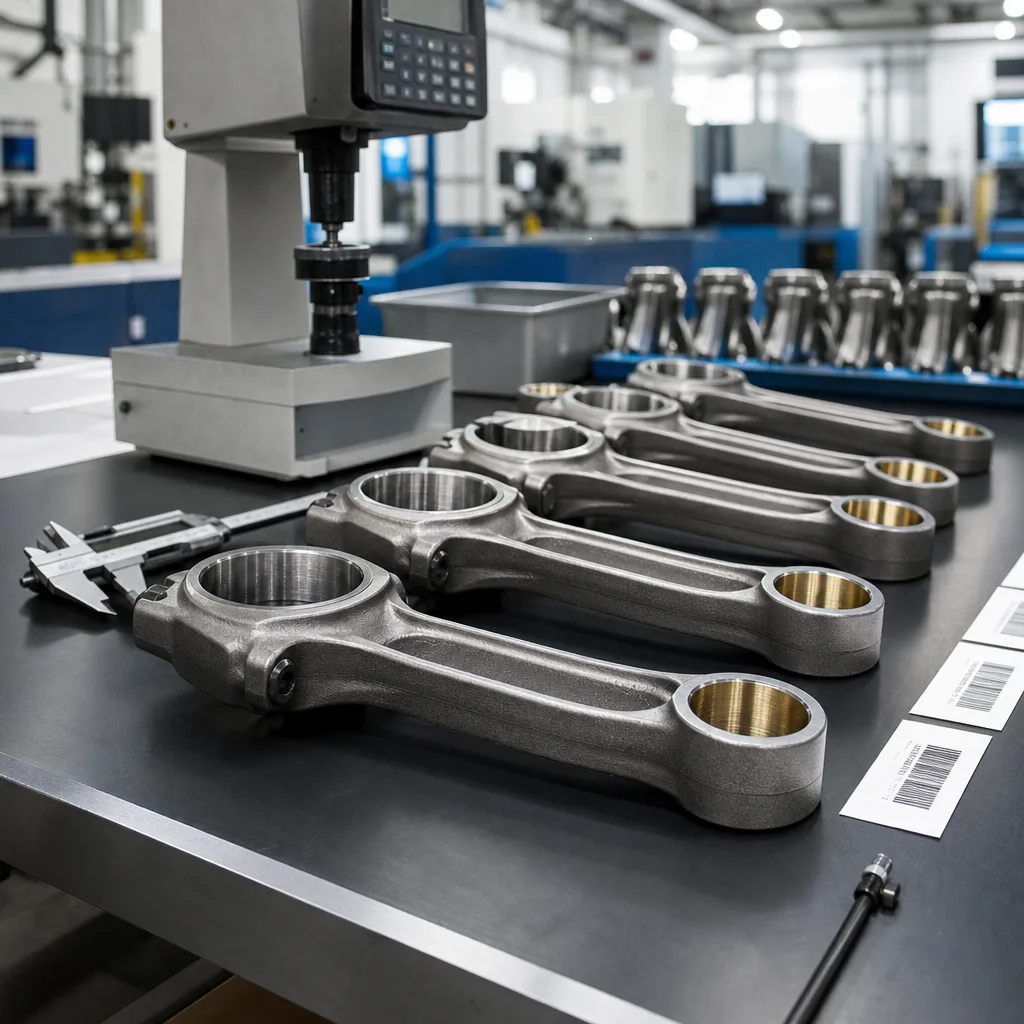
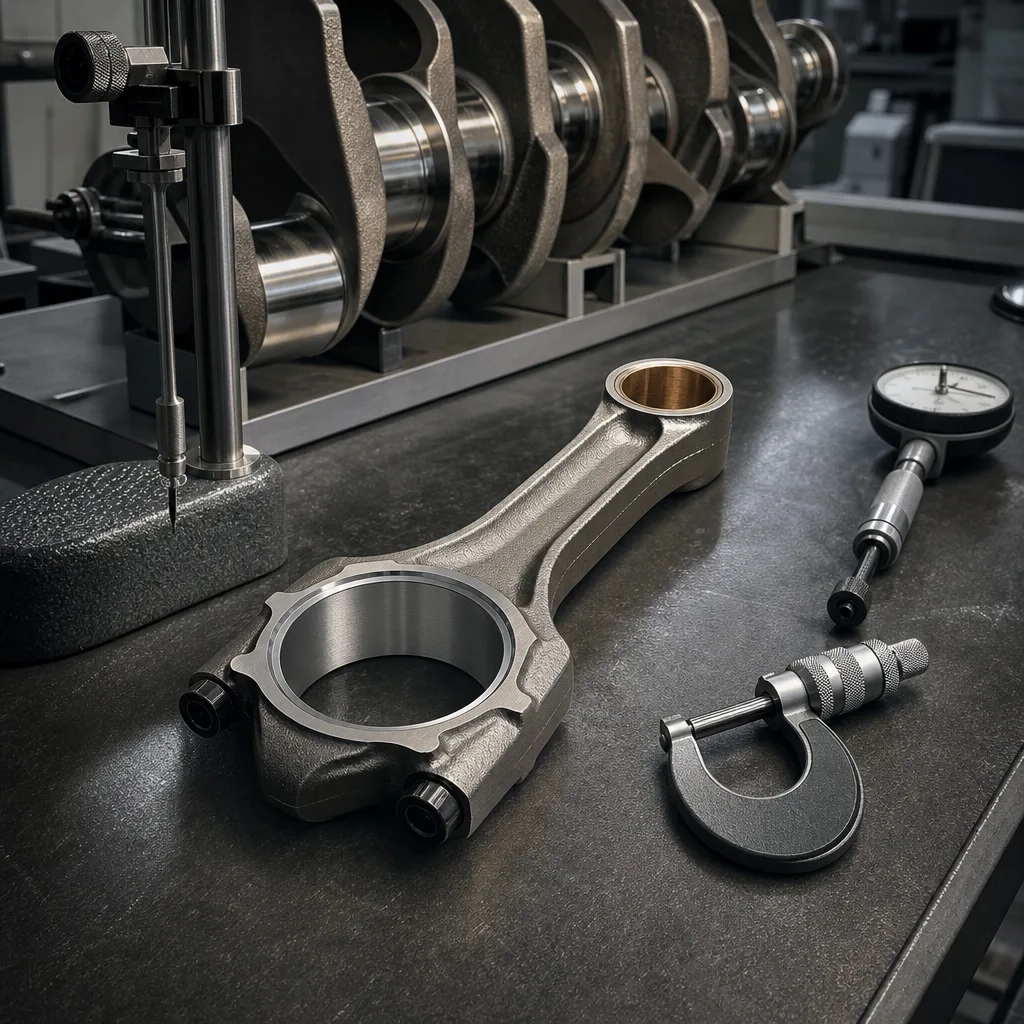
For a connecting rod, OE-equivalent means the replacement part matches the original application in the engineering characteristics that affect engine geometry and bearing life: centre-to-centre length, big-end bore diameter, roundness and cylindricity, small-end bore or bushing specification, beam profile, cap geometry, parting-face control, fastener interface, and weight class. The rod transfers combustion load from the piston to the crankshaft, keeps the bearing aligned at high cyclic speed, and contributes to the engine’s balance strategy. When a critical dimension drifts, the result can be bearing noise, oil-film loss, accelerated journal wear, piston height variation, uneven compression, or vibration after rebuild.

For buyers, the useful question is not only “will it fit?” It is “will it behave like the original part under load?” That requires a review of steel grade or equivalent material specification, forging or forming route, heat-treatment condition, hardness range, shot peening where specified, and surface finish at the bearing and pin interfaces. It also means checking how the rod works with adjacent parts: crankshaft journal, rod bearing shells, piston pin, piston, rod bolts, and cap seating surfaces. A part can look correct in a catalogue image and still fail procurement approval if the big-end bore loses roundness after bolt torque, the pin-end clearance is poorly controlled, or the finished mass range is too wide for matched engine sets.

In B2B sourcing, OE-equivalent should be treated as a documented engineering position, not a sales label. The supplier should identify the relevant Honda CR-V engine family, confirm the intended application range, and provide controlled specifications for the replacement rod. Where one CR-V generation uses more than one engine configuration, buyers should avoid broad catalogue assumptions and confirm coverage by engine code, displacement, production period, transmission where relevant, and destination market. Engine-code confirmation is especially important when an aftermarket catalogue groups multiple K-series or R-series applications under one commercial reference.

Driventus supplies rods for aftermarket replacement programmes where the target is dimensional and functional equivalence to the original application, not a cosmetic match. If you are building a line card, see our catalog and the broader engine components range for adjacent parts.

Specification points buyers should verify

A procurement spec should be built around measurable controls. The most productive supplier conversations start with drawings, tolerances, inspection methods, sampling plans, and release criteria, not part numbers alone. For a connecting rod for Honda CR-V OE equivalent programme, the specification should define geometry, material condition, machining quality, fastener requirement, cleanliness, corrosion protection, and batch-level acceptance standard.

</tr></thead><tbody> </tbody></table>If the supplier cannot state these values in a controlled drawing, inspection report, or production control plan, the part is not ready for volume procurement. A sample that installs correctly has value, but it is not enough on its own. Buyers should confirm whether that sample reflects normal production tooling, normal heat treatment, normal bolt supply, and the same machining and gauging flow used for shipment lots. Pre-production samples and mass-production batches should be linked by revision status so approval data remains valid after the first order.

For replacement projects, ask for sample dimensional reports, material and hardness information, fastener details, surface-finish data for bearing and pin bores, and a clear revision status before release. For distributor programmes, it is also sensible to define packaging configuration, matched-set handling, carton labelling, corrosion protection, drop-test expectations for export cartons, and shelf-life requirements at the RFQ stage. These details reduce warehouse errors and keep technical claims from becoming avoidable commercial disputes.

How OE-equivalent rods differ from low-grade aftermarket parts

The main difference is process control. Low-cost parts often rely on visual similarity and may leave machining, metallurgy, fastener selection, cap matching, inspection frequency, or traceability weakly controlled. That is a serious issue in a connecting rod because small deviations accumulate under cyclic load. A slightly inconsistent big-end bore, an uncontrolled parting face, incorrect bolt clamp load, or unstable heat-treatment process may not be obvious during installation. It can appear later as bearing noise, low oil pressure complaints, vibration, or premature engine failure.

Item What to verify Why it matters
Centre-to-centre lengthNominal length and tolerance from OE drawing, validated sample, or approved technical referencePreserves compression height, piston travel, deck clearance, and timing relationship
Big-end boreDiameter after cap bolt torque, roundness, cylindricity, cap alignment, parting-face condition, and surface finishProtects bearing crush, bearing clearance, oil-film stability, and crankshaft journal life
Small-end boreDiameter, bushing material if fitted, pin clearance, bore roundness, and surface finishControls piston pin fit, pin noise, oil retention, and wear pattern
Side facesRod side clearance faces, parallelism, burr control, and finishPrevents crankshaft cheek contact, oiling issues, and assembly interference
Mass and balanceTotal weight, big-end/small-end weight split where specified, matched-set tolerance, and lot repeatabilityReduces vibration, imbalance, and rebuild inconsistency
FastenersBolt grade, thread form, seating face, stretch or torque-angle method, lubrication condition, and reuse policyMaintains cap clamp load and prevents bore distortion or cap movement under cyclic load
Material and heat treatmentSteel grade or equivalent material, forging condition, hardness range, microstructure, heat-treatment record, and deformation controlAffects fatigue life, dimensional stability, and resistance to bending and tensile load
Surface conditionBearing contact finish, pin-bore finish, parting-line quality, chamfer consistency, burr removal, residual debris, and rust preventionReduces installation issues, contamination risk, and premature bearing damage
Marking and traceabilityPart number, engine/application reference, batch code, revision status, production date or lot code, and packaging labelSupports recalls, warranty handling, FIFO warehouse control, and customer claim investigation

</tr></thead><tbody> </tbody></table>A validated OE-equivalent rod should come with incoming inspection criteria, batch traceability, and confirmation that the supplier uses stable machining, heat-treatment, deburring, cleaning, and corrosion-control processes. It should also show that the cap and rod body are managed as a matched assembly where required, because cap interchange or incorrect pairing can change big-end bore geometry after tightening. The supplier should be able to explain how nonconforming parts are contained, how drawing revisions are controlled, how gauge calibration is maintained, and how mixed lots are prevented during packing.

This is where quality system evidence matters more than catalogue claims. A strong supplier will not simply state that the part is compatible; it will show how compatibility is maintained batch after batch through inspection plans, production records, and corrective-action procedures. If a supplier can also support custom manufacturing, that is useful for private label, kit packing, or programme-specific labels, but the base requirement remains dimensional conformity. Branding, packing, and commercial presentation should follow the engineering release.

Validation, standards, and test evidence

For export programmes, technical files should refer to published standards and defined test methods instead of broad marketing claims. Relevant references can include IATF 16949:2016 and ISO 9001:2015 for process control, REACH (EC) No 1907/2006 for substance compliance in the EU, and application-level durability, corrosion, cleanliness, or packaging methods where required by the buyer’s approval plan. The exact evidence package may vary by market, but the principle stays the same: an OE-equivalent claim should be supported by records that can be reviewed before purchase and traced after shipment.

For a rod, validation usually covers:

  • Dimensional inspection against the controlled drawing, including centre distance, big-end bore in torqued condition, small-end bore, side faces, chamfers, and critical seating surfaces
  • Roundness, cylindricity, and surface-finish checks at the big-end and small-end bores using calibrated gauges or CMM/air-gauge methods where appropriate
  • Hardness verification after heat treatment, with acceptance limits, sampling frequency, and lot identification
  • Microstructure, material chemistry, or material certificate review where required by the buyer’s approval plan
  • Magnetic particle inspection or crack detection where specified for forged, resized, or high-risk applications
  • Static proof, tensile-related assessment, fatigue validation, or other strength checks on representative samples when required for programme approval
  • Mass consistency across batch and sub-batch lots, including matched-set control where sets are supplied
  • Surface finish, deburring, residual contamination, and cleanliness checks at bearing, pin, and cap contact areas
  • Fastener verification, including bolt grade, thread condition, seating condition, tightening method, and torque-angle or stretch guidance where applicable
  • Salt-spray, humidity, or storage simulation where export transit time, sea freight, or long warehouse storage creates corrosion risk

If the application belongs to a broader engine programme, some buyers also request compatibility evidence with adjacent components such as bearings, pistons, piston pins, crankshafts, and rod bolts. This is particularly useful when a distributor is assembling a complete repair kit or when a repair network wants fewer installation variables across multiple branches.

The strongest validation file connects the engineering specification to actual production output. A one-time sample photo does not prove repeatability. Measurement reports, inspection plans, batch records, torque-state bore checks, material or hardness evidence, and corrective-action procedures show whether the supplier can maintain the same part over multiple shipments. For importers and distributors, that repeatability is the difference between a sellable replacement component and a part that creates claim risk after installation.

Sourcing checklist for distributors and repair networks

Before you release a purchase order, confirm the following:

  • Written application coverage for the relevant Honda CR-V engine family, ideally by engine code, displacement, production period, and destination market where available
  • Cross-reference logic that separates confirmed fitment from assumed catalogue interchange
  • Sample approval against measured dimensions, torque-state big-end bore results, mass data, and installation checks, not only visual fit
  • Controlled drawing, revision status, inspection report, and release criteria for the approved sample
  • Material, heat-treatment, hardness, microstructure where required, and surface-finish information appropriate to the application
  • Fastener specification, tightening guidance, lubrication condition, and policy on bolt replacement or reuse where bolts are included or recommended
  • Batch traceability and packaging labels with part number, lot code, revision reference, quantity, and country of origin where required
  • Lead time, MOQ, reorder stability, supplier capacity, and forecast handling across multiple shipments
  • Country-of-origin documentation, export paperwork, REACH or other compliance statements required by the destination market
  • Warranty terms tied to documented installation conditions, bearing clearance checks, lubrication requirements, torque procedure, and approved use case
  • Packaging protection against corrosion, impact damage, mixing of matched sets, and warehouse misidentification

For multi-location repair chains, the practical value is consistency. Technicians need the same fit, bearing clearance behaviour, pin fit, and torque response on every installation. Training and warranty control become easier when the rod, bolts, packaging, and documentation do not change unexpectedly between shipments. Warehouses also need reliable replenishment, clear labels, stable part numbers, and lot visibility so stock can move across branches without confusion.

For distributors, the commercial value is a lower claim rate and fewer returns due to bearing noise, oil pressure issues, vibration, installation mismatch, or incomplete documentation. A well-documented connecting rod for Honda CR-V OE equivalent programme also improves customer confidence because sales teams can answer technical questions with evidence instead of relying only on catalogue wording.

If you need a supplier who can support programme-level documentation and export supply, use request a quote as the starting point. That allows us to review the exact application, target volume, expected documentation set, packaging requirement, and supply terms before quotation.

Frequently asked questions

No. It is an aftermarket part designed to match the original application in fit, function, key dimensions, material condition, and installation behaviour. Driventus is an independent aftermarket manufacturer; brand names are referenced for fitment only.

Request the controlled drawing, sample inspection data, torque-state big-end bore results, material and heat-treatment information, hardness records, fastener details, batch traceability, and the supplier’s quality records. Those documents matter more than catalogue wording.

Yes. Where needed, [custom manufacturing](/oem-services.html) can cover part marking, packaging, labels, matched-set packing, and document packs, provided the base application and validation requirements are defined first.

If you are sourcing for distribution, workshop supply, or programme replacement, send the application details, engine code where available, target volume, and required document pack through [request a quote](/contact.html). We will confirm fitment, documentation, packaging requirements, and supply terms before pricing.

Request a Quote
Option Typical strength Dimensional consistency Documentation Procurement risk
OE-equivalent aftermarketControlled to a validated drawing, defined material condition, approved fastener specification, and inspection planHigh when the supplier maintains stable tooling, torque-state bore measurement, calibrated gauges, and lot controlsDrawing, sample inspection record, material or hardness evidence, traceability, and quality-system evidence should be availableLower, if documentation is complete and application coverage is confirmed
Used or reconditioned rodDependent on prior service history, reconditioning quality, resizing method, and crack inspectionVariable, especially where cap surfaces, big-end bores, or pin bushings have been servicedOften limited to workshop measurement notes or inconsistent supplier claimsHigh for repeatable distribution supply
Low-cost unverified aftermarketOften unclear, with unknown material, heat-treatment, bolt grade, and machining controlVariable to poor, especially across mixed lots or supplier substitutionsFrequently limited to catalogue fitment claims and basic packing labelsHighest due to technical uncertainty, claim exposure, and batch-to-batch variation