Connecting Rod GMC Manufacturer China Sourcing Guide
Sourcing connecting rods for GMC engine applications takes more than matching an interchange number. Importers need a supplier that can control the manufacturing route, material traceability, bore geometry, bolt seating, and corrosion-resistant export packaging. For distributors, engine rebuilders, and repair-chain buyers, the practical questions are clear: which engine families can be supported, what MOQ applies, how samples are approved, and whether repeat batches will stay consistent without uncontrolled substitutions. Driventus manufactures engine and powertrain components in Taizhou, Zhejiang, and supplies B2B customers in more than 60 countries. This guide explains how procurement teams can evaluate a connecting rod GMC manufacturer China sourcing programme, what documents to request, and which process controls matter before a purchase order is released. Driventus is an independent aftermarket manufacturer; brand names are referenced for fitment only.
What Buyers Should Verify Before Sourcing
A connecting rod is a fatigue-loaded engine component, so small variation in big-end roundness, centre-to-centre length, side clearance, or bolt seating can affect bearing clearance and service life. When evaluating a connecting rod GMC manufacturer China sourcing project, procurement teams should look for evidence that production is controlled from material receipt through final inspection, not only a catalogue image or interchange claim.
Key supplier checks include:
Business scope covering engine components, not only general trading activity.
IATF 16949:2016 or ISO 9001:2015 certification with a scope relevant to machining, forging, or engine parts.
Material traceability from steel bar, forging blank, powder metal lot, or casting batch to finished product lot.
PPAP-style sample documentation when required by OEM, Tier-1, fleet, or large distributor programmes.
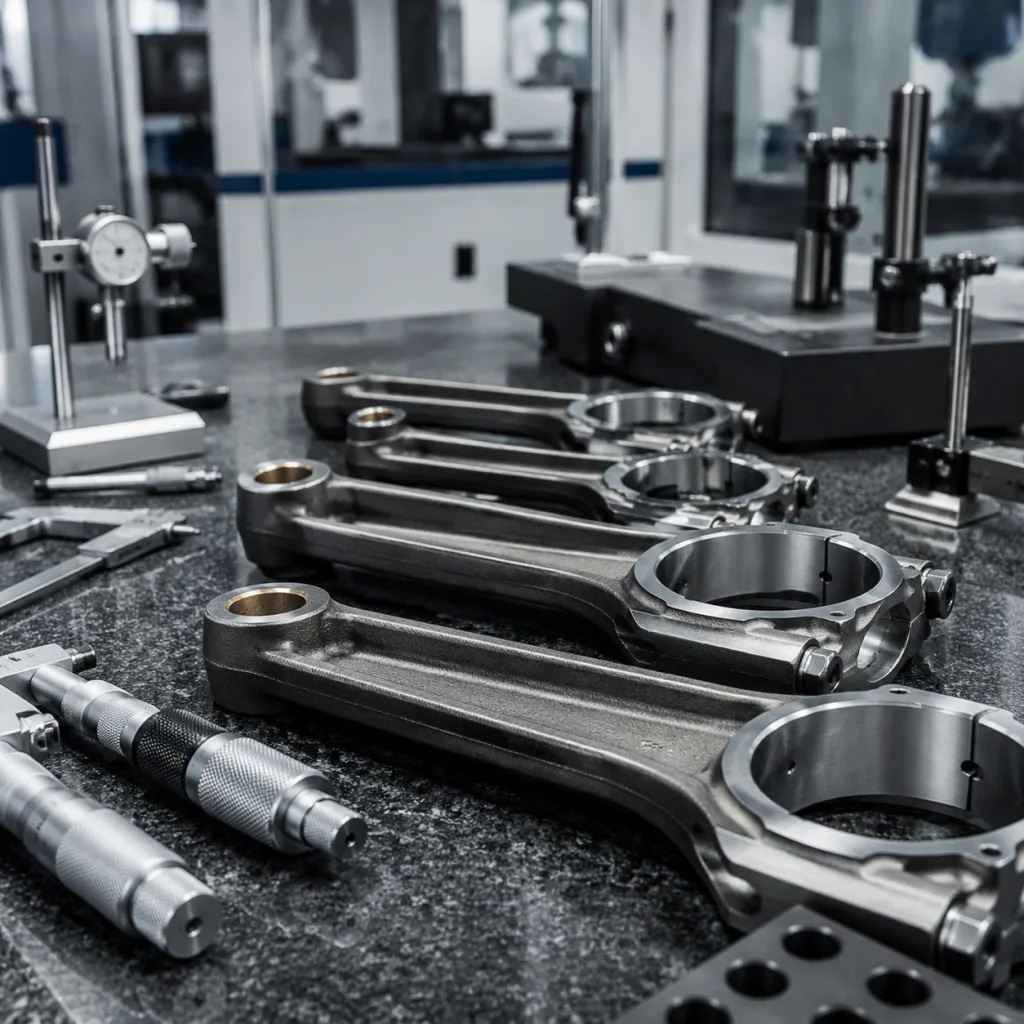
Dimensional inspection records for big-end bore, small-end bore, twist, bend, side clearance, and weight.
Controlled rod bolt sourcing, torque procedure, thread inspection, and cap-to-rod matching.
Export packaging specification with anti-rust protection, clear batch labels, and carton strength suitable for ocean freight.
For buyers consolidating several engine families, review our catalog and the engine component range before issuing an RFQ. A clear application list reduces the risk of mixing visually similar rods that use different pin diameters, bolt sizes, bearing widths, or cap designs.
Manufacturing Route and Material Controls
Connecting rods for GMC-fit applications are commonly produced by forged steel plus precision machining, powder metal processing, or billet machining for lower-volume and special-service programmes. The right route depends on the engine family, annual demand, validation requirement, tooling budget, and target price.
Production route
Typical use case
Procurement considerations
Forged steel
Higher-volume aftermarket and OE-style service parts
Strong fatigue performance, tooling investment required, stable for repeat programmes
Powder metal
High-volume OE-equivalent designs where the original design uses this route
Process and density control are critical; geometry is usually design-specific
Billet machined steel
Low-volume, sample, or special service programmes
Higher unit cost, flexible geometry, useful when tooling investment is not justified
</tr></thead><tbody> </tbody></table>Material control should include incoming chemical composition checks, heat number recording, hardness verification after heat treatment where specified, and batch-level retention of inspection records. Buyers should not accept generic descriptions such as “standard steel” without a grade, heat number, hardness range, and mechanical property targets where applicable. If a drawing is unavailable, the RFQ should still define the application, sample part, target annual quantity, packaging method, destination port, and required cross-reference format.
Driventus can review application data and sample parts through custom manufacturing for projects where buyers need a controlled private-label or programme-specific connecting rod.
Dimensional and Functional Inspection Points
A visual match is not enough for connecting rods. Two rods can look similar on a bench but differ in pin bore, bearing width, cap geometry, bolt specification, or weight range. Procurement teams should define inspection points before production, especially when the part will be sold under a distributor’s own label or supplied into a repair-chain network.
Recommended specification list for RFQ review:
Centre-to-centre length measured on calibrated fixtures.
Big-end bore diameter, roundness, taper, and bearing crush allowance.
Small-end bore diameter and bushing finish where applicable.
Side clearance width at the big end and pin end.
Bend and twist limits measured against drawing, OE sample, or approved benchmark part.
Rod and cap mating identification to prevent mismatch during machining, inspection, and packing.
Weight range and balance method where the engine family requires matched sets.
Bolt torque or torque-angle procedure used during final bore sizing.
Surface finish requirement at bearing, pin, and thrust contact areas.
100% visual inspection for cracks, burrs, dents, nicks, thread damage, and contamination.
Measurement equipment should be calibrated under a documented system aligned with ISO 9001:2015 requirements. For higher-risk programmes, request gauge R&R evidence for critical dimensions and a first-article inspection report before approving mass production. Clear inspection criteria also make later claims easier to analyse because both buyer and supplier can compare results against the same measurement method.
Quality System, Audit Evidence, and Compliance
A credible supplier should be able to explain how nonconforming rods are identified, segregated, analysed, and prevented from entering export stock. Certification alone is not enough, but it is a useful starting point. Driventus operates under IATF 16949:2016 and ISO 9001:2015 frameworks; buyers can review the quality system when preparing an audit checklist.
Procurement teams should request:
Current quality certificates with scope, address, expiry date, and issuing body.
Process flow chart, control plan, and inspection plan for the relevant rod family.
Material certificates for each production lot.
Heat-treatment records when heat treatment is part of the manufacturing route.
Final inspection report with sampling level, inspection method, and acceptance criteria stated.
Corrective action process for dimensional, assembly, labelling, or packaging claims.
Traceability label format for inner cartons, master cartons, pallets, and batch records.
For EU and UK importers, material and coating declarations may be required to support compliance reviews under REACH (EC) No 1907/2006. Connecting rods are not emissions approval devices, but engine repair parts can still be included in broader vehicle compliance documentation. Avoid any claim that suggests approval, endorsement, or genuine-part status from a vehicle manufacturer unless the buyer holds direct written evidence from that manufacturer.
MOQ, Lead-Time, and Export Packaging
Commercial terms should match the manufacturing route. Forged parts usually require tooling and minimum batch planning, while billet-machined parts may support smaller trial quantities at a higher unit cost. A practical sourcing plan separates sample validation, pilot order, and repeat shipment so the buyer can confirm fitment, packaging, labelling, and warehouse handling before scaling volume.
Typical commercial planning points:
Item
Common sourcing range
Notes for buyers
Sample quantity
5-20 pieces
Used for dimensional, assembly, and documentation checks
Pilot order
100-500 pieces per part number
Confirms packaging, labelling, batch consistency, and import handling
Repeat MOQ
Depends on route and tooling
Forging programmes usually require higher batch quantities
Sample lead-time
30-60 days after data confirmation
Longer if tooling, fixtures, or validation testing are required
Mass production lead-time
45-90 days
Depends on material availability, order mix, and inspection scope
Export packaging
VCI bag, inner carton, master carton, pallet
Must prevent corrosion, impact damage, and cap/rod mismatch
</tr></thead><tbody> </tbody></table>Import managers should specify Incoterms, destination port, carton labelling, barcode requirements, pallet height limits, and any Amazon, warehouse, or distributor routing rules in the RFQ. For mixed shipments with pistons, gaskets, water pumps, or turbochargers, packaging should keep heavy components away from precision-machined surfaces and protect finished rods from moisture during sea freight and inland transport.
RFQ Data for GMC-Fit Connecting Rod Programmes
A complete RFQ shortens quotation time and reduces assumptions. For GMC-fit applications, send the engine code or displacement, model year range, fuel type, sample photos, and any existing part-number cross-reference available from your own system. If an OE-style internal reference is already used in the buyer file, it may be written in a format such as OE 06A107065, but generic cross-references should not be treated as proof of vehicle manufacturer approval.
Useful RFQ fields include:
Target application and market: North America, EU, UK, Australia, Brazil, or mixed export.
Annual forecast and first order quantity.
Required production route, if already specified.
Drawing, sample part, 3D data, or approved benchmark part.
Bearing, bushing, and rod bolt inclusion requirements.
Private-label packaging artwork and carton label format.
Inspection report language and document package requirements.
Required shipment date, preferred Incoterms, and destination port.
Buyers can request a quote with an application list and forecast. Driventus will review fitment data, manufacturing route, MOQ, lead-time, packaging, and documentation requirements before confirming feasibility.
Frequently asked questions
Yes. Driventus supports B2B private-label supply for distributors, wholesalers, and repair-chain programmes. Packaging, carton labels, inspection reports, and batch traceability can be configured according to the buyer’s import, warehouse, and market requirements.
Request current IATF 16949:2016 or ISO 9001:2015 certification, plus process flow, control plan, material certificates, heat-treatment records where applicable, and final inspection reports. For EU or UK compliance reviews, ask for material and coating declarations relevant to REACH (EC) No 1907/2006.
No. Fitment references identify intended application only. Driventus is an independent aftermarket manufacturer; brand names are referenced for fitment only. Buyers should avoid approval, endorsement, or genuine-part claims unless they hold direct written evidence from the vehicle manufacturer.
For a controlled quotation on GMC-fit connecting rods, send your application list, forecast quantity, packaging requirement, documentation needs, and destination market. Start the review at /contact.html