Crankshaft Isuzu OEM Supplier: Sourcing Guide
When buyers search for a crankshaft Isuzu OEM supplier, they usually need more than a price list. They need a source that can hold dimensional repeatability, document material traceability, and support stable replenishment for export and aftermarket channels. For crankshafts, procurement risk is usually tied to balance, journal finish, fillet quality, and whether the supplier can match the target OE geometry without introducing fit issues in main bearings, rods, seals, or sprocket interfaces. Driventus is an independent aftermarket manufacturer; brand names are referenced for fitment only. We manufacture engine and powertrain components in Taizhou, Zhejiang, and supply B2B customers across 60+ countries. This article explains what to verify before placing an order, which documents matter in an audit, and how to compare supply options for repeat programs and cross-referenced OE applications.
What buyers should verify first
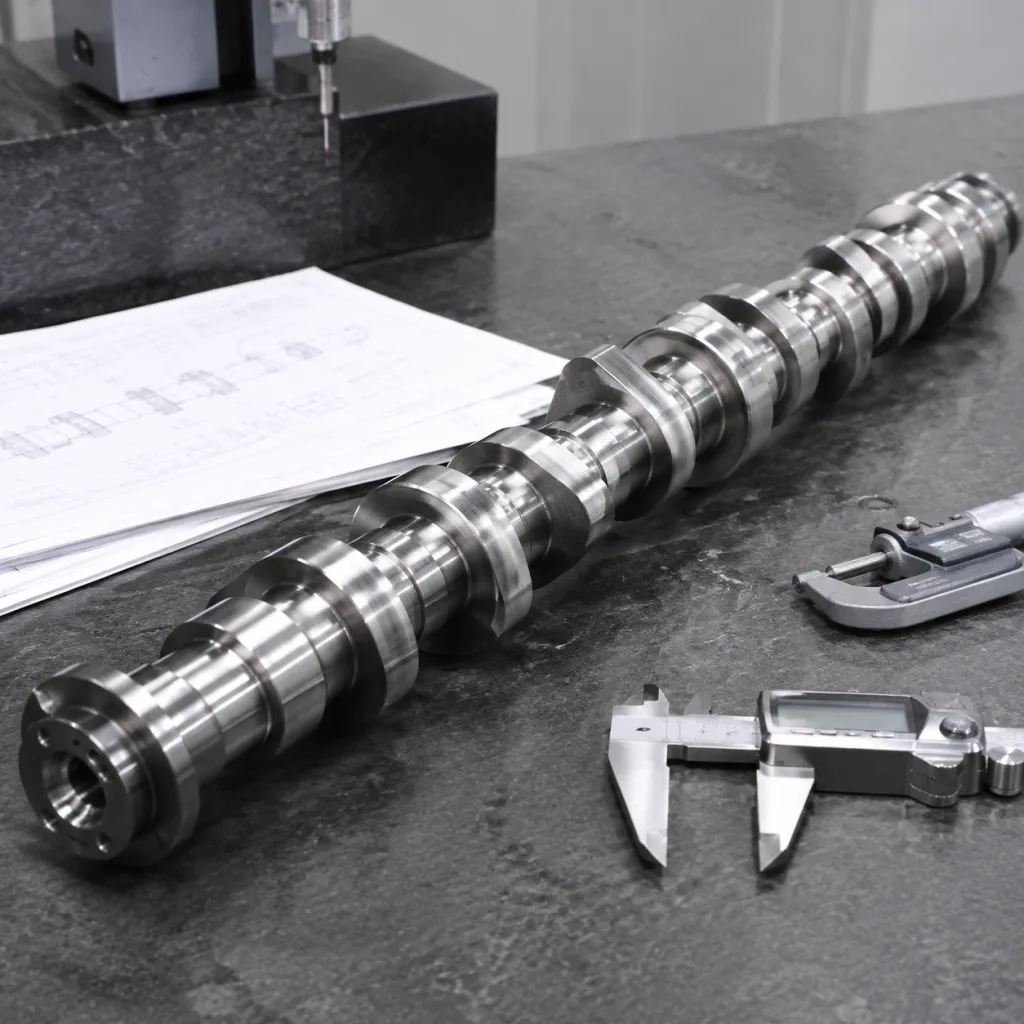
For an OEM or aftermarket sourcing programme, the first screen is dimensional control. Ask for the nominal journal diameters, fillet radii, thrust face width, straightness limit, and dynamic balance method. A competent supplier should also confirm alloy route, heat treatment, hardness band, and surface finish on the main and rod journals.
For Isuzu-style engine programmes, buyers should ask for the actual control numbers, not generic “high precision” claims. A useful quotation should state the target journal size, tolerance band, and inspection method. As a practical benchmark, many buyers will expect journal diameter tolerance within ±0.005 mm, roundness within 0.003 mm, runout not exceeding 0.03 mm, and surface roughness around Ra 0.2–0.4 μm on bearing journals, unless the OE drawing states otherwise. Fillet radius should be controlled to the drawing value, with special attention to edge blending and undercut consistency because these affect fatigue life.
Practical checklist
- Journal size tolerance and roundness
- Crankpin and main bearing concentricity
- Runout and bend limit after heat treatment
- Surface hardness and case depth, if applicable
- Nitriding or induction hardening specification
- Packing method for corrosion protection and transit damage
- Target residual imbalance in g·mm and balancing sequence
- Fillet radius, chamfer, and oil hole deburring control
If the quotation references an OE number, ask for the cross-reference format in writing, such as `OE 06A107065`, and confirm whether the match is for full dimensional equivalence or fitment only. That distinction matters for claims handling and stock coding. For purchase orders, the supplier should also confirm revision level, applicable engine family, and whether the part is sold as bare crankshaft or with keyway, gear seat, or tone-wheel interface already machined.
Why certification matters in crankshaft sourcing
Certification does not make a crankshaft suitable by itself, but it is a strong indicator that the factory runs controlled processes. For procurement teams, the relevant baseline is `IATF 16949:2016` for automotive quality management and `ISO 9001:2015` for documented process control. For export markets, confirm material and coating compliance where required, including `REACH (EC) No 1907/2006` for EU shipments.
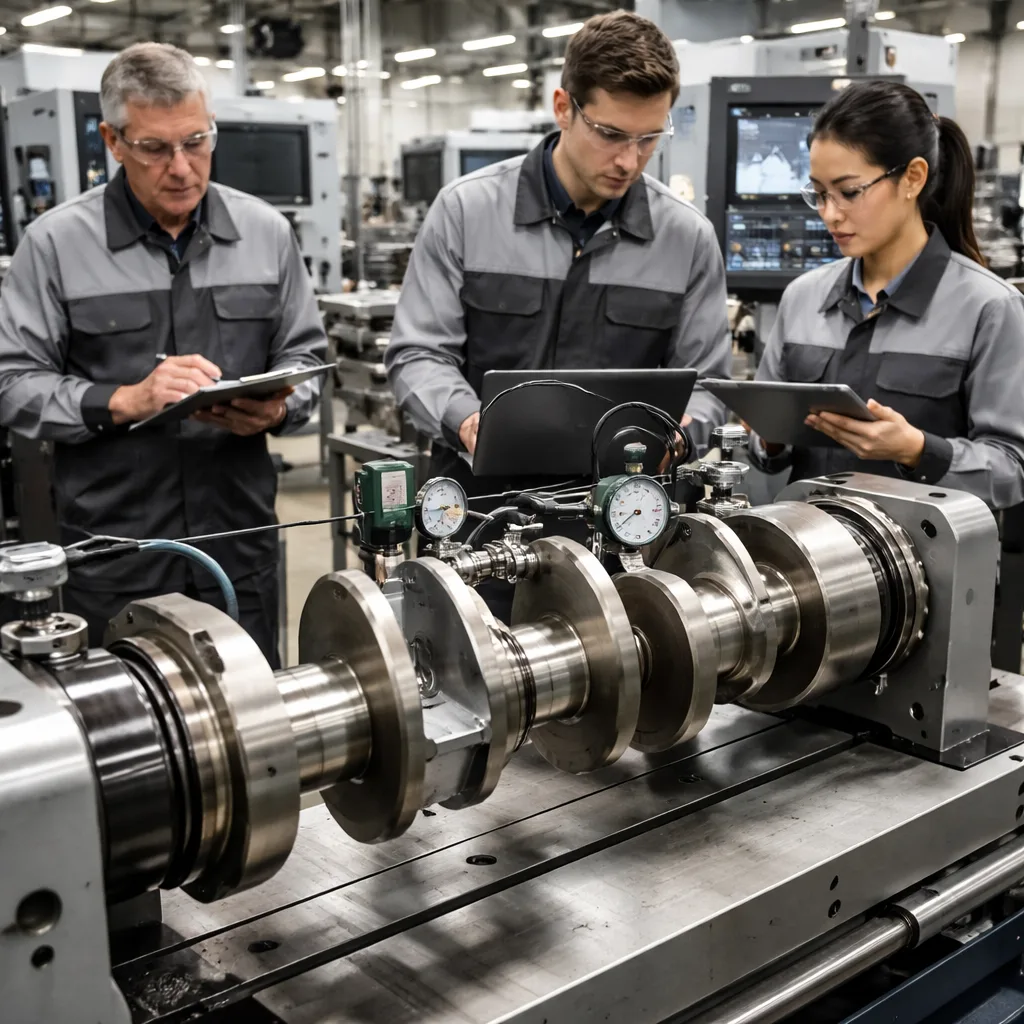
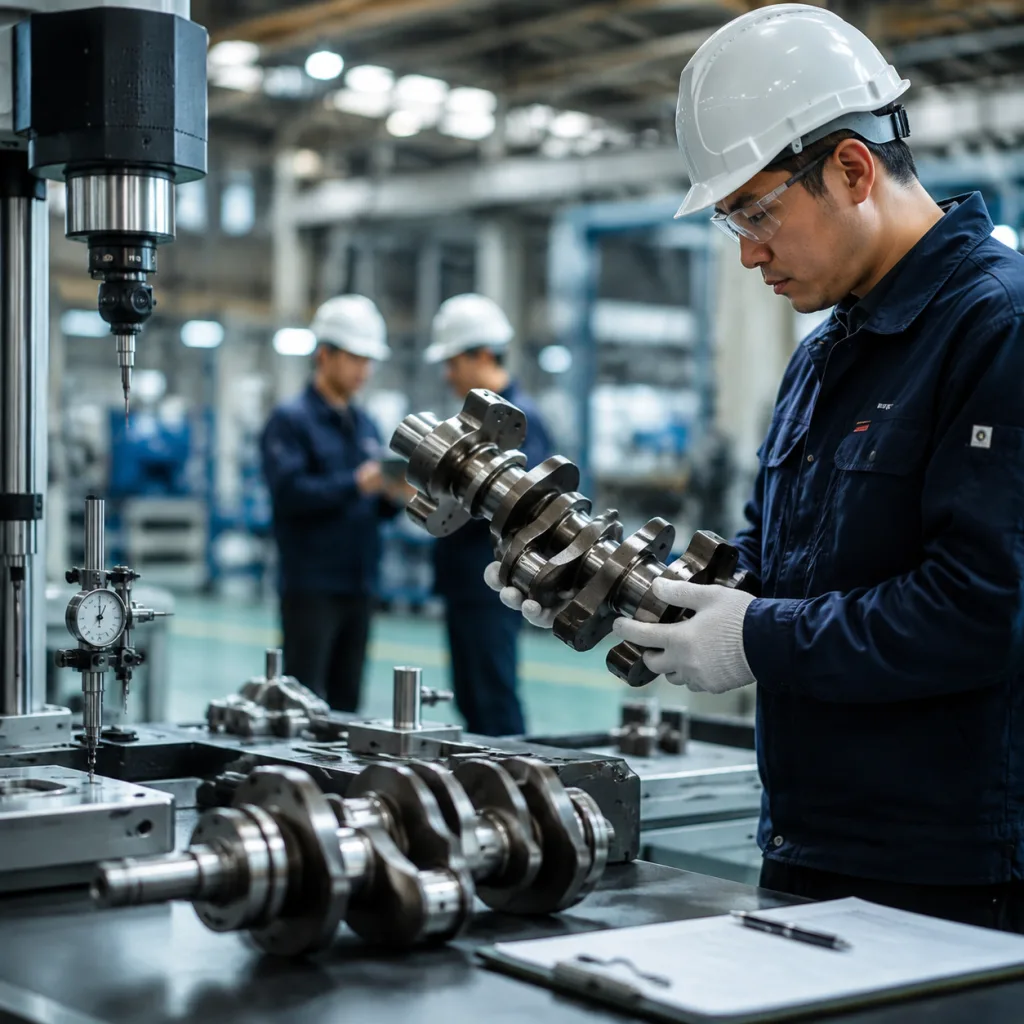
A serious source should be able to tie certification to real process controls: incoming billet or forging verification, heat number traceability, furnace records, hardness maps, SPC on journal diameters, and final gauge calibration status. Buyers should ask how often calibration is checked for micrometers, air gauges, and balance machines, and whether the factory can retain records for at least one full commercial cycle. In sourcing terms, this matters because a certificate without records does not reduce warranty exposure.
Driventus maintains an export-oriented quality structure with incoming inspection, in-process checks, and final dimensional verification. Our quality system supports traceability across batches, heat numbers, and inspection records. If your programme needs special packaging, private label cartons, or route-specific documentation, that should be agreed before sampling, not after mass production. For approval files, ask for the controlled drawing revision, inspection plan, and PPAP-style evidence set before you release a deposit.
Lead times, MOQ, and supply planning
A practical supplier should state MOQ, sampling lead time, and production lead time separately. For crankshafts, the critical path is usually raw forging or casting preparation, machining capacity, heat treatment slots, and final balancing. Buyers should also ask whether the part is common stock, made to order, or supported through a rolling forecast.
You should expect different commercial logic by programme type. Stocked cross-reference items may have an MOQ of 20–50 units per part number, while custom or low-volume programmes often start at 100–300 units depending on machining setup and packaging requirements. Sample lead time is commonly 7–15 days for stocked items and 15–30 days for newly tooled or revised parts. Standard production lead time is often 30–45 days for repeat orders and 45–60 days when forging, heat treatment, or coating capacity must be reserved in advance. If a supplier cannot separate sample, pilot, and mass-production timelines, it is harder to plan service levels.
| Item | What to confirm | Why it matters |
|---|---|---|
| MOQ | Per part number and per batch | Affects inventory exposure |
| Sample lead time | First article availability | Needed for bench and fitment checks |
| Mass-production lead time | Standard order cycle | Supports replenishment planning |
| Balance standard | Target residual imbalance | Impacts vibration and warranty risk |
| Pack configuration | Single pack or bulk pack | Affects damage rate and warehouse handling |
| Traceability | Heat, batch, and inspection records | Supports claims and audit work |
| Payment terms | Deposit, balance, or LC terms | Impacts cash flow and order release |
| Forecast window | 60/90/120-day demand view | Reduces stock-outs and rush fees |