Connecting Rod for Lexus RX Replacement: OE Match Checks
Selecting a connecting rod for Lexus RX replacement is a controlled engineering and procurement decision, not a branding exercise. The right part has to match the engine code, centre-to-centre length, big-end and small-end bore, beam geometry, weight class, and fastener specification. For sourcing teams, the main risks are fitment failure, imbalance, bearing distress, and repeat warranty claims after assembly. Driventus supplies connecting rods for aftermarket and B2B engine rebuild channels, with production controls aligned to IATF 16949:2016 and ISO 9001:2015. Driventus is an independent aftermarket manufacturer; brand names are referenced for fitment only. For related engine hardware, see [our catalog](/products.html), our [quality system](/quality.html), and [custom manufacturing](/oem-services.html).
What makes the correct replacement rod
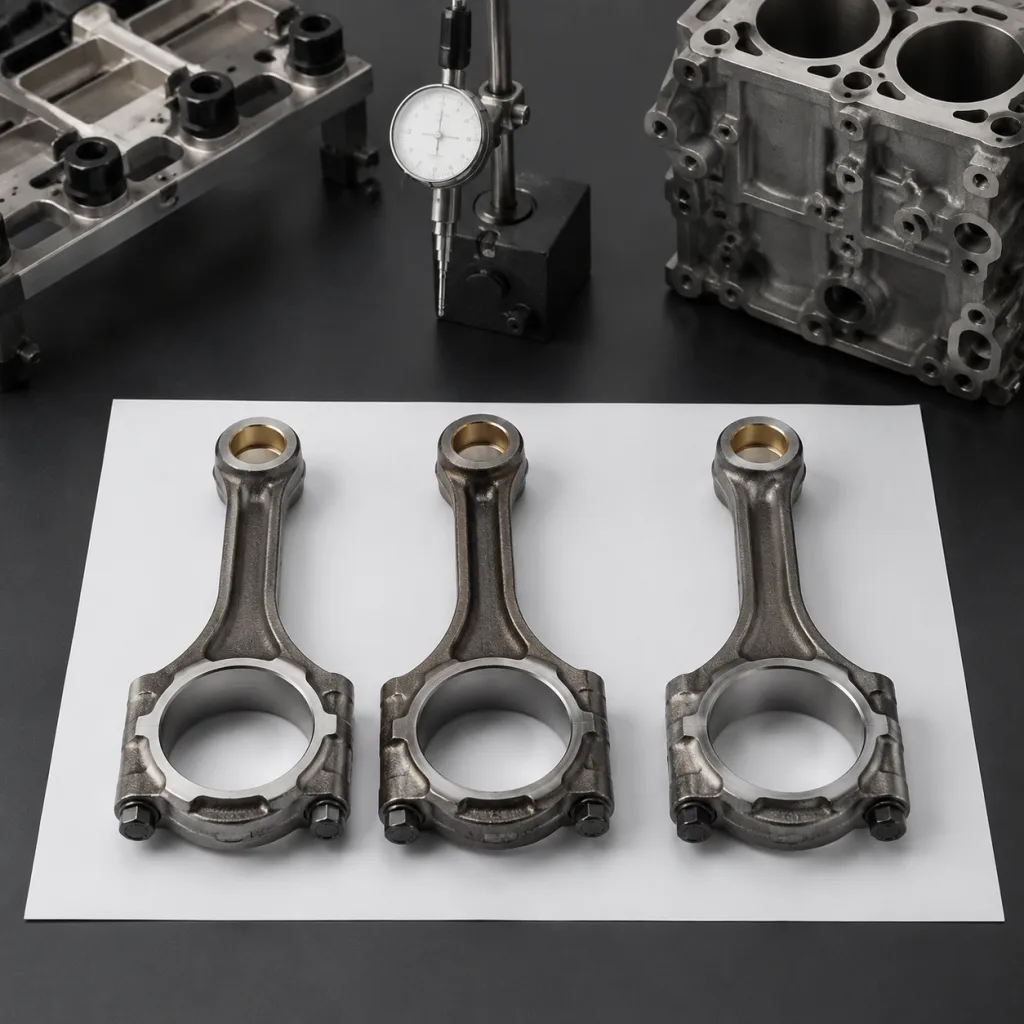
A replacement rod has to do more than physically fit the crank pin and piston pin. The key checks are:
Engine code and application year range
Centre-to-centre length
Big-end bore and width
Small-end bore and bushing condition
Rod cap joint type and bolt specification
Bent and twist limits after machining
Mass consistency within the set
For Lexus RX applications, buyers should confirm the exact engine variant before ordering. A rod for one displacement family may share the same general shape but still differ in length, pin size, or width. OE 06A107065-style cross-references are not appropriate unless the application data explicitly uses that convention; only verified cross-references should appear in purchasing documents.
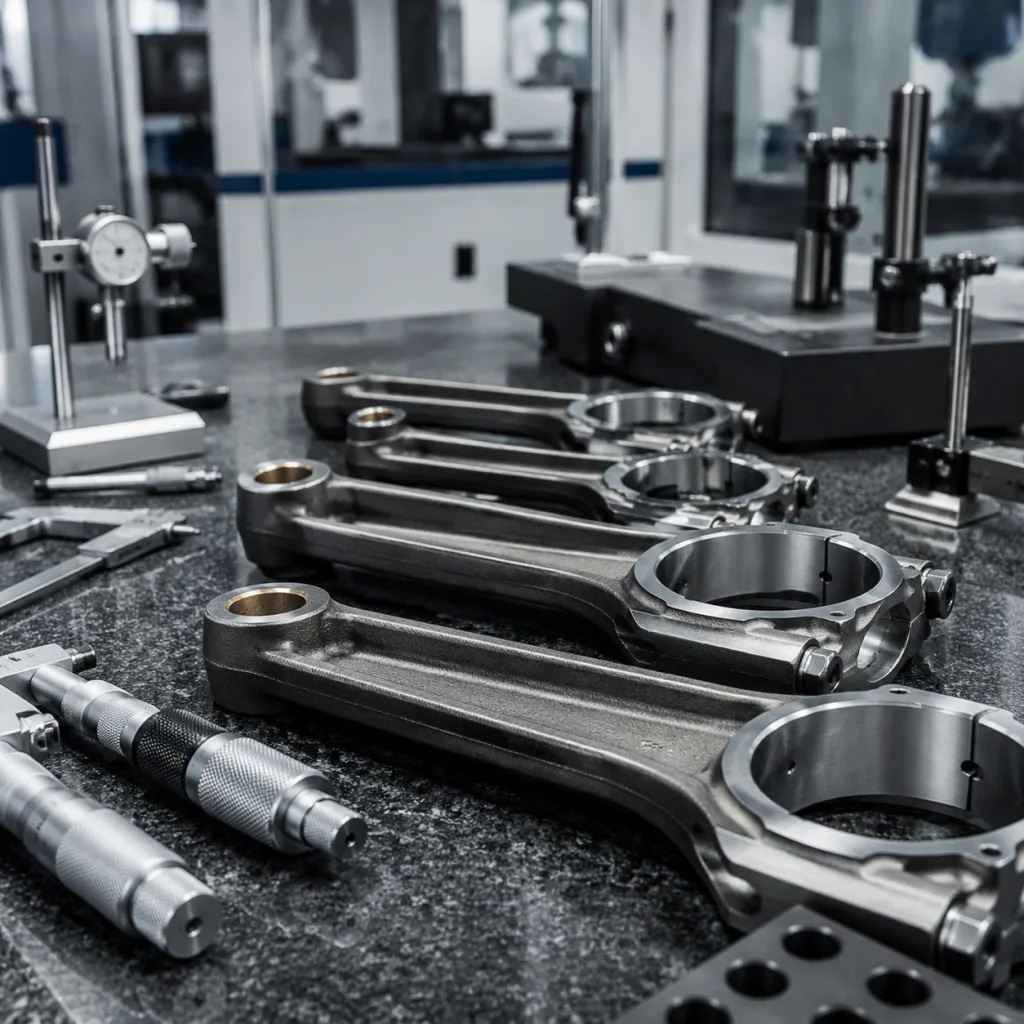
Dimensional checks procurement teams should request
Before approving a connecting rod for Lexus RX replacement, request a dimension sheet and a sample inspection report. The minimum fields are:
Check point
Typical purchase requirement
Centre-to-centre length
Match OE drawing or validated sample
Big-end bore
Match bearing shell and crank journal spec
Small-end bore
Match pin diameter and bushing spec
Weight
Matched within set tolerance
Surface finish
No scoring, burrs, or parting-line mismatch
Straightness
Verified within drawing limits
Fasteners
Bolt grade and torque method documented
</tr></thead><tbody> </tbody></table>For rebuilders, dimensional match matters more than visual similarity. A rod can look correct and still create side loading, oil-film collapse, or noise after warm-up. If the part is supplied as a forged steel rod or a powdered-metal equivalent, ask for the material route, heat-treatment window, and hardness range on the inspection record.
Validation testing for replacement approval
A proper replacement programme should include part validation before volume purchase. The common checks are:
1. Compare the rod against the master sample or OE drawing. 2. Verify bolt preload or the torque-angle method. 3. Check big-end roundness after cap tightening. 4. Confirm weight pairing across a full set. 5. Inspect magnetic particle or crack-detection records if required. 6. Review engine test or bench confirmation for noise, oil pressure, and bearing wear.
Where coating, bushing, or surface treatment is involved, ask for the related process record. For export programmes, material declarations may also need REACH (EC) No 1907/2006 support documents. If your market requires durability evidence, SAE J2527 may be used for related component testing programmes, while gasket interfaces and emissions-adjacent assemblies may require validation aligned with ECE R-83 depending on the full engine package.
Comparison of sourcing options
Replacement sourcing usually falls into three routes, each with a different risk profile.
Sourcing route
Strength
Limitation
Direct OE-equivalent aftermarket
Best for repeatability and cost control
Requires strict dimensional validation
Repaired or reconditioned rod
Useful for low-volume service work
More variable wear history
Custom-engineered replacement
Good for hard-to-find applications
Longer approval cycle
</tr></thead><tbody> </tbody></table>For distributors and repair chains, the most stable route is a documented OE-equivalent part with controlled metallurgy, verified machining, and set-level mass matching. Driventus can support this with custom manufacturing when a standard catalogue part is not available.
How Driventus supports replacement programmes
Driventus manufactures engine and powertrain components in Taizhou, Zhejiang, with export supply to more than 60 countries. For connecting rods, buyers can request:
Dimensional inspection reports
Material and heat-treatment records
Set matching by weight class
Packaging for distributor or workshop channels
Private-label or programme-specific packing
Our production and inspection flow is managed under IATF 16949:2016 and ISO 9001:2015. That matters for buyers who need stable batch repeatability across multi-location service networks. If you are building a wider sourcing basket, review our catalog and the quality system documentation before finalising vendor approval. Driventus is an independent aftermarket manufacturer; brand names are referenced for fitment only.
Frequently asked questions
Match the engine code first, then verify centre length, pin diameter, big-end bore, and bolt specification against the OE drawing or a validated sample. Do not rely on the vehicle model alone.
Ask for dimensional inspection data, material and heat-treatment records, weight-matching data, and packaging confirmation. For export markets, request any REACH-related declarations that apply.
Yes. If the standard part does not fit your programme, use our [request a quote](/contact.html) form for a custom review, sample submission, and feasibility check.
For OE-equivalent sourcing, sample review, or programme-specific packaging, use our [request a quote](/contact.html) page and share the engine code and target dimensions.