Connecting Rod for Jeep Grand Cherokee OE Equivalent: Buyer Guide
Sourcing a connecting rod for Jeep Grand Cherokee OE equivalent is not a catalog-name exercise. It is a tolerance, material, and validation decision. The rod has to match the original engine installation in centre-to-centre length, big-end geometry, small-end pin interface, beam clearance, cap retention, and mass range. If any of those details drift, the rebuild risk moves from “wrong part” to bearing failure, piston height error, imbalance, or short fatigue life.
For rebuilders, fleet maintenance buyers, and aftermarket distributors, the safest purchasing file starts with the exact engine application and ends with measured evidence. Brand names are used for fitment reference only; Driventus is an independent aftermarket manufacturer. Our connecting rods are produced under IATF 16949:2016 and ISO 9001:2015 controls, with material, machining, inspection, and traceability steps suitable for export supply. Use this guide to turn a vague RFQ into a part that can be checked, approved, and reordered consistently.
Start with a fitment decision, not a vehicle name
A Jeep Grand Cherokee badge is not enough to release a connecting rod order. The decision point is whether the proposed rod matches the exact engine installation and OE reference used by the customer’s program.
Treat “OE-equivalent” as a pass/fail engineering match. The rod should align with the original requirements for:
- Centre-to-centre length within the required tolerance
- Big-end bore, width, roundness, and cap stack-up
- Small-end bore and wrist-pin interface
- Beam profile, offset, and crankcase clearance
- Rod mass and balance range across a matched set
- Bolt specification and cap retention method
Do not approve a rod only because it is listed under the same model family. Confirm model year, engine code, displacement, and OE reference before sampling. If the purchasing file includes a cross-reference such as `OE 06A107065`, use it only when it is part of verified source data, not as a generic claim.
Driventus can review customer drawings, sample parts, OE references, and application data before production release. That review is where many sourcing errors are caught: similar-looking rods can differ in pin diameter, beam offset, bearing width, or bolt design.
Specification deep-dive: the dimensions that decide approval
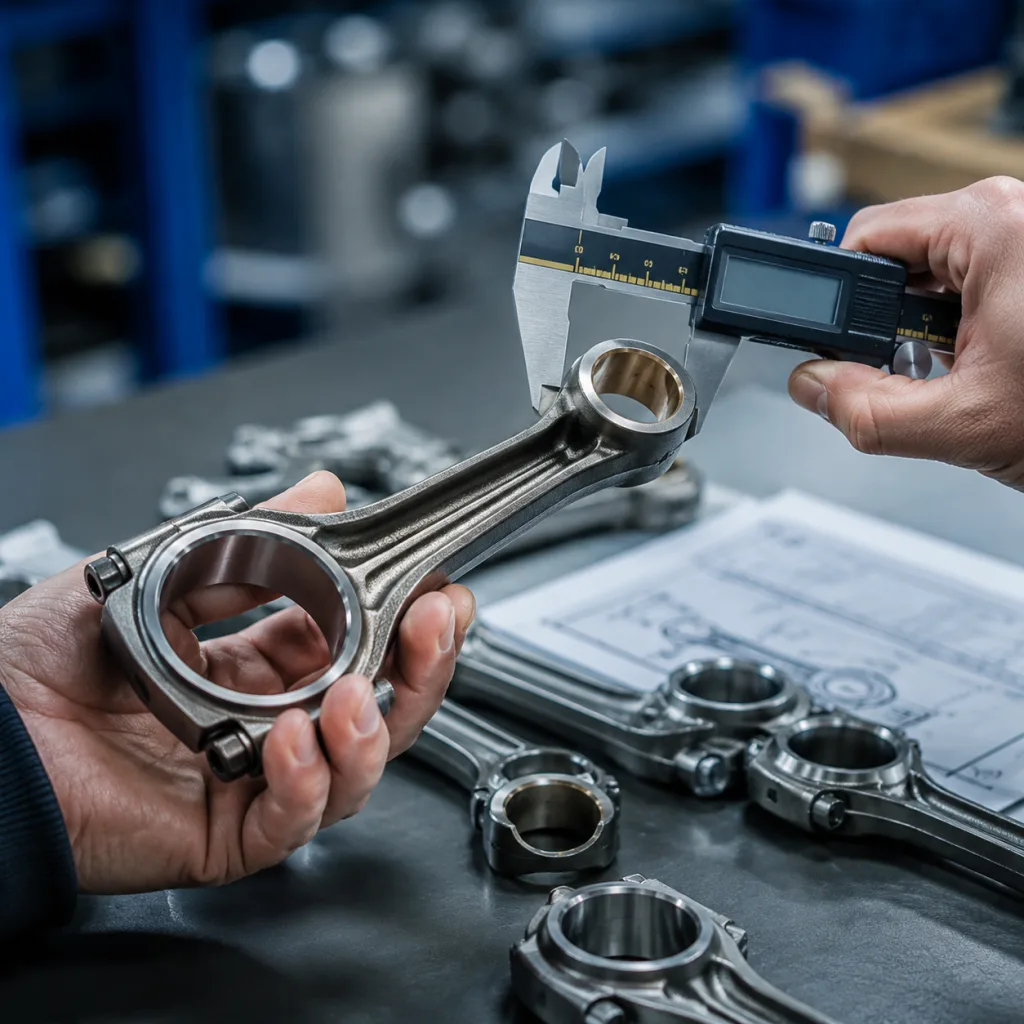
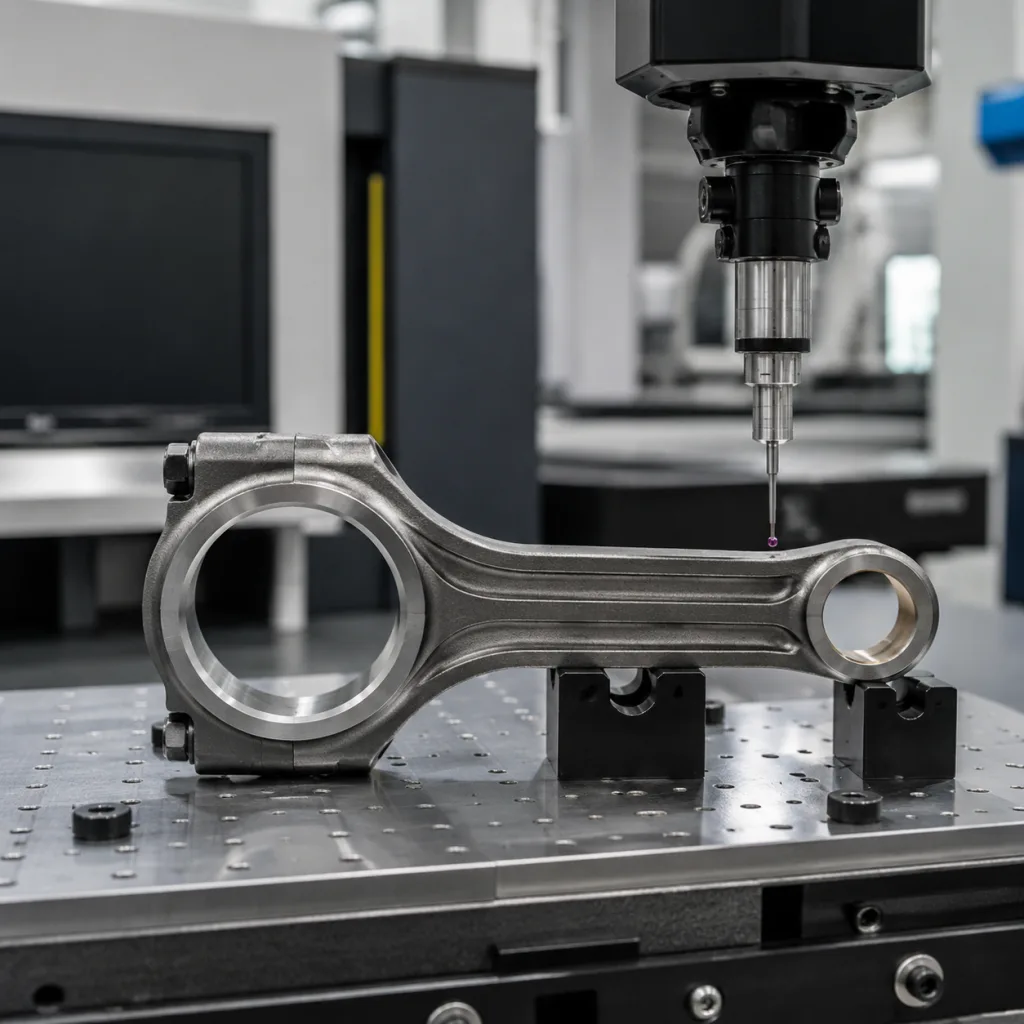
Incoming inspection should focus on the features that control engine geometry, lubrication, and durability. Cosmetic similarity is secondary.
| Checkpoint | What to confirm | Failure mode if missed |
|---|---|---|
| Centre-to-centre length | Rod length against drawing or approved sample | Compression height error, piston-to-head clearance issue |
| Big-end bore | Diameter, roundness, cylindricity, surface finish | Bearing crush loss, oil-film instability, knock |
| Big-end width | Side clearance and crankpin fit | Excess friction or oil-control problems |
| Small-end bore | Pin fit, alignment, and finish | Pin seizure, piston noise, uneven wear |
| Beam and offset | Clearance to piston, block, crankshaft, and oil jets | Contact marks, assembly interference |
| Mass matching | Rod-to-rod variation in the set | Vibration and balance complaints |
| Fasteners | Bolt grade, thread quality, torque or stretch behavior | Cap movement or bolt failure |
| Surface condition | Shot peen quality, chamfers, machining marks | Stress concentration and fatigue cracking |