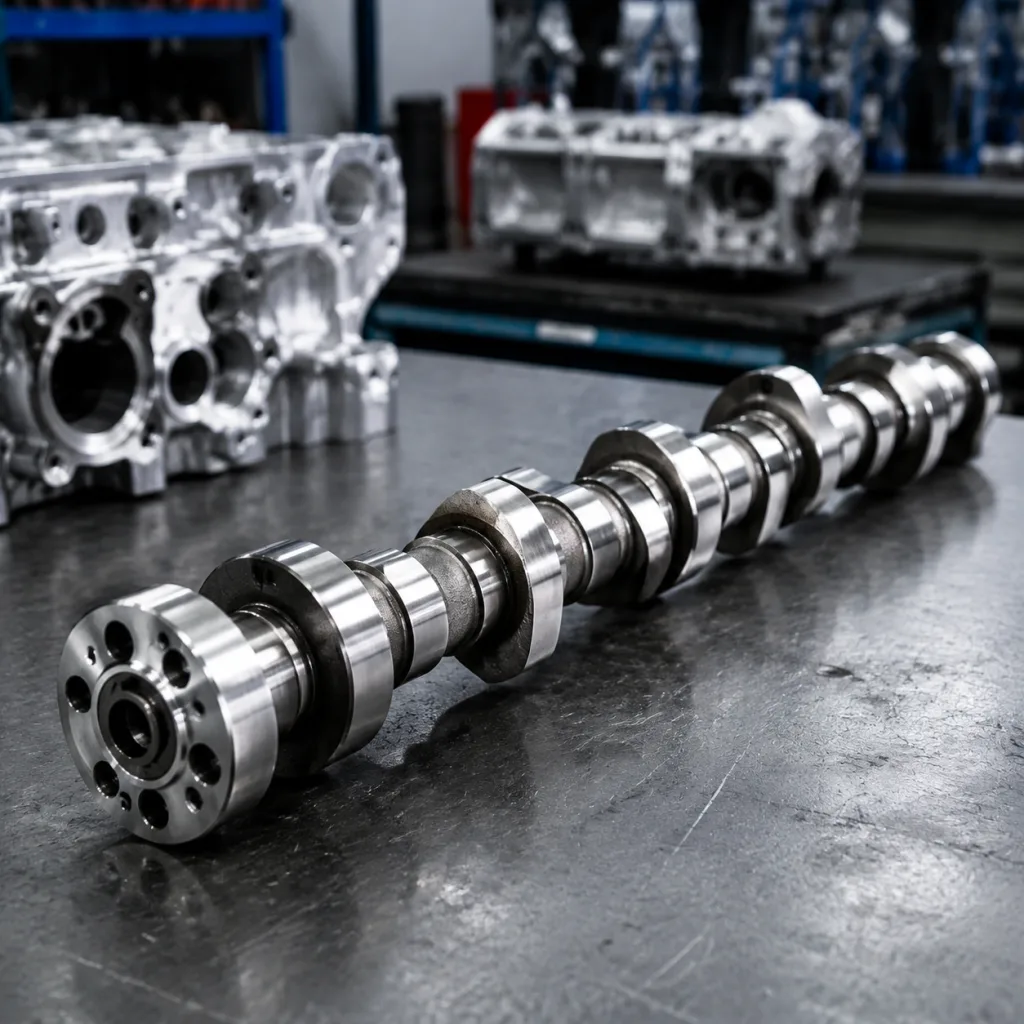
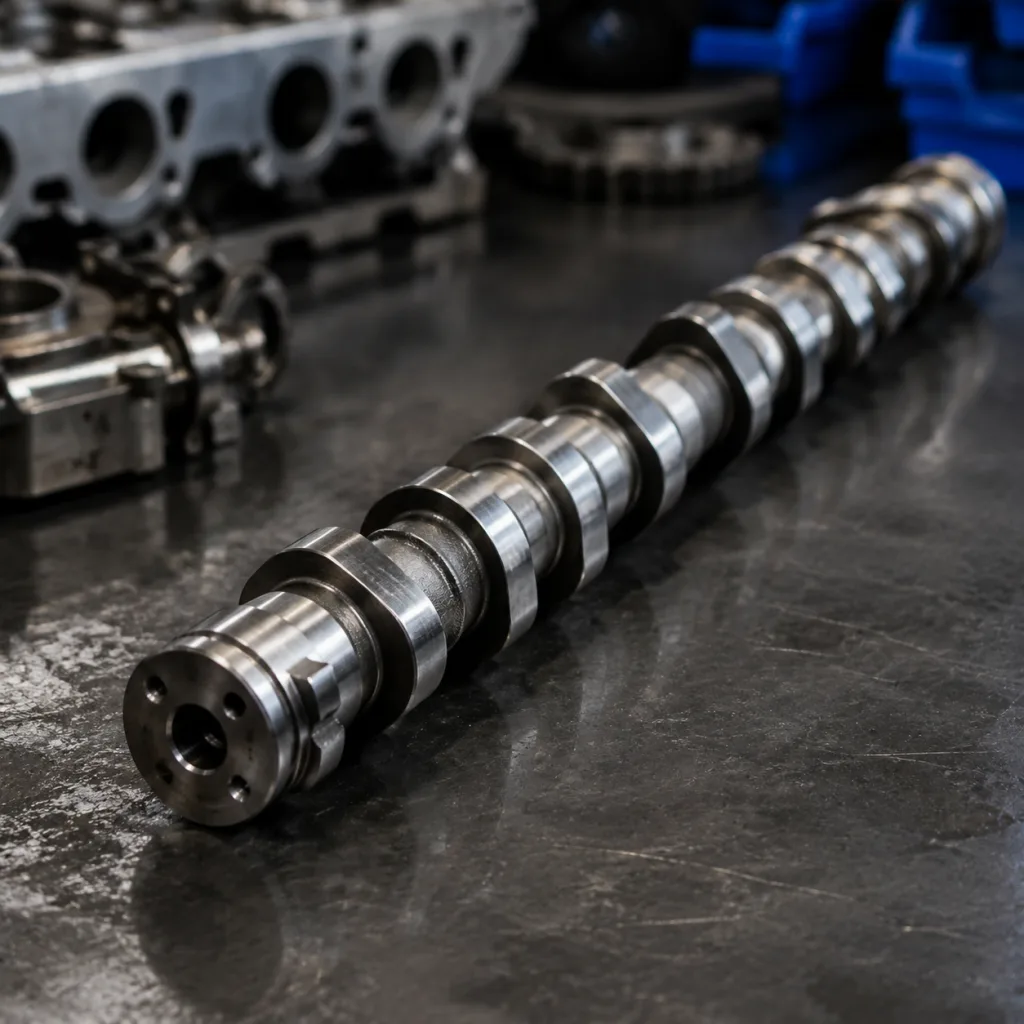
A camshaft mini OE equivalent only works when it matches the original part in geometry, timing reference, surface condition, and material response under load. That matters more than appearance. A part can look identical and still fail on lift, phasing, journal fit, or trigger alignment. For procurement teams, those misses turn into returns, labour claims, and vehicle downtime.
Driventus is an independent aftermarket manufacturer; brand names are referenced for fitment only. Based in Taizhou, Zhejiang, Driventus produces engine and powertrain components for export markets and operates under IATF 16949:2016 and ISO 9001:2015 systems. This guide uses a decision-first structure: what to compare, where replacements fail, how to validate them, and when a custom route is safer than a direct cross-reference.
Decision points before you call it equivalent
An OE-equivalent camshaft is not defined by appearance. It is defined by whether it preserves the engine’s timing and wear behaviour within the original design window.
The fastest way to sort a true match from a risky substitute is to compare the features that actually control valve event timing and durability:
Journal diameter and centreline alignment
Overall shaft length and thrust face position
Lobe lift, base circle, and lobe spacing
Drive-end geometry, keyway details, and trigger features
Surface hardness, case depth, and runout
If any one of those moves outside the engine builder’s tolerance window, the part may still install but not perform correctly. For sourcing, that means the first question is not “Does it fit?” but “Does it preserve the same functional geometry as the OE part?”
Typical acceptance bands used in procurement are tight: journal diameter often sits within ±0.01 mm to ±0.02 mm of the OE print, overall length within ±0.10 mm, runout at 0.03 mm to 0.05 mm TIR or better, and lobe lift within ±0.05 mm to ±0.10 mm depending on the engine family. If you do not have the OEM drawing, use a retained sample as the master reference and record every critical dimension against it.
Where replacements fail in the field
Most camshaft problems are not dramatic on day one. They show up as noise, rough idle, timing drift, or early wear after installation.
Common failure modes include:
1. Incorrect trigger-wheel geometry or sensor reference 2. Wrong thrust location, causing axial load or timing variation 3. Lobe profile that changes valve lift or duration 4. Journal finish that accelerates break-in wear 5. Heat treatment that is too soft, too hard, or inconsistent 6. Runout that creates vibration and uneven bearing load
The dangerous part is that several of these still allow a camshaft to pass a casual visual check. A buyer who approves from catalogue photos alone is taking avoidable risk. Engine code, emissions variant, model year, and OE part number all need to be checked before comparison.
A part built for the wrong platform can look close and still miss the trigger position, bearing geometry, or thrust face by enough to cause a return. That is why direct cross-reference should be backed by measurements, not description text.
Spec checks that belong in the RFQ
Procurement teams should treat camshafts as precision parts with a defined specification pack, not as generic wear items.
Use a single RFQ checklist so engineering and purchasing are judging the same thing:
Check item
What to verify
Why it matters
Dimensions
Length, journal diameter, lobe spacing, thrust face
Prevents assembly interference
Geometry
Lift, base circle, nose radius, timing phasing
Protects valve event timing
Material
Alloy cast iron or billet steel grade
Affects wear and fatigue life
Surface finish
Journal roughness and lobe finish
Reduces break-in wear
Heat treatment
Hardness and case depth
Controls scuffing and lobe durability
Runout
Straightness and concentricity
Avoids vibration and timing variation
</tr></thead><tbody> </tbody></table>For controlled sourcing, ask the supplier to quote the measurement method as well as the number. Typical values may include journal surface roughness at Ra 0.2 μm to 0.4 μm, lobe finish at Ra 0.4 μm to 0.8 μm, and hardened surfaces in the 50 HRC to 60 HRC range where the design calls for it. If the supplier cannot state the finish method, hardness range, or inspection equipment, the programme risk is too high for a direct replacement buy.
Commercial data belongs in the same quote. MOQ, EXW or FOB price, carton quantity, and lead time should be visible before purchase order release. Market norms vary, but catalogue camshafts are often quoted with MOQs of 50 to 200 pieces, price breaks at 500 and 1,000 units, and lead times around 30 to 45 days after sample approval. Those figures are only useful if the supplier confirms them in writing.
A practical validation sequence
The approval sequence should move from dimensional proof to functional proof. Start with metrology, then verify the part behaves correctly in assembly.
Typical validation package
CMM or micrometer verification of journals, lobes, and overall length
Surface roughness measurement on journals and lobes
Hardness testing after heat treatment
Magnetic particle inspection or equivalent crack detection
Runout and concentricity measurement
Assembly fit check with matched followers, bearings, and sprockets
Engine test or dyno confirmation where programme risk justifies it
Do not approve a first article because one sample looks good. Request at least three pieces from the same lot and compare all critical dimensions. Buyers commonly specify zero cracks on magnetic-particle inspection, no burrs or chips on drive features, and journal-to-bearing clearance consistent with the engine builder’s spec, often around 0.02 mm to 0.06 mm depending on platform.
Published standards can strengthen the quality gate around those checks. Driventus operates under IATF 16949:2016 and ISO 9001:2015, and material compliance may also be aligned to REACH (EC) No 1907/2006 where required for the destination market. For emissions-related aftermarket applications, buyers should also confirm the vehicle-level rules that apply in the destination market.
Scenario: when direct cross-reference is enough
A direct cross-reference works best when the buyer already has a verified OE number, a stable engine application, and enough sample data to compare geometry. In that case, the job is straightforward: confirm the replacement part matches the critical dimensions and document the acceptance limits.
Use the direct route when:
The engine code and model year are confirmed
The OE part number is verified against a sample or drawing
The trigger features and thrust faces are visible in inspection data
The application is high-volume and low-variation
The buyer wants a standard replacement, not a design change
Use a custom or engineered route when the part number alone is not enough, the platform has mixed emissions variants, or the programme needs different packaging, labelling, or heat-treatment requirements. In those cases, a part that is “close” is usually not acceptable. The supplier should either prove equivalence or build to the exact programme requirement.
For broader engine sourcing, see our catalog and the broader engine components range. If the application falls outside standard interchange, custom manufacturing can be used to match programme-specific geometry, material, or packaging needs.
How Driventus fits the sourcing workflow
Driventus supplies camshafts and related engine components to distributors, wholesalers, OEM and Tier-1 supply chains, and multi-location repair networks. The value for buyers is not just price; it is repeatable lot quality, inspection records, and a clear replacement process.
The support model includes:
OE cross-reference review from customer-supplied data
Dimensional comparison against a sample or drawing
Production under controlled quality-system checks
Export documentation for multi-market supply chains
Packaging and labelling to support warehouse traceability
The cleanest enquiry includes the OE part number, engine code, sample photos, quantity, annual forecast, target market, and packaging requirement. That gives the supplier enough information to say whether the part is a direct cross-reference, a dimensionally equivalent match with packaging differences, or a custom build. If private-label cartons, barcode labels, or kitting are needed, specify them early because they affect both cost and lead time.
Driventus is an independent aftermarket manufacturer; brand names are referenced for fitment only.
Q&A on procurement risk
Is an OE equivalent camshaft the same as OE original?
Not necessarily. It should match the required dimensions, geometry, material, and performance window, but it is still an aftermarket part unless supplied by the vehicle maker. Verification against the OE drawing or a validated sample is essential.
What documents should buyers request?
Ask for dimensional inspection records, hardness results, a material declaration, lot traceability, and confirmation of the target OE cross-reference. For higher-risk programmes, request sample approval and fitment evidence. For commercial comparison, include MOQ, tiered pricing, lead time, packing specification, and carton count so the quote can be reviewed on a true landed-cost basis.
Can Driventus make a custom camshaft?
Yes. If the standard replacement does not match the application, Driventus can review drawings or samples for custom manufacturing through the OEM service route. Provide the OE reference, target annual volume, tolerance requirements, and any special heat-treatment or packaging needs at the enquiry stage.
Frequently asked questions
Not necessarily. It should match the required dimensions, geometry, material, and performance window, but it is still an aftermarket part unless supplied by the vehicle maker. Verification against the OE drawing or a validated sample is essential. In practice, buyers should confirm critical dimensions, hardness, surface finish, and runout before approval.
Ask for dimensional inspection records, hardness results, a material declaration, lot traceability, and confirmation of the target OE cross-reference. For higher-risk programmes, request sample approval and fitment evidence. If the order is commercialised, also ask for MOQ, tiered pricing, lead time, packing specification, and carton count so the quote can be compared on a true landed-cost basis.
Yes. If the standard replacement does not match your application, Driventus can review drawings or samples for custom manufacturing through the OEM service route. Provide the OE reference, target annual volume, tolerance requirements, and any special heat-treatment or packaging needs at the enquiry stage.
If you are sourcing a camshaft mini OE equivalent for stock or a programme build, send your target part data, annual volume, target price, and sample details through our team at [request a quote](/contact.html).