Connecting Rod for Honda HR-V Replacement: Fitment Guide
When sourcing a connecting rod for Honda HR-V replacement, the decision should start with fitment risk, not catalog similarity. The same-looking rod can differ in center-to-center length, big-end and small-end bore, bolt spec, weight, and heat treatment, and any one of those differences can change bearing life or assembly clearance. For that reason, procurement teams should verify the engine code, piston pin diameter, crankshaft journal, bearing selection, bolt stretch method, and service clearances before buying.
For typical HR-V programs, ask suppliers for nominal dimensions with stated tolerances, plus the inspection method used to measure them. As a practical baseline, length may be held within ±0.05 mm and bore sizes within ±0.01 mm, but the correct tolerance window depends on the OE drawing and the engine builder's requirements. Driventus is an independent aftermarket manufacturer; brand names are referenced for fitment only. Our parts are produced under IATF 16949:2016 and ISO 9001:2015 controls, with material and process checks suited to B2B replacement supply. If you need a catalog match, quality documentation, or a quotation, review our catalog, check our quality system, or use request a quote.
Start with the failure modes, not the listing photo
A correct replacement is defined by what can fail in service. The most common sourcing mistake is to approve a rod because it matches the OE number at a glance, then discover that the bore, bolt, or weight class does not align with the actual engine build.
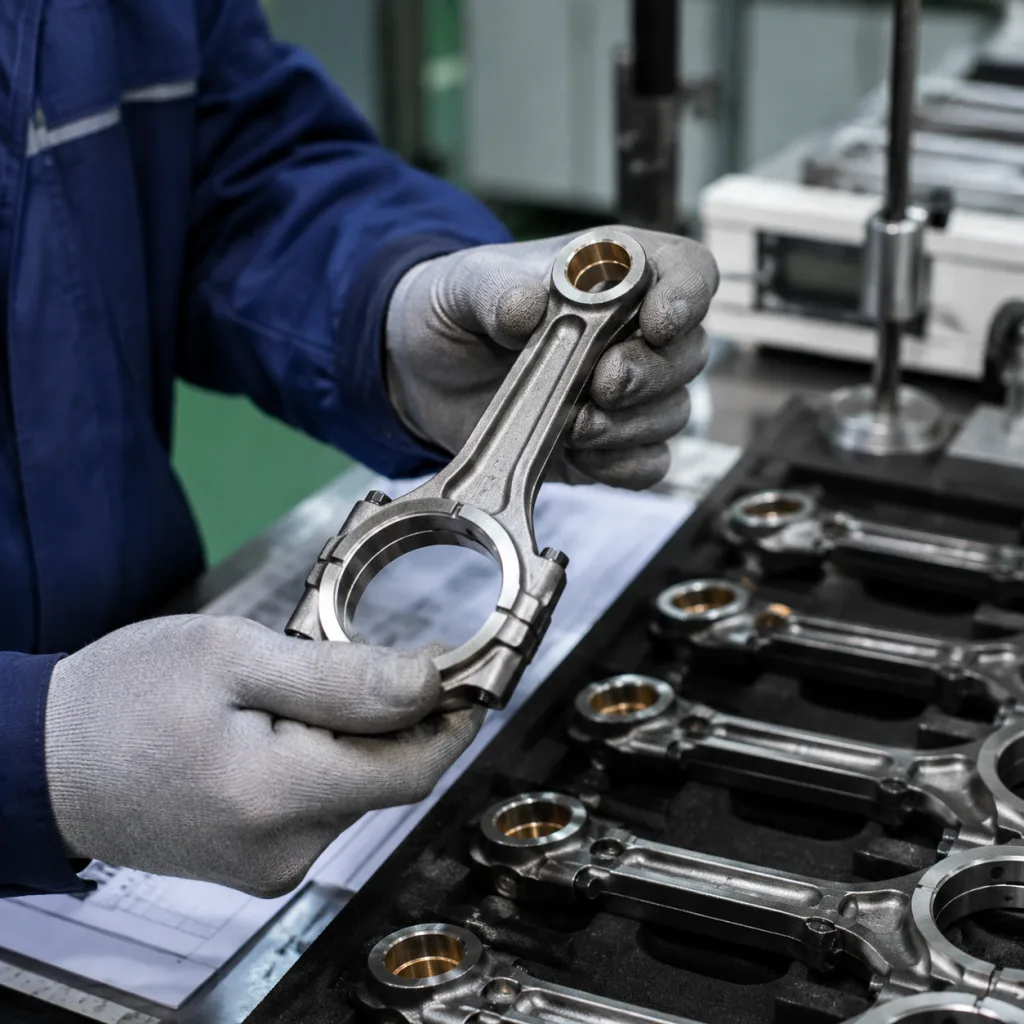
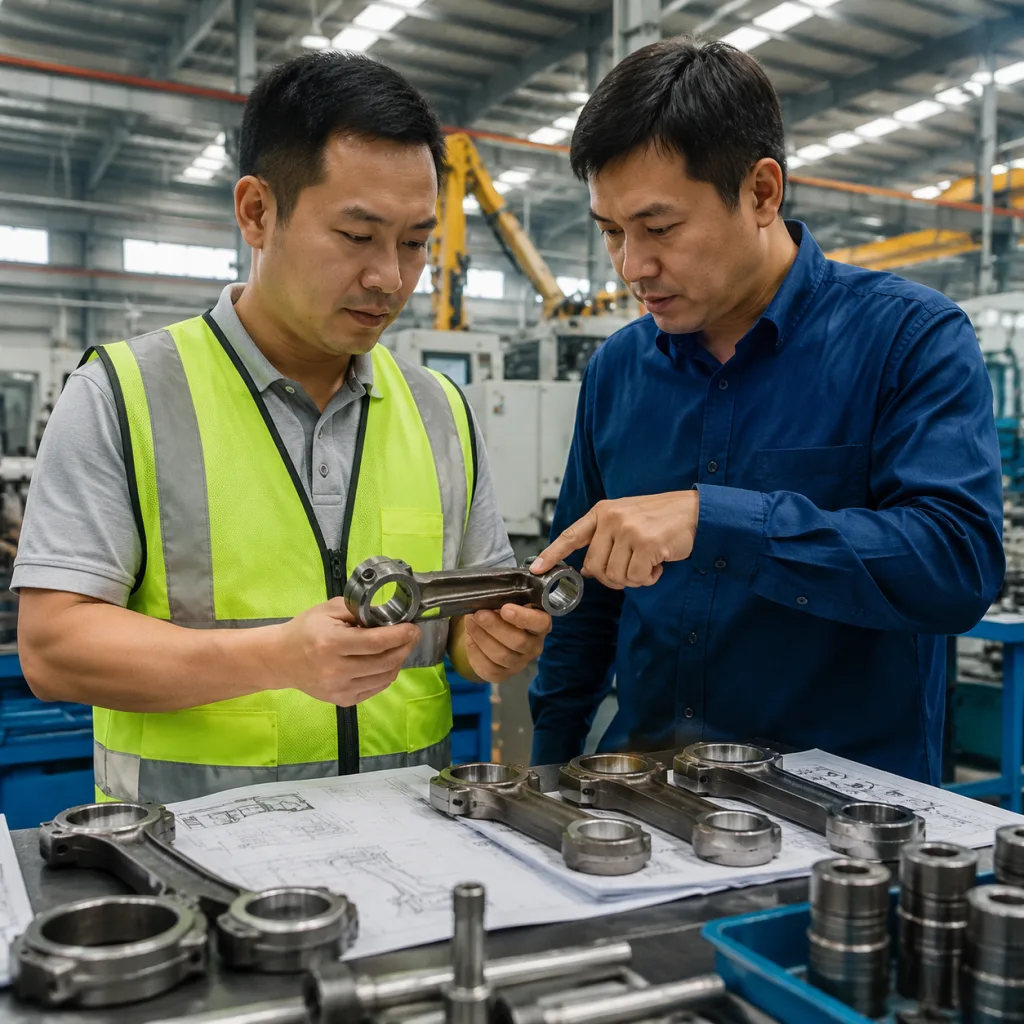
Use the sample, OE reference, and engine build sheet together. Compare center-to-center length, big-end bore, small-end bore, big-end width, small-end width, rod journal diameter, pin diameter, bolt specification, beam section, and mass. If the supplier cannot provide a measured sample report, treat that as a risk flag. A rod that is visually close but dimensionally off can pass receiving inspection and still create noise, bearing wear, or clearance problems later.
The spec sheet buyers should actually request
Ask for the documents that prove control, not just a sales page. The minimum package should include:
- Dimensional drawing with nominal values and tolerances
- Material certificate showing alloy grade and heat lot
- Hardness report with measured range and test location
- Lot traceability record tied to production batch
- First-article inspection report with actual dimensions
- Packaging specification with carton count and pallet data
These records let buyers confirm that the connecting rod for Honda HR-V replacement matches the ordered specification and that future shipments can be checked against the same baseline. For higher-volume programs, also confirm whether the supplier keeps revision control, retains inspection data for reorders, and can state whether bushings are pre-installed, caps are matched, bolts are included, and the parts ship as balanced sets or individual units. If your program needs PPAP-style support, request the control plan, process flow, and inspection frequency for each critical characteristic.
Fitment checks before the PO goes out
Before release, verify the rod against the engine build sheet and the supplier drawing. The key values are center-to-center length, big-end bore diameter, small-end bore diameter, big-end width, small-end width, bolt thread and head style, rod weight, and surface finish where specified.
Material and process matter too. Buyers should confirm the connecting rod material, usually a forged alloy steel or powder-forged steel depending on the application, plus the heat-treatment condition and hardness window. If the engine uses floating pins or pressed pins, the small-end interface must match that design exactly. For tolerances, require the supplier to identify the critical dimensions and state acceptable variation instead of relying on generic catalog language. Bore and pin-fit dimensions often need control to the hundredth of a millimeter, while length and width tolerances should be explicit enough to protect bearing alignment and side clearance.
How MOQ, price, and lead time usually move together
Commercial terms depend on complexity, tooling status, and whether the order is for sample validation, stock replenishment, or program supply. A sample order is often 1-5 sets and carries a higher unit price because setup and inspection time are concentrated into a small run. Production MOQ is commonly 50-200 units for standard aftermarket runs, while private-label or custom-carton orders may move to 200-500 units depending on packaging and artwork.
Lead time usually falls into three buckets: stock items can ship in 3-7 days after payment confirmation, standard production orders often take 15-30 days, and first-time custom orders may need 30-45 days when drawings, samples, and approval steps are included. Pricing is usually driven by material cost, forging or machining method, heat treatment, inspection scope, and order size; unit pricing often improves at breakpoints such as 50, 100, and 500 pieces. Ask for unit price, MOQ, sample cost, tooling cost if any, estimated ship date, and quotation validity. Confirm whether the quote is EXW, FOB, or CIF, and whether packaging, labels, and export documents are included. For pricing, sample requests, or a technical drawing review, use request a quote.
International sourcing: the questions that prevent customs and packaging issues
For EU, UK, US, Canada, Australia, and Brazil programs, the practical questions stay the same: is the rod dimensionally correct, is the batch traceable, can the supplier repeat the spec from order to order, and can the export paperwork match the PO terms? Buyers should also confirm carton labeling, carton count, pallet configuration, moisture protection, and document packs before booking freight.
A workable RFQ should ask the supplier to confirm engine code, OE reference, intended market, annual forecast, required sample quantity, target lead time, and any packaging or barcode standard. If the order is for workshop distribution or e-commerce fulfillment, ask whether the inner pack must be one piece per bag, whether desiccant is required, and whether master cartons can carry a buyer SKU. If your team needs a broader engine-parts range, start with our catalog and align the connecting rod with pistons, bearings, gaskets, and crankshaft data before purchase order release. For pricing, sample requests, or a technical drawing review, use request a quote.
Quick Q&A for procurement teams
Q: How do I confirm the rod is the right replacement? A: Match center-to-center length, big-end bore, small-end bore, bolt spec, mass, and material grade against the OE drawing or a validated sample. Do not rely on visual similarity alone, because two rods can look alike while differing in critical dimensions or load behavior.
Q: Can you supply based on an OE number? A: Yes. Share the OE reference, engine code, or sample part. We use that data to confirm fitment, check dimensional equivalence, and verify whether the replacement is appropriate for the intended HR-V application before production. For quoting, we also confirm quantity, target delivery window, packaging requirements, and whether the order is for samples, stock, or ongoing supply.
Q: What quality documents can be provided? A: Typical documents include a dimensional drawing, material certificate, hardness report, first-article inspection data, and lot traceability records under IATF 16949:2016 and ISO 9001:2015 controls. Additional records can be supplied when the program requires a stricter approval package, such as control plan details, process flow, sample inspection data, or photo evidence of the packaging configuration.
Frequently asked questions
Match center-to-center length, big-end bore, small-end bore, bolt spec, mass, and material grade against the OE drawing or a validated sample. Do not rely on visual similarity alone, because two rods can look alike while differing in critical dimensions or load behavior. For a buying decision, also confirm the stated tolerances, pin style, bearing compatibility, and whether the rod is intended for the exact HR-V engine code in your market.
Yes. Share the OE reference, engine code, or sample part. We use that data to confirm fitment, check dimensional equivalence, and verify whether the replacement is appropriate for the intended HR-V application before production. For quoting, we also confirm quantity, target delivery window, packaging requirements, and whether the order is for samples, stock, or ongoing supply.
Typical documents include a dimensional drawing, material certificate, hardness report, first-article inspection data, and lot traceability records under IATF 16949:2016 and ISO 9001:2015 controls. Additional records can be supplied when the programme requires a stricter approval package, such as control plan details, process flow, sample inspection data, or photo evidence of the packaging configuration.
If you need pricing, drawing confirmation, MOQ guidance, or a sample review for a connecting rod for Honda HR-V replacement, contact the team here: /contact.html
Request a Quote