Connecting Rod for Honda CR-V Aftermarket Replacement
A connecting rod for Honda CR-V aftermarket replacement has to do more than resemble the OE part. Buyers should judge it by geometry, bore control, material stability, and batch repeatability—not by catalogue fitment alone. If any of those variables drift, piston height, bearing clearance, oil film performance, and engine durability can all suffer.
Driventus supplies aftermarket connecting rods for selected Honda CR-V engine applications as OE-equivalent replacement parts, with production controlled under IATF 16949:2016 and ISO 9001:2015. Driventus is an independent aftermarket manufacturer; brand names are referenced for fitment only.
The sourcing question is usually practical: can the supplier hold dimensions, prove process control, and support a realistic MOQ and lead time for service parts, rebuild programmes, and distributor stocking? The sections below break that down into decision points buyers can use immediately.
When a rod is acceptable—and when it is not
For this product class, the first decision is whether the part is functionally interchangeable or merely similar. A connecting rod for Honda CR-V aftermarket replacement should match the OE geometry closely enough that the engine builder does not need to compensate during assembly.
Use these checks as a go/no-go filter:
Centre-to-centre length matches the OE drawing, typically within ±0.02 to ±0.05 mm depending on engine family
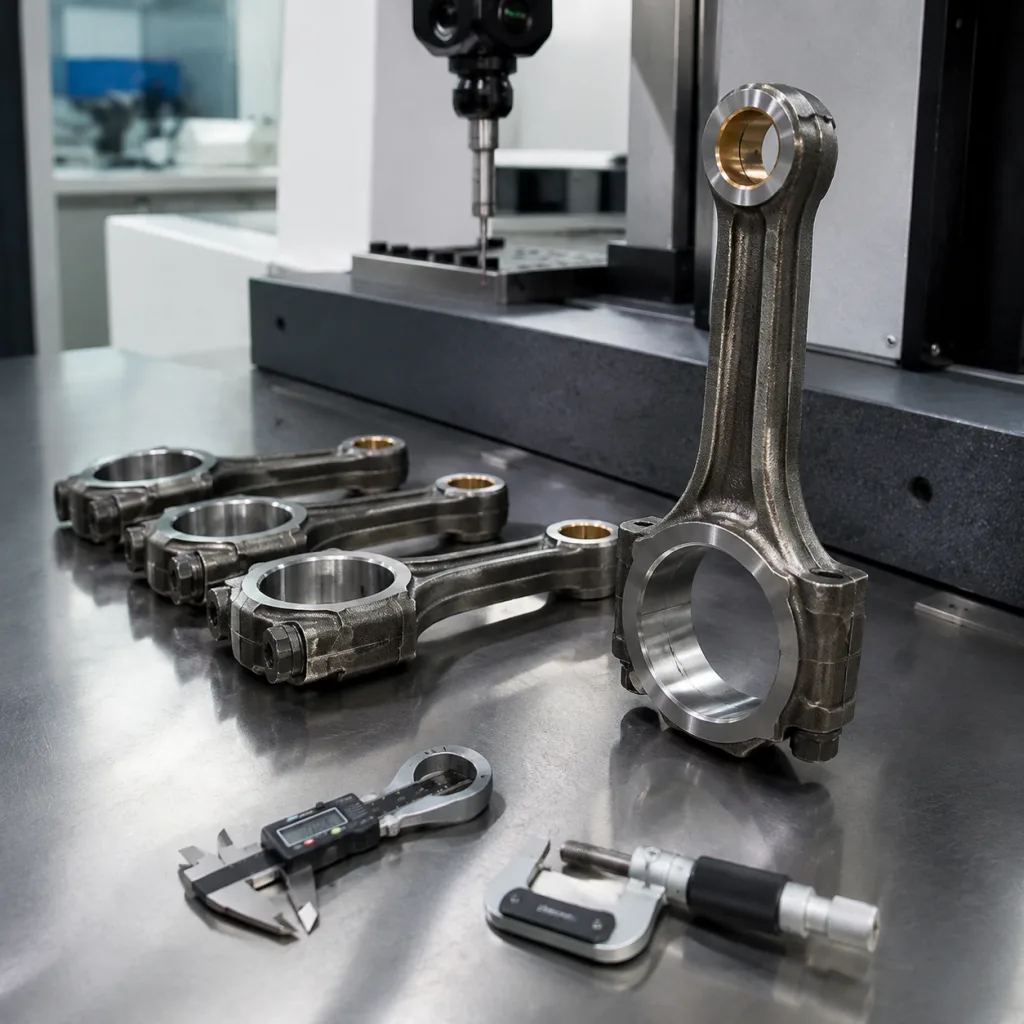
Big-end and small-end bores are held to print, commonly within ±0.01 to ±0.02 mm after finish machining
Wrist pin and crank pin interfaces are verified for size, roundness, and taper
Beam profile, cap alignment, and bolt-hole position line up with the reference sample or customer drawing
Batch weight variation stays controlled, often within 2 to 5 g for mixed-cylinder service sets unless the engine calls for tighter matching
Surface finish and shot-peen condition are confirmed where fatigue life depends on them
A rod that is too long or too short can shift piston deck height and compression ratio. One that is out of round can shorten bearing life fast. That is why sourcing should start from measured samples and print data, not a nominal catalogue description. Where the OE part number is supplied by the customer, Driventus can support OE cross-reference review such as OE 06A107065 style data when applicable to the engine family.
The inspection questions that expose weak suppliers
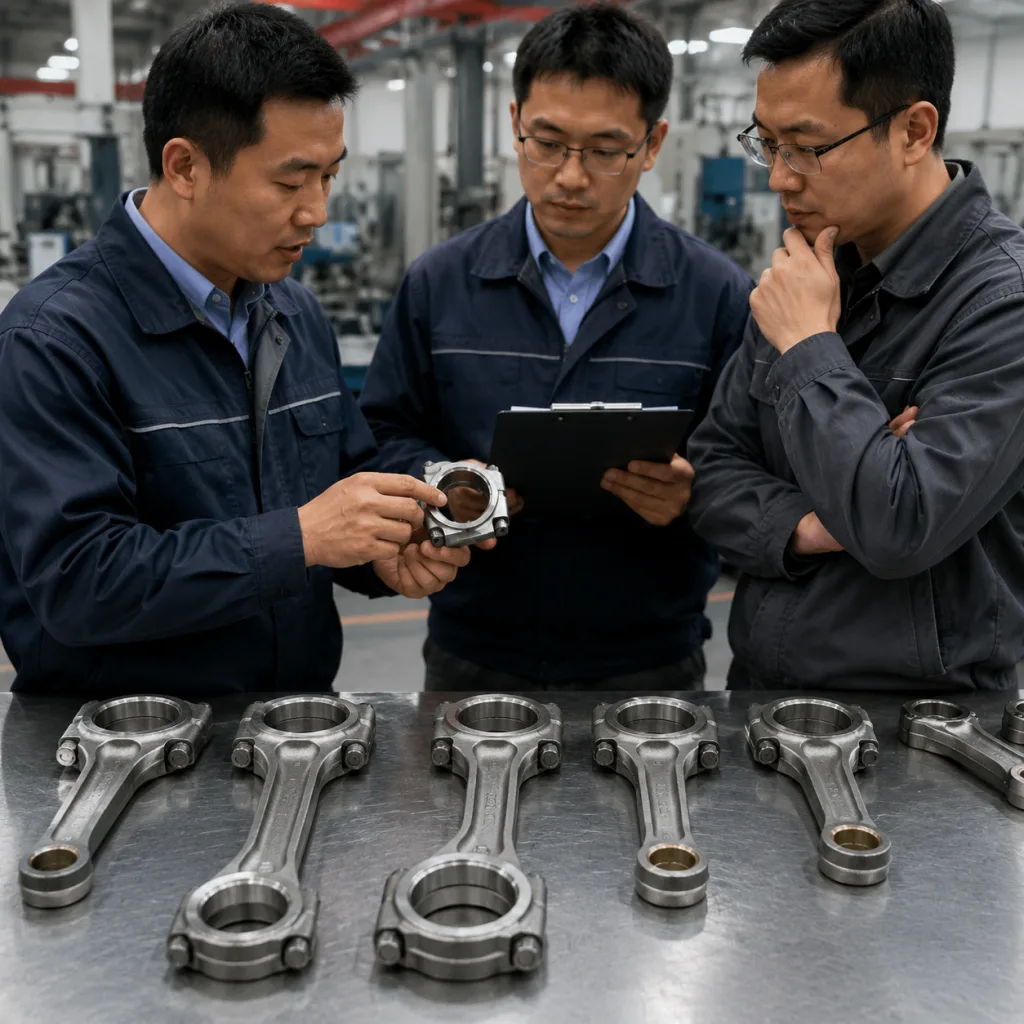
A credible replacement programme includes inspection evidence, not just a finished sample. Buyers usually need to know whether the supplier can hold the same result from lot to lot.
Validation item
Why it matters
What to confirm
Centre distance
Controls piston position and geometry
Measured against the customer drawing or OE sample, with stated tolerance and gauge method
Big-end bore
Affects bearing fit and oil clearance
Roundness, size, and cap alignment, ideally with a bore report by sampling lot
Small-end bore
Affects pin fit and wrist-pin retention
Bore size, finish, and bushing spec if applicable
Weight matching
Helps reduce cylinder-to-cylinder imbalance
Batch spread, nominal target weight, and sorting method
Material and heat treatment
Drives strength and fatigue resistance
Material certificate, hardness range, and process record
Surface integrity
Influences crack resistance and fatigue life
Visual inspection and NDT method, if specified
Bolt torque / stretch
Protects cap-joint integrity
Torque value, stretch range, and lot traceability for fasteners
</tr></thead><tbody> </tbody></table>If a supplier cannot show sample size, measured values, rejection criteria, and gauge list, the inspection pack is not complete enough for launch approval. Driventus works under IATF 16949:2016 and ISO 9001:2015, with process documentation available through the quality system. For launch orders, request a first article sample set with dimensional report, hardness results, and packaging approval before mass release.
Material choice is the real performance lever
Connecting rods are usually forged or sintered depending on engine design, cost target, and duty cycle. For Honda CR-V replacement applications, the material route has to preserve fatigue strength while staying dimensionally stable after machining.
Typical control points include:
Alloy selection and incoming material traceability, including heat number retention
Forging or forming control, including grain flow direction where relevant
Heat treatment to the target hardness range, commonly around 28 to 36 HRC for many passenger-car steel rods depending on design intent
Machining of the big end and small end to specified bore sizes, with roundness and taper checks on a defined sampling plan
Cap bolt torque and thread retention checks, with torque values and method controlled in the work instruction
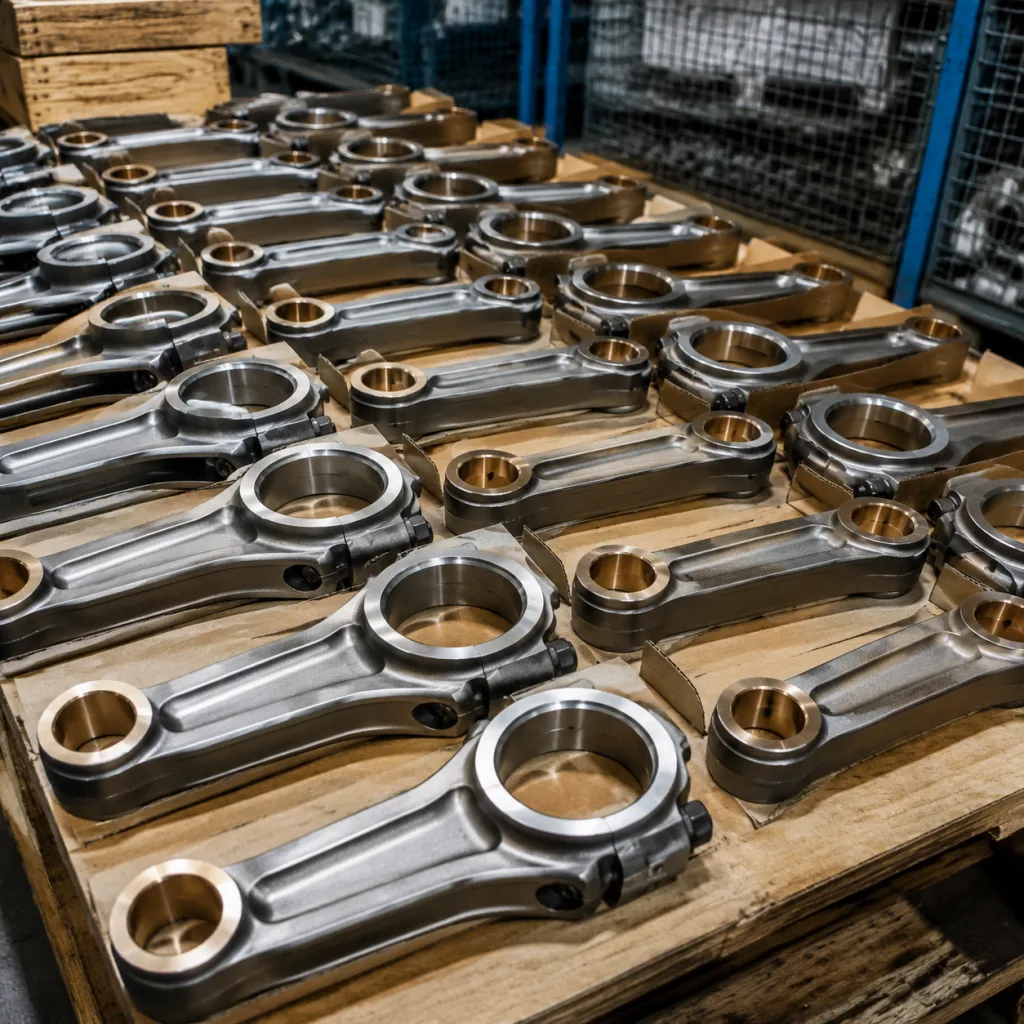
Final marking and pack control for traceability, including lot code, date code, and carton identification
For export markets, material declarations may also need to align with REACH (EC) No 1907/2006 for regulated substances, especially when the part is supplied into the EU. Buyers should also confirm whether the rod is supplied as a fully machined part or a semi-finished blank, because the commercial comparison changes with each route. Driventus can support custom manufacturing when a customer needs a drawing-based rod for a specific engine code, service level, or private-label programme.
Which supply channel are you actually buying for?
Replacement connecting rods serve three common channels, and each channel rewards a different sourcing strategy.
Aftermarket distributors and wholesalers need stable availability, clear cross-reference data, and packaging that supports branch distribution. In this channel, buyers often care about carton quantity, inner-box count, and whether the supplier can keep the same spec through at least a 12-month replenishment cycle.
OEM and Tier-1 suppliers focus on dimensional repeatability, controlled PPAP-style documentation, and consistent metallurgy. Even when the part is sold aftermarket, the same discipline helps with supplier approval. Buyers in this segment typically ask for process flow, FMEA-style risk control, control plan, and lot traceability back to material heat.
Multi-location repair chains want predictable installation outcomes. That usually means less rework, fewer returns, and lower variation between branches. For these customers, the key commercial metric is not only unit price, but installed cost: labor time, remake rate, and warranty exposure.
A usable quote should show MOQ, sample price, unit price bands by volume, standard lead time, and expedited options. As a working benchmark, buyers commonly ask for samples in 5 to 10 sets, pilot orders around 50 to 200 pieces, and production MOQs that support stocking without overcommitting cash. Lead times often split into sampling at about 7 to 15 days, pilot lots at 15 to 25 days, and bulk production at 25 to 45 days depending on tooling, coating, and inspection scope. Buyers can review the broader range in our catalog before requesting samples or cross-reference support.
How to source the part without slowing the launch
Driventus manufactures engine and powertrain components in Taizhou, Zhejiang, with export experience in more than 60 countries. For a Honda CR-V connecting rod programme, the sourcing process is usually straightforward, but it works best when the buyer sends complete inputs the first time.
1. Share the engine code, OE reference, or sample part. 2. Confirm the dimensional drawing, material route, target hardness, and any bolt or bushing requirements. 3. Review the first samples, inspection records, and mass-matching data. 4. Approve pack format, labelling, carton count, and pallet requirements. 5. Release the purchase order after sample sign-off and commercial confirmation.
Quotes are clearer when buyers provide annual volume, target MOQ, destination market, and whether they need plain bagging, barcode labels, or retail cartons. If a customer needs a private-label rod or a drawing-specific variant, Driventus can align the part to the required specification through custom manufacturing. If you need pricing, sample availability, or a cross-reference check for a specific Honda CR-V engine, you can request a quote. A complete inquiry should include engine code, photos of the old part, expected monthly or annual demand, target inspection format, and any special packaging or shipment terms so the quotation reflects real buying conditions rather than a placeholder estimate.
Frequently asked questions
Yes, when the customer provides the OE reference, engine code, or sample. Driventus supports OE cross-reference review for fitment, but brand names are used only for identification.
Confirm centre length, big-end and small-end bore sizes, material route, heat treatment, weight tolerance, and packaging. Ask for sample inspection data, hardness results, and batch traceability, plus MOQ, lead time, and carton configuration before release.
No. Driventus is an independent aftermarket manufacturer; brand names are referenced for fitment only. The part is supplied as an aftermarket replacement, not as an approved OEM item.
If you are sourcing a connecting rod for a Honda CR-V replacement programme, send your OE reference, drawing, sample, annual volume, target MOQ, and packaging requirements and we will review the fitment and supply options. Start here: /contact.html