Connecting Rod for Ford Transit Replacement: Sourcing Guide
A connecting rod for Ford Transit replacement has to match more than the vehicle name. Procurement teams should verify engine code, OE reference, centre distance, big-end bore, small-end fit, bolt specification, and mass balance before committing to volume.
That matters because Transit platforms often share model names while using different diesel or petrol engines by market, emissions package, and revision level. A close visual match can still fail on clearance, balance, or fastener preload.
Driventus supplies engine components from Taizhou, Zhejiang, with production aligned to IATF 16949:2016 and ISO 9001:2015 requirements. Driventus is an independent aftermarket manufacturer; brand names are referenced for fitment only. If you are building a replacement programme, use dimensional inspection, material verification, and batch traceability to reduce returns and field failures. The sections below focus on the checks that actually protect fitment, durability, and sourcing decisions.
Which rod details decide fitment first?
For replacement work, the question is not whether the part looks right. The real test is whether it matches the engine architecture and the dimensions that control bearing load, pin fit, and balance.
Confirm these points before purchase
Engine code and revision level, not just model year
Centre distance against the engine variant drawing or teardown sample
Big-end bore after torquing the cap with the specified bolt preload
Small-end bore against piston pin diameter and required clearance
Bolt specification, including thread, shank length, and tightening method
Rod mass so batch matching stays within engine-builder limits
Parting line quality, shot-peen coverage, and surface finish where specified
Transit fitment changes by engine family and market. OE-style cross-references should only be used when the catalogue already supports them, and they still need to be confirmed against the actual engine code in hand.
Where replacements fail in the field
Most returns start with one of a few avoidable mistakes. A rod can pass a casual visual check and still create bearing wear, noise, or balance issues once the engine is running.
Common failure modes
Wrong engine variant: the part fits the family name but not the exact build
Bore drift: the big-end or small-end is outside the required clearance window
Fastener mismatch: the bolt length or stretch method does not match the cap design
Mass spread: rods are not paired well enough for a smooth rotating assembly
Surface defects: burrs, cracks, poor cap joint finish, or weak shot-peening coverage
The sourcing lesson is simple: a low-price rod that misses one controlling dimension is expensive once a fleet starts reporting comebacks. That is why buyers should ask for control data, not just a description and a part number.
Spec check: the dimensions and materials that matter
A supplier should be able to show the specification behind the part, not only claim OE-equivalent fit. For a connecting rod, the useful details are the ones tied directly to stress, wear, and repeatability.
Inspection point
Typical control method
Why it matters
Centre distance
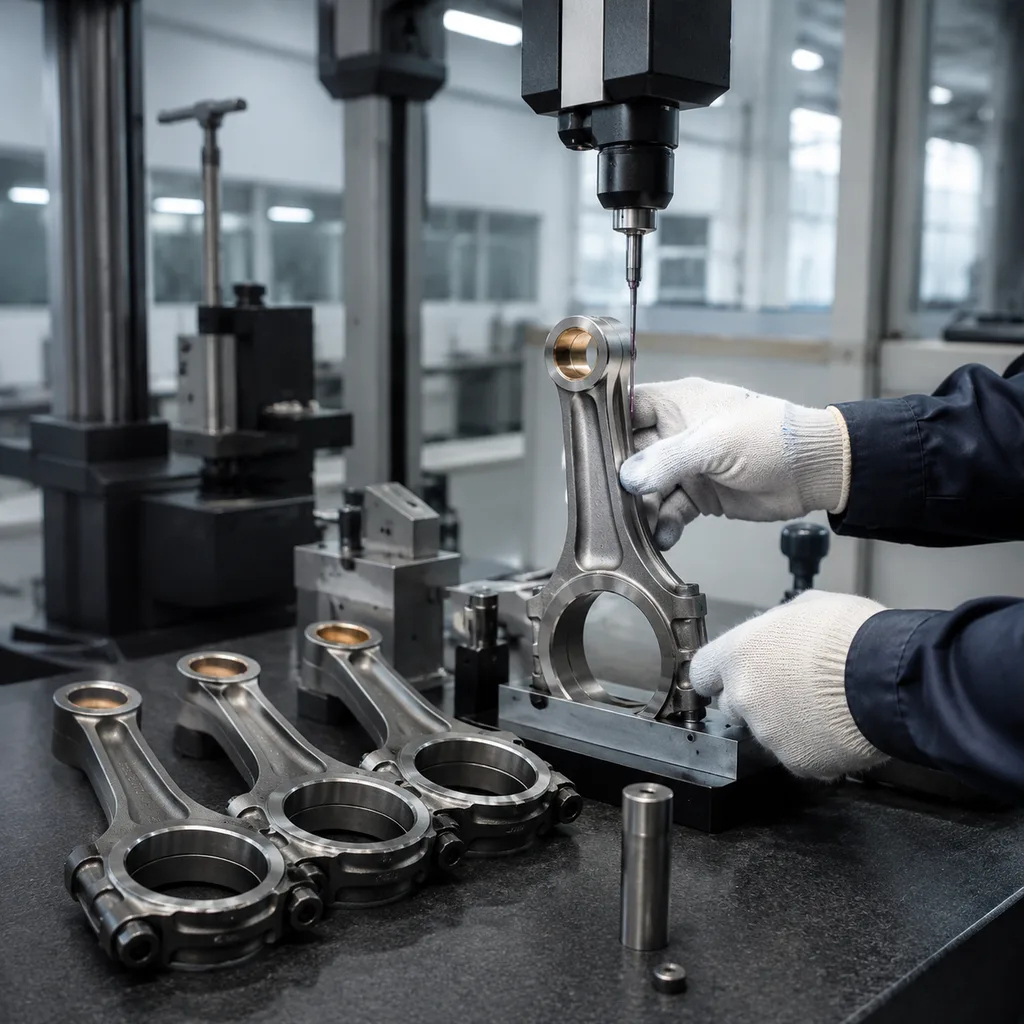
CMM or gauge fixture
Controls compression ratio and deck relationship
Big-end bore
Honed bore gauge after cap torquing
Protects bearing clearance
Small-end bore
Pin gauge / bore gauge
Ensures pin fit and oil film
Rod mass
Precision scale, matched by pair
Supports engine balance
Bolt integrity
Torque-angle or stretch check
Prevents cap separation
Visual finish
100% inspection
Detects cracks, burrs, or damage
</tr></thead><tbody> </tbody></table>Most light commercial diesel applications use forged steel because fatigue margin matters more than headline cost. Material alone is not enough, though. Heat treatment, shot peening, machining quality, and cap-joint flatness all influence service life.
A practical procurement specification should also cover:
Base material grade and heat number traceability
Hardness range after heat treatment
Shot-peen coverage on the beam and transition zones
Surface cleanliness and rust-preventive coating
Packaging that prevents flange damage in export handling
Published compliance references may include IATF 16949:2016, ISO 9001:2015, and, depending on the destination market, REACH (EC) No 1907/2006 for material declarations and restricted-substance control.
How to validate a batch before launch
Replacement rods should be tested the way a rebuild shop would verify an OE part, especially when one part number covers several Transit engine variants.
Recommended validation steps 1. Check cap-to-beam alignment after final torque. 2. Measure big-end and small-end bore after assembly. 3. Confirm side clearance against the crankshaft and adjacent rods. 4. Inspect weight matching across the batch. 5. Run crack detection on sample pieces, such as magnetic particle inspection. 6. Review packaging and transport protection for batch consistency.
This is the point where many sourcing programmes save money or lose it. If the validation package is thin, field risk shifts to the importer. If the data are complete, the launch decision becomes much easier to defend.
At Driventus, replacement programmes are supported with dimensional control and production traceability. Where a customer needs a revised geometry or fleet-specific package, our custom manufacturing process can align the rod to the target print while preserving the required material and heat-treatment window. Our quality system covers incoming inspection, process checks, final inspection, and traceability records.
What should go into the RFQ?
Sourcing gets cleaner when the RFQ removes guesswork. The better the brief, the less likely you are to receive mixed-fit quotations or parts that look similar but are not interchangeable.
RFQ data to include
Vehicle: Ford Transit, exact model year and engine code
Part type: connecting rod, with OE cross-reference if available
For distributors, wholesalers, and repair chains, catalogue clarity matters as much as price. Review our catalog and the broader engine components range if you are consolidating multiple SKUs. If you already have a sample rod or a drawing, request a quote with the engine code and target tolerance stack.
Driventus is an independent aftermarket manufacturer; brand names are referenced for fitment only.
Frequently asked questions
Match engine code, OE reference, centre distance, bore sizes, and bolt specification. A visual match is not enough for replacement sourcing.
Yes. We support dimensional matching, sample comparison, and controlled batch production for replacement programmes and export orders.
Ask for dimensional reports, material traceability, hardness data, and quality records aligned to IATF 16949:2016 or ISO 9001:2015.
If you need a verified replacement programme for Transit applications, send the engine code or sample details and we will review the fitment data with you. Start here: /contact.html