Connecting Rod for Ford Transit OE Equivalent: Buyer Guide
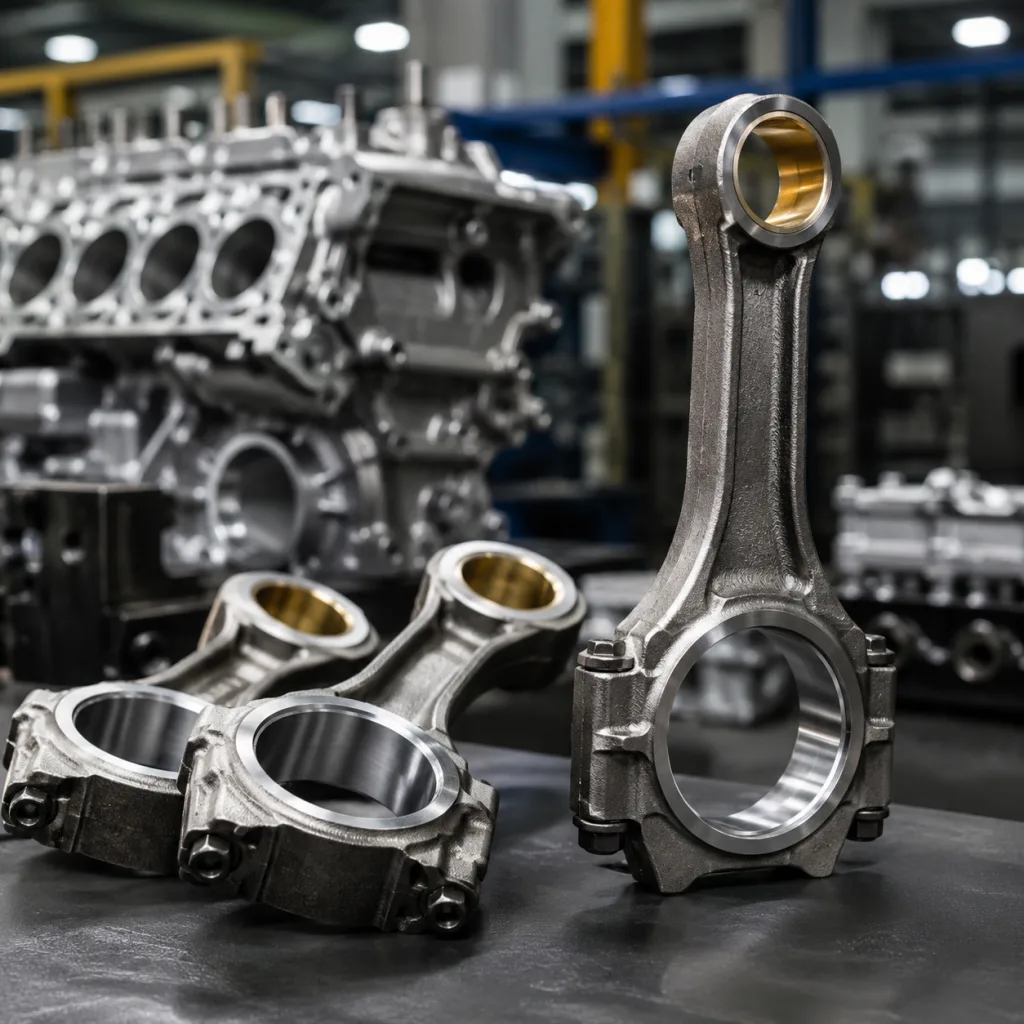
A connecting rod for Ford Transit OE equivalent has to match the original part at the engineering level, not just look similar in a catalog photo. The checks that matter are center-to-center length, big-end and small-end geometry, rod bolt specification, mass, material condition, and the way the part behaves after torquing and heat cycling. If any of those move outside the OE design envelope, fitment and durability can suffer.
For procurement teams, the right source is one that can provide dimensional data, material declarations, inspection records, and lot traceability for every production batch. Driventus supplies engine components for aftermarket and B2B replacement channels, with manufacturing controls aligned to IATF 16949:2016 and ISO 9001:2015. Driventus is an independent aftermarket manufacturer; brand names are referenced for fitment only.
For Ford Transit applications, the rod must be verified against the engine code, piston pin diameter, big-end width, center-to-center length, bolt type, and any set-balancing requirement. OE reference matching helps, but it is not enough on its own. A buyer still needs measurement data, material confirmation, and fitment records that prove the rod is suitable for the intended engine build. Surface finish, shot peening coverage, hardness, cap-face machining, and big-end roundness all affect fatigue life because the rod is a highly loaded rotating component. If your sourcing team needs a replacement rod with controlled tolerances and export-ready documentation, use the same process you would apply to any critical engine component: dimension, material, test, and traceability review before purchase.
What OE equivalent means for a Transit connecting rod
OE equivalent does not mean "close enough" or "looks the same." It means the rod is designed to operate within the same functional and dimensional envelope as the original part in the target Ford Transit engine, so it assembles correctly and survives the same load profile.
In practical procurement terms, OE equivalence should be checked against the features that directly affect assembly accuracy and durability:
- Center-to-center length
- Big-end bore diameter, roundness, and cap alignment after torquing
- Small-end bore diameter and bush condition, where applicable
- Big-end width and small-end width
- Rod mass, matched-set tolerance, and end-to-end balance requirement
- Rod bolt size, thread pitch, tightening method, and seat design
- Material grade, forging route, heat treatment, and surface conditioning
- Cap interchangeability, part orientation, and mating mark consistency
Transit rods can differ by engine family, fuel system, emissions tier, and model year. The same nameplate may cover multiple diesel displacements and hardware revisions, and even within a single engine family there can be changes tied to piston, pin, or crankshaft updates. For that reason, buyers should verify the engine code and OE reference first, then confirm the physical sample against the drawing or benchmark part. If you are building a replacement catalog, keep the fitment record tied to the exact engine code, OE number, and revision level rather than the vehicle name alone.
Key specifications buyers should verify
A dependable sourcing decision starts with a dimensional sheet, not a catalog title. Before approving a new source for a connecting rod for Ford Transit OE equivalent, request nominal values, tolerance limits, inspection methods, and the basis used to claim equivalence. A credible supplier should be able to explain how each critical feature was measured and how the production line controls repeatability.
| Specification item | Why it matters | What to verify |
|---|---|---|
| Center-to-center length | Sets piston position and affects compression height, deck height, and combustion chamber behavior | Match to OE drawing, validated sample, or approved benchmark standard |
| Big-end bore | Controls bearing fit, oil film stability, and crank journal support | Bore size, roundness, surface finish, and cap alignment after torquing |
| Small-end bore | Determines pin fit and small-end durability | Pin diameter, finish, bushing presence, and press-fit or floating-pin design |
| Rod beam profile | Affects stiffness, fatigue resistance, and mass | Beam cross-section, forging consistency, and dimensional repeatability |
| Rod bolt | Retains the cap under cyclic load | Bolt grade, thread condition, tightening method, and traceability |
| Weight matching | Reduces vibration and improves balance across cylinder sets | Individual rod mass, set tolerance, and any end-to-end weight split requirement |
| Surface treatment | Improves fatigue life under cyclic loading | Shot peening coverage, residual stress control, and surface integrity |
| Material and hardness | Determines strength, toughness, and wear behavior | Material declaration, hardness range, and heat-treatment evidence |