Connecting Rod Fiat Supplier: Sourcing Guide for Buyers
Choosing a connecting rod Fiat supplier is a technical sourcing decision long before it becomes a price comparison. Procurement teams have to confirm fitment by engine code, steel or powder-metal metallurgy, big-end and small-end machining stability, traceable production records, and the supplier's ability to repeat the same specification across batches, cartons, and shipments. For engine builders, distributors, repair networks, and importers, the practical questions are precise: which Fiat engine family is covered, which OE reference or buyer drawing is being matched, what bore and centre-distance tolerances will be inspected, what MOQ applies, and whether the quoted lead time can support repeat orders rather than a one-time sample.
Driventus supplies engine and powertrain components from Taizhou, Zhejiang, with production aligned to IATF 16949:2016 and ISO 9001:2015. Driventus is an independent aftermarket manufacturer; Fiat and other brand names are referenced for fitment only. This guide explains what buyers should verify when sourcing connecting rods for Fiat platforms, how to compare suppliers beyond unit price, and which technical documents should be requested before issuing a purchase order.
What buyers should verify before sourcing
A useful supplier quote should cover much more than unit price. Connecting rods work under tensile, compressive, and bending loads inside the rotating assembly, so the buying team should confirm fitment, material route, machining controls, inspection method, and export readiness before sampling or mass production begins. Clarifying these points early helps prevent mismatched bearings, incorrect pin-end geometry, unclear responsibility, and shipping delays.
Before requesting a formal quotation from a connecting rod Fiat supplier, buyers should verify:
- Application fitment: confirm Fiat engine code, displacement family, fuel type, piston pin diameter, crankpin journal size, bearing shell reference, and whether the application is passenger car, light commercial, naturally aspirated, or turbocharged.
- OE cross-reference: use the target OE number only where already specified by the buyer, for example OE 06A107065, and treat it as a fitment reference rather than a claim of OE approval.
- Sample or drawing basis: define whether production will follow a physical sample, 2D drawing, 3D model, buyer specification, or confirmed aftermarket reference.
- Material route: confirm forged steel, sintered powder metal, or other specified construction, and request material certification that matches the agreed route, such as heat number, steel grade, or powder-metal batch.
- Dimensional controls: check centre-to-centre length, big-end bore after cap torque, small-end bore or bush ID, cap alignment, big-end width, side clearance, bolt hole condition, and weight class.
- Surface condition: verify shot peening where specified, bearing bore finish, thrust-face finish, cap mating quality, oil hole deburring, anti-rust treatment, and storage protection.
- Traceability: request batch code, heat number where applicable, production date, inspection records, operator or line reference where available, and carton-level identification.
- Compliance: confirm REACH (EC) No 1907/2006 material declaration where required, plus destination-market packaging, labelling, pallet, and documentation requirements.
For Fiat-related sourcing, buyers often need support across several countries and distribution channels. A factory exporting to the EU, UK, US, Canada, Australia, and Brazil should be ready to prepare export packing, carton labelling, country-of-origin documents, commercial invoice details, and shipment paperwork that fits importer workflows. This matters because even a dimensionally correct connecting rod can create cost if the outer carton, label format, pallet height, or document set does not match the buyer's warehouse and customs process.
The most useful first enquiry includes the engine code, target OE reference, annual volume estimate, preferred packing format, and destination market. If the part is not already in regular production, the buyer should also send a sample, drawing, or CAD file so the supplier can assess forging or blank availability, fixture needs, machining sequence, validation workload, and lead time before quoting.
Technical points that matter on connecting rods
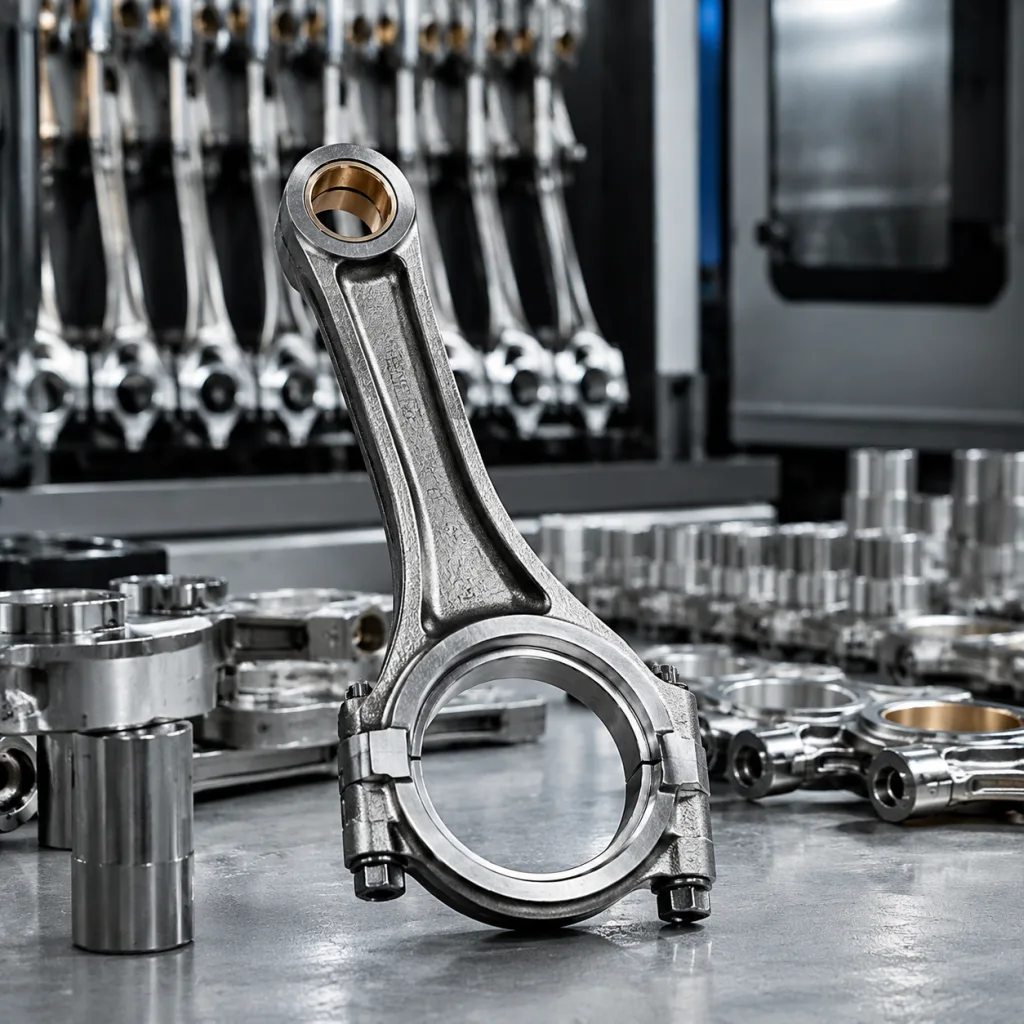
Connecting rods are load-bearing precision parts. Small deviations can affect assembly quality, engine balance, bearing life, oil clearance, and service durability. Buyers should ask for a specification sheet and inspection method, not just a product photo or a catalogue line. A serious connecting rod Fiat supplier should be able to explain how the part is made, how it is measured, and which critical dimensions are controlled during production.
Core specifications to request
| Item | What to confirm | Why it matters |
|---|---|---|
| Centre distance | Measured from big-end centre to small-end centre, with declared tolerance | Affects piston deck height, compression geometry, and cylinder-to-cylinder consistency |
| Big-end bore | Finished bore size after cap tightening to the inspection torque and bolt condition | Must match crank journal, bearing shell crush, and oil clearance requirements |
| Roundness and cylindricity | Big-end geometry measured with a bore gauge or CMM after torquing | Helps prevent uneven bearing load, hot spots, and premature bearing wear |
| Small-end bore | Bush or pin-end diameter, surface finish, and oil-hole condition | Controls piston pin fit, oil film stability, pin noise, and seizure risk |
| Big-end width | Rod side width and thrust-face finish | Affects side clearance, crankshaft compatibility, and oil flow at the crankpin |
| Weight | Individual rod weight and matched-set tolerance, often separated into total and end weight where required | Important for rotating and reciprocating balance in multi-cylinder engines |
| Material | Forged steel, powder metal, or specified alloy with certificate | Impacts tensile strength, fatigue resistance, fracture behaviour, and manufacturing route |
| Surface treatment | Shot peening, polishing, phosphate, black oxide, or anti-rust oil | Influences fatigue life, corrosion resistance, and storage condition |
| Cap design | Fracture-split or machined cap, bolt type, thread condition, and mating face | Affects alignment, service procedure, and repeatability after tightening |
| Test method | CMM, air gauge or bore gauge, hardness, metallography, magnetic particle inspection, or other NDT where specified | Verifies dimensional control, material condition, and production consistency |