Connecting Rod for Ford Focus OE Equivalent: Replacement Guide
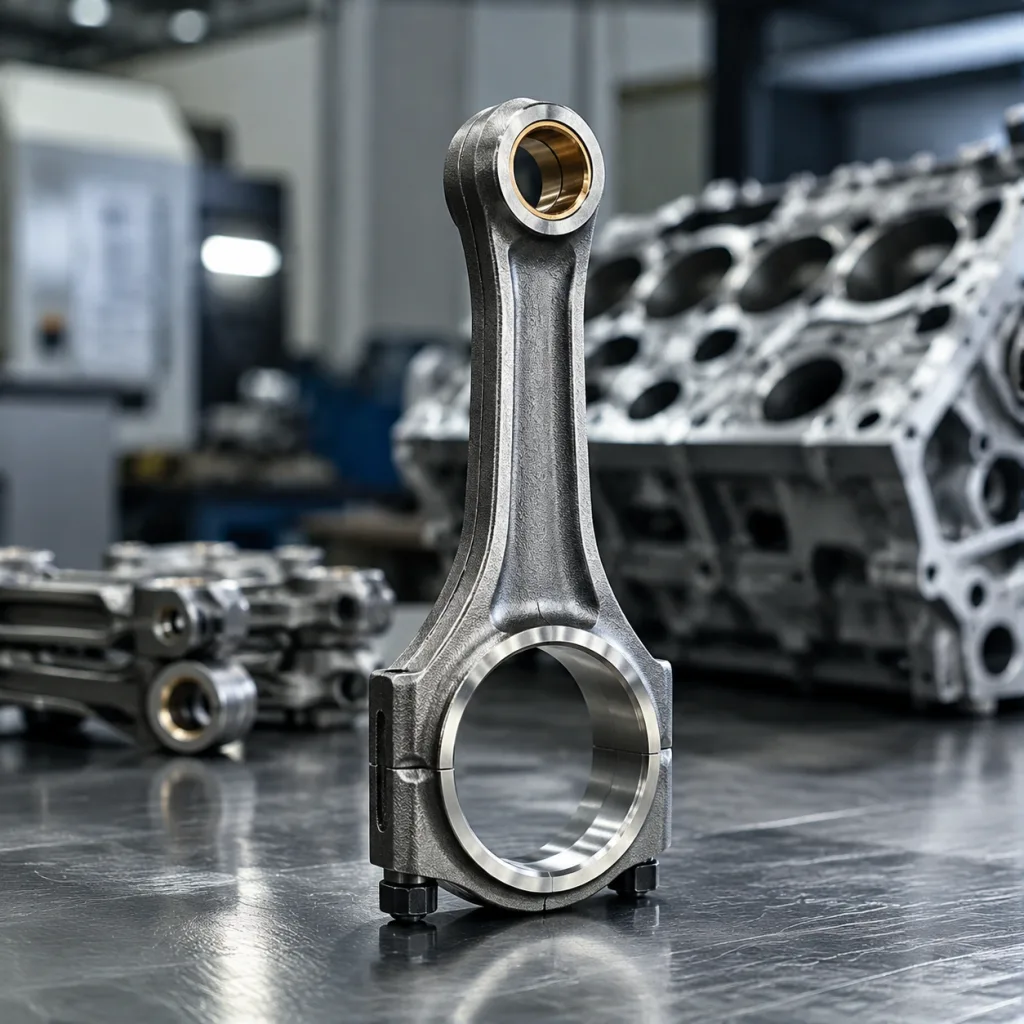
Buyers looking for a connecting rod for Ford Focus OE equivalent applications usually need a replacement that matches the original engine family's geometry, mass, and fatigue performance without sourcing through a vehicle brand channel. The real procurement risk is not whether one rod can be made to fit. It is whether every batch stays consistent in dimensions, inspection records, and export handling. Driventus is an independent aftermarket manufacturer; brand names are referenced for fitment only. We supply engine and powertrain components from Taizhou, Zhejiang, under IATF 16949:2016 and ISO 9001:2015 systems. For this part family, buyers should verify center-to-center length, big-end and small-end bore, bore roundness, rod mass, beam alignment, surface finish, heat-treatment condition, and the inspection method used to confirm them. A correct replacement is defined by measurable data, not visual similarity alone. This guide explains what to check before placing a first order or repeating a program that has already proven itself in the field.
What OE-equivalent means for this part
For a connecting rod, OE-equivalent means the part matches the functional dimensions and mechanical performance of the original application closely enough to operate in the same engine family. The assembler should not need nonstandard machining, selective matching, or altered bearing clearances to make it work. It does not mean brand endorsement, factory approval, or a claim that the part is identical to the vehicle maker's supplied component.
In procurement terms, OE-equivalent should be defined by the data that affects fit, oil-film stability, and fatigue life, not by outside appearance. Two rods can look almost the same and still differ in mass distribution, bore geometry, cap alignment, rod bolt specification, or surface treatment. Any of those differences can affect balance, bearing wear, or long-term durability once the engine sees load and thermal cycling.
Key items to confirm include:
Center-to-center length
Big-end bore and width
Small-end bore and bushing specification
Beam section and finished mass
Cap joint design and fastener type
Material grade and heat-treatment condition
Surface finish and shot-peening coverage
Clearance targets for the intended bearing and pin package
The practical test for OE-equivalence is simple: the rod should install, balance, and run within the same duty cycle as the original application without special correction work in the rebuild or assembly process. If the supplier cannot describe the rod's geometry and process route in measurable terms, the term OE-equivalent does not give the buyer much protection.
Driventus is an independent aftermarket manufacturer; brand names are referenced for fitment only.
Dimensions and tolerances buyers should verify
The inspection sheet should carry more weight than the catalogue description. For an OE-equivalent rod, buyers should request recorded measurements from production inspection, not just a part-number statement or a visual fitment note. In engine components, fitment is only the starting point. Repeatability and dimensional control are what protect warranty exposure.
Ask for the following data before approval:
Check item
Why it matters
Typical buyer request
Center-to-center length
Controls piston deck position and compression-height interaction
Measured value with tolerance range
Big-end bore
Determines bearing fit and oil-film stability
Bore size, roundness, and honing record
Big-end width
Affects side clearance and crankshaft running condition
Width measurement and tolerance
Small-end bore
Affects pin fit and bushing life
Bore size and bushing material
Rod weight
Affects balance across cylinders
Individual weight and matched-set spread
Beam alignment
Prevents side loading and fatigue
Straightness or bend check result
Cap joint
Controls clamp load and joint stability
Fastener specification and torque procedure
Surface finish
Influences stress concentration and wear
Finish target and inspection method
</tr></thead><tbody> </tbody></table>For a production program, the most important numbers are not always the nominal dimensions. The spread across the batch can matter just as much. A rod with the correct nominal size can still create problems if the weight variation is too wide or if the bore is round in only one axis. Buyers should also ask how the supplier measures parts: CMM, bore gauge, dedicated fixture, or another controlled method. Gauge calibration should be on a defined schedule.
If the rod will be used across multiple engine variants, ask for batch traceability so retained samples can be compared over time. That makes drift in machining, heat treatment, or final sorting easier to catch before it becomes a field issue.
Materials, heat treatment, and durability checks
A connecting rod is a fatigue part. It works under repeated tensile, compressive, and bending loads, often with high cycle counts and limited room for process variation. Material choice matters, but it is only one part of the story. The forging route, machining sequence, heat treatment, and surface conditioning all shape the final durability of the rod.
Common buyer checks include:
1. Material declaration, such as forged steel or powder-forged steel where applicable 2. Heat-treatment records and hardness range 3. Shot-peening process confirmation and coverage target 4. Magnetic-particle or crack inspection on critical production lots 5. Dimensional audit after final machining 6. Bushing and pin-seat inspection where the application uses a serviceable small end 7. Fastener specification and proof-load evidence for cap bolts when supplied as an assembly
For export procurement, ask whether the component meets the relevant substance and conformity expectations for your market, including REACH (EC) No 1907/2006 where applicable to the finished article and process controls. If your program requires documented performance screening, request validation data aligned to internal duty-cycle testing or published methods where relevant to component durability evaluation. The test plan should match the engine duty, not a generic laboratory package.
A reliable supplier should be able to explain how the forging route, machining sequence, and final inspection result are connected. If the explanation changes from one purchase order to the next, the process may not be stable enough for repeat supply. Buyers should also ask whether failed parts are retained for root-cause review and how corrective actions are closed in the quality system.
OE cross-reference and sourcing workflow
When a customer asks for a connecting rod for Ford Focus OE equivalent, sourcing should begin with the engine code and OE part-number cross-reference, not vehicle trim alone. Focus model names can cover multiple engine families, and the same model year may include different rod lengths, pin diameters, compression ratios, and crankshaft packages. A vehicle label is not enough to define the part.
Recommended workflow:
Confirm engine code and OE reference from the customer list
Match the rod drawing to the OE dimensions
Compare material and joint type
Verify the pin-end and crank-end interface dimensions against the intended engine family
Check packaging, traceability, and barcode requirements
Approve a sample lot before commercial release
Record the approved sample against the customer program and revision level
If the application spans more than one engine family, keep the cross-reference file separated by engine code and model-year band. A part that fits one 1.6L variant may not match another variant with a different compression package, piston height, or pin design. This matters especially for distributors and repair chains, where a visually similar part can still generate returns if it is interchanged across engine codes.
For broader engine sourcing, review our catalog and the related engine components range. This is also the stage where import managers should confirm Incoterms, carton quantity, label content, and corrosion-protection requirements for stored stock. If the customer needs a private-label pack, approve the packaging specification alongside the metal part, not after the first shipment.
Why procurement teams audit the supplier, not only the part
A replacement rod program works only when production and inspection remain stable. That is why buyers often audit the factory system before approving a second-source or private-label supply. The part can be technically correct on day one and still become a liability if process control slips, gauges drift, or lot segregation breaks down.
Driventus operates under IATF 16949:2016 and ISO 9001:2015, which supports controlled process documentation, corrective action, and traceability discipline. For buyers, the practical questions are:
Can the supplier supply dimensional reports by batch?
Are incoming material records retained and linked to finished lots?
Are critical gauges calibrated on schedule?
Is nonconforming product segregated and dispositioned with recorded authority?
Can the supplier support PPAP-style documentation where required by the customer?
Are change controls in place for tooling, heat treatment, and subcontracted processes?
If you need a special rod variant, forged blank, or packaging standard for retail distribution, see our custom manufacturing capability. For quality documentation and inspection controls, review our quality system. The procurement decision becomes easier when the supplier can show process control instead of simply promising it. Buyers should also ask how the factory handles engineering changes, because a silent revision to a forging die or balancing step can create a mismatch between an approved sample and a later repeat order.
In practice, a supplier audit is not paperwork for its own sake. It is how a buyer reduces the risk that the second shipment differs from the first in ways that are hard to detect until the engine is assembled.
Buying checklist for repeat orders
Before placing a repeat order, keep the checklist short, measurable, and tied to the approved sample or drawing revision. The goal is to remove ambiguity before goods move into production or distribution.
Engine code and application range confirmed
OE reference cross-checked
All key dimensions verified against drawing
Weight class and set matching confirmed
Heat treatment and hardness range documented
Packaging and rust prevention agreed
Batch traceability and sample retention confirmed
Lead time, MOQ, and inspection requirements aligned
Label format and barcode content confirmed
Revision status and approved sample number recorded
For distributors and repair-chain buyers, the main cost is usually not the rod itself. It is the cost of a mismatch: returns, warranty time, workshop downtime, and lost confidence in the catalog. A disciplined approval record reduces that risk and makes reorder decisions faster. If the application is sensitive, add a photo of the approved part, the measurement report, and the packaging specification to the purchase file so the next buyer can repeat the same decision without revalidating the basics.
If you need commercial terms, sampling, or engineering review, you can request a quote and share the OE reference, engine code, target annual volume, and any packaging or inspection requirements. Driventus is an independent aftermarket manufacturer; brand names are referenced for fitment only.
Frequently asked questions
Not necessarily. OE-equivalent means the part matches functional dimensions, material behavior, and application fit. It does not mean vehicle-maker approval, endorsement, or identical origin. Buyers should confirm dimensions, weight, material route, and inspection evidence before release.
Ask for dimensional inspection records, material declaration, heat-treatment data, batch traceability, and packaging details. For regulated markets, confirm REACH-related compliance as applicable. If the application is sensitive, also request the approved sample reference and any available hardness or balancing records.
Yes. We support custom manufacturing for specified drawings, pack labels, and program requirements. Send the engine code, OE reference, target quantity, and any dimensional or surface-treatment requirements for review so we can confirm feasibility before sampling.
If you are sourcing a replacement rod program and need a technical match, send your OE reference, engine code, and annual demand to /contact.html.