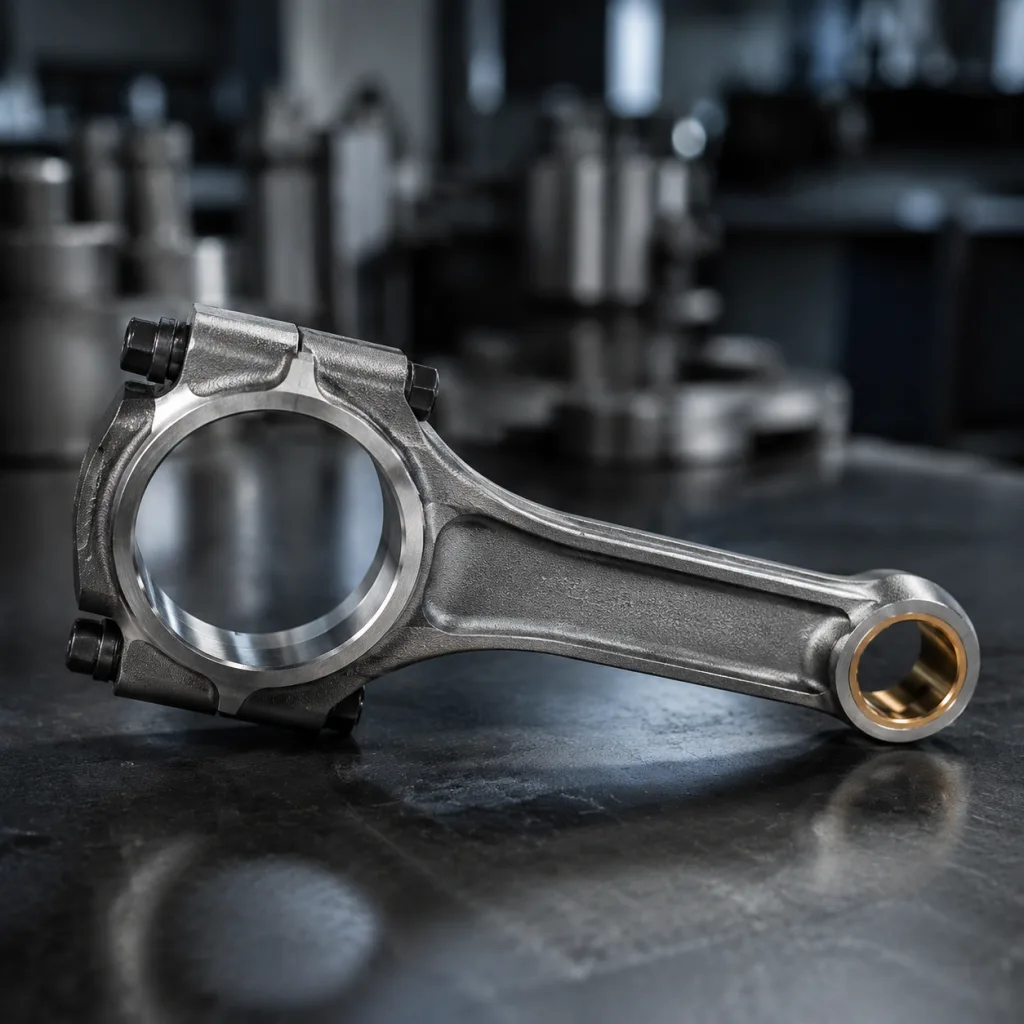
Selecting a **connecting rod for Citroen C3 replacement** work is not just a fitment check. For importers, distributors and engine-rebuild buyers, the part has to match OE-controlled dimensions, the material route, big-end and small-end geometry, and mass tolerance across repeat orders. A rod that looks correct on paper but varies in bore roundness, center-to-center length, cap alignment or bolt-seat finish can shift bearing crush, oil clearance, piston-pin fit or rod straightness after assembly.
For Citroen C3 applications, buyers usually need verified interchange data by engine code, batch traceability and proof that machining and inspection controls are repeatable. That matters especially when sourcing for fleets, wholesale rebuilders or multi-site workshops that measure success by low comeback and warranty rates. This guide covers the main checkpoints for replacement connecting rods, including dimensional control, material and heat-treatment considerations, and the documents procurement teams should request before placing volume orders. Driventus is an independent aftermarket manufacturer; brand names are referenced for fitment only.
What matters in a replacement connecting rod
A replacement rod has to do more than physically fit the engine. It must keep crankshaft, bearing and piston-pin alignment stable under repeated tensile and compressive loads, across many thermal cycles. In practical terms, a connecting rod for Citroen C3 replacement needs to behave like a controlled engine component, not a generic forged part.
For buyers comparing supply options, the main points are:
OE-equivalent geometry: center-to-center length, big-end housing bore, small-end bore or bush ID, big-end width and small-end width must match the target application drawing.
Controlled mass spread: total mass and, where required, rotating and reciprocating end balance should stay within the agreed tolerance so cylinder-to-cylinder variation remains low.
Material consistency: forged alloy steel grade, grain flow through the beam and fillet areas, and heat-treatment consistency all affect fatigue life.
Machining quality: bore roundness, cylindricity, taper, parallelism and cap register accuracy directly influence bearing crush and oil-film stability.
Surface condition: shot peening, deburring and controlled fillet radii help reduce stress concentration and crack-initiation risk.
Traceability: batch marking, process records and inspection reports support containment and warranty analysis.
Each point matters for a different reason:
If center-to-center length drifts by even a few hundredths of a millimeter from target, piston deck height and effective compression can vary between cylinders.
If the big-end housing bore is oversized, tapered or out of round, installed bearing ID and running oil clearance can move outside the crankshaft journal specification.
If the small-end bore or bush has poor geometry or surface finish, the piston pin can develop noise, tight-spot seizure or accelerated wear.
If rod and cap alignment is inconsistent, the rebuilt engine can show uneven bearing contact even when fastener torque is correct.
If weight spread is uncontrolled, workshops may face avoidable NVH variation, especially in multi-cylinder rebuild programs.
For procurement teams, the practical shift is simple: evaluate the component as a controlled engine part rather than a catalog line. If you source across PSA small-displacement petrol or diesel variants, request documented application mapping and dimensional validation by engine code and OE reference, not just by vehicle model name.
It also helps to separate three sourcing questions:
1. Will it fit the target engine code and rod, bearing and journal combination? 2. Will it assemble correctly with the specified bearing shells, piston pin and rod bolts? 3. Will it repeat consistently across batches and future orders?
Many field failures happen because only the first question is checked. For wholesale and rebuilder channels, the second and third questions usually drive total claim cost.
For a connecting rod used in Citroen C3 engine repair, dimensional inspection should be defined in the supply agreement or technical appendix. Even when the forging outline looks identical, deviation at the housing bores, mating faces, bolt seats or side faces can affect assembly and service life.
A solid validation plan should cover nominal size, form and positional accuracy. In other words, buyers should look beyond a simple pass or fail statement and ask how each characteristic is measured, at what stage, and under what assembly condition.
Inspection point
Why it matters
Typical control focus
Center-to-center length
Piston position and compression geometry
Nominal dimension, tolerance band, fixture method
Big-end housing bore
Bearing crush and running clearance
Diameter, roundness, cylindricity, taper
Small-end bore / bush ID
Piston pin fit
Bore size, perpendicularity, surface finish
Big-end side width
Crankpin side clearance
Width consistency and face parallelism
Parting-face flatness
Cap seating and bore stability
Flatness, seating quality, burr-free condition
Rod twist and bend
Piston tracking and bearing load distribution
Fixture-based geometry check
Weight matching
Balance and NVH
Total weight and grouped end-weight control
</tr></thead><tbody> </tbody></table>### Why these checks should be explicit
A purchase order that only says “fit for Citroen C3” leaves too much room for interpretation. In practice, the buyer should define which dimensions are critical, what tolerance applies, what sampling plan is used and whether any feature requires 100% inspection.
Particular attention should be paid to:
Big-end housing bore after cap assembly: the bore should be measured with the cap installed, matched to its original rod, and tightened using the specified bolt type and torque or stretch condition. Free-state measurement is not enough.
Small-end bore finish: a bore can meet size but still be unsuitable if hone quality, axis alignment or surface roughness is poor.
Twist and bend: these affect piston skirt loading, ring seal stability and bearing load distribution.
Side width and parallelism: these influence axial float and cap seating consistency on the crankpin.
Validation documents buyers should request
Full dimensional inspection report for first article or initial sample
Material certificate for forging or finished part
Heat-treatment record where applicable
Hardness report by specified test location
Crack-detection or non-destructive testing record if specified
PPAP-style submission where required by OEM or Tier-1 customers
For larger programs, good practice is to request a first-article package that includes:
drawing balloon with measured results
gauge or fixture method description
photos of key inspection points
sample marking and batch identification
confirmation of torque values or bolt-stretch condition used during bore measurement
When the buyer is consolidating supply for several regions, standardize acceptance criteria across all warehouses. This reduces disputes caused by different local inspection methods and helps internal quality teams compare claim data consistently.
In short, a dimensional report has the most value when it shows how the supplier measured the part, not only the final numbers.
Material, process and quality controls to ask about
Connecting rods for passenger-car engines are typically produced from forged steel, then rough machined, heat treated, finish machined and honed. For replacement programs, process capability is usually a better predictor of field performance than a low ex-works price.
A supplier should be able to explain:
whether the rod is forged steel rather than cast or powder-metal, and which route applies to the target part number
the steel grade family used for the required load case
the heat-treatment route and target hardness window
how rod and cap matching is maintained after fracture split or conventional split machining, depending on design
whether big-end housing bores are finish-honed after simulated bolt loading
how visual inspection, dimensional sampling and lot release are defined
These questions matter because the rod is a fatigue-loaded part. Even if dimensions are initially correct, weak process control can create hidden durability variation from lot to lot.
Material and forging considerations
For many automotive connecting rods, buyers will prefer a forged route because forging improves grain flow and mechanical consistency in high-stress areas such as the beam transition and big-end fillet. During supplier discussions, ask:
what forging source is used
whether the raw forging is dedicated to the part number or shared across variants
what material identification controls exist from forging receipt to final packing
whether the supplier can provide hardness data and, where required, metallographic or microstructure evidence
If multiple forging vendors are used, lot segregation becomes critical. Mixed forgings can pass visual inspection while showing different machinability, hardness response or fatigue performance.
Machining and bore control
Machining discipline is critical on the big-end and small-end features. A technically capable supplier should be able to describe:
how parting faces are machined and protected from impact damage
how rod and cap pairing is maintained throughout production and packing
what controls are used for boring and honing
whether in-process checks include roundness, taper and bore-axis alignment
how tool wear is monitored to prevent drift at the end of a production batch
For the big end, one useful audit question is whether the final housing bore is checked with the cap assembled using the specified fastener and torque condition. That is much closer to the installed state than a loose-cap measurement.
Heat treatment and surface condition
Heat treatment influences strength, dimensional stability and fatigue life. Buyers should request clarity on:
heat-treatment type and sequence
target hardness range
hardness test location and sampling frequency
any stress-relief process after major machining stages
Surface finishing also matters. Shot peening, correct undercut or fillet geometry and burr removal can improve fatigue resistance by reducing local stress raisers.
Quality governance and compliance
For quality governance, buyers should expect a documented quality system aligned with IATF 16949:2016 and ISO 9001:2015 principles for process control, traceability, corrective action and supplier management. If the rod includes a bush, coating or packaging material with chemical compliance requirements, ask for declarations relevant to REACH (EC) No 1907/2006.
In engine-component sourcing, a practical audit question is whether the supplier controls both machining capability and outgoing lot segregation. Mixed lots create avoidable claims, especially when workshops install matched sets and later find weight or bore variation between cylinders.
A strong supplier should also be able to explain what happens when a lot falls outside target:
how nonconforming product is identified
how suspect stock is quarantined
whether traceability allows recall by batch or production date
how corrective action is documented and verified on the next run
That level of process visibility often separates a reliable long-term source from a low-cost but unstable one.
Replacement sourcing checklist for distributors and rebuilders
When buying for stock or contract supply, use a structured approval checklist. This is especially important when the product will be sold into rebuild channels rather than direct retail, because rebuilders are more sensitive to dimensional variation and claim cost than one-off service jobs.
Recommended procurement checklist
1. Confirm engine code coverage and any revision differences within the C3 platform. 2. Request OE cross-reference mapping and verify it against your internal application data. 3. Review drawing-controlled dimensions and acceptance tolerances. 4. Specify bolt supply status: supplied with bolts, without bolts, or according to your rebuild-kit structure. 5. Define packing method to prevent parting-face damage, corrosion and cap mix-up in transit. 6. Agree batch marking for traceability at warehouse and workshop level. 7. Approve samples based on measured inspection, not photographs only. 8. Set claim-handling terms including quarantine process and lot trace-back.
How to use the checklist in practice
Each item should be converted into an approval gate rather than treated as a general discussion point.
Engine code coverage should be confirmed against actual application data, because a Citroen C3 model designation may span different engines, years and revisions.
Cross-reference mapping should be reviewed carefully where multiple aftermarket references converge into one supplied part, as this can hide differences in bolt type, bush specification or width.
Bolt supply status matters because many rebuilders will install new rod bolts only, while others source bolts separately according to internal kit policy.
Packing method is not a minor detail; impact damage on parting faces, corrosion in the bore, or mixed caps can turn acceptable production into warehouse claims.
Additional points buyers often miss
In many sourcing projects, the following details are overlooked until after the first shipment:
whether the rod and cap are permanently matched and individually marked
whether the small end uses a bush and, if so, whether it is supplied semi-finished or honed to final size
whether the product is supplied as a single rod or as a matched engine set
what anti-corrosion protection is applied for sea freight or long storage
whether inner-box labels include batch, quantity and part number in the buyer’s required format
whether cartons are strong enough for pallet stacking without cap-face impact
If your program includes private-label packaging, kitting with bearings or pistons, or custom inspection plans, this should be defined before mass production. For that, custom manufacturing is often more efficient than adapting standard stock after production.
Buyers serving Europe and the UK should also ensure that packaging labels, outer-carton identification and compliance documents match importer requirements before shipment. A technically correct part can still create delay if documentation, customs marking or warehouse labeling is incomplete.
For larger accounts, it is often useful to create a formal supplier approval sheet that combines technical, quality and logistics criteria in one document. That makes repeat ordering easier and reduces dependence on informal email history.
When to replace the rod rather than reuse it
Professional engine rebuilders do not automatically reuse an original connecting rod after bearing failure, hydrolock, piston seizure or over-rev damage. Reuse depends on measured inspection results, service-limit criteria and confidence in the part’s load history.
Replacement is generally preferred when any of the following are found:
visible blueing or thermal discoloration near the big end
big-end housing bore out-of-round or oversize beyond service limit
twist or bend outside rebuild specification
small-end wear or bushing damage affecting piston-pin fit
fretting at parting faces
bolt-seat damage or uncertain fastener history
crack indications under magnetic particle inspection or other approved NDT method
Why reuse can be risky
A rod may look serviceable but still have suffered overload or permanent set. This is common after:
severe bearing seizure
lubrication failure
engine overspeed events
piston-to-valve contact
hydrostatic lock from coolant or water ingress
In these cases, the rod may have seen loads well above normal service conditions, and the cost of a failure after rebuild is usually far higher than the cost of replacement.
Typical inspection logic used by rebuilders
Before deciding to reuse an original part, many rebuilders will check:
1. Big-end housing bore size and roundness after cap assembly and under correct fastener torque. 2. Rod bend and twist on a dedicated fixture. 3. Small-end condition including bush wear, bore finish and pin fit. 4. Parting-face condition for fretting, impact damage or loss of seating quality. 5. Crack detection if the rebuild standard requires non-destructive testing. 6. Fastener condition and whether replacement bolts are mandatory.
If any of these checks are borderline, replacement is normally the safer commercial decision.
For volume buyers, this matters because the replacement part is often installed in engines that have already experienced a severe event. In those cases, dimensional margin and material integrity matter more than minimum purchase price.
A sound sourcing approach is to pair rods with corresponding checks on crankshaft journals, bearings, piston pins and lubrication-system cleanliness. A rod that is dimensionally correct cannot compensate for debris left in oil galleries or an out-of-spec crankpin.
In other words, selecting the right connecting rod for Citroen C3 replacement is only one part of the repair outcome. The rebuild process around it must also be controlled.
Supply considerations for long-term programs
For ongoing replacement demand, procurement teams should evaluate more than unit price. The practical issues are continuity, batch consistency and technical communication, especially when the part will feed multiple warehouses, export markets or rebuild partners.
Useful commercial and technical points include:
MOQ by part number and by mixed order
lead time for repeat orders versus first production
sample lead time for validation
carton quantity and pallet configuration
dispatch inspection level
warranty feedback loop
ability to support drawing updates or packaging changes
Planning for continuity of supply
Long-term programs benefit from early clarity on:
whether raw forgings are stocked or made to order
whether machining capacity is dedicated or shared with other engine-part families
what happens if demand spikes suddenly
how seasonal shutdowns affect lead times
whether safety stock can be held for strategic customers
A low-price source can become expensive if repeat availability is unstable or if engineering changes are not communicated in time.
Batch consistency and field performance
For a part such as a connecting rod, continuity means more than keeping the same catalog number active. Buyers should also confirm that the supplier can maintain:
stable weight grouping across repeat lots
consistent bore-finishing standards
unchanged material and heat-treatment route unless approved through revision control
controlled revision management for drawings, labels and packaging
This is particularly important for distributors supplying engine rebuilders, because a workshop may install a set months after purchase. If later batches differ in marking, weight class or bolt specification without notice, returns and technical queries increase quickly.
Vendor consolidation and program efficiency
Where demand is spread across several engine references, many buyers prefer a supplier that can support rods together with pistons, gaskets, crankshafts and water pumps under one vendor setup. That can simplify documentation, incoming inspection and freight planning.
Vendor consolidation can also help with:
unified packaging standards
one quality contact for claims and corrective actions
combined sample approvals across related engine components
more efficient pallet utilization for export orders
Communication and documentation support
For international B2B programs, responsiveness matters. Buyers should know:
how quickly technical questions are answered
whether measured sample reports can be supplied before order confirmation
whether photos, labels and pack lists are standardized
how claim feedback is handled and closed
If you are qualifying a new source for this part family, ask for measured samples, process overview and cross-reference support before issuing a trial order. To discuss fitment data, inspection requirements or volume supply, you can request a quote.
Frequently asked questions
Start with exact engine-code applicability, then verify center-to-center length, big-end housing bore, small-end bore or bush size, side width, weight range and bolt configuration. Vehicle model alone is not enough for procurement approval.
Yes. For many passenger-car applications, forged steel rods provide better grain flow and fatigue performance than lower-control alternatives. Buyers should still request material, hardness and process documentation rather than relying on a description alone.
Common requests include dimensional reports, material certificates, hardness results, traceability records, packing specification and confirmation of systems aligned with IATF 16949:2016 and ISO 9001:2015. For first approval, an initial-sample or PPAP-style package is also useful.
If you are evaluating replacement connecting rods for wholesale, rebuild or OEM-service supply, we can review fitment data, dimensional checkpoints and inspection requirements with your team. Contact Driventus to discuss your program at /contact.html