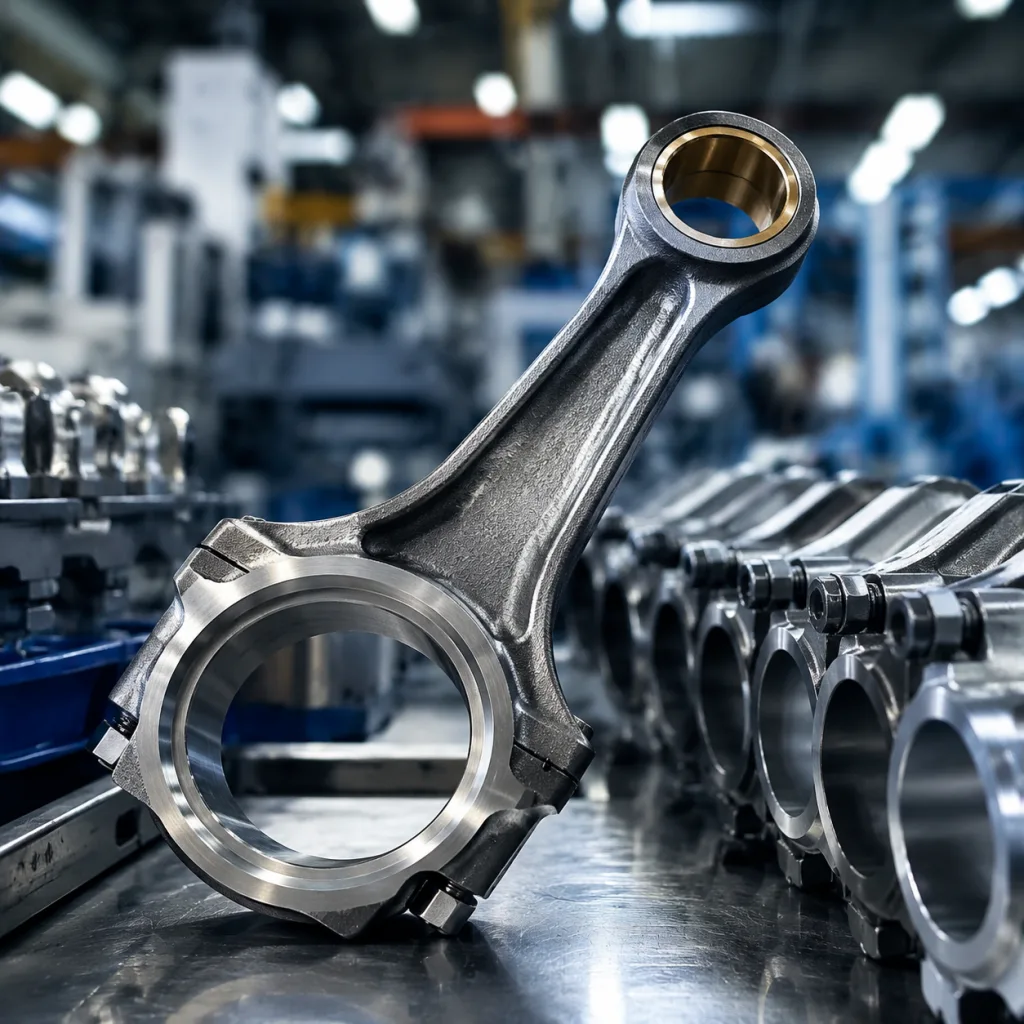
Connecting Rod for Infiniti QX60 OE Equivalent Specs
Procurement teams sourcing a **connecting rod for Infiniti QX60 OE equivalent** application are usually trying to manage three risks at once: dimensional mismatch, inconsistent batch quality, and weak traceability. A rod may pass basic receiving inspection and still cause field failures if the big-end housing bore, centre-to-centre length, pin-bore fit, bolt preload, or cap-matching control drifts away from the intended drawing condition. For this product family, “OE equivalent” needs to mean more than nominal fitment. It should point to controlled material, repeatable machining, documented inspection, and validation data tied to the exact engine application.
For QX60 programs, fitment should be confirmed by engine code, model year, and interchange mapping, not by vehicle name alone. The Infiniti QX60 has been sold with different engine configurations depending on year and market, so buyers should verify the supplier’s cross-reference basis against the target engine family before approving supply. In practice, it also makes sense to review how the supplier controls hardness, fracture detection, bolt specification, lot traceability, packaging discipline, and export documentation before releasing a distributor program, replacement contract, or private-label order.
What OE-equivalent should cover
An OE-equivalent rod is more than a part that can physically assemble onto the crankpin and wrist pin. In B2B sourcing, it should align with the original design intent for geometry, material route, cap pairing method, bolt specification, and inspection condition. If a supplier cannot show how those controls are maintained lot by lot, the part is better described as a visual or functional substitute than a controlled OE-equivalent replacement.
For buyers evaluating a connecting rod for Infiniti QX60 OE equivalent supply program, the term should cover four things at the same time:
1. Dimensional interchangeability so the rod installs without forcing adjustments elsewhere in the rotating assembly. 2. Material and heat-treatment equivalence so hardness, tensile performance, and fatigue resistance remain within an OE-like range. 3. Assembly integrity so rod, cap, and bolts function as a validated matched system. 4. Documented production control so approval-sample quality can be repeated across future lots.
Checkpoint
OE-equivalent expectation
Risk if not controlled
Centre-to-centre length
Drawing-based tolerance verified by CMM or dedicated fixture
Piston deck variation, compression imbalance
Big-end housing bore
Size, roundness, and cap alignment checked in torqued condition
Bearing crush loss, oil-clearance drift, hot bearing failure
Small-end bore / bushing
Correct diameter, finish, and pin-fit class
Pin scuffing, noise, seizure risk
Material and heat treatment
Approved steel route with defined hardness window
Reduced fatigue life, plastic deformation
Matched set control
Rod, cap, and bolts serialized or otherwise lot-linked
Cap mix-up, bore distortion, assembly scrap
</tr></thead><tbody> </tbody></table>It is just as important to define what OE-equivalent does not automatically mean. It does not mean the rod is supplied by Nissan/Infiniti, built on the same service-parts line, or approved for every engine variant sold under the QX60 badge. From a sourcing standpoint, buyers should ask whether the quoted rod is equivalent at the specific engine application level, including any supersessions or VIN-break exclusions.
For QX60 applications, a credible supplier should be able to explain which drawing, sample, or reverse-engineering basis was used; whether the design is forged or powder-forged; whether the cap is fracture-split or conventionally machined; and what application limits apply if multiple engine revisions are in circulation. That level of detail is what separates a controlled aftermarket program from a broad catalog claim.
Critical dimensions and material controls
The first checks are usually dimensional, followed by metallurgical and assembly-related controls. A capable supplier should be able to quote target values, tolerance bands, inspection condition, and sampling frequency, not simply say the rod “meets OE quality.”
For a connecting rod for Infiniti QX60 OE equivalent program, the most important characteristics are the ones that directly affect bearing clearance, piston motion, alignment, and rotating-mass balance. These are not cosmetic details. They determine whether the engine runs smoothly and survives sustained load.
Centre-to-centre length: in passenger-vehicle rod programs, a typical control range is often held within ±0.02 mm to ±0.05 mm, depending on design and process capability. This dimension influences piston deck height and compression consistency.
Big-end housing bore size: commonly controlled in the torqued condition after finish honing. Buyers should ask for the nominal diameter and tolerance from the approved drawing or sample study.
Big-end roundness and cylindricity: a practical acceptance target for many aftermarket rod programs is ≤0.01 mm roundness after final machining, again subject to design intent.
Big-end width and side-face condition: these influence side clearance on the crankshaft and running alignment.
Small-end bore or bushing ID: often controlled in the low-micron range relative to the wrist pin specification; surface finish and lubrication path also matter.
Bend and twist: typically checked by dedicated fixture, gauge bench, or CMM. Even a small angular error can lead to uneven skirt loading, pin stress, and localized bearing wear.
Mass and end-balance control: many rebuilders expect 2-4 g total-mass matching within a set, while tighter programs may also specify rotating-end and reciprocating-end mass spread.
Surface integrity: no burrs, denting, parting-face damage, fretting, or handling marks that could affect bore geometry after bolt-up.
Dimensional accuracy alone is not enough if the metallurgical route is wrong. The construction should follow the original design concept as closely as practical, whether that is forged steel or powder-forged steel. Buyers should ask the supplier to define:
steel grade or approved equivalent grade family,
forging or powder-metal route,
normalizing, quench-and-temper, or other heat-treatment sequence,
hardness target and allowable range,
decarburization limits where applicable,
microstructure verification method,
fracture-split interface control if used,
bolt material grade, thread form, and tightening method.
For many steel connecting rods, hardness may be controlled in a practical production window such as HB or HRC equivalent per the approved process, but the exact acceptance range should come from the validated part specification rather than a generic market claim. If the rod uses a bushing, buyers should also confirm the bushing material, press-fit control, and final honing process.
Cap mating control deserves special attention. With fracture-split technology, the rod and cap form a unique mating pair and must not be mixed. With a machined cap, pairing and machining sequence still matter because cap substitution can distort the big-end housing bore. A reliable supplier should be able to show how cap matching is maintained through machining, washing, inspection, preservation, and packing.
From a commercial-risk perspective, it is also worth asking how often critical dimensions are checked: first-off, patrol frequency during machining, final audit, and release by shipment lot. A capability statement carries more weight when it includes the actual gauge type, measurement condition, and reaction plan for out-of-spec readings.
Validation data worth asking for
Documentation is often the clearest line between a qualified manufacturer and a catalog reseller. For first-article approval, buyers typically request a dimensional report, material certification, hardness results, and a traceable control plan tied to the supplied part number and lot.
When reviewing a connecting rod for Infiniti QX60 OE equivalent supplier, the goal is not simply to collect certificates. The real objective is to confirm that the quoted rod has been validated as a controlled production part, with evidence tied to the exact configuration being offered. Documents should reference the supplier part number, lot or heat identity, revision level, and test date.
Minimum evidence pack
Dimensional report or CMM report covering critical characteristics such as centre distance, big-end bore, big-end width, small-end bore, bend, and twist.
Hardness verification using a recognized method such as Rockwell or Brinell, with method alignment to ASTM E18 where applicable.
Crack-detection record. For ferromagnetic steel rods, magnetic particle inspection may be used in line with ASTM E1444/E1444M or equivalent internal work instruction.
Material certification from the steel source or approved upstream processor, ideally including chemical composition and heat/lot reference.
Bolt validation data, including supplier identity, thread gauge checks, and torque or preload validation method.
Lot traceability record linking raw material, forging batch, machining lot, inspection release, and finished packing.
The most useful validation pack goes further and answers the questions a distributor, rebuilder, or private-label importer will need later if there is a field complaint:
Control plan: critical characteristics, gauge method, sample frequency, and containment action.
Process flow chart: raw material, forging, heat treatment, rough machining, cap split or cap machining, finish machining, honing, washing, preservation, inspection, and packing.
PFMEA summary: covering likely failure modes such as bore distortion, cap mismatch, hardness drift, bolt error, or corrosion from poor preservation.
Gauge calibration records: especially for bore gauges, torque tools, thread gauges, weighing equipment, and CMM systems.
Capability evidence: Cp/Cpk or internal process capability data for critical dimensions when the customer requires statistical proof.
Record-retention policy: whether retained samples, digital inspection files, and traceability records are stored by lot and for how long.
For ongoing supply, a mature quality system should reflect IATF 16949:2016 and ISO 9001:2015 discipline, including MSA, PFMEA, control plans, nonconformance handling, and change management. Where the customer requires PPAP-style submission, that expectation should be stated at the RFQ stage rather than after tooling or pilot production.
Buyers should also separate one-time approval data from shipment-by-shipment release data. A strong supplier can usually provide both:
Initial approval documents for technical release.
Routine lot documents such as inspection summaries, traceability labels, and material references.
Deviation or concession records if a process change or exception occurs.
This distinction matters because many sourcing failures do not start with a bad first sample. They start when the approved process is not sustained across later production lots.
Sourcing checklist for distributors and private-label buyers
Replacement programs often break down on commercial and operational details rather than pure engineering. Before placing volume orders, confirm the controls below in writing.
For a connecting rod for Infiniti QX60 OE equivalent purchase, a complete RFQ should leave as little room for misunderstanding as possible. The more clearly the buyer defines fitment, packaging, documentation, and after-sales expectations at the start, the lower the risk of receiving a part that is technically acceptable but commercially unusable.
RFQ points that save time later
Exact fitment basis: model year, engine code, VIN break, and any supersession notes.
Supply format: single rods, engine sets, or matched rod-and-bolt kits.
Inspection scope: incoming AQL requirement, in-process checks, final audit frequency, and whether customer witness inspection is needed.
Corrosion protection and pack-out: rust preventive oil, VCI, individual separators, tray loading, carton labeling, and pallet standard.
MOQ and lead time: pilot batch, standard production lot, and emergency replenishment lead time.
Compliance documents: REACH (EC) No 1907/2006 declaration for EU-bound shipments when required, plus any customer-specific restricted-substance statement.
Branding format: plain box, buyer private label, or custom manufacturing to customer specification.
Beyond the RFQ list, procurement teams should confirm several operating points before nomination:
Commercial controls to confirm before order release
Price basis: whether the quoted price includes bolts, matched caps, export pack-out, inspection documents, and origin marking.
Tooling and gauge ownership: who owns special fixtures, broaches, fracture fixtures, gauges, and revision-controlled tooling if a dedicated program is launched.
Batch definition: how one production lot is defined for traceability and whether mixed-lot shipment is allowed.
Label content: part number, lot number, quantity, country of origin, barcode format, and customer PO reference.
Warranty and claim handling: evidence required for a receiving defect, assembly issue, or field return.
Change notification: advance notice period for raw-material change, process relocation, subcontractor change, or drawing revision.
Capacity planning: monthly rated output, surge capacity, and contingency planning during demand peaks.
Private-label buyers should pay particular attention to pack-out discipline. Connecting rods are precision-machined parts, and weak packaging can cause nicking, bore damage, corrosion, or rod-cap mix-up even when manufacturing quality is sound. Rods should be physically separated to prevent metal-to-metal contact, protected with a stable preservative, and packed so matched components remain together through inbound warehouse handling.
If the buyer is building a regional aftermarket line, it is also worth aligning the supplier on service expectations such as pre-shipment photo reporting, inspection support, sample approval sequence, response time for technical inquiries, and root-cause turnaround for claims.
If you are benchmarking suppliers, review our catalog and the wider engine components range to compare how rod programs fit alongside bearings, pistons, gaskets, and related engine products. For many importers, supplier consolidation under one quality and logistics system reduces transaction cost and claim risk.
Fitment control and responsible claims
For this product family, the safest approach is to approve fitment only after cross-checking the buyer’s application list against engine code, drawing basis, and sample measurement. A single vehicle badge does not guarantee one rod specification across all production years, especially where there have been changes in engine family, bolt design, pin-bore finish, or bearing geometry.
This point matters when sourcing a connecting rod for Infiniti QX60 OE equivalent use, because catalog shorthand can hide real differences. A supplier may list one rod under a broad vehicle heading, while actual interchangeability depends on engine family, production date, and any running design changes.
A responsible fitment-approval process normally includes:
1. Application review against model year, engine code, VIN-break information, and market coverage. 2. Drawing or sample comparison to verify critical geometry and hardware condition. 3. Bolt confirmation for thread, shank design, seating condition, and tightening specification. 4. Pilot-order inspection before full-volume release. 5. Catalog wording review so the sales claim matches the validated scope exactly.
Avoid suppliers that use broad phrases such as “fits all” without documented exclusions. Also avoid claims of vehicle-manufacturer approval unless formal written evidence exists. Driventus is an independent aftermarket manufacturer; vehicle and brand names are referenced for fitment identification only.
Responsible claims should also define whether the rod is being sold as:
OE equivalent,
aftermarket replacement,
reverse-engineered replacement,
private-label production to buyer drawing,
or a customer-specific upgraded specification.
These distinctions matter because they affect technical expectation, legal presentation, customs description, and distributor communication. Overstated claims can create disputes even when the physical part is usable.
From a procurement standpoint, the better decision is usually the supplier that can demonstrate repeatable bore control, matched-cap traceability, stable metallurgy, validated bolt hardware, and clean export documentation, even if the unit price is not the lowest. In total-cost terms, that usually reduces field claims, engine-rebuild failures, quarantine events, and batch disputes after import.
Frequently asked questions
No. OE-equivalent should mean equivalent fit, critical dimensions, material route, and validation evidence for the approved application. It does not mean the part comes from the vehicle manufacturer or carries manufacturer endorsement.
At minimum: a dimensional report, material or metallurgical certificate, hardness data, crack-inspection record where applicable, bolt specification or validation data, and lot traceability. For tighter programs, request PPAP-style documents, process flow, PFMEA, control plan, and gauge-calibration evidence.
Not safely without validation. Coverage can change by model year, engine code, market specification, VIN break, or superseded design. Approve by application list plus measured sample or drawing comparison, not by vehicle name alone.
If you are comparing suppliers for a QX60 rod program, send the model-year range, engine code, interchange reference, and inspection criteria for review against our production controls. [request a quote](/contact.html)