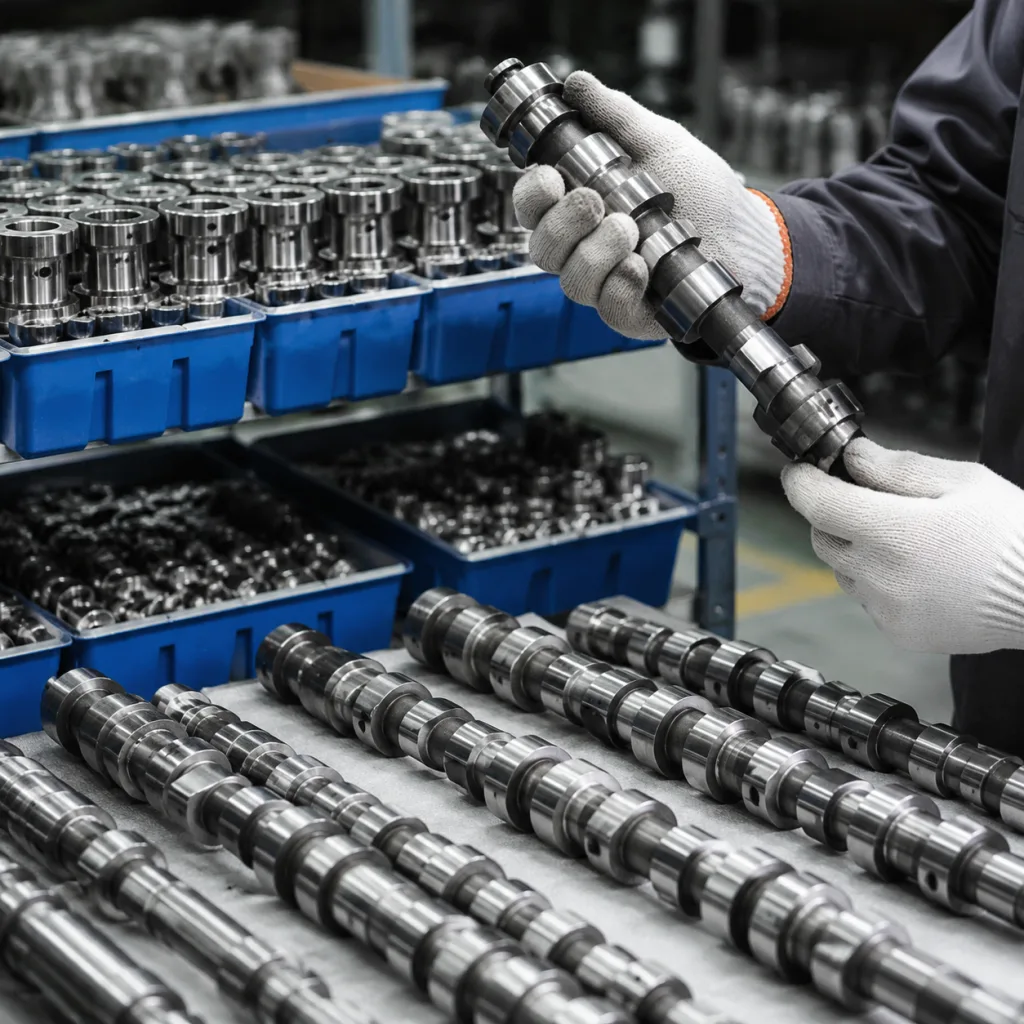
Choosing a camshaft for Honda HR-V aftermarket replacement is about more than basic fitment. For distributors, repair-chain buyers, and engine rebuilders, the real question is whether the part can match OE function under operating load. Cam profile accuracy, journal finish, hardness depth, runout, and oil-path cleanliness all influence valve timing stability, wear rate, and noise. A camshaft that fits the cylinder head but falls outside tolerance can lead to idle instability, poorer emissions behaviour, or premature follower damage.
That is why procurement teams should work from measurable criteria rather than broad marketing language. Dimensional equivalence, metallurgical control, validation testing, and lot traceability all need to be checked against actual values and control methods, not general claims such as 'OE quality' or 'high precision.' Useful examples include journal diameter tolerance, total indicated runout (TIR), lobe profile inspection method, surface roughness on journals and lobes, hardness range, hardened-layer verification, and cleanliness controls for oil passages. This article explains what to review before buying, how replacement parts are commonly validated, and which documents support cross-border sourcing. It is especially relevant when sourcing a camshaft for Honda HR-V aftermarket replacement for wholesale stock, private-label programmes, or engine-rebuild work where batch-to-batch consistency matters as much as initial fitment. Driventus is an independent aftermarket manufacturer; brand names are referenced for fitment only.
What matters in an HR-V camshaft replacement
For this product category, nominal engine compatibility is only the starting point. A camshaft controls valve opening events inside a narrow timing window, so even small deviations in lobe geometry or shaft straightness can affect combustion, fuel economy, and service life.
When evaluating a camshaft for Honda HR-V aftermarket replacement, buyers should ask a simple but important question: will this part reproduce OE valve-train behaviour once the engine is hot, fully lubricated, and running within normal field tolerances? In other words, it should be assessed as a functional engine component, not merely as a machined shaft with matching overall dimensions.
Key purchasing criteria include:
Base material and heat treatment: commonly pearlitic or alloyed chilled cast iron for many passenger-car camshafts, or forged/induction-hardened steel on some designs, depending on engine family and follower contact requirements
Lobe profile accuracy: valve lift, opening/closing ramps, and angular phasing must stay within drawing tolerance to preserve valve timing and contact pattern
Journal diameter, roundness, and cylindricity: critical for oil-film stability and head-bore compatibility
Runout: total indicated runout must be controlled to limit vibration, noise, and local wear
Surface finish: journals and lobes require defined roughness values, typically verified by profilometer rather than visual inspection
Oil-hole cleanliness and deburring: blocked, partially occluded, or burr-raised passages can cause lubrication starvation at first start or during high-temperature operation
Lot traceability: heat/lot-level records support claims handling, root-cause analysis, and repeat ordering
Each of those items has a direct service consequence:
If lobe geometry drifts, opening and closing events can shift enough to affect idle quality, low-speed torque, cold-start behaviour, and emissions stability.
If journal size, roundness, or cylindricity is inconsistent, oil clearance can move outside the intended range, increasing the risk of scoring or accelerated head-bore wear.
If runout is high, the valve train may operate with cyclic side loading, creating noise and uneven contact patterns.
If hardness depth is shallow or inconsistent, the part may pass initial inspection but wear rapidly after installation.
If cleaning and deburring are poor, trapped contamination can enter the lubrication circuit during first start-up.
Before requesting quotations, it helps to define what an acceptable replacement means. In many purchasing projects, the supplier should be able to confirm:
1. The target engine code or application range 2. The reference used for development, such as an OE sample or approved drawing 3. The list of critical-to-function dimensions and characteristics 4. The inspection method used on those dimensions 5. The release standard applied to each production lot
This avoids a common sourcing problem: suppliers appear to be quoting the same item, but they are actually working from different technical assumptions.
It is also good practice to request the inspection plan used for first article and routine production release. Suppliers operating under IATF 16949:2016 and ISO 9001:2015 should be able to provide controlled documentation, gauge calibration records, reaction plans for out-of-spec conditions, and nonconformance handling through their quality system.
OE-equivalence checks buyers should request
An aftermarket replacement should be assessed against the OE sample or an approved drawing set. Where the sourcing brief includes an OE reference, buyers should ask for cross-reference confirmation in the standard format, for example OE 06A107065 when applicable to the enquiry. Cross-references should support fitment matching only and should not imply vehicle manufacturer approval.
For a camshaft for Honda HR-V aftermarket replacement, OE-equivalence should be understood as functional equivalence within controlled tolerances. Matching overall length alone is not enough. A supplier can reproduce the obvious envelope dimensions and still miss the tighter geometric and metallurgical controls that determine how the engine actually behaves.
Recommended verification points
Check item
Typical control method
Why it matters
Overall length
Vernier/CMM measurement
Confirms end fit and thrust alignment
Journal diameter
Micrometer/CMM
Prevents oil clearance deviation
Journal roundness/cylindricity
Roundness tester/CMM
Supports stable hydrodynamic lubrication
Lobe lift and profile
Cam measuring machine/CMM
Maintains valve event accuracy
Lobe phasing/index angle
Cam measuring machine with angular reference
Confirms opening event timing, not just peak lift
Shaft runout
V-block and dial indicator or dedicated fixture
Reduces vibration and uneven wear
Surface hardness
Rockwell or microhardness test
Confirms wear resistance
Case depth or hardened layer
Metallographic section
Supports long service life
Surface roughness
Profilometer
Affects lubrication and break-in
Oil passage cleanliness
Visual, borescope, airflow, or flush check
Prevents lubrication failure
</tr></thead><tbody> </tbody></table>Beyond the table, it is worth asking how the supplier defines and controls the key datums. For example:
Which features are used as measurement references? If the datum strategy changes, comparison between lots can become unreliable.
How is lobe phasing checked? Lift value alone does not confirm correct event timing if angular position is even slightly off.
Is profile inspection done on every part, by sampling, or only during set-up? The answer affects supply risk and should match the criticality of the feature.
Are hardness results tied to each lot code? Without lot linkage, later field analysis becomes much harder.
It is also useful to ask for sample inspection evidence, not just a statement of compliance. A first-article package or controlled dimensional report should ideally show actual measured values, tolerance bands, and the instrument type used. That gives purchasing and engineering teams a much clearer basis for supplier comparison.
Where emissions-related engine performance is a concern, dimensional drift can indirectly affect compliance targets set by vehicle programmes designed around regulations such as ECE R-83 in applicable markets. Aftermarket suppliers should therefore control cam geometry tightly enough to avoid timing variation that may contribute to unstable combustion, misfire tendency, or elevated exhaust output.
For range management, distributors should also look beyond a single SKU. If the same buyer is planning related engine-component procurement, it helps to review adjacent parts in our catalog and the dedicated /products/engine-components.html section so camshafts, rocker components, valves, and gasket sets can be sourced as a coordinated package. That can simplify fitment control, inbound logistics, and claims handling across the valve-train range.
Materials, machining and finishing controls
Camshaft reliability depends on a controlled process route from raw casting or forging through final grinding. When comparing suppliers, buyers should ask which operations are completed in-house and which are subcontracted, because every handoff can introduce more lot-to-lot variation.
In a camshaft for Honda HR-V aftermarket replacement, performance is built step by step. Machining and grinding establish dimensional accuracy, but durability depends just as much on material integrity, heat-treatment consistency, and finishing discipline. If a supplier speaks only about nominal dimensions, an important risk area is being left unexplored.
Typical control points include:
Raw material certification for chemical composition, microstructure requirements, and incoming defect checks
Heat treatment control with furnace records, hardness verification, and sampling frequency defined in the control plan
CNC rough and finish machining of datum surfaces, journals, and end features
Lobe grinding with profile correction, wheel-dress intervals, and periodic machine capability review
Deburring and cleaning of oil passages before final inspection
Rust-preventive packaging suitable for sea freight and warehouse storage
A stronger supplier review usually goes one step deeper at each stage:
1. Raw material and blank quality
Before machining begins, the casting or forging should be controlled for chemistry, porosity, surface defects, and dimensional stability. Buyers can ask:
Is material sourced to a fixed internal or customer specification?
Are incoming lots linked to production batch numbers?
Are visible defects screened before machining value is added?
Is there any control for internal soundness where the process warrants it?
If raw blank quality varies, later grinding may still produce a part that looks acceptable from the outside while carrying hidden durability risk.
2. Heat treatment discipline
Heat treatment sits at the centre of wear performance. Buyers should ask whether the supplier records:
Furnace parameters and cycle history
Lot-by-lot hardness checks
Sampling plan for hardened layer verification
Reaction plan when results drift toward control limits
Without this level of control, wear resistance can vary from shipment to shipment even when dimensions remain stable.
3. Machining and datum control
Journal machining, end features, and key reference surfaces need to be produced from a consistent datum strategy. Process capability on these features often determines whether later lobe grinding remains stable. If journals are not tightly controlled, the finished part may show variable runout or poor alignment in the cylinder head.
4. Profile grinding and finishing
Lobe grinding is one of the most function-critical operations. Buyers should confirm whether the supplier uses profile correction, in-process verification, and scheduled wheel-dressing controls. These details matter because wheel wear and machine drift can change the actual opening ramp, base-circle geometry, and nose shape over time.
Why hardness and finish matter
Lobe-to-follower contact sees repeated cyclic loading and boundary/mixed lubrication during parts of the operating cycle. If hardness is below target, lobe wear will accelerate. If it is too high without adequate toughness, the risk shifts toward cracking or spalling. Surface roughness also has to be balanced: too rough can increase break-in wear, while too smooth may reduce oil retention depending on follower type and lubrication regime.
The same logic applies to journals. A journal finish outside target can affect oil-film formation, friction, and the stability of hydrodynamic lubrication. That is why a generic statement such as 'polished finish' is far less useful than a defined roughness range measured by profilometer.
Cleaning, preservation and export packaging
Even a well-machined part can fail in service if final cleaning is weak or corrosion protection is inadequate. For export buyers, the supplier should be able to explain:
How oil passages are flushed, air-blown, or otherwise verified
Whether anti-rust oil, VCI packaging, or both are used
How unit boxes and master cartons prevent handling damage to lobes and journals
Whether palletisation is designed for sea freight and long warehouse dwell time
For exports into the EU and UK, buyers may also ask for material declarations aligned with REACH (EC) No 1907/2006 for relevant substances communication. This is particularly relevant when procurement policies require chemical compliance statements across the engine component range.
Validation testing before launch and repeat supply
A replacement camshaft should not enter serial supply on dimensional checks alone. Validation should include bench and durability testing that reflects the engine architecture and intended service conditions.
For a camshaft for Honda HR-V aftermarket replacement, validation serves two purposes. First, it shows that the initial design and process can produce an acceptable part. Second, it demonstrates that the same result can be repeated over time and across production lots. Many field complaints do not come from the first sample; they appear later, when follow-on batches are not controlled to the same standard.
Common validation activities include:
Metallographic examination to verify microstructure and hardened layer consistency
Fatigue or endurance testing under cyclic load conditions representative of valve train operation
Lubrication pathway checks after machining and cleaning
Mating component review with rocker, tappet, or follower contact pattern evaluation
Installation trial in the target cylinder head to confirm free rotation and bearing contact condition
Packaging validation for corrosion resistance during export transit
To make those points more useful in supplier assessment, buyers can request the following detail:
Initial approval testing
At launch stage, ask what evidence supported the original release of the part number:
Was an OE sample reverse-engineered and benchmarked?
Were multiple samples measured to confirm repeatability?
Was the part trial-fitted in the relevant cylinder head?
Was contact pattern checked with the intended mating components?
Was any endurance or accelerated wear testing completed?
A supplier that can describe the release route clearly is usually better positioned to maintain consistency later.
Durability and functional confidence
Not every aftermarket programme uses full OEM-level validation, but the functional checks should still be proportionate to risk. Where the component operates in a high-cycle contact environment, endurance testing, or at least structured wear evaluation, provides stronger confidence than static dimensional reports alone. Buyers can also ask whether the supplier has any bench evidence on wear scar development, surface distress, scuffing tendency, or post-test hardness retention.
Repeatability after SOP
For buyers supplying multi-location repair networks, repeatability matters just as much as the initial approval lot. Ask for:
1. Process capability data on critical dimensions 2. A defined lot coding system 3. Retention policy for production inspection records 4. Corrective action workflow for any field-return analysis
These controls are especially important when stock is shipped to multiple regions or held in distribution warehouses for long periods. If a field issue appears, buyers need to isolate the affected lot quickly rather than suspending all inventory.
Change control and ongoing monitoring
One useful but often overlooked question is whether the supplier has a formal process for production changes. Buyers should ask how tooling updates, material-source changes, heat-treatment adjustments, or subcontractor changes are reviewed before release. Even a small process alteration can influence profile accuracy, surface integrity, or hardness outcome.
Where private-label or market-specific adaptations are needed, Driventus supports custom manufacturing for packing, branding-neutral labelling, and specification review based on customer drawings or approved samples.
Procurement checklist for importers and distributors
When sourcing this part for wholesale or programme supply, a structured checklist helps reduce claims risk and improves reorder consistency.
For importers and distributors buying a camshaft for Honda HR-V aftermarket replacement, the aim is not only to secure a technically acceptable part. The process also needs to be commercially repeatable: correct application matching, predictable lead times, defensible quality records, and manageable field-claim exposure.
Buyer checklist
Confirm engine code, production range, and valve train configuration
Request OE/sample cross-reference confirmation where available
Verify critical dimensions, hardness range, and runout limit on the inspection report
Ask whether PPAP-style documentation or first article records can be supplied if required by the account
Check packaging format: unit box, master carton, palletisation, and anti-corrosion protection
Review warranty terms and field-claim evidence requirements
Confirm lead time, MOQ, and batch traceability method
Request copies of IATF 16949:2016 and ISO 9001:2015 certificates
The checklist works best when buyers turn it into a standard supplier-approval workflow. A practical sequence may look like this:
1. Confirm application scope
Before comparing prices, lock down:
vehicle model and market
engine code or displacement variant
production year range
valve-train configuration and any revision differences
This helps prevent mixed quotations for parts that are physically similar but not functionally interchangeable.
2. Compare technical evidence, not just catalog claims
Ask each supplier for the same core documents, such as:
dimensional report
hardness report
material or heat-treatment evidence
lot-traceability example
packaging photos or specification
Standardising the document request makes side-by-side comparison much more meaningful.
3. Review logistics and stock risk
A technically sound part can still create supply problems if the commercial terms are misaligned. Buyers should therefore check:
minimum order quantity relative to sales forecast
lead time stability during peak periods
carton quantity and pallet efficiency
shelf-protection method for long transit
policy for urgent replenishment or consolidated shipments
4. Clarify claims handling before the first order
One of the most useful pre-order questions is how the supplier handles a field complaint. Buyers should understand:
what evidence is required from the installer or distributor
whether lot number is mandatory for review
target timing for containment and corrective action
whether replacement, credit, or technical analysis is offered
A sound sourcing decision should weigh unit price against claim exposure, reinspection cost, and stock obsolescence risk. The lowest ex-works price can become expensive if profile variation, hardness inconsistency, or contamination leads to installation complaints or high return rates.
For programme buyers, it may also help to score suppliers across four categories: technical conformity, documentation strength, supply reliability, and total landed cost. That gives a more balanced basis for vendor nomination than unit price alone.
Driventus manufactures engine and powertrain components for export programmes in multiple regions. If you are qualifying a new source for camshafts or related valve train parts, you can request a quote with your target specification, annual volume, and destination market.
Frequently asked questions
At minimum: a dimensional inspection report, material or heat-treatment evidence, hardness test results, lot traceability details, and current IATF 16949:2016 and ISO 9001:2015 certificates. For programme business, first article or PPAP-style records may also be useful. Buyers sourcing a camshaft for Honda HR-V aftermarket replacement may also request surface roughness results, runout data, lobe-profile inspection evidence, packaging specifications, sample labels, and any available installation or durability validation summary.
No. Dimensional conformity is necessary, but it is not sufficient. Buyers should also review material, hardness, hardened-layer consistency, runout, lobe profile accuracy, phasing, surface finish, cleanliness of oil passages, and, where possible, durability or installation validation on the target engine configuration. A part can match basic external dimensions and still underperform if metallurgy, finish, or profile control is inconsistent.
Lot traceability links each shipment to inspection records, raw material batches, heat-treatment records, and production dates. That makes it easier to contain a field issue, support corrective action, and reduce the cost of broad recalls or mixed-stock investigations across warehouse locations. It is especially important for distributors supplying multiple branches or export markets where stock from different production batches may be held at the same time.
If you are evaluating replacement camshafts for wholesale, OEM service, or repair-network supply, send your part list or sample for review through the Driventus team here: /contact.html