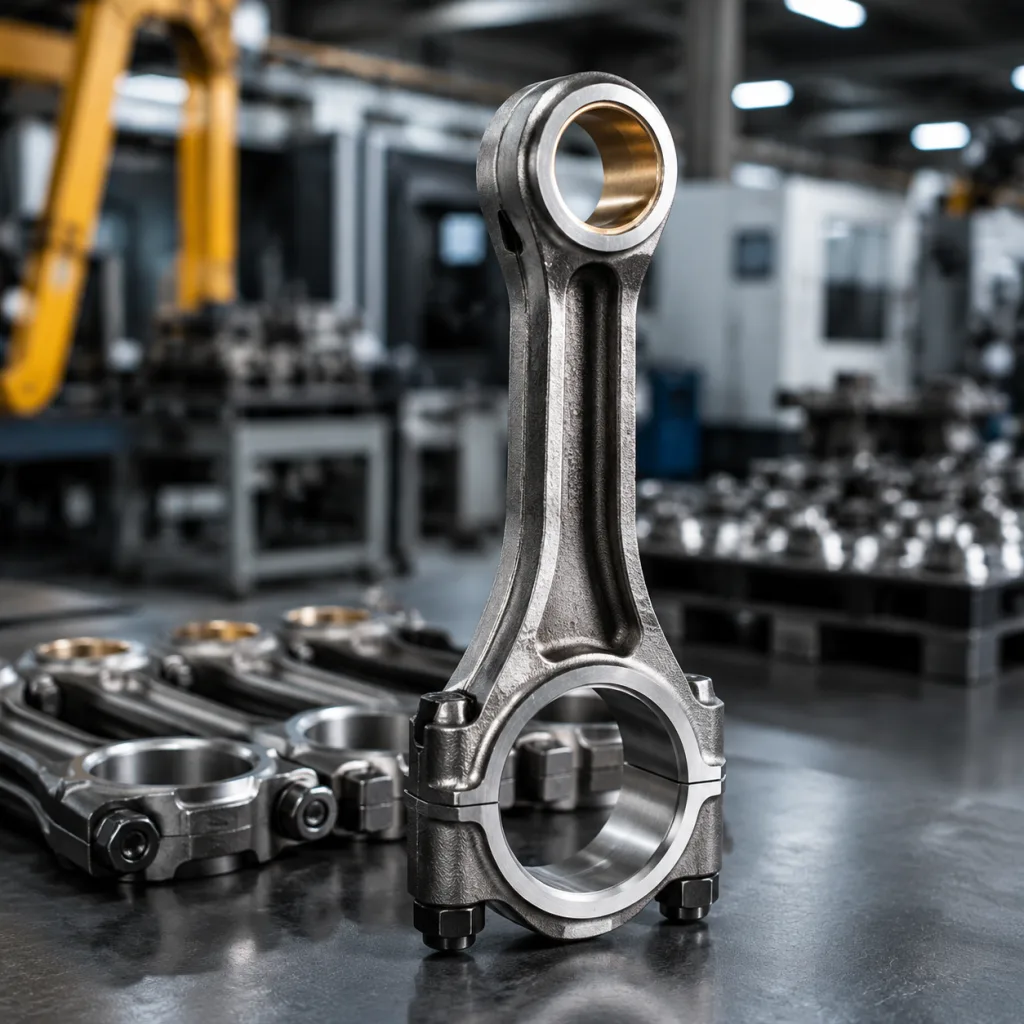
A connecting rod is a precision load-bearing component, not a visual replacement part. For Dodge-related engine applications, procurement teams need evidence that a replacement rod matches the OE design intent for centre-to-centre length, big-end bore geometry, small-end bore finish, bolt clamp load, side clearance and mass control. A connecting rod Dodge OE equivalent must fit the crankshaft, piston pin, bearing set and block package without forcing changes to mating components or service procedures. It also needs stable metallurgy, controlled heat treatment and repeatable machining across production batches. Driventus manufactures engine and powertrain components in Taizhou, Zhejiang for distributors, importers, OEM programmes and repair-chain supply. This guide outlines the checks buyers should request when evaluating OE-equivalent connecting rods for aftermarket replacement, including drawing review, validation testing, traceability and compliance documentation. Driventus is an independent aftermarket manufacturer; brand names are referenced for fitment only.
What OE equivalence means for a replacement connecting rod
For replacement programmes, OE equivalence does not mean a supplier has vehicle manufacturer approval. It means the part is engineered to match the functional geometry, material performance and installation requirements of the original component. The claim should be supported by measurable evidence, not by appearance, catalogue wording or an unsupported cross-reference.
A connecting rod Dodge OE equivalent should be checked against an approved drawing, a buyer-controlled specification or a verified reverse-engineering file. Key reference points include centre-to-centre length, big-end bore size and roundness, small-end bore diameter and finish, bearing locating features, cap split design, bolt specification, side clearance and total mass. If the rod is supplied for an engine repair programme, packaging and labelling should also support fitment control across the agreed engine codes, model years and set quantities.
Typical procurement checks include:
Cross-reference mapping to buyer-supplied OE-style references, where applicable to the customer’s project data.
Confirmation that the rod design matches the specified engine family, stroke, crank journal and piston pin diameter.
Dimensional inspection from serial production tooling, not only prototype or hand-finished samples.
Material certificate showing grade, heat number and heat-treatment condition.
Bolt torque and angle recommendation, or confirmation that the installer must follow OE-style service procedure data.
Packaging and label review to prevent mixed applications, loose sets or incorrect carton references.
Driventus is an independent aftermarket manufacturer; brand names are referenced for fitment only.
Dimensional points buyers should verify
Connecting rods operate under alternating tensile and compressive loads. Small deviations in bore geometry, length, cap alignment or bolt seating can lead to bearing distress, piston noise, oil film instability, uneven cylinder loading or premature fatigue. For B2B sourcing, the dimensional review should be completed before the commercial award is treated as final.
Check point
Why it matters
Typical evidence to request
Centre-to-centre length
Controls piston deck height and compression relationship
CMM report or dedicated fixture inspection record
Big-end bore roundness and taper
Affects bearing crush, oil film control and journal loading
Bore gauge data after final honing
Small-end bore diameter and finish
Controls piston pin clearance, lubrication and noise
Surface finish and bore diameter report
Big-end width and side face finish
Influences crankshaft side clearance and oil flow
Width inspection and visual finish criteria
Rod and cap alignment
Prevents bearing edge loading and uneven clamp force
Cap assembly inspection record
Weight range
Supports engine balance consistency within sets
Batch weight data by rod and cap assembly
Bolt thread and seating condition
Determines clamp load repeatability
Thread gauge and torque audit record
Bearing locating features
Helps prevent bearing movement or incorrect shell seating
Feature inspection and drawing confirmation
</tr></thead><tbody> </tbody></table>Buyers should also confirm whether the part is supplied with bolts installed, bushings fitted, or small-end machining left for a later assembly stage. These details affect inspection responsibility, packaging protection and the approval sample plan.
For many replacement projects, Driventus can review samples, buyer drawings or cross-reference files through custom manufacturing. For stocked and programme items, buyers can review related engine components in our catalog and the engine range at /products/engine-components.html.
Materials, forging route and heat treatment
Most passenger and light commercial connecting rods use forged steel, powder-forged or powdered metal construction; some higher-load petrol, diesel and performance applications require higher-strength alloy steel. The correct route depends on the engine load case, production cost target, fatigue margin and OE design concept. Buyers should avoid specifying only a visual match because grain flow, heat treatment, bolt joint behaviour and final machining sequence are central to durability.
A practical specification file for a connecting rod programme should include:
Base material grade or agreed equivalent, with chemical composition limits.
Forging, powder-forging or sintering route, including supplier control of blanks.
Heat-treatment process, hardness range and inspection location.
Shot peening requirement, if used for fatigue improvement.
Final machining sequence for big-end bore, small-end bore, bolt seats and side faces.
Surface defect acceptance criteria for parting lines, bolt seats, cap faces and beam area.
Anti-corrosion protection suitable for sea freight, customs storage and warehouse handling.
Rules for rework, scrap and segregation of parts after heat treatment or final honing.
Driventus production control is built around IATF 16949:2016 and ISO 9001:2015 requirements. These standards do not replace the customer’s engineering specification, but they define the operating discipline for process control, corrective action, traceability, internal audits and management review. For importers selling into the EU, UK and other regulated markets, material and chemical declarations may also be requested in relation to REACH (EC) No 1907/2006. The exact declaration scope depends on the part material, coating, preservative oil, packaging and customer market.
Validation testing for replacement confidence
A connecting rod is not validated by appearance. Buyers should request a test plan that reflects the application risk, order volume and consequences of field failure. For a standard aftermarket replacement rod, the baseline evidence should include dimensional capability, hardness, material verification and bolt joint control. For higher-load or high-volume programmes, additional fatigue, cleanliness or assembly testing may be justified before production release.
Common validation items
Material verification: chemical composition check against the agreed grade.
Hardness test: confirmation after heat treatment, using an agreed measurement method and location.
Metallographic review: grain flow, inclusions, decarburisation or heat-treatment structure where required.
Dimensional capability: capability study on critical-to-function dimensions from production tooling.
Torque audit: bolt seating and clamp repeatability under controlled assembly conditions.
Fatigue testing: rotating bending, axial loading or customer-defined cycle testing for higher-risk programmes.
Cleanliness check: control of machining residue, especially where rods ship with bushings or assembled bolts.
Assembly trial: verification with bearing shells, piston pin and crank journal data where the programme requires it.
For large distributors and repair-chain customers, incoming sample approval should be paired with periodic production audits. The supplier should define inspection frequency, sampling plan, nonconforming product controls and change-notification rules. Evidence should be retained by batch or lot number so that later claims can be linked to the actual production run, not only to a calendar month.
Documentation package for importers and programme buyers
A replacement part programme needs documents that support both technical approval and commercial continuity. When evaluating a connecting rod Dodge OE equivalent supplier, the buyer should define the document pack before trial order release. This prevents disputes after mass production begins and makes repeat shipments easier to audit.
Recommended document package:
Controlled drawing or buyer-approved specification sheet.
Full dimensional inspection report from production tooling.
Material certificate with heat or batch traceability.
Heat-treatment and hardness report.
Process flow chart and control plan.
PFMEA where required by the customer programme.
Initial sample inspection report or PPAP-style submission, if specified.
Bolt specification and torque audit record.
Packaging specification with corrosion protection method.
Batch traceability format for cartons, labels and production records.
Change-control agreement for material, tooling, process or sub-supplier changes.
Driventus can align documentation with distributor sourcing files, OEM/Tier-1 style development requirements or private-label replacement programmes. Buyers can review the Driventus quality system to understand the framework used for inspection, corrective action and traceability. Where the project requires a new rod geometry, sample reverse engineering and prototype validation can be managed through custom manufacturing.
Commercial and fitment risks to control before ordering
Price differences between connecting rod suppliers often reflect differences in material control, machining precision, bolt quality, inspection frequency, corrosion protection and scrap policy. A low quotation can become expensive if bearing failures, fitment returns, mixed sets or unsupported interchange claims reach the field. Procurement teams should separate commercial review from technical approval, then connect both decisions through a controlled sourcing file.
Key risks and controls include:
Incorrect engine application: confirm engine code, displacement, crank journal and piston pin size before ordering.
Mixed rod weight classes: define allowable weight band and labelling rules for individual rods and matched sets.
Inconsistent bolt supply: lock bolt material, dimensions, coating and supplier source during approval.
Poor corrosion protection: test packaging for expected sea freight, customs delay and warehouse duration.
Uncontrolled changes: require written approval for tooling, material, process or sub-supplier changes.
Weak traceability: make carton labels, lot numbers and production records easy to connect during claims handling.
For replacement programmes, a pilot order should be inspected against the same criteria used for production approval. If the supplier cannot maintain the approved data set over repeated shipments, the part should not be treated as stable for multi-location distribution. A structured approval file also gives purchasing, quality and aftersales teams the same reference point when volumes increase.
Frequently asked questions
No. OE equivalent means the part is designed and validated to match the functional requirements of the original component. It does not mean approval or endorsement by any vehicle manufacturer. Driventus is an independent aftermarket manufacturer; brand names are referenced for fitment only.
Useful inputs include engine family, sample part, buyer drawing, piston pin diameter, crank journal details, target volume, packaging requirement, validation expectation and any OE-style cross-reference supplied by the customer. Dimensional confirmation is recommended before production release.
Yes. Driventus can support sample analysis, drawing development, tooling, prototype inspection and controlled production for private-label or programme-specific requirements, subject to technical review, MOQ and validation plan agreement.
If you are qualifying a replacement connecting rod programme, share your sample, drawing or cross-reference file and Driventus will review the technical route. To discuss specifications, validation and supply options, [request a quote](/contact.html).