connecting rod · 2026-06-18

Connecting Rod for Chevrolet Suburban OE Equivalent: Sourcing Guide

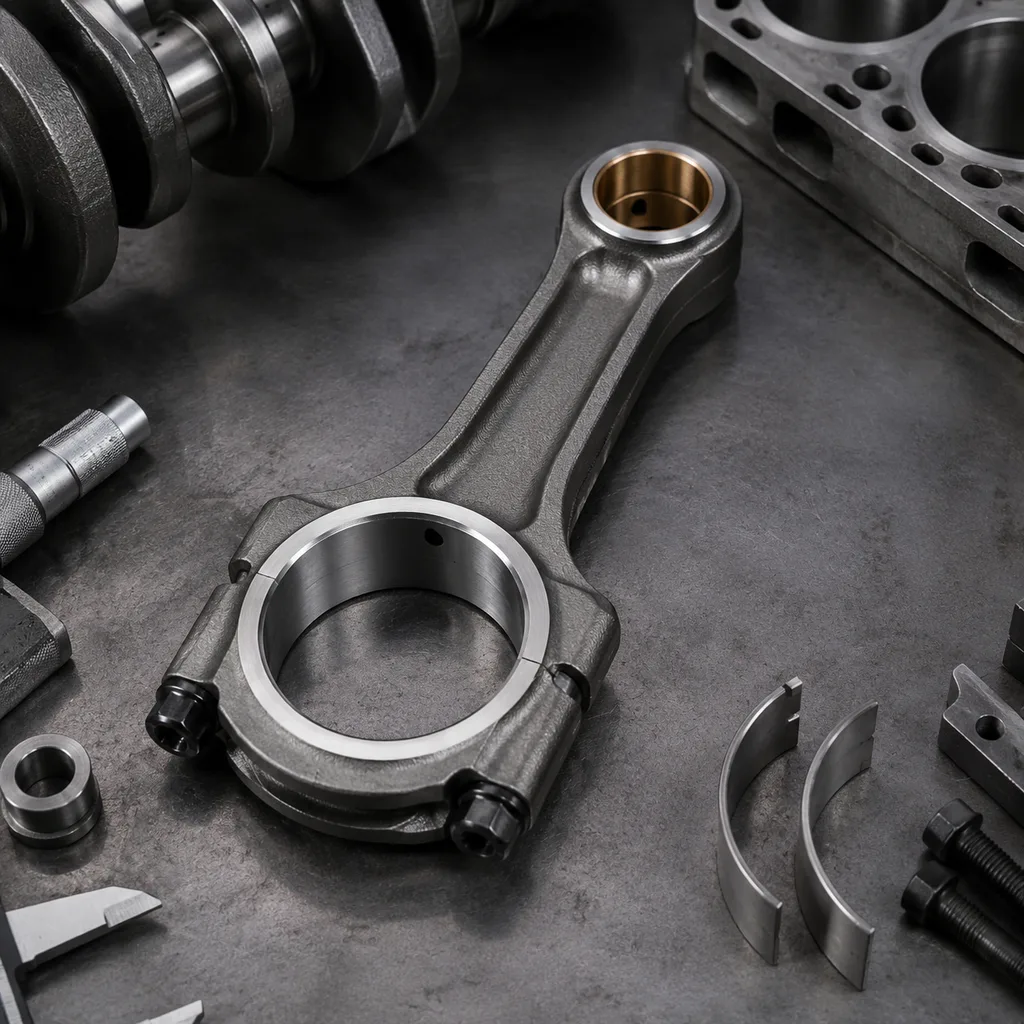
Buying a connecting rod for Chevrolet Suburban OE equivalent service is not a catalogue-matching exercise. It is a risk-control decision: the wrong bore, bolt preload, pin fit, or weight spread can turn a low-cost replacement into an engine failure claim.

Start with the exact engine code, model year, piston pin size, crank journal diameter, and OE part-number cross-reference. Then confirm the rod construction route— forged steel, powdered metal, or fracture-split—because each one carries different expectations for strength, machining, cap alignment, and price. Only after those points are fixed should procurement compare offers.

Driventus is an independent aftermarket manufacturer; brand names are referenced for fitment only. We support distributors, OEM suppliers, and repair networks that need documented inspection, repeatable quality, and stable export lead times. For related engine hardware, see our catalog, our quality system, and custom manufacturing.

Decision framework: when is a rod truly OE-equivalent?

An OE-equivalent rod should match the original design intent closely enough to install, clear, lubricate, and survive inside the engine’s operating envelope. For a Chevrolet Suburban application, that normally means the same rod family, centre-to-centre length, big-end geometry, small-end geometry, bearing interface, and pin fit for the specific engine variant.

Do not approve a rod because it “looks the same.” Approve it because the supplier can state measurable targets and tolerances. A serious quotation should identify:

  • Centre-to-centre length to the nearest 0.01 mm, with the tolerance window shown
  • Big-end bore and roundness after the cap is torqued
  • Small-end bore size, bushing condition, and wrist-pin fit range
  • Rod bolt grade, thread form, and tightening method
  • Finished rod weight and permitted lot spread
  • Heat-treatment route, hardness range, and inspection method

A generic “fits multiple engines” claim is not enough. Ask for engine-code confirmation, piston pin diameter, crank journal size, and explicit OE part-number cross-reference. If the part is quoted against an OE number, that number should appear in the quotation and packaging file, together with the application code and model-year range.

Spec deep-dive: the dimensions that decide fitment

Most rod problems start with one unchecked number. The table below separates the specification from the buying consequence, so procurement and incoming inspection can review the same control points.

</tr></thead><tbody> </tbody></table>For fleet and wholesale buyers, request inspection records from IATF 16949:2016 and ISO 9001:2015 controlled processes. If the rod is evaluated for regulated markets, add REACH (EC) No 1907/2006 material compliance declarations to the sourcing file. North American programmes often also ask for PPAP-style dimensional reports, sample approval records, and lot traceability back to the forging or powder-metal batch.

Spec deep-dive: the dimensions that decide fitment

Failure modes your validation plan should catch

A connecting rod should be validated as a loaded engine component, not treated as a catalogue line item. The inspection plan needs to catch the failures that create returns: distorted big-end bores, incorrect pin clearance, bolt stretch outside target, weight mismatch, cracks, and unstable heat treatment.

Build validation in three layers:

1. First-shipment inspection: confirm bore size, centre-to-centre length, finished weight, bolt specification, and machined finish against the approved drawing or sample. 2. Sample build verification: assemble the rod with the intended bearing and piston pin to check side clearance, bearing crush, pin fit, and bolt behavior under the specified preload. 3. Lot release sampling: review dimensional reports from each production lot. Agree the sampling level in advance, using AQL-style acceptance for cosmetic items and tighter controls for critical dimensions.

Useful checks include dimensional inspection, magnaflux or equivalent crack detection, torque-angle verification, and run-out measurement after assembly. For higher-volume programmes, batch sampling should also cover hardness, microstructure, and mass matching.

If the application is used in light-duty engine service, suppliers may add bench fatigue testing and thermal cycling. The exact plan depends on engine family and duty cycle, but the buyer should insist on documented methods—not broad claims. When emissions-sensitive calibration or engine variants are involved, confirm fitment by engine code rather than vehicle badge alone.

Step-by-step RFQ process to avoid wrong-part shipments

The fastest way to reduce mis-shipments is to make every enquiry repeatable. Use the same data fields, then require the supplier to echo them back in the quotation.

1. State the vehicle model year and engine code. 2. Provide the OE part number or catalogue supersession. 3. List the required quantity, forecast volume, and target release schedule. 4. Define packaging, barcode, carton mark, and labelling rules. 5. Identify any weight-matching, bolt package, or surface-finish requirement. 6. Ask for sample quantity, sample charge, tooling status, MOQ per SKU, mass-production lead time, and expedite options.

For mixed-market inventory, keep engine-specific rod families separated by application notes. This matters when a distributor balances aftermarket stock with OEM-style supply or buys through multiple channels. Similar-looking rods can belong to different engine variants.

Driventus supports our catalog for standard coverage and custom manufacturing when a programme needs a non-standard finish, modified bolt specification, private-label pack-out, or controlled weight-matching band. Driventus is an independent aftermarket manufacturer; brand names are referenced for fitment only.

Supplier audit checklist: what separates a stable source from a risky one

Connecting rod failures are costly because they can damage the crankshaft, bearings, block, piston assembly, and oiling system. That is why import managers often audit process control before releasing volume orders.

A credible supplier file should include:

  • Heat-treatment traceability
  • Incoming material certification
  • Process capability checks for critical dimensions
  • Torque-control records for rod bolts
  • Final inspection and packaging controls
  • Sample approval records tied to the exact revision shipped

The commercial side matters too. Ask for a quotation that separates sample cost, unit price by volume band, and lead time by order size. Pilot quantities, replenishment orders, and annual contract volumes do not carry the same cost structure because forging, machining, heat treatment, and inspection do not scale evenly.

For export programmes into the EU, UK, US, Canada, Australia, and Brazil, the strongest supplier signals are stable lot-to-lot output, documented inspection, and a clear claim process. If the supplier can support an external factory review, that is more useful than catalogue language. Buyers can review our quality system or request a quote for programme-specific documentation.

Frequently asked questions

No. OE-equivalent means the aftermarket part is designed to match the OE fit, form, and function target, but it is not the vehicle maker’s original branded part. For procurement, the practical test is whether the replacement meets the required geometry, material condition, finish, and durability target for the application.

Provide engine code, model year, OE part number if available, required quantity, and any packaging or labelling requirements. If you have them, also include pin diameter, crank journal size, target weight range, and whether you need sample pieces, because those details reduce fitment errors and price revision after sampling.

Yes. We support application-specific changes through [custom manufacturing](/oem-services.html), including specification adjustments, packing options, private-label programme support, and controlled changes to bolt specification, surface finish, or weight-matching band.

If you need a verified replacement programme for this application, send the OE reference, engine code, target volume, and any required tolerance or packaging rules, then [request a quote](/contact.html).

Request a Quote
Item What to verify Buyer control point Why it matters
LengthCentre-to-centre dimensionNominal value with stated tolerance, often ±0.02 mm to ±0.05 mm depending on engine familyConfirms piston deck position and compression geometry
Big-end boreDiameter and roundness after cap torqueMeasured with the cap torqued to specified preload; roundness and taper listedControls bearing crush and oil clearance
Small-end boreBush size, finish, and pin fitBore size, surface finish, and pin clearance range specifiedProtects pin fit and oil film
Rod boltsGrade, preload, thread formBolt grade and tightening spec listed, including whether torque-to-yield appliesPrevents fatigue failure
WeightEnd-to-end match and batch spreadEnd matching and total rod weight controlled, often within a few grams for production lotsReduces imbalance risk
MaterialForged, powdered-metal, or fracture-split routeMaterial route and alloy declaration statedAffects fatigue strength and machining behavior
HardnessVerified after heat treatmentHardness range, test method, and sample size reportedConfirms process stability
Surface finishShot-peening, machining marks, bearing seat finishCritical surfaces covered by inspection criteriaReduces stress concentration and bearing wear