Choosing a cylinder sleeve Peugeot supplier is less about finding the lowest quote and more about separating usable parts from parts that only look right on paper. The hard failures are usually dimensional drift, inconsistent metallurgy, poor roundness after machining, and weak corrosion protection in transit. Any one of those can turn a rebuild into a repeat claim.
Driventus supplies engine components from Taizhou, Zhejiang, under IATF 16949:2016 and ISO 9001:2015 controls. We support aftermarket distributors, OEM and Tier-1 buyers, and multi-location repair networks. Driventus is an independent aftermarket manufacturer; brand names are referenced for fitment only. If you are qualifying a Peugeot sleeve source, the real question is simple: can the supplier hold the bore, hold the schedule, and prove it with records?
Which supplier risks matter most
When buyers review a cylinder sleeve Peugeot supplier, the fastest way to avoid trouble is to focus on failure modes first and price second. A low quote is not helpful if the sleeve arrives with finish variation, unstable interference fit, or an unclear heat-treatment route.
Watch these failure modes
Bore distortion after machining or shipping
Incorrect wall thickness for the block revision
Surface roughness that slows ring seating
Weak liner retention in press-fit applications
Poor pack-out that creates rust or edge damage
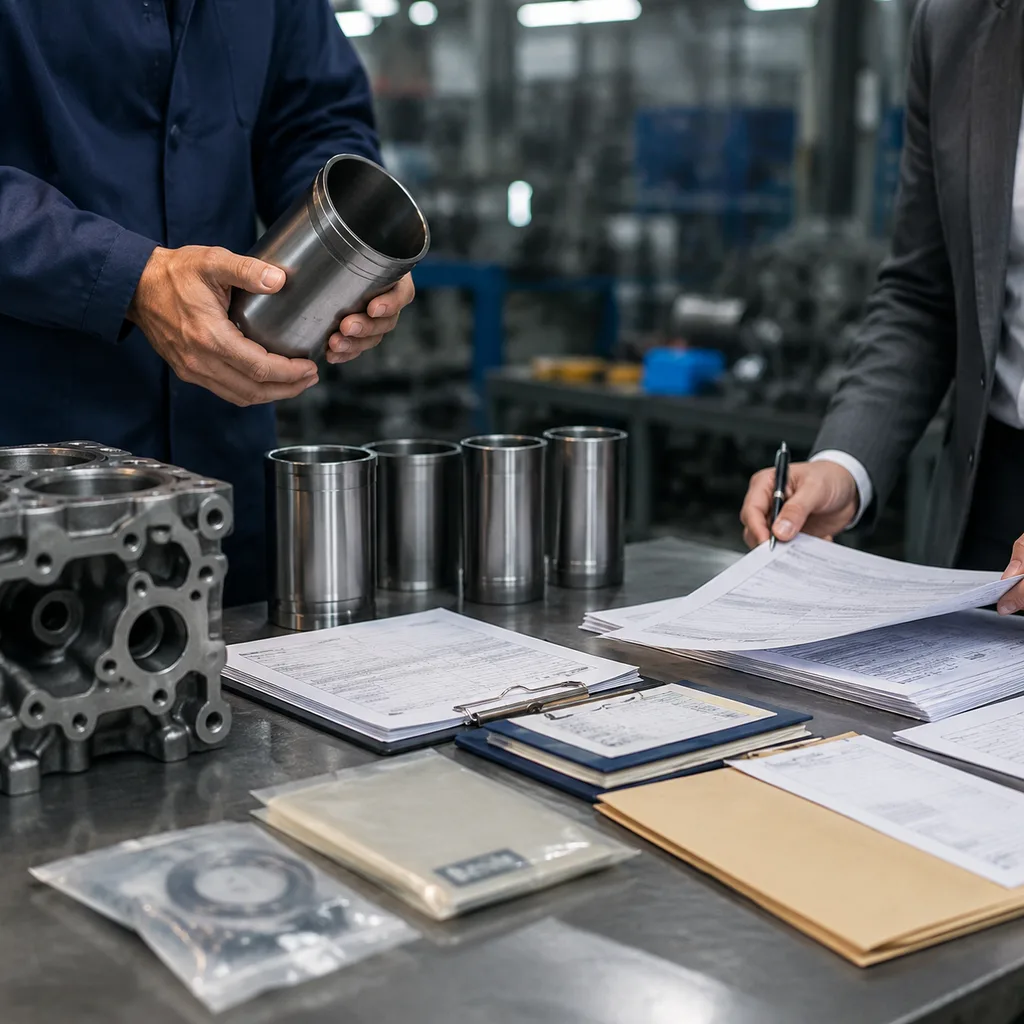
For Peugeot programmes, the same engine family can hide small block revisions that change sleeve geometry. That is why the supplier should identify whether the part is dry or wet, what the final honing allowance is, and how the sleeve is retained in the block. If those points are vague, incoming inspection becomes guesswork. Ask for a drawing, a first-article sample, and an inspection report before you approve mass production.
Spec checks that separate good from risky
Cylinder sleeves can look similar while performing very differently. Procurement teams should compare the specifications that actually move rebuild quality, not the ones that make a catalog entry look complete.
Specification item
What to request
Why it matters
Material
Alloy cast iron or steel grade declaration tied to heat or melt lot
Determines wear resistance and machinability
Hardness
Verified Rockwell or Brinell range
Affects honing behavior and liner life
Bore diameter
Nominal size plus tolerance
Controls piston clearance
Outer diameter
Nominal size plus tolerance
Controls press fit or wet-seal fit
Length
Overall length and any step geometry
Affects deck height and seating
Roundness / cylindricity
Measured values from inspection
Prevents blow-by and oil use issues
Surface finish
Ra target on the finished bore
Impacts ring seating
Treatment / coating
Anti-rust oil, phosphate, or none
Affects storage and first-fit condition
</tr></thead><tbody> </tbody></table>If the RFQ includes an OE number, verify it against the actual engine code and block revision. Peugeot and related PSA applications often share names while differing in castings and machining allowances. A supplier should provide dimensional drawings and state the gauge method used for each critical dimension.
How to run the RFQ without missing hidden cost
The cleanest RFQ is the one that makes the supplier price the same thing you plan to buy. If packaging, coating, or machining stage is left open, the quote will be hard to compare and even harder to hold.
Include these items in the RFQ
Engine code, OE cross-reference, sleeve type, and bore size
Annual volume and expected order split
Required tolerance, finish, and inspection report format
Packaging standard, label format, and carton count
Target delivery window and preferred Incoterm
Sample quantity for validation and pilot builds
Then ask for tiered pricing at 100 / 500 / 1,000 pcs so the break points are visible. If the programme covers multiple warehouses or repair networks, confirm whether partial shipments are allowed and how lot traceability is maintained across dispatches. Landed cost is the number that matters, not unit price alone.
What Driventus can support in production
Driventus is set up for repeat B2B supply, not one-off retail dispatch. Our process is built around sample approval, dimensional verification, and stable batch production.
MOQ can be aligned to programme size, packaging requirement, and tool status; standard sleeves are often set at 100–300 pcs per part number, while custom programmes may need a higher engineering MOQ.
Sample builds are typically 7–15 days after drawing approval. Repeat orders are often 20–35 days. Tooling or process changes can extend that window.
Incoming and final inspection records are available, including first-article dimensions, critical characteristic checks, and lot traceability.
Export packing can be adapted for distributor, warehouse, or container shipment, including VCI protection, carton counts, pallet height limits, and barcode labels.
If you need a non-standard sleeve diameter, wall thickness, flange profile, or surface treatment, our custom manufacturing option supports engineering-based development. That is useful when a buyer is consolidating multiple aftermarket SKUs into one controlled source.
Documents buyers should require up front
Technical claims are only useful when they come with proof. Buyers in the EU, UK, US, Canada, Australia, and Brazil often ask for the same document set: manufacturing certification, material traceability, dimensional reports, and packing controls.
Driventus operates under IATF 16949:2016 and ISO 9001:2015, which helps standardize production records and corrective action flow. We also support compliance requests tied to REACH (EC) No 1907/2006 where applicable to materials and packaging. For finish durability and corrosion resistance, many buyers ask for test references such as SAE J2527 where a coating or surface treatment is involved.
Before releasing the first PO, request a pack that includes the material certificate, final inspection report, sampling plan, and packing declaration. Use the quality system page when you need a summary of inspection discipline, traceability, and corrective action handling before supplier approval.
When qualification prevents expensive rework
The real sourcing risk with cylinder sleeves is lot-to-lot variation. One batch may fit cleanly, while the next batch shifts just enough to change assembly behavior. That is where a qualified supplier matters more than a broad catalog.
A dependable source should be able to show:
stable machining capability across repeat batches
documented inspection of critical dimensions
traceability back to melt or material batch
packaging that protects the surface during export transit
fast response when a drawing changes
For Peugeot aftermarket programmes, this matters even more on older platforms with mixed repair histories. If the block has already been machined once, the sleeve has to match the rebuild plan exactly. Ask whether the supplier can support corrective action within 24–72 hours. That response time often decides whether a problem stays contained or becomes a delayed vehicle return.
Frequently asked questions
Provide engine code, OE cross-reference if available, bore size, sleeve type, annual volume, target annual split by destination, required packaging, and target lead time. A drawing or sample helps confirm fitment faster.
Yes. We can review non-standard bore, OD, length, flange, and surface requirements through our custom manufacturing process, subject to engineering review and tooling feasibility. Please share the drawing, target tolerance, and expected annual demand so we can confirm MOQ and pricing.
Yes. We can support dimensional reports, traceability records, and compliance documents aligned to IATF 16949:2016 and ISO 9001:2015 requirements, depending on the order. If needed, we can also align document release to sample, pilot, and mass-production stages.
If you are qualifying a cylinder sleeve Peugeot supplier or need a programme review for your next RFQ, please [request a quote](/contact.html).