Valve Seat Material: Specifications, Grades, and Selection
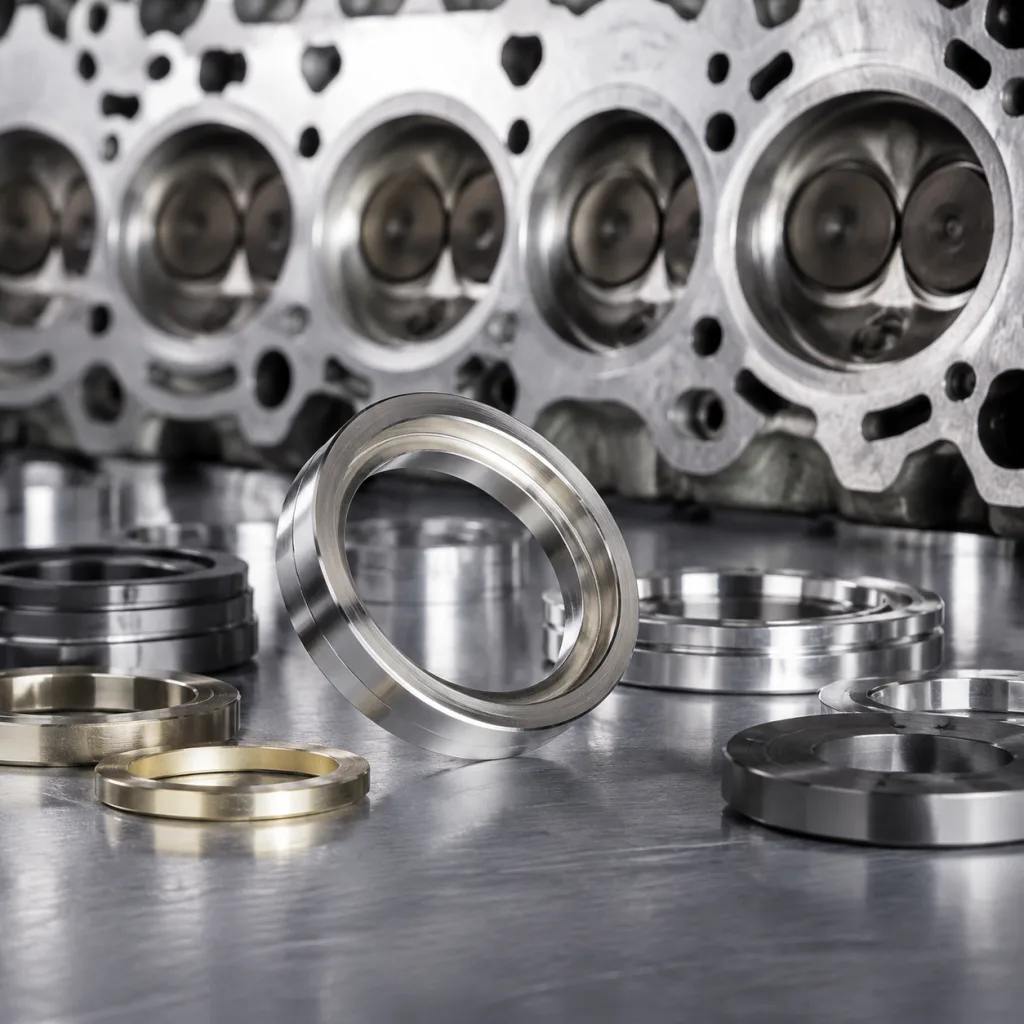
Valve seat material affects heat transfer, wear rate, sealing stability, and service life, so sourcing teams need more than a generic alloy name before release. The right choice depends on fuel type, exhaust temperature, valve-train load, head material, and the dimensional tolerance of the finished seat insert. Common applications include passenger cars, light commercial vehicles, heavy-duty diesel, and industrial power units. The trade-off is simple: softer alloys machine faster, but they can recess sooner in hot operation. Harder sintered or cobalt-containing grades resist micro-welding and fretting, but they demand tighter tooling control, slower cutting speeds, and stricter press-fit discipline. Driventus is an independent aftermarket manufacturer; brand names are referenced for fitment only. Our seats are produced under IATF 16949:2016 and ISO 9001:2015 controlled processes, with material traceability aligned to B2B sourcing requirements in the EU, UK, US, Canada, Australia, and Brazil.
Which Valve Seat Material Fits the Duty Cycle?
Start with the service condition, not the alloy name. In sourcing, the material choice usually follows temperature, fuel, head material, and how much machining tolerance the program can support.
Material family
Typical use
Typical hardness range
Typical density / structure
Strengths
Limits
Cast iron alloy
Older petrol engines, low-load applications
180–260 HBW
Fully cast, non-porous
Good machinability, low cost, easy supply
Lower hot hardness, more recession risk in hot exhaust duty
Iron-based sintered steel
Modern OEM and aftermarket seats
28–40 HRC
Controlled powder-metal density, typically 6.8–7.4 g/cm³ depending on grade
Stable wear resistance, good repeatability, consistent fit
Needs process control for porosity, sinter shrinkage, and finish
Nickel- or cobalt-alloyed grades
High-temperature exhaust seats
32–48 HRC or application-specific equivalent
Dense alloy, often used where hot strength matters most
Better resistance to hot recession, impact, and micro-welding
Higher cost, more difficult machining, tool wear increases
Copper-bearing heat-conductive grades
Performance and thermal management cases
120–220 HBW or grade-specific
Higher thermal conductivity than standard iron grades
Moves heat away from the valve face and helps local temperature control
Softer in some duty cycles, so load case must be verified
</tr></thead><tbody> </tbody></table>For specification work, confirm the composition range, hardness after sintering or heat treatment, and whether the insert is intended for intake or exhaust use. Intake seats can often use a simpler grade. Exhaust seats usually need higher hot strength, better oxidation resistance, and tighter control of the interference fit. As a rule of thumb, exhaust seat inserts in hot-running applications should not be selected only on price; a lower-cost grade that looks acceptable on paper can still recess early if the application runs above roughly 650–750 °C at the seat face for sustained periods.
Specification Checklist Before RFQ Release
A sourcing sheet should define the seat before any purchase order is released. If the buyer leaves geometry or acceptance criteria vague, suppliers quote different products and price comparisons become meaningless.
Outer diameter and inner diameter, with the fit class required for the cylinder head bore
Seat angle, usually 45° for the sealing face, plus any top and throat angles in the valve-train design
Thickness, top land width, and chamfer geometry to prevent cracking during pressing
Hardness range after final processing, with the test method and test location stated
Surface finish on the contact face and outside diameter
Material grade, batch traceability, and any heat-number or lot linkage
Packaging method to prevent corrosion, edge damage, and dimensional drift
Approved drawing revision, sample status, and deviation approval process
Typical sourcing tolerances depend on the platform, but buyers often specify OD within ±0.01 to ±0.03 mm on precision inserts, ID within ±0.01 to ±0.02 mm where machining stock is critical, thickness within ±0.02 to ±0.05 mm, and seat angle within ±0.5° unless the OEM drawing is tighter. Where the cylinder head uses a light interference fit, define the bore and insert relationship explicitly; many programs target an interference of about 0.03 to 0.08 mm, but this must be verified against head alloy, insert OD, and press method.
If the application references OE 06A107065-style cross-references, treat them as fitment references only and validate all critical dimensions against the target head. For imported parts, request a dimensional report from first article inspection, a sample measurement map from at least 5 pieces per cavity or lot, and confirmation of gauge calibration dates before approval.
What Actually Shortens Seat Life?
Seat life is usually lost in the gap between the spec sheet and the real duty cycle. A valve seat material that works in a naturally aspirated petrol engine may fail early in a turbocharged or gas-fuel application.
Main failure drivers
Hot hardness: Helps resist valve recession when exhaust gas temperature is high; in sourcing terms, ask how hardness changes after exposure to the target duty temperature, not only at room temperature.
Thermal conductivity: Moves heat out of the valve face and into the head; a higher-conductivity seat can lower local metal temperature and slow edge recession.
Wear resistance: Reduces pitting, micro-welding, and fretting under repeated closing cycles; this becomes more important as seat pressure and cycle count rise.
Impact toughness: Limits cracking from interference fit, detonation, or local hot spots; critical where the head bore is thin or the press force is high.
Compatibility with the head alloy: Aluminium heads often need an insert grade that balances thermal expansion with press-fit retention, while cast-iron heads tolerate a different fit strategy.
Surface integrity: Burrs, radial cracks, and edge chips can start failure even when the base alloy is correct.
Published standards do not replace engine validation. They define the quality framework, not the final duty-cycle result. For coated or corrosion-sensitive supply chains, align documentation with REACH (EC) No 1907/2006 where applicable, especially for the European market. If the seat will see extended high-load operation, ask for validation data at the expected valve temperature range, because a material that performs well below 500 °C may behave very differently near 700 °C or above.
Compare Grades by Application
Different engine families place different demands on the insert. The right answer is rarely the hardest material. It is the one that survives the actual load case without creating machining or cost problems.
Application
Preferred direction
Typical buying logic
Why
Petrol passenger car
Iron-based or sintered alloy
Optimize for cost, machinability, and adequate wear life at normal service intervals
Balanced cost and endurance for broad-market engines
Turbo petrol
Higher hot-strength alloy
Prioritize recession resistance, hardness retention, and oxidation resistance
Higher exhaust temperature increases seat load
Diesel
High wear and hot-load grade
Verify soot loading, sustained temperature, and long idle / load cycles
Handles heavy-duty thermal and mechanical duty
LPG / CNG
Heat-resistant alloy
Confirm dry combustion, higher exhaust temperature, and valve material compatibility
Dry fuel can accelerate seat wear if the grade is too soft
Performance rebuild
Application-specific alloy
Match cam profile, spring load, head material, and intended rpm band
Validation depends on the full valvetrain package
</tr></thead><tbody> </tbody></table>For procurement, the most useful question is not “Which material is best?” but “Which material is best for this duty cycle, this head alloy, and this machining line?” If a customer needs non-standard geometry or a controlled supply programme, custom manufacturing can align the seat insert to the valve, head bore, and machining process. For catalogue sourcing across related parts, see our catalog and the valve-train range in engine components.
MOQ, price, and lead-time logic should be tied to the material family and tooling status. Standard catalog seats in common sizes usually support lower MOQ and faster delivery because tooling already exists; custom OD/ID/angle combinations generally require a higher MOQ to amortize setup, gauging, and press-fit trials. In RFQs, ask suppliers to quote three brackets: sample lot, pilot lot, and production lot. A practical sourcing structure is often 20–50 pcs for samples, 100–300 pcs for pilot runs, and 500+ pcs for production, with the exact breakpoints driven by cavity count, packaging, and inspection burden. Lead time is typically shortest for stocked standard grades, longer for special alloy or non-standard geometry, and longest when first article approval or PPAP-style documentation is required. Buyers should also ask how price changes with coating, tighter tolerance, corrosion protection, and export packaging, because these items can materially change landed cost.
Step-by-Step Inspection and Quality Control
A stable supply chain depends on measurable acceptance criteria. Driventus uses an IATF 16949:2016 and ISO 9001:2015 framework for process control, traceability, and corrective action handling. Buyers should ask for the same discipline at the part level and define what gets checked at receiving, first article, and production release.
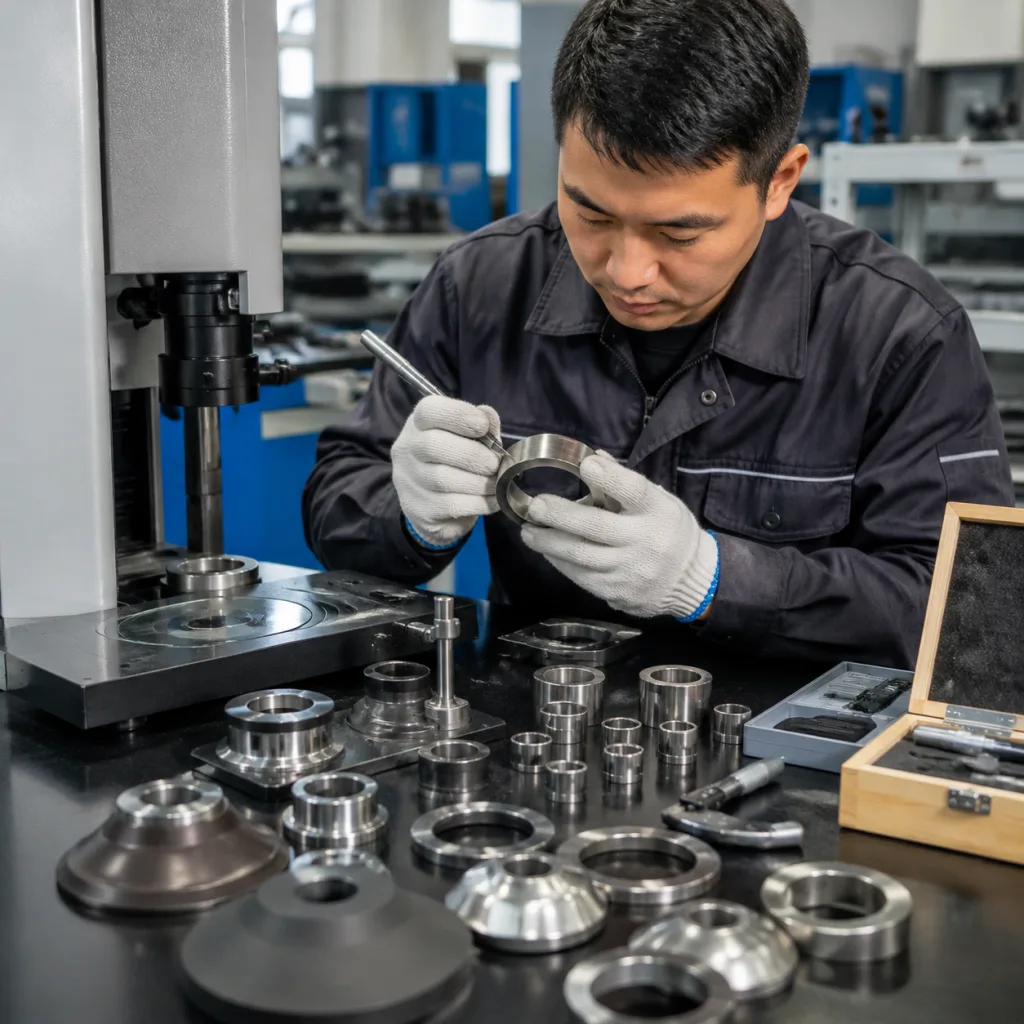
1. Confirm chemical composition or powder specification against the approved drawing and material certificate. 2. Measure OD, ID, thickness, seat angle, and concentricity on a calibrated gauge set. 3. Verify hardness on the defined test scale and location, with the test load and dwell time stated. 4. Inspect for burrs, chipping, out-of-round, edge collapse, and surface porosity. 5. Review packaging, rust prevention, and lot traceability before stock acceptance. 6. Check sample retention, lot marking, and change-control notes so revisions are not mixed in storage. 7. Record nonconformance thresholds for reject, sort, and rework decisions before launch.
A buyer-facing control plan should specify the inspection frequency as well as the measurement values. For example, first article inspection may require 100% dimensional review on a sample set, while ongoing production might move to AQL-based sampling with defined critical, major, and minor defect categories. If your programme requires supplier audits, a documented quality system helps shorten approval cycles and reduces incoming defects. For recurring supply, ask for PPAP-style evidence, first article data, process capability where available, and change-control notification terms. Where the seat is critical to warranty risk, include rust-prevention method, shelf-life expectation, and packaging drop-test criteria in the sourcing spec so the quote is comparable across vendors.
How to Choose the Right Grade for Procurement
A good procurement decision follows the duty cycle, not the catalog hierarchy. The correct valve seat material is usually the one that meets thermal demand, stays stable in the head, and still fits the supplier’s machining process.
Use this decision order:
Start with the exhaust gas temperature and expected load profile.
Confirm valve material, seat angle, and interference-fit requirements.
Match the insert grade to the head alloy and thermal expansion behaviour.
Check whether the application needs corrosion resistance, lead-free fuel compatibility, or dry-fuel durability.
Lock the drawing revision before placing repeat orders.
Compare suppliers on measurable terms: hardness range, allowed dimensional tolerance, sample approval time, MOQ, and repeat lead time.
Ask for tooling ownership and replacement policy when the seat geometry is custom.
A practical sourcing matrix is useful when comparing quotes. If two vendors offer the same grade but one quotes tighter tolerances, the tighter-spec supplier should also be asked how the price changes with reduced scrap risk, increased inspection, and longer lead time. If the application is expected to run hot, a slightly higher unit price can be justified by lower warranty exposure and better installed life. Where the programme is still under development, request a sample lot and run validation tests before volume release. If you need pricing, technical review, or drawing support, request a quote.
FAQ
What is the most common valve seat material for modern engines? Iron-based sintered alloy is common because it balances cost, machinability, and wear resistance. Exhaust applications may require a harder, higher-temperature grade, especially where recession risk is high.
How do I compare two seat materials on paper? Check composition, hardness, thermal conductivity, heat resistance, dimensional tolerance, and the intended intake or exhaust duty. Then confirm OD, ID, thickness, angle, and fit class against the cylinder head drawing.
Can the same material work for petrol and diesel engines? Sometimes, but not always. Diesel and turbocharged applications usually need higher hot strength and better wear resistance than light-duty petrol engines.
What tolerance should I ask for on a valve seat insert? Use the drawing as the source of truth, but many precision programs specify OD and ID tolerances in the ±0.01 to ±0.03 mm range, with angle tolerance around ±0.5° unless tighter control is required.
How should MOQ and lead time be handled in an RFQ? Ask suppliers to quote sample, pilot, and production quantities separately, then separate tooling, inspection, packaging, and freight. Standard sizes should usually quote faster and with lower MOQ than custom geometry or special-alloy seats.
Frequently asked questions
Iron-based sintered alloy is common because it balances cost, machinability, and wear resistance. Exhaust applications may require a harder, higher-temperature grade, especially where recession risk is high.
Check composition, hardness, thermal conductivity, heat resistance, dimensional tolerance, and the intended intake or exhaust duty. Then confirm OD, ID, thickness, angle, and fit class against the cylinder head drawing.
Sometimes, but not always. Diesel and turbocharged applications usually need higher hot strength and better wear resistance than light-duty petrol engines.
Use the drawing as the source of truth, but many precision programs specify OD and ID tolerances in the ±0.01 to ±0.03 mm range, with angle tolerance around ±0.5° unless tighter control is required.
Ask suppliers to quote sample, pilot, and production quantities separately, then separate tooling, inspection, packaging, and freight. Standard sizes should usually quote faster and with lower MOQ than custom geometry or special-alloy seats.
If you are sourcing valve seats for a new programme or replacement supply, contact Driventus for technical review, sampling, and quote breakdowns by MOQ, lead time, and tolerance class at /contact.html.