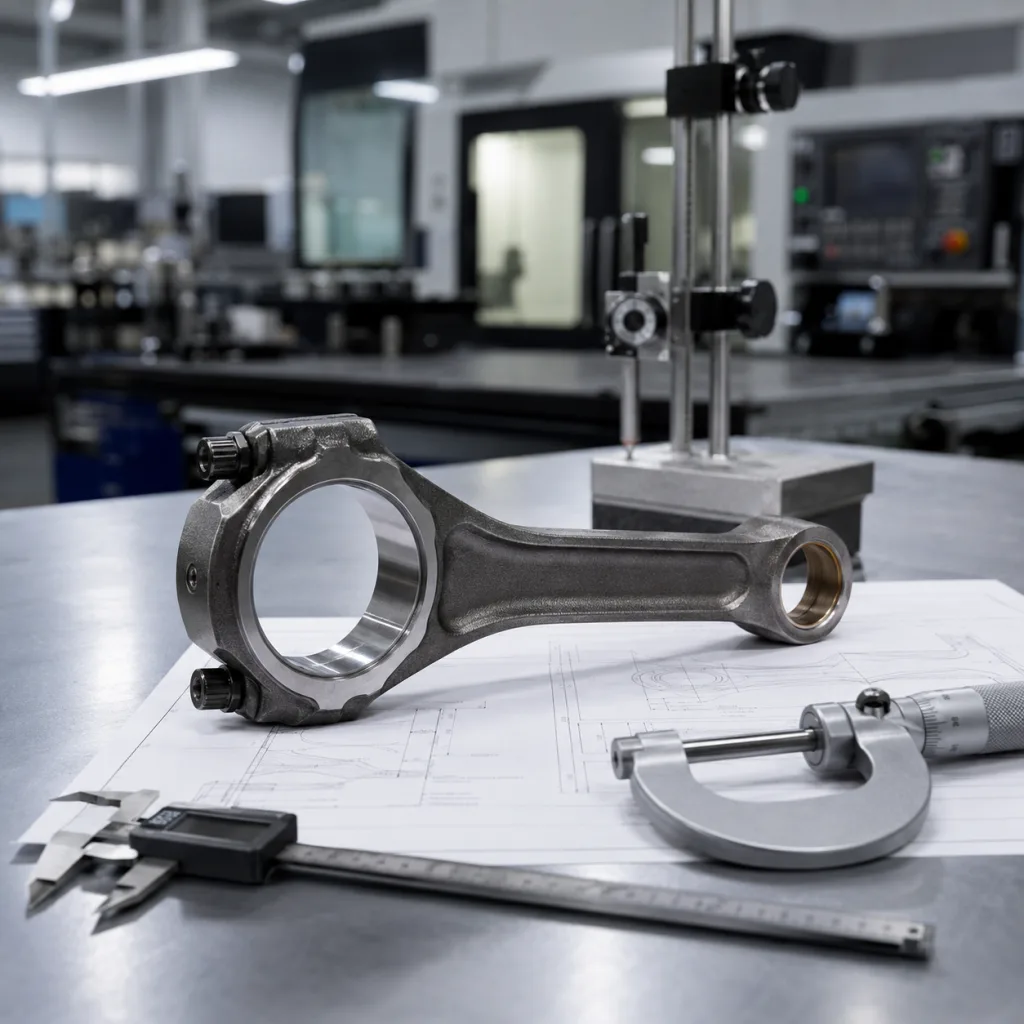
Connecting Rod for Buick Regal Aftermarket Replacement
A connecting rod for Buick Regal aftermarket replacement must do more than fit between the crankpin and piston pin. It has to preserve centre-to-centre length, big-end bore geometry, small-end finish, bolt clamp load and weight balance while operating under repeated combustion and inertia loads. For importers, distributors and repair-chain buyers, the greatest sourcing risk is often not visible forging quality but small dimensional drift that can lead to bearing distress, piston noise, cap fretting or early fatigue after installation. Driventus manufactures engine and powertrain components in Taizhou, Zhejiang, for B2B supply programmes serving North America, Europe, Australia and Brazil. This guide explains how procurement teams can evaluate replacement connecting rods for Buick Regal applications, including OE-equivalent geometry, material validation, machining control, quality documentation and export packaging. Driventus is an independent aftermarket manufacturer; Buick, Regal and other brand names are referenced for fitment identification only.
Replacement intent: dimensional match before price comparison
For Buick Regal service parts, a connecting rod is commonly sourced to rebuild an engine after bearing failure, hydro-lock damage, piston seizure, overheating or high-mileage wear. The replacement rod must match the intended engine family, piston pin arrangement and crankshaft journal specification. A catalogue listing by model name alone is not enough for approval, especially where several engines or production revisions may exist within the same vehicle line.
Key fitment checks include:
Centre-to-centre length: controls piston deck height and compression relationship.
Big-end bore diameter and roundness: affects bearing crush, oil clearance and operating temperature.
Small-end bore diameter and surface finish: influences wrist pin movement, lubrication and noise.
Rod side clearance: must suit the crankshaft, bearing and thrust arrangement.
Bolt thread specification and clamp load: critical for cap retention at high engine speed and load.
Mass and balance range: reduces vibration and bearing load variation across an engine set.
Cap design and orientation: fracture-split and machined-cap rods require correct matching and assembly practice.
For aftermarket distribution, Driventus recommends ordering by confirmed engine code, sample drawing, buyer specification or OE part-number cross-reference format where available. If a programme uses generic cross-reference identifiers such as OE 06A… or OE 11251…, they should be treated as catalogue aids, not as evidence of vehicle manufacturer approval. Price comparison should begin only after the application, critical dimensions, inspection method and packaging format are confirmed.
OE-equivalence criteria for Buick Regal connecting rods
OE-equivalence is a technical target, not a marketing label. It means the replacement rod is designed to meet the functional geometry, material performance and durability requirements of the original application without claiming endorsement by the vehicle manufacturer. Driventus is an independent aftermarket manufacturer; brand names are referenced for fitment only.
Control point
Typical procurement requirement
Why it matters
Centre-to-centre length
Drawing-controlled; lot inspection recorded
Maintains piston position and compression relationship
Big-end bore
Roundness and cylindricity checked after cap assembly
Supports stable bearing crush and oil film formation
Small-end bore
Diameter and surface finish verified
Helps prevent pin knock, seizure or accelerated bush wear
Rod twist and bend
Checked by fixture, comparator or CMM method
Reduces piston skirt loading and cylinder wear
Weight matching
Batch or set range agreed by buyer
Limits engine vibration and bearing load variation
Bolt tightening data
Torque-angle, torque-plus-yield or clamp-load procedure defined where applicable
Prevents cap fretting, bolt fatigue and bore distortion
Material traceability
Heat number or batch traceability retained
Supports warranty investigation and audit readiness
Surface condition
Burrs, laps, cracks and machining damage controlled
Reduces fatigue initiation and contamination risk
</tr></thead><tbody> </tbody></table>Where a buyer supplies a drawing, Driventus can apply specific tolerance bands, measurement points and inspection frequency through custom manufacturing. Where the buyer sources from catalogue fitment, validation should include first-article inspection, sample trial assembly and packaging approval before the first bulk shipment. This approach protects both the distributor and installer by making the acceptance criteria measurable before serial supply begins.
Materials, forging and machining controls
Most modern replacement connecting rods are produced from forged steel, powder-forged steel or another application-matched material route. The choice must be consistent with the engine load case, fracture-split or machined-cap design, bearing arrangement and required fatigue life. For a connecting rod for Buick Regal aftermarket replacement, procurement teams should request the material grade or equivalent specification, heat treatment record and mechanical property summary rather than relying on a broad description such as “steel rod.”
A practical specification list for sourcing includes:
Forged steel, powder-forged steel or application-matched equivalent material.
Controlled heat treatment with hardness range stated on the inspection plan.
Shot peening or other surface treatment where required by the original design intent.
CNC machining of big-end and small-end bores using controlled fixtures.
Big-end finish machining after cap assembly and fastener tightening to the defined procedure.
100% visual inspection for forging laps, cracks, thread damage, burrs and handling marks.
Magnetic particle inspection or comparable crack detection where specified by the buyer or programme risk level.
Deburring, washing and cleanliness control to reduce abrasive residue entering the oil system.
Machining sequence is as important as material selection. The big-end bore should be finished with the cap installed and the fasteners tightened according to the approved method because bolt stretch and cap seating influence bore shape. If bolts are replaced, coatings are changed or lubrication differs from the agreed process, the torque-tension relationship can shift. That point should be reviewed during sample approval, not after a field claim. For higher-volume programmes, buyers should also define how tool wear, gauge calibration and process capability are monitored over repeated production lots.
Validation testing and standards buyers should request
Connecting rods are not governed by one universal aftermarket approval standard. Buyers therefore need a documented validation plan that combines quality management, material control, dimensional inspection and application-specific testing. Driventus operates under IATF 16949:2016 and ISO 9001:2015 quality management systems. These standards support process control, traceability, corrective action and continual improvement, but they do not replace part-specific engineering verification.
Recommended validation evidence includes:
First Article Inspection Report with measured critical dimensions and sampling basis.
Material certificate linked to production batch or heat number.
Hardness and, where required, microstructure report after heat treatment.
Bolt torque, torque-angle or clamp-load verification record.
Big-end bore data measured after cap assembly with the specified fastener procedure.
Fatigue test summary where the programme requires endurance confirmation.
Weight range data for rods supplied in engine sets.
Control plan and inspection checklist for serial production.
Gauge calibration evidence for critical measurement equipment when requested.
Packaging drop, compression or transport review for export shipments.
For buyers importing to the EU or UK, chemical compliance requests may also refer to REACH (EC) No 1907/2006 for substances of concern in supplied articles. Other markets may require their own customer declarations or material restrictions. Emissions rules such as ECE R-83 apply to vehicle-level emissions approval and should not be misrepresented as a connecting-rod certification. A clear compliance matrix prevents confusion during customs review, customer audits and warranty discussions, while keeping technical claims accurate.
Sourcing checklist for distributors and repair chains
A distributor buying engine hard parts needs repeatable fitment, stable carton presentation and clear documentation. A repair chain needs low installation risk, quick branch-level identification and a straightforward claim process if a rebuild problem occurs. Both groups should evaluate the supplier beyond the unit price because a low-cost rod can become expensive if it causes catalogue confusion, mixed sets or inconsistent inspection records.
Before placing a regular order, confirm:
1. Application data: model year range, engine family, piston pin type, cap design and bearing interface. 2. Cross-reference policy: how OE-style references are managed, including generic formats such as OE 06A… when used in the buyer system. 3. Inspection scope: which dimensions are measured per batch, which are controlled statistically and which gauges are used. 4. Set matching: whether rods are packed individually, in matched sets or in buyer-defined weight groups. 5. Fasteners: whether rod bolts are included, pre-installed, oiled, coated, marked or supplied separately. 6. Labelling: part number, batch number, quantity, country of origin, barcode format and private-label requirements. 7. Warranty evidence: what data will be provided if a bearing, noise, bolt or dimensional complaint occurs. 8. Lead time and safety stock: whether the supplier can support seasonal rebuild demand and replenishment orders. 9. Change control: how material, machining, supplier or packaging changes are communicated before shipment.
Buyers can review related engine hard parts in our catalog and the engine range at /products/engine-components.html. For supplier qualification, review the Driventus quality system, including process controls aligned with IATF 16949:2016 and ISO 9001:2015. For recurring programmes, it is useful to agree the drawing revision, label template, inspection report format and carton specification before the purchase order is released.
Common replacement errors and how to reduce returns
Many connecting-rod returns are caused by application mismatch or rebuild process errors rather than a visible part defect. Procurement specifications can reduce these issues when they include installation notes, batch traceability and packaging data that help technicians identify the correct part before the engine is assembled.
Common failure points include:
Installing a rod with the wrong small-end design for the piston pin.
Mixing rods outside the accepted weight range in one engine.
Reusing bolts where the engine specification requires replacement.
Applying torque without the specified lubricant, sequence or angle procedure.
Separating matched caps from their original rods or reversing cap orientation.
Fitting bearings to an out-of-round big-end bore after cap damage or incorrect tightening.
Failing to clean oil galleries, crank passages and bearing debris after a prior bearing failure.
Ignoring crankshaft journal wear, taper or surface damage during rebuild.
For multi-location repair groups, Driventus can support packaging that separates matched sets, includes batch identification and allows branch-level traceability. For wholesalers, consistent outer carton strength, moisture protection and barcode accuracy matter during sea freight, warehouse handling and inland distribution. If your programme requires private-label cartons, special inspection sampling, kitting with fasteners or drawing-based deviations, those requirements should be frozen before mass production and repeated in the purchase order. Clear instructions at the sourcing stage reduce preventable returns and make any genuine quality investigation faster.
Frequently asked questions
Confirm the engine family, production year range, piston pin design, crank journal interface, cap design and any OE-style cross-reference used in your catalogue. A sample, drawing or first-article report is recommended before bulk purchase.
No. Driventus is an independent aftermarket manufacturer; Buick, General Motors and other brand names are referenced for fitment only. We supply OE-equivalent replacement parts based on application requirements and buyer specifications, without claiming vehicle manufacturer approval.
Depending on order scope, Driventus can provide inspection reports, material certificates, hardness records, batch traceability, control plans, measurement data and packaging specifications. Requirements should be agreed before production.
For a connecting rod for Buick Regal aftermarket replacement, share your engine application, annual volume, packaging requirement and inspection documents needed. To discuss samples or production supply, [request a quote](/contact.html).