Camshaft for Renault Captur Replacement: OE-Equivalent Sourcing Guide
A camshaft for Renault Captur replacement has to match the exact engine application, not just the vehicle name. The correct part depends on the engine code, intake or exhaust position, valve timing profile, journal dimensions, drive-end design, and any sensor or VVT-related features used by the original assembly. For procurement teams, the sourcing decision goes beyond unit price. A reliable replacement programme depends on controlled dimensions, consistent surface hardness, accurate lobe geometry, clean surface finish, corrosion-safe packaging, and traceable quality records that help reduce returns and warranty exposure.
Driventus supplies engine components for B2B buyers that require repeatable fitment across aftermarket distribution, repair networks, fleet service programmes, and import channels. Driventus is an independent aftermarket manufacturer; Renault and other brand names are referenced for fitment identification only. Before releasing a camshaft order, buyers should validate the part against OE references, approved drawings, installation clearances, and the corresponding timing system, whether belt or chain driven. Documentation should also align with quality expectations such as IATF 16949:2016, ISO 9001:2015, and material compliance requirements including REACH (EC) No 1907/2006 where applicable. The sections below explain what to verify before ordering, which OE-equivalence checks matter most, and how to compare suppliers before placing volume orders.
What a Renault Captur camshaft replacement must match
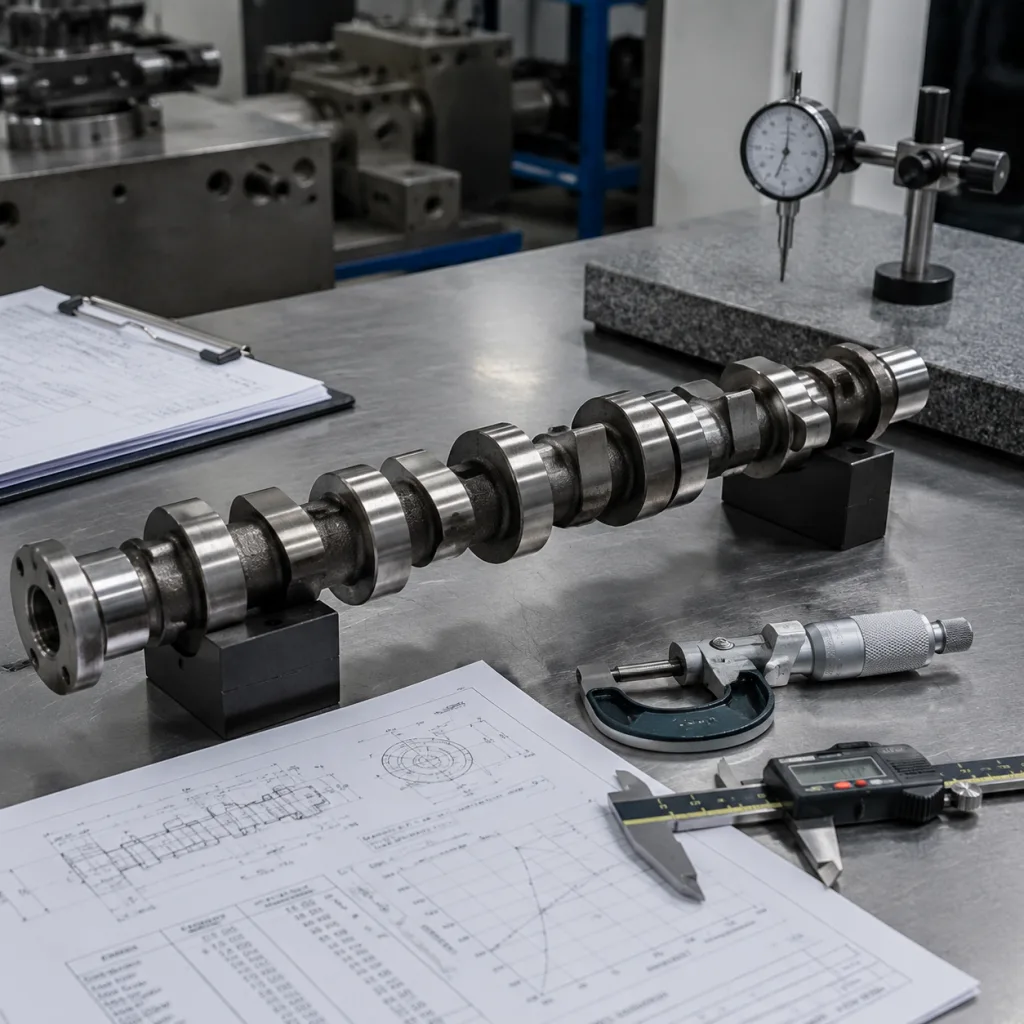
For a camshaft for Renault Captur replacement, the first requirement is dimensional and functional equivalence to the original engine specification. Captur fitments vary by engine family and production specification, so buyers should confirm the engine code, valve count, intake/exhaust position, and timing architecture before approving a part number.
Key match points:
Journal diameter, journal width, and bearing spacing
Overall shaft length and end-face geometry
Lobe lift, duration, ramp shape, and lobe separation angle
Cam phasing, dowel position, and drive-end configuration
Sprocket, pulley, or actuator attachment method
Sensor target wheel, trigger feature, or locating slot, if fitted
Surface finish on journals, lobes, and thrust areas
Oil-feed holes, grooves, and chamfer details
A camshaft can appear similar in a catalogue image and still fail in service if the lobe profile, trigger position, or phasing is wrong. Incorrect geometry can cause rough running, timing errors, valve-train noise, increased wear, emission faults, or engine damage. For procurement, the safer route is to begin with the OE reference and then confirm drawings, measurement data, and sample inspection results against the replacement lot.
When the application is uncertain, ask for cross-reference support from our catalog and review the related engine-component range at [/products/engine-components.html]. A verified fitment file should include the engine code, production range, camshaft position, and any notes on timing drive or VVT hardware.
OE-equivalence checks buyers should request
Replacement sourcing should be based on measurable evidence rather than visual comparison or catalogue claims alone. For a camshaft used in Renault Captur fitments, request technical data before sample approval and repeat the critical checks when moving to production lots.
Check item
What to verify
Typical buyer purpose
Drawing match
Overall dimensions, journal sizes, thrust faces, lobe data
Fit confirmation
Material report
Alloy grade, casting/forging route, heat treatment process
Durability review
Hardness data
Surface hardness and core hardness where specified
Wear control
Lobe geometry
Lift, base circle, ramp profile, timing angle
Valve-train performance
Runout
Shaft straightness across the full length
NVH and timing stability
Surface roughness
Journal and lobe finish
Oil film retention and wear reduction
Oil passage inspection
Holes, grooves, chamfers, cleanliness
Lubrication reliability
Balance / mass control
If specified for the variant
High-speed stability
Packaging validation
Rust protection, separators, impact resistance
Lower transit damage risk
</tr></thead><tbody> </tbody></table>For larger programmes, ask for first-article inspection records, batch traceability, and a defined control plan. A supplier working to IATF 16949:2016 and ISO 9001:2015 should be able to show calibrated gauges, controlled inspection points, documented nonconformance handling, and clear release criteria. If your internal process requires technical alignment, use our quality system as a reference point for documentation expectations.
Buyers should also confirm how changes are managed. A small modification in material, heat treatment, machining sequence, or surface finishing can affect wear life and installation behaviour. For repeat orders, request revision control and lot-level identification so that field feedback can be traced quickly.
Why engine code matters more than model name
The Renault Captur nameplate does not identify one universal camshaft. Different markets and model years may use different petrol or diesel engine families, emission calibrations, valve-train layouts, and timing systems. Two vehicles with the same commercial model name can require different intake and exhaust camshafts.
Common procurement control points
Confirm engine code from the VIN, build sheet, service record, or teardown sample
Confirm whether the part is the intake camshaft, exhaust camshaft, or a matched pair
Confirm whether VVT hardware is integrated, mounted separately, or not used on the application
Confirm the timing drive type: belt, chain, sprocket, pulley, or actuator arrangement
Confirm any sensor ring, trigger wheel, slot, or target feature on the shaft
Confirm supersession history and regional application notes before catalogue release
Model-only ordering creates avoidable risk because the installation may be mechanically possible but functionally wrong. A camshaft with a near-matching journal layout can still produce incorrect valve timing or sensor signals if the phase relationship differs.
If an application list cites OE-style references, treat them as cross-check aids rather than final approval. Some reference numbers may be used broadly in aftermarket databases or may resemble numbers from unrelated engine families, so verify the exact engine code and OE supersession path before release. Driventus does not claim manufacturer approval. Driventus is an independent aftermarket manufacturer; Renault and other brand names are referenced for fitment identification only.
Validation testing for replacement camshafts
Before replacement stock is shipped to distributors, importers, or repair networks, the part should pass controlled validation. For camshafts, validation normally combines dimensional inspection, material and hardness checks, surface-quality review, and functional confirmation on representative engines, cylinder-head assemblies, or dedicated fixtures.
Typical validation items include:
Dimensional inspection against the approved drawing
Journal, thrust face, and drive-end measurement
Lobe lift, base circle, and timing angle measurement
Straightness, concentricity, and runout checks
Rockwell or equivalent hardness verification on treated surfaces
Surface roughness inspection on journals and lobes
Visual and magnetic-particle or equivalent defect checks where required
Oil-hole cleanliness and burr control
Trial assembly with compatible followers, bearings, seals, and timing components where appropriate
Packaging inspection to prevent corrosion, handling damage, and transit impact
Validation should reflect how the part will be used in the field. A distributor shipping single units may need stronger individual protection and clearer labels, while a repair-chain programme may prioritise installation notes and fast identification by engine code. For higher-volume orders, buyers should define sampling levels, acceptance criteria, and corrective-action timelines before the first production shipment.
For export markets, material declarations may be requested alongside compliance screening under REACH (EC) No 1907/2006 where relevant to the finished article and packaging supply chain. If a buyer needs a non-standard profile for a regional engine variant, Driventus can support custom manufacturing after the technical specification, sample, or drawing package is confirmed.
Commercial fit for distributors, workshops, and importers
Replacement camshafts are usually purchased under one of three commercial models: stock replenishment, fleet or workshop service support, and catalogue expansion. Each model needs the same technical discipline, but the buying priorities differ.
For distributors and wholesalers:
Accurate cross-reference data and clear application coverage
Stable packaging, barcode support, and consistent labelling
Low return rate and fast issue investigation
Repeatable batch quality across replenishment orders
SKU planning for related engine parts, seals, followers, and timing components
For repair chains and workshop groups:
Fast availability by engine code and camshaft position
Lower installation risk through clear application notes
Warranty-friendly documentation and traceability
Practical packaging that protects machined surfaces until installation
Support for common failure investigations, such as oil starvation or timing-system damage
For importers and regional buying offices:
Container or pallet planning by part family
Reliable lead-time communication and order consolidation
Batch traceability and export documentation
Support for mixed SKU programmes and phased launches
Market-specific compliance and labelling review where required
A procurement team should request sample approval, lot control, inspection data, and product data sheets before moving to production orders. Commercial terms should also cover packaging specification, minimum order quantity, lead time, claim handling, and technical response time. For a broader view of available engine components, see our catalog.
How to compare suppliers before you place the order
A replacement camshaft should be judged on evidence, repeatability, and support capability. A low piece price can become expensive if it leads to field failures, catalogue errors, installation delays, or warranty disputes. Use a structured comparison before supplier approval:
1. Confirm OE cross-reference, engine-code coverage, and intake/exhaust position. 2. Review drawing data, critical dimensions, and inspection reports. 3. Check material route, heat-treatment process, and hardness range. 4. Confirm lobe geometry, runout, oil-hole details, and surface roughness controls. 5. Review packaging, corrosion protection, shelf-life controls, and label format. 6. Confirm documentation for your market, including traceability and quality-system records. 7. Ask for sample verification on at least one representative installation or fixture. 8. Review how the supplier handles engineering changes, claims, and repeat-order consistency.
If a supplier cannot provide dimensional data, material traceability, controlled inspection records, and a clear quality process, the risk of repeat failures is high. Also look for practical technical support: a responsive supplier should help interpret OE references, confirm application notes, and separate installation-related failures from product-related issues.
Procurement teams that need a technical quotation or a controlled replacement programme can use request a quote to start the specification review. Include the OE reference, engine code, required quantity, target market, and any sample or drawing data so the replacement camshaft can be assessed accurately.
Frequently asked questions
No. Model-only ordering is risky because Renault Captur applications use multiple engine families and timing layouts. Match by engine code, OE reference, camshaft position, and any VVT or sensor features before release.
Ask for dimensional inspection data, material traceability, hardness results, lobe-geometry checks, packaging details, and evidence of controlled quality processes under IATF 16949:2016 or ISO 9001:2015.
No. Driventus is an independent aftermarket manufacturer; Renault and other brand names are referenced for fitment identification only. We supply OE-equivalent replacement parts and technical support for aftermarket sourcing.
If you need a camshaft replacement matched to your Captur engine code, send the OE reference, required position, quantity, and any sample data for review. Start here: /contact.html