Connecting Rod for Alfa Romeo Giulia Replacement: Fitment Guide
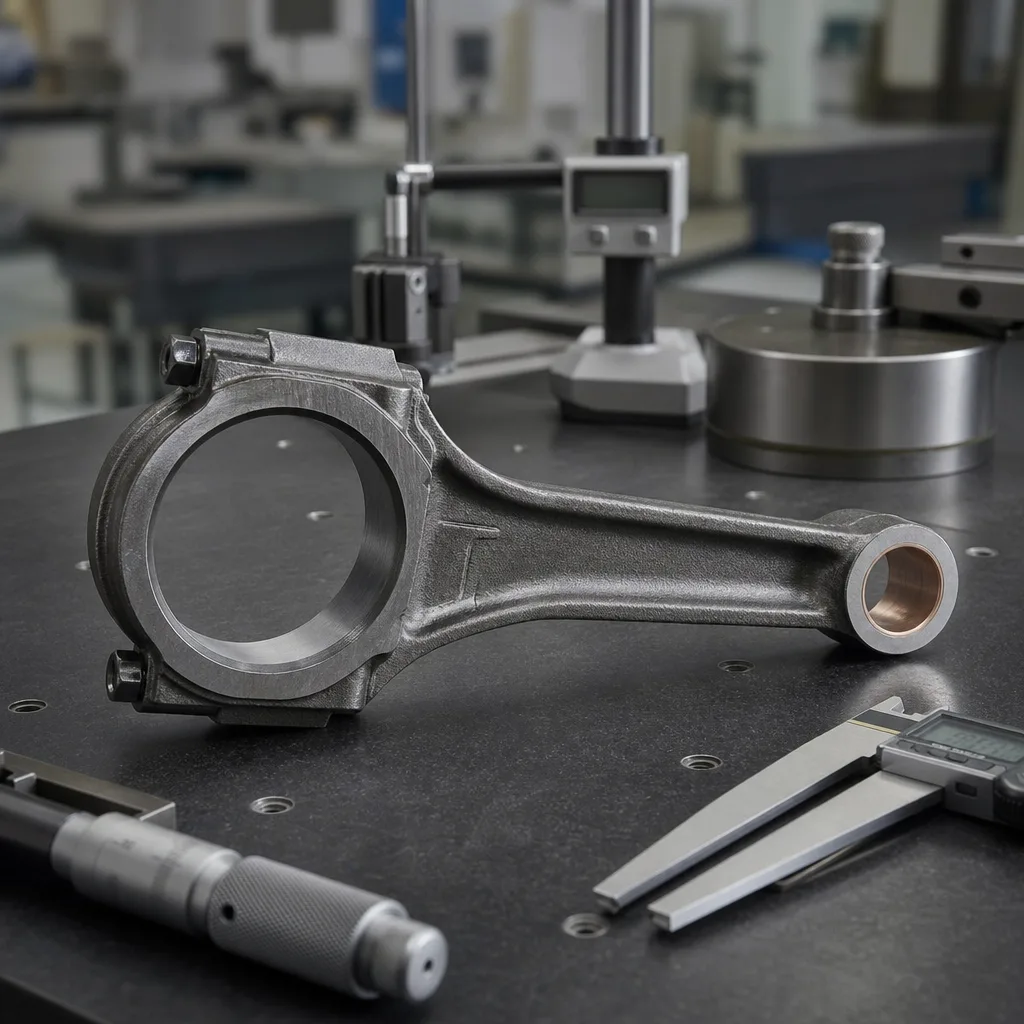
A correct replacement connecting rod has to match the engine’s geometry, mass class, and bolt specification, not just the external shape. For procurement teams and rebuild shops, the critical checks are centre-to-centre length, big-end width, small-end bore, cap register, rod bolt stretch, and weight matching. If any of those values drift, bearing load rises and the engine can suffer noise, heat, or early fatigue. Driventus is an independent aftermarket manufacturer; brand names are referenced for fitment only. Our production is controlled under IATF 16949:2016 and ISO 9001:2015, with traceability from raw material to finished part. For the Alfa Romeo Giulia application, the goal is OE-equivalent fitment that can be validated against the removed part, the engine code, and measured dimensions before shipment.
Why OE-equivalent geometry matters
A connecting rod is a load path between the piston and crankshaft, so dimensional accuracy matters more than appearance. For a replacement on the Giulia platform, the rod must align with the crank journal, preserve bearing crush, and keep the piston centred in the bore through the full stroke.
Small differences in big-end width, small-end bore, or centre-to-centre length can change oil clearance and side loading. That is why a visually similar part is not enough. Driventus controls these parts under IATF 16949:2016 and ISO 9001:2015, with heat-lot traceability and documented inspection. Brand names are referenced for fitment only; there is no manufacturer endorsement implied.
Measurements to verify before ordering
Use the removed rod as the primary reference. VIN lookup alone is not sufficient because engine variants, revisions, and prior repairs can change the required part.
- Centre-to-centre length: confirm against the original part drawing or a calibrated measurement.
- Big-end bore and width: check for bearing shell fit, side clearance, and cap register compatibility.
- Small-end bore: verify pin diameter and whether the design uses a bushing or direct-fit eye.
- Rod bolt specification: confirm thread size, seat style, and stretch or torque procedure.
- Weight class: compare the rod as a single part and as a matched set.
- Beam clearance: check oil squirter, block, and counterweight clearance if the engine has been rebuilt.
- Surface condition: reject rods with visible twist, nicking, fretting, or evidence of overheating.
If the existing part is damaged, provide at least three dimensions, engine code, and photos of the cap, beam, and bush area.
Inspection points and acceptance criteria
| Check | What to confirm | Why it matters |
|---|---|---|
| Centre distance | Matches the original within the required tolerance band | Controls compression height and piston position |
| Big-end roundness | Bore remains round after cap torquing | Protects bearing contact and oil film stability |
| Small-end fit | Pin bore matches the piston pin specification | Prevents seizure or excessive clearance |
| Bolt preload | Correct stretch or torque-to-yield procedure | Reduces cap movement and fatigue risk |
| Weight matching | Rods are sorted to the same class | Minimises imbalance across cylinders |
| Surface finish | No tool marks, scale, or corrosion at critical faces | Supports repeatable clamping and life |