Crankshaft Infiniti OEM Supplier: Sourcing Guide
Procurement teams sourcing a crankshaft Infiniti OEM supplier need more than a parts list. They need dimensional control, material traceability, stable capacity, and a supplier that can support cross-reference validation before release. Driventus Auto Parts manufactures crankshafts in Taizhou, Zhejiang, for aftermarket distributors, OEM and Tier-1 buyers, and multi-location repair networks. We operate under IATF 16949:2016 and ISO 9001:2015, with export experience across 60+ countries. Driventus is an independent aftermarket manufacturer; brand names are referenced for fitment only. For buyers comparing suppliers, the key questions are straightforward: can the plant hold journal geometry, runout, and surface finish targets; can it document heat treatment and inspection; and can it support the MOQ and lead time required for your region? This article explains what to verify before placing an order and how to reduce sourcing risk.
What buyers should confirm before sourcing
For Infiniti-fit crankshafts, the part must match the engine family, bearing journal layout, trigger features, thrust design, and balancing specification. A supplier should be able to provide OE cross-reference support where available, for example OE 06A107065 format only when the application data already cites it.
Minimum procurement checks:
- Engine code and displacement confirmation
- Journal diameter, width, and fillet radius data
- Axial clearance and thrust surface specification
- Material grade and heat-treatment route
- Dynamic balance target and inspection method
- Packaging standard for sea freight and warehouse intake
If these points are missing, the risk is not only fitment error. It is also delayed receiving inspection, higher claims rate, and slower rollout across multiple branches or distributors.
Manufacturing controls that matter in crankshaft supply
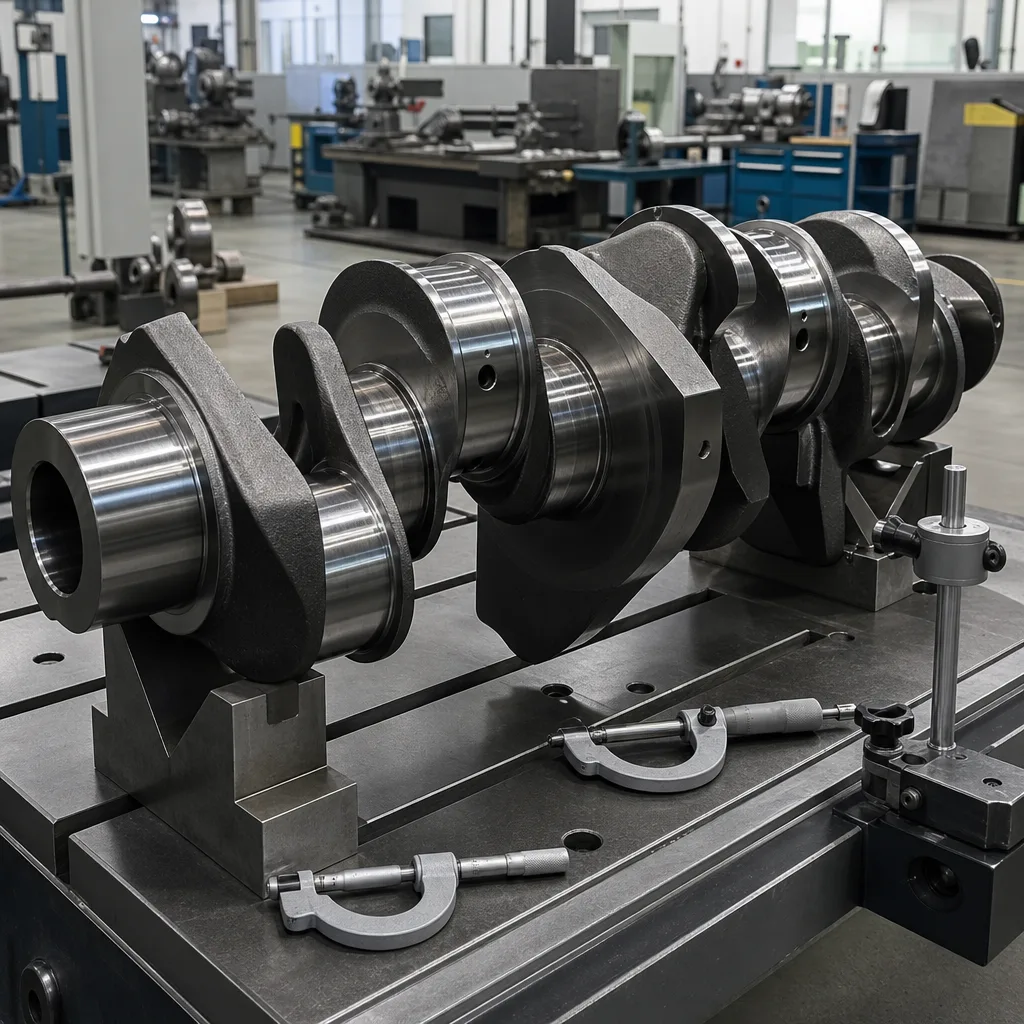
A credible supplier should control forging or casting input, rough machining, heat treatment, finishing, and final inspection. For forged crankshafts, buyers commonly ask for material certification, hardness mapping, and magnetic particle inspection of critical areas. The process should be documented under IATF 16949:2016 and ISO 9001:2015.
Key control points
1. Material traceability from heat number to finished part batch 2. Machining stability on main journals, rod journals, and thrust faces 3. Surface finish control on bearing contact areas 4. Runout measurement after final machining and before packing 5. Dynamic balancing for NVH-sensitive applications
Driventus also supports REACH (EC) No 1907/2006-aligned material management for regulated markets where chemical compliance documentation is requested.
Typical technical specification ranges buyers request
The exact specification depends on engine code, but procurement teams usually ask for the following data before approval. These are the controls that affect interchangeability and service life.
| Item | Typical buyer requirement | Why it matters |
|---|---|---|
| Journal diameter tolerance | Per drawing, often in the micrometre range | Bearing fit and oil film stability |
| Main bearing runout | Tight controlled limit per application | Reduces vibration and wear |
| Surface roughness | Controlled on bearing surfaces | Supports lubrication performance |
| Hardness | Application-specific after heat treatment | Wear resistance and fatigue strength |
| Balance grade | Defined by engine family | NVH and durability |
| Packaging | VCI, anti-rust oil, export carton | Corrosion control in transit |