Clutch Kit vs SKF Alternative: Sourcing Comparison
Buyers comparing a clutch kit vs SKF alternative usually need a sourcing decision, not a brand debate. The real questions are dimensional match, friction material, cover load, release bearing quality, and whether the supplied kit can complete the vehicle’s duty cycle without noise, slip, or pedal complaints. For B2B procurement, the practical test is whether the replacement meets OE fitment, delivers stable torque transfer, and supports repeatable warranty performance across batches. Driventus is an independent aftermarket manufacturer; brand names are referenced for fitment only. We manufacture engine and powertrain components in Taizhou, Zhejiang, and supply distributors, OEM programmes, and repair networks in 60+ countries under IATF 16949:2016 and ISO 9001:2015 controls. If you need a direct-fit sourcing review, use this comparison to narrow the technical and commercial trade-offs before you request a sample or RFQ.
How to decide if it is truly equivalent
- Confirm OE cross-reference and VIN application before quoting
- Verify disc outer diameter, hub spline, and facing thickness against the service part
- Check cover assembly height and bolt circle to within the vehicle stack-up window
- Confirm bearing type, seal design, grease specification, and operating temperature range
- Request batch traceability, incoming inspection records, and sample approval results
- For first-pass screening, ask for the supplier’s dimensional report with measured values, not just catalog claims
Where the cheaper option fails
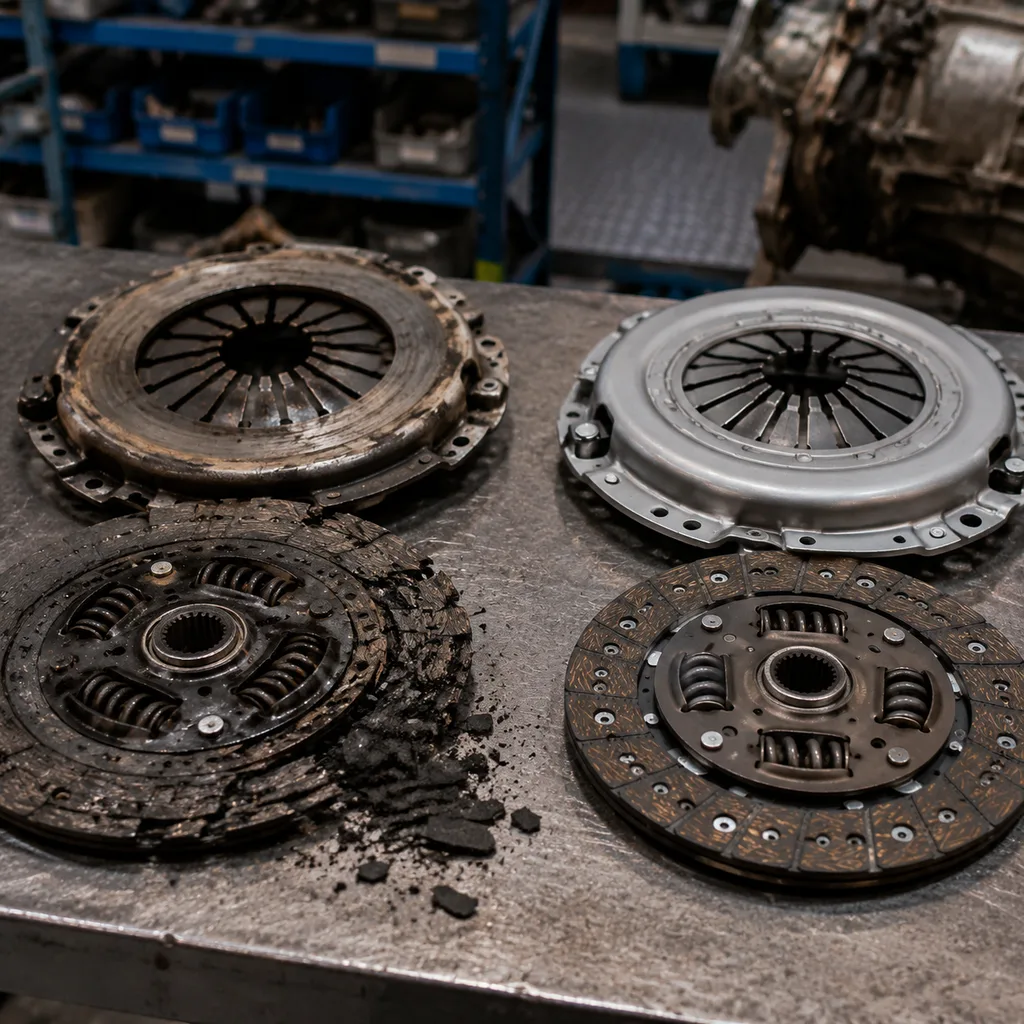
A lower unit price can be offset by higher returns, slower claims handling, or more workshop rework. In clutch applications, total cost of ownership depends on fit consistency, pedal feel, clamp-load stability, and how often the kit needs follow-up adjustment after installation. A well-matched aftermarket equivalent can perform well, but only when the supplier controls friction stability, cover spring rate, release bearing quality, and lot-to-lot dimensional tolerance.
For procurement teams, the practical comparison is usually: OE match versus acceptable tolerance band, not brand name versus brand name. If the disc OD is nominally 228 mm, buyers should still confirm the allowed variation, often ±0.3 mm to ±0.5 mm depending on the application; spline fit, hub runout, and friction face thickness should also be reported with actual readings. If clamp load is not documented, ask for test conditions and the measured range, such as minimum/target/maximum values at the stated installed height. On wear parts, small numeric differences matter because a 0.2 mm thickness shift can alter pedal travel, engagement point, and release margin enough to trigger field complaints.
What to verify before sample approval
If you are cross-referencing a specific OE number such as OE 06A107065, the right comparison is not only price. It is whether the replacement matches the installed hardware, pedal travel, and gearbox interface without modification. That includes checking spline engagement length, stack height, and release bearing compatibility so the installed kit behaves predictably under real service conditions.
A buyer-ready validation pack should include measured disc diameter, hub spline count and major/minor diameter, facing thickness, cover height, and bearing dimensions. Ask for the axial runout limit, friction coefficient range, and clamp-load test method used for approval; for example, a supplier should state whether the part passed dynamic balance and engagement checks at the same installed height used on the vehicle. If the application is sensitive, request a trial order with installation feedback from at least one workshop or fleet unit and compare pedal effort, noise, shudder, and slip over the first 1,000 km to 3,000 km of service.
When possible, match the part to the vehicle’s duty cycle: city delivery units need repeated start-stop durability, while highway or mixed-use fleets need thermal stability and consistent release feel. The safest supply decision is the one where the supplier can tie each batch to test data, material certificates, and the exact revision of the drawing or reference spec used for production.
Which commercial terms change the outcome
- MOQ is usually lowest on common applications and higher on niche or low-volume references; ask for MOQ by OE number, not by generic family
- Typical first-order lead time should be quoted separately from repeat-order lead time, since tooling release and packing setup can add days or weeks
- Request a price ladder for 100, 300, 500, and 1,000 units so you can see when freight and carton efficiency improve
- Confirm whether the quoted price includes inner box, export carton, barcode label, and pallet configuration
- Ask which components are made in-house and which are sourced, especially the disc facing, diaphragm spring, bearing, and hardware kit
- Require traceability by lot code, production date, and inspection status for any claim-sensitive programme
A practical sourcing rule for buyers
For buyers managing regional SKU rationalisation, a controlled aftermarket equivalent can reduce part proliferation while keeping service coverage intact. The strongest route is usually the one that balances application coverage, predictable supply, and documented validation, rather than the one that simply carries a familiar name.
A practical award decision should combine technical pass/fail criteria with commercial thresholds. For example, you might require: sample approval within 7 to 14 days, first production lead time of 25 to 35 days, repeat lead time of 15 to 25 days, and a pricing target that remains stable for at least one quarterly forecast cycle. If the supplier cannot hold tolerance, traceability, and replenishment timing together, the apparent savings on the unit price usually disappear in field cost and admin time. For that reason, buyers should compare not just the catalog price but also MOQ, packing configuration, sample policy, claim response time, and the supplier’s ability to support private label or programme-specific labeling.
Frequently asked questions
Not always. The applications may overlap, but you still need to verify disc diameter, spline count, cover height, bearing type, stack height, and torque capacity before treating them as interchangeable. A real comparison should also confirm tolerance bands, not only nominal dimensions.
For industrial procurement, ask for IATF 16949:2016 and ISO 9001:2015. For regulated materials, REACH (EC) No 1907/2006 is also relevant. Ask for test records tied to the part number, including measured dimensions, lot traceability, and approval dates.
Yes. We support specification-led programmes, packaging requirements, and private label supply through controlled manufacturing. Start with your OE reference, vehicle data, target annual volume, expected annual call-off, and required tolerance or validation documents so we can quote the correct build.
If you are comparing a clutch kit vs SKF alternative for a current programme, send the OE reference and target volume and we will review fitment, MOQ, pricing, lead time, and supply options at /contact.html.
Request a Quote