clutch kit · 2026-06-20

Clutch Kit Toyota Supplier: Sourcing Guide

If you are evaluating a clutch kit Toyota supplier, price should not be the first filter. The better question is whether the factory can hold key dimensions, friction behavior, and traceability across repeated production lots. For procurement teams, that means checking the bill of materials, release testing, packaging control, and the supplier’s ability to support OE-number cross-references without brand claims. Driventus is an independent aftermarket manufacturer; brand names are referenced for fitment only. Our approach is built for distributors, repair networks, and OEM/Tier-1 buyers that need repeatable supply rather than one-off shipments. We manufacture in Taizhou, Zhejiang, and export to 60+ countries under IATF 16949:2016 and ISO 9001:2015 systems. This article shows how to screen suppliers, where sourcing breaks down, and which commercial terms actually move the landed cost.

Decision framework: what to verify first

A clutch kit purchase starts with fitment control and ends with supply assurance. Before you ask for pricing, confirm that the supplier can match the application by OE cross-reference, transmission code, and engine family, then confirm the commercial terms that fit your channel.

A buyer-ready RFQ should ask for the following:

  • OE cross-reference handling: ask for the supplier’s reference format, such as `OE 31210-xxxxx`, and the matching application list by model year, engine code, and gearbox code.
  • Bill of materials: require the kit to be listed as friction disc, cover assembly, release bearing, and any pilot or alignment parts, with part numbers and material descriptions.
  • Dimensional control: request key dimensions with tolerances, including spline count, hub diameter, cover bolt circle, disc thickness, and release bearing ID/OD.
  • Packaging and labelling: specify carton marks, barcode, batch code, pallet count, and country-of-origin data so the receiving team can book stock without relabelling.
  • Documentation: request IATF 16949:2016, ISO 9001:2015, inspection records, and material declarations where needed.

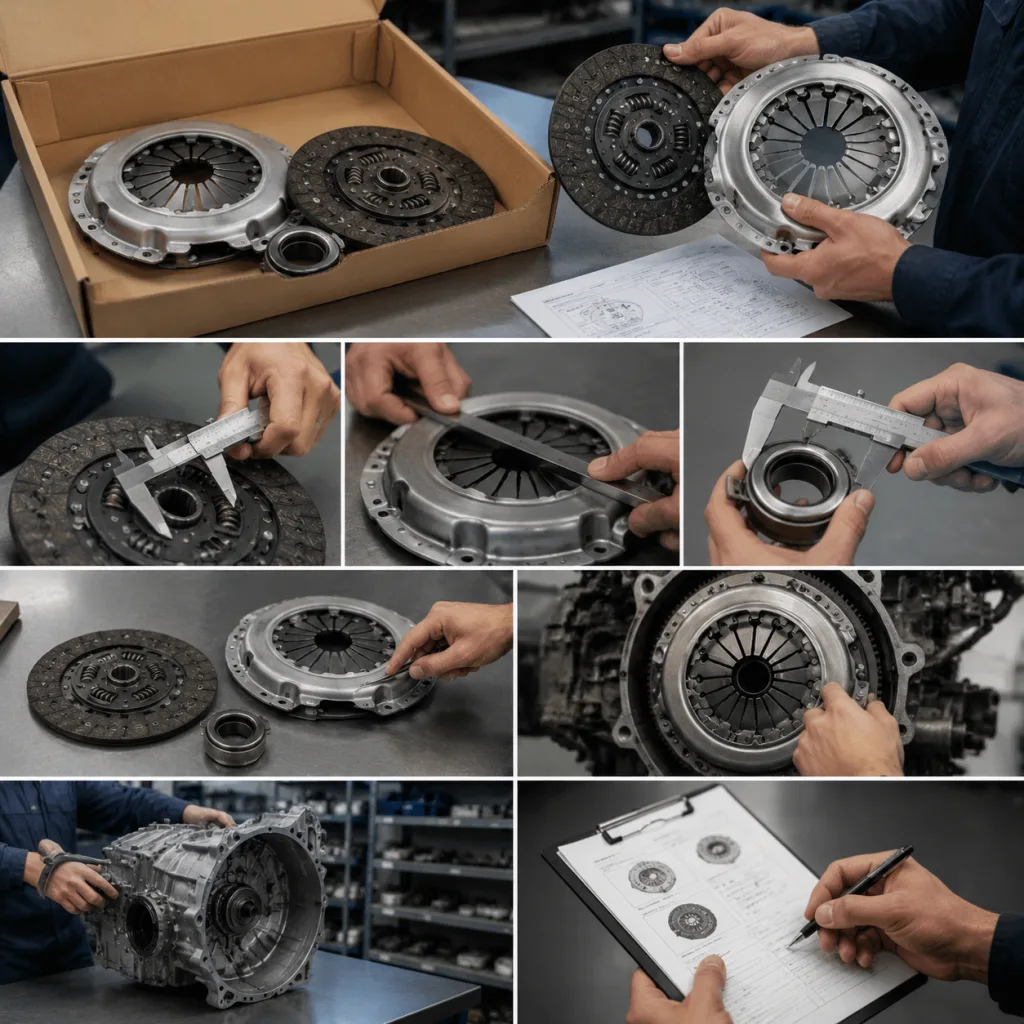
A Toyota application check should not stop at the vehicle badge. Confirm the gearbox family, then compare the sample against the installed part for spline count, hub depth, and cover height before approving volume supply.

For teams building a wider range, start with our catalog and review related powertrain lines under engine components.

Where sourcing fails: hidden cost drivers

The lowest unit price is often not the lowest landed cost. In clutch sourcing, the losses usually show up later: relabelling, mixed cartons, extra inspection, delayed launches, and returns that would have been avoidable with a tighter RFQ.

The main cost drivers are MOQs that are too high, lead times that are too vague, packaging that does not suit distribution, and sample parts that differ from production parts. If those items are not fixed at quote stage, the apparent savings disappear at receiving.

A practical quote should specify these numbers up front:

</tr></thead><tbody> </tbody></table>When comparing bids, ask every supplier to quote the same scope: product, label, carton, pallet, inspection documents, and any special inserts. If one quote excludes packaging or inspection, the savings are not real.

For distributors, a common decision rule is to test a new SKU with a lower MOQ, then scale to a replenishment plan once sell-through is proven. That keeps cash risk down while protecting supply continuity.

Where sourcing fails: hidden cost drivers

Spec deep-dive: what the kit must hold

A reliable supplier should be able to explain how the kit is built and how it is checked before release. For clutch kits, the critical points are friction stability, clamp load consistency, bearing noise control, and dimensional repeatability from lot to lot.

Driventus operates under a documented quality system aligned to IATF 16949:2016 and ISO 9001:2015. For procurement teams, that matters because it supports process control, batch traceability, and release discipline rather than inspection after the fact.

Typical release checks

  • Visual inspection for lining cracks, rivet condition, surface contamination, and plate deformation
  • Dimensional inspection for disc OD, hub concentricity, spline fit, cover height, and runout
  • Functional checks for release bearing smoothness, roughness, and rotation noise
  • Balance verification where the application calls for it
  • Packaging verification to confirm kit completeness, count accuracy, and label match
  • Lot traceability to support field claims and returns analysis

Suggested buyer tolerances to request

  • Disc thickness: match the approved sample, with lot variation controlled to the supplier’s internal specification and clearly stated in the report
  • Spline fit: no binding on the target transmission shaft; require a go/no-go fit check on the actual mating component
  • Cover height and bolt pattern: within drawing limits or confirmed sample baseline, with deviation flagged before shipment
  • Bearing noise: no abnormal sound or roughness during hand rotation, and no detectable play outside the stated acceptance window

Ask for the inspection format, not just a certificate. A useful pack includes sample photos, measurement points, measured values, and the inspector’s sign-off date. Where regulations apply, material declarations may be prepared for REACH (EC) No 1907/2006. For export markets that require broader vehicle-compliance context, buyers may also ask for documentation relevant to ECE R-83 or SAE J2527 only when applicable to the platform, not the clutch itself.

Step-by-step: how to validate fitment

Fitment errors are expensive because they usually appear after the product reaches the warehouse or workshop. The safest process is to validate by vehicle platform, transmission family, and OE reference before you place volume orders.

Use this approval sequence:

1. Confirm the engine and gearbox combination on the target vehicle file. 2. Match the clutch kit to the transmission code, not only the vehicle badge. 3. Check disc spline count, hub profile, and release system type against the removed part. 4. Compare cover assembly dimensions, bearing type, and mounting pattern against the existing sample. 5. Request a pre-production sample and measure it against your approved reference. 6. Record the approved dimensions, photos, and packaging standard in your item master before release to purchase.

For volume launches, define the approval gate. A practical rule is one physical sample for engineering sign-off, one carton sample for warehouse sign-off, and one pilot batch for field feedback before steady replenishment.

If your programme includes private label or regional packaging, custom manufacturing can support labelled kits, carton changes, and mixed-market configurations without changing the core product definition.

Step-by-step: how to validate fitment

Comparison: when to reject a supplier

A supplier can look competitive on paper and still create cost later. Reject the offer if any of the following are true:

  • No clear OE cross-reference method is provided, or the supplier refuses to identify the exact transmission family.
  • The supplier will not separate the kit BOM by component, material, and quantity.
  • Lead time is stated only as an estimate with no production schedule, no sample timing, and no shipment window.
  • Inspection records are unavailable, incomplete, or inconsistent by batch.
  • Samples differ materially from mass-production parts in fit, finish, or packaging.
  • Packaging cannot be controlled for export distribution, pallet loading, or barcode scanning.

A practical buyer test is to ask for the same item quoted three ways: sample, pilot, and mass production. If the supplier cannot keep the part definition, packaging spec, and lead time logic consistent across those three quotes, the sourcing risk is too high.

For purchasing teams, the best signal is consistency. A supplier that can support documented release, stable part matching, and predictable replenishment is usually the safer long-term choice than one that only sells on unit price. If you want a structured review of your target list, you can request a quote and ask for sample, lead-time, and packaging options in the same enquiry.

Frequently asked questions

No. Toyota fitments are one major application area, but we also support other passenger car and light commercial programmes. Cross-reference is handled by application data, not brand ownership.

Yes. We work with distributors, wholesalers, repair chains, and OEM/Tier-1 buyers. MOQ, carton spec, and replenishment terms can be aligned to channel needs, including pilot runs, mixed cartons, and repeat replenishment orders.

Typical documents include commercial invoice, packing list, inspection records, and traceability details. Quality documentation aligned to IATF 16949:2016 and ISO 9001:2015 can be shared where required, and packaging/label specs can be included in the shipment pack.

If you are benchmarking suppliers or building a new Toyota clutch programme, send your application list and target volumes to review sample options and commercial terms. Contact us at /contact.html

Request a Quote
Commercial item What to confirm Why it matters
MOQPer part number, per kit, or mixed carton; ask for the minimum order in pieces and cartonsAffects inventory risk, cash flow, and the ability to test a new SKU without overcommitting
Sample lead timeTarget 7-15 days for standard samples, depending on tooling and stock positionLets engineering and purchasing validate fitment before PO release
Pilot lead timeTarget 15-30 days for first batch or approved pre-production runReduces launch risk and helps confirm packaging, label, and barcoding
Mass-production lead timeCommonly 30-45 days after order confirmation and deposit for stocked processes; longer for special packagingPrevents stock-outs during demand spikes
PackingNeutral box, branded box, inner qty, outer carton size, pallet spec, and drop-test requirementReduces damage and relabelling cost
Payment termsDeposit, balance, or LC support; ask whether terms change by order size or repeat statusImpacts working capital
TraceabilityLot code, date code, inspection record, and retained sample policySupports warranty handling
IncotermsEXW, FOB, CIF, DDPChanges landed-cost calculations