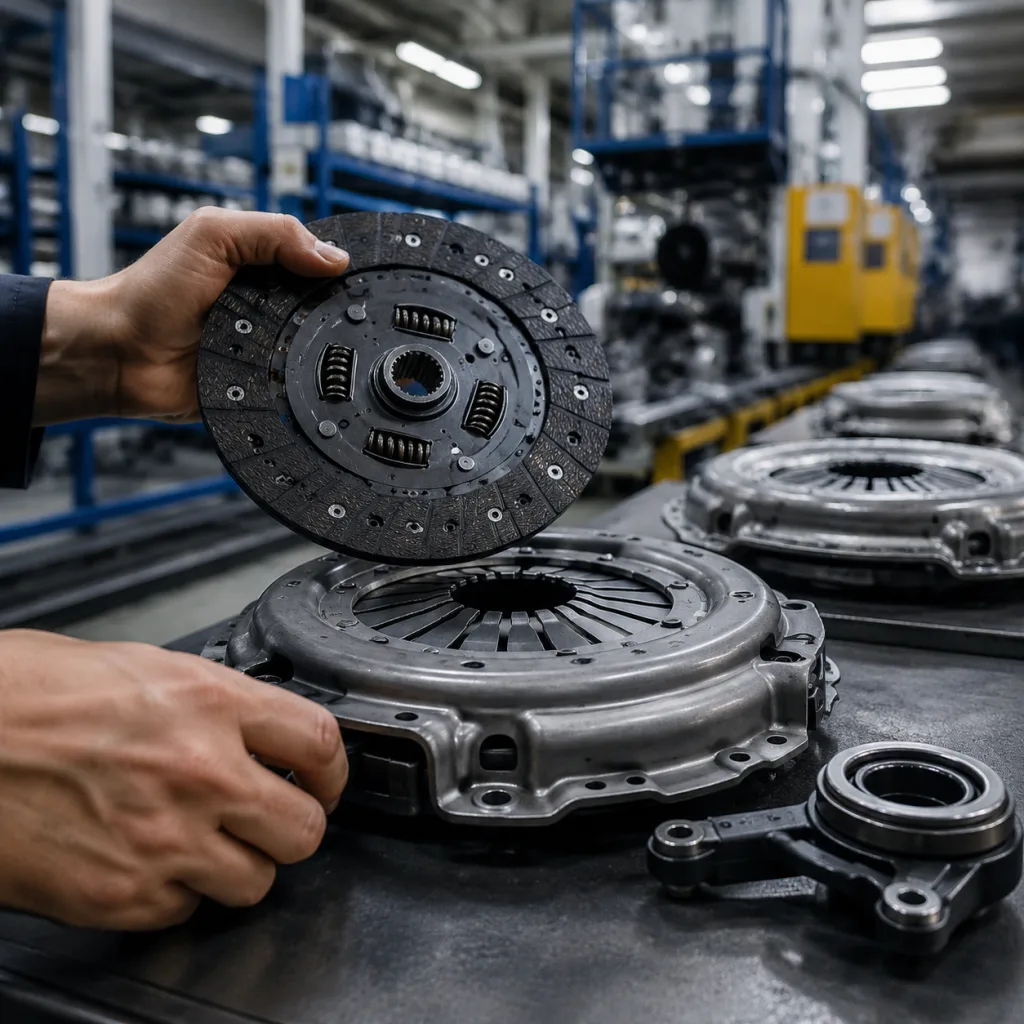
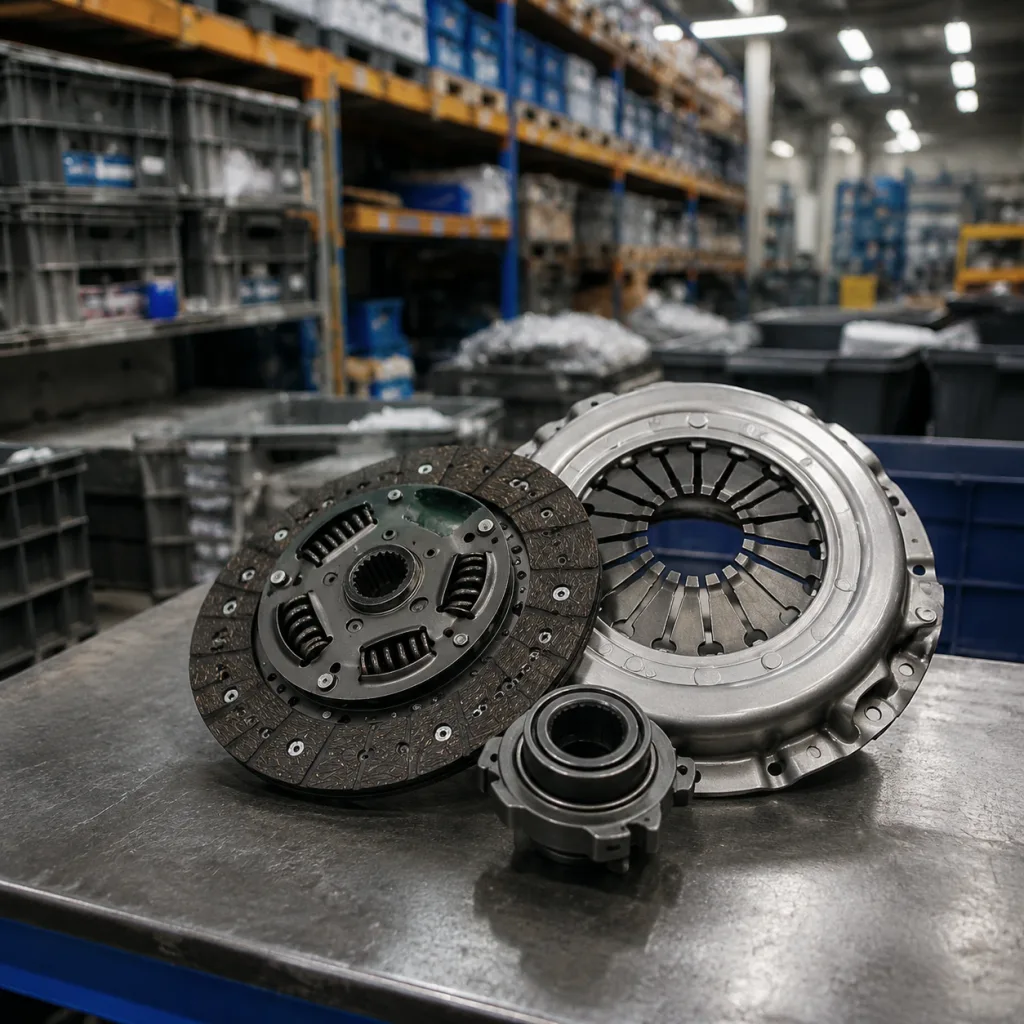
A clutch kit Skoda replacement programme usually starts for one of three reasons: warranty claims are rising, the range has too many near-duplicate SKUs, or supply for fast-moving applications has become unstable. The buying decision is not a simple part-number match. A reliable aftermarket range needs the right kit structure—pressure plate, driven disc, release bearing or concentric slave cylinder where required, fasteners where specified, installation notes, and traceable packaging. Common Skoda passenger-car applications use 190 mm, 200 mm, 215 mm, 220 mm, 228 mm, 230 mm, or 240 mm driven discs, with gearbox-dependent spline counts and release systems. Small deviations in cover height, spline fit, hub offset, or release travel can cause pedal noise, clutch drag, incomplete disengagement, or early slip. Driventus manufactures clutch kits for independent aftermarket supply with incoming material control, machining verification, assembly checks, and batch documentation under IATF 16949:2016 and ISO 9001:2015 frameworks. Driventus is an independent aftermarket manufacturer; vehicle brand names are used only for fitment identification.
Start With the Range Decision, Not the Catalogue Image
For a clutch kit Skoda replacement range, the first sourcing question is not “does the kit look the same?” It is “which applications can safely share one bill of materials?” Skoda passenger cars and light commercial variants use different clutch layouts depending on engine torque, gearbox family, model year, flywheel type, and release system. A kit should be specified against application data, gearbox code, disc outside diameter, spline count, hub offset, release type, and any application-specific fasteners.
The practical B2B target is broad coverage without careless consolidation. A catalogue image can hide meaningful differences in clamp load, release bearing height, diaphragm spring geometry, hub damper tuning, or cover assembly height. Merge too aggressively and fitment complaints follow. Split too cautiously and inventory cost rises.
Use this decision rule when structuring the range:
Separate the SKU when disc diameter, spline count, release bearing type, concentric slave cylinder configuration, flywheel type, or hub offset changes.
Review before merging when the cover bolt pattern is shared but clamp load, release travel, or diaphragm geometry differs.
Do not merge only because the kit appears similar in a photo or crosses to a broad generic reference.
Core kit elements should be defined before pricing:
Pressure plate: diaphragm spring design matched to clamp load, cover height, and release travel; clamp load should be agreed as a measured target, often within ±8–10% of the approved master sample.
Clutch disc: friction lining, hub damper, spline profile, cushion segment, hub offset, and rivet pattern; disc runout is commonly controlled within 0.50–0.80 mm depending on diameter and drawing requirement.
Release system: mechanical release bearing or concentric slave cylinder, depending on gearbox configuration; bearing height, mounting interface, and hydraulic connector angle must match the application.
Fasteners: included where torque-to-yield or single-use bolts are specified; bolt grade, thread pitch, coating, and torque sequence should be listed in the packing instruction.
Instructions and labels: fitment notes, installation cautions, batch code, country of origin, and barcode structure; distributor programmes often require EAN-13 or GS1-128 carton labelling.
When buyers request a clutch kit Skoda replacement range, Driventus reviews fitment data, sample parts, and the proposed bill of materials before confirming coverage. OE part-number cross-references may be used for fitment mapping where supplied by the customer. No vehicle manufacturer approval is implied.
The Dimensions That Decide Fit or Failure
Clutch quality is not judged by one component. The pressure plate, flywheel face, disc hub, gearbox input shaft, release fork or hydraulic actuator, and bearing travel work as one system. For sourcing, the drawing pack should state measuring datum, tool type, sample size, and acceptance rule. “Same as OE” is not enough.
Parameter
Buyer Check
Practical Tolerance / Target
Typical Risk if Incorrect
Disc outside diameter
Match application specification
Usually ±0.30–0.50 mm against drawing
Reduced torque capacity or housing interference
Spline count and major diameter
Verify with gearbox input shaft
100% go/no-go gauge check for first lot
Installation failure, shaft fretting, or noise
Cover assembly height
Compare against OE sample datum
Often controlled within ±0.50 mm
Wrong release point or clutch drag
Diaphragm finger height
Measure after assembly
Max spread commonly ≤0.50–0.80 mm
Pedal vibration or bearing overload
Hub offset
Confirm flywheel-side orientation
Typically ±0.30–0.50 mm
Contact with flywheel bolts or gearbox housing
Release bearing height
Match release fork or CSC travel
Commonly ±0.30 mm on critical height
Incomplete disengagement or preload failure
Bolt circle and locating features
Check against flywheel pattern
Position usually controlled within ±0.20–0.30 mm
Misalignment, vibration, or assembly rejection
Disc lateral runout
Check after riveting and balancing
Commonly ≤0.50–0.80 mm TIR
Judder, drag, or uneven lining wear
Rotating balance
Confirm at defined rpm
Customer-specific g·mm limit by diameter
Vibration and premature bearing wear
</tr></thead><tbody> </tbody></table>For high-volume replacement programmes, approve inspection drawings with fixed datum points. Critical dimensions should be checked with calibrated gauges, CMM or height measurement where appropriate, and spline go/no-go tools. A typical first-article file includes 5–10 measured samples, followed by lot-based inspection records using AQL or customer-defined sampling.
Friction material also needs a defined target. An aggressive lining can increase judder, noise, and flywheel wear. A low-friction compound can reduce the clamp safety margin during loaded starts or frequent urban use. For aftermarket distribution, the better balance is stable engagement, thermal resistance, controlled wear, and predictable pedal feel. Buyers should ask for friction coefficient targets, fade recovery data after elevated-temperature cycling, and lining thickness tolerance, commonly ±0.15–0.25 mm where drawings require it.
A Launch Test Sequence Buyers Can Enforce
Before volume shipment, validate the kit in a sequence that catches both component problems and range-data errors. For a new clutch kit Skoda replacement programme, a practical approval route is: sample build, dimensional first-article report, functional bench testing, packaging drop check, and signed fitment confirmation against the application table.
Useful validation points include:
Static clamp load measurement for pressure plate assemblies, reported in N against the approved master sample and normally controlled within ±8–10% unless the customer drawing specifies tighter limits.
Release load and travel curve checks, including lift-off point, maximum release load, and return behaviour through the full bearing stroke.
Burst speed testing for driven plates where required by internal safety criteria; buyers often specify a safety margin above maximum engine speed, such as 1.5–2.0 times rated rpm.
Torque capacity verification against engine output margin, with a target safety factor commonly 1.25–1.50 over peak engine torque for standard replacement use.
Balance control for rotating assemblies at the defined rpm and correction plane.
Friction lining shear and rivet retention checks, with actual values recorded rather than pass/fail only.
Endurance cycling for diaphragm spring fatigue, including clamp-load retention after repeated release cycles.
Noise, vibration, and harshness review using application samples or bench simulation, especially for DMF applications and low-speed urban use.
Do not treat one strong sample as a launch guarantee. Repair-chain supply depends on repeatability. A kit may pass the first bench test and still create claims if later lots drift in release height, lining thickness, or bearing specification.
Driventus controls batch traceability from friction material and stamped steel components through machining, assembly, and final inspection, so quality teams can connect field feedback to production data. A buyer-ready launch file should identify the approved sample code, production lot, inspection operator, gauge numbers, friction batch, bearing batch, and carton label revision.
Where market access requires chemical compliance documentation, materials can be reviewed against REACH (EC) No 1907/2006 requirements. Packaging and labelling can also be configured for customer import, warehouse, and e-commerce data standards. Buyers can review related product groups in our catalog.
RFQ Checklist: What to Ask Before Price
A clear RFQ prevents quotation gaps and later warranty arguments. It also forces suppliers to quote the same kit structure instead of hiding differences in bearing brand, fastener content, packaging, or inspection depth. Include annual volume, target SKUs, packaging type, first shipment date, Incoterm, destination port, and whether the programme needs Driventus branding, neutral packaging, or private label.
Documents to Request
IATF 16949:2016 and ISO 9001:2015 certificate copies.
Control plan for clutch cover, disc, and bearing or CSC assembly.
Key inspection report with actual measured values for disc diameter, spline fit, cover height, finger height, runout, bearing height, and kit weight.
Material declaration for friction lining and metallic components, including REACH/RoHS status where relevant to the buyer’s market.
Packaging specification, carton drop-test approach, and pallet plan; export cartons should normally be tested for compression, corner drop, humidity exposure, and label readability.
Batch traceability format and warranty claim process, including required photos, mileage, vehicle data, and return-part handling.
Commercial and Range Data
Application list by model, engine, gearbox, year range, and market.
MOQ by kit family and by private-label packaging option; as a working planning range, standard-packed repeat orders often start from 100–300 kits per SKU, while private-label or new-tooling items may require 300–1,000 kits depending on parts commonality.
Lead time for first-article samples and repeat production; typical planning assumptions are 20–35 days for sample confirmation after technical data is frozen, 45–75 days for first mass production, and 30–60 days for repeat orders subject to bearing and lining availability.
Barcode type, label language, carton quantity, and master-carton format; many warehouse systems require one sellable kit per inner carton and 2–4 kits per master carton depending on weight.
Incoterms, consolidation options, and shipment inspection method, such as EXW, FOB, CIF, or DDP by agreement.
Price logic by forecast tier, because a quote for 50 kits per SKU will not carry the same steel, bearing, packaging, and setup economics as a 500-kit call-off.
One more issue belongs in the RFQ: catalogue maintenance. Engine-code splits, gearbox changes, and release-system revisions can create expensive returns if the application table is not updated. The supply agreement should define who owns cross-reference updates, how supersessions are communicated, and whether old packaging may still be shipped after a label revision.
Driventus supports aftermarket distributors with standard kits, private-label packaging, and application-specific engineering review. For buyers needing a non-standard kit structure, custom manufacturing can cover drawings, sample reverse engineering, and dedicated validation requirements.
Where Production Control Actually Breaks Down
Clutch kit production can fail at several points before final packing: stamping, machining, heat treatment, friction material bonding or riveting, bearing sourcing, and assembly. Final visual inspection will not catch every problem. The controls need to sit at each process stage.
Driventus operates under a documented quality system aligned with IATF 16949:2016 and ISO 9001:2015. For clutch programmes, production controls may include incoming steel hardness checks, diaphragm spring load testing, disc runout measurement, cover flatness control, spline gauge verification, release bearing checks, and final kit audit. Typical process gates include incoming material inspection, stamped-cover verification, spring heat-treatment review, pressure-plate machining inspection, disc riveting audit, bearing incoming check, functional assembly check, and final packing scan.
Important inspection items include:
Disc runout and parallelism after riveting, commonly checked with a dial gauge on a rotating fixture.
Pressure plate surface finish and flatness; buyers may specify Ra and flatness limits where noise or engagement quality is critical.
Diaphragm spring finger height distribution, measured at a defined installed load or reference position.
Cover bolt-hole position and thread condition, checked using locating fixtures and thread gauges.
Release bearing rotation smoothness and axial clearance, with abnormal noise, roughness, or grease leakage rejected.
CSC sealing and connection checks where applicable, including pressure-hold testing and connector-orientation confirmation.
Kit completeness and label accuracy, ideally verified by barcode scan against the bill of materials before carton sealing.
Torque-mark and fastener verification where single-use bolts are packed inside the kit.
Export documentation should match the physical kit from production through warehouse receipt. Importers in the EU, UK, US, Canada, Australia, and Brazil often need stable HS coding, country-of-origin marks, carton labels, and batch numbers that remain readable after storage and transport. Warranty teams benefit from QR or barcode tracking that links claims to production date, inspection records, and the original shipment. A buyer-ready traceability label should normally contain SKU, batch number, production date or code, quantity, country of origin, barcode, and packaging revision.
Warranty Triage: What the Complaint Usually Means
Most clutch claims fall into a small group of causes: installation error, incorrect application selection, hydraulic system faults, contamination, flywheel surface problems, or genuine component defect. Treating every complaint as a defective kit slows resolution and hides the real pattern. Warranty analysis should separate “no fit”, “noise”, “slip”, “drag”, “judder”, “pedal issue”, and “leakage”. Each category points to a different root-cause path.
Common scenarios:
No fit: application data, gearbox code, spline count, bearing type, or hub offset may be wrong.
Slip: clamp load, friction material, oil contamination, flywheel condition, or incorrect break-in should be checked.
Drag: release travel, hydraulic bleeding, disc runout, spline movement, or cover height may be the cause.
Judder: flywheel surface, disc parallelism, contamination, hub damper match, or installation alignment can be involved.
Pedal noise or vibration: diaphragm finger height, release bearing preload, fork condition, or bearing quality needs review.
Leakage: CSC seal quality, connector fit, hydraulic line condition, or installation damage should be isolated.
A replacement range should define exclusions and inspection conditions. If a dual-mass flywheel is outside wear tolerance, a new clutch kit may still judder or slip. If the hydraulic system contains air or has a weak master cylinder, the driver may report poor disengagement even when the clutch cover and disc are correct. Oil contamination from a rear main seal or gearbox input-shaft seal can create the same symptom set.
Recommended warranty-reduction controls include:
Fitment tables that distinguish engine code, gearbox, production year, and market.
Clear instruction to inspect flywheel face, pilot bearing where fitted, and rear main seal leakage.
Separate coding for kits with mechanical release bearing and kits with concentric slave cylinder.
Installer guidance on spline lubrication, bolt tightening sequence, and correct disc orientation; over-lubrication should be avoided because excess grease can contaminate the lining.
Photos or measurement evidence required for claim review, including disc orientation, flywheel face, release system, and failed component close-ups.
Sample retention from each shipment, commonly 1–2 kits per production batch for dispute comparison and repeat measurement.
For supplier comparison, unit price is only one line. The stronger question is whether the factory can hold release geometry, friction behaviour, packaging accuracy, and batch traceability across repeat orders. To discuss a clutch kit Skoda replacement programme, buyers can request a quote with target applications, annual volume, desired MOQ, price tier, lead-time requirement, and packaging standard.
Frequently asked questions
Check application data, gearbox type, disc diameter, spline count, release bearing type, cover height, hub offset, and whether the vehicle uses a single-mass or dual-mass flywheel. Buyers should also request inspection reports, sample validation results, and batch traceability details before volume orders.
Yes. Driventus can support private-label packaging, carton labels, barcode formats, and application lists for distributors and repair chains. MOQ, lead time, and packaging structure depend on kit complexity and annual forecast.
No. Driventus is an independent aftermarket manufacturer; brand names are referenced for fitment only. Products are developed for aftermarket replacement use and validated against dimensional, material, and performance requirements.
If your team is building or reviewing a clutch replacement range, send target applications, annual demand, and packaging requirements. Driventus can review fitment and supply options through /contact.html