Camshaft for Toyota Land Cruiser Replacement Guide
Buying a camshaft for Toyota Land Cruiser replacement is not a simple catalogue match. It is a fitment, metallurgy, inspection and logistics decision rolled into one part number.
Land Cruiser engines work in fleets, mines, farms, workshops, remote-service routes and off-road conditions where a small error in lobe phasing, journal size or surface hardness can become a warranty problem far from the original warehouse. The camshaft has to bolt in, but it also has to preserve valve timing, oil clearance, follower contact and corrosion protection through international distribution.
This guide is written for B2B buyers: distributors, importers, repair-chain purchasing teams and sourcing engineers comparing aftermarket Land Cruiser camshafts for repeat supply. It covers how to identify the right application, where replacement programmes fail, what to measure, how to validate first samples, and how MOQ, packaging and documentation affect landed risk.
Driventus manufactures engine components in Taizhou, Zhejiang, and supplies export markets under IATF 16949:2016 and ISO 9001:2015 process controls. Driventus is an independent aftermarket manufacturer; vehicle brand names are referenced for fitment identification only.
Start With the Fitment Decision, Not the Photo
Land Cruiser camshafts can look deceptively similar across petrol and diesel engine families, production years and regional specifications. A visual match is useful for screening. It is not enough for a controlled replacement programme.
Before sourcing, confirm the exact engine code, cylinder head type, valve-train layout, cam drive arrangement, sensor trigger design and lubrication path. For Toyota Land Cruiser replacement camshafts, buyer-side references often include OE-style numbers beginning with 13501 or 13502, but the reference still has to be matched to the correct engine variant and market.
Build the quotation file around evidence, not assumptions:
Engine code, model-year range and destination market
OE cross-reference used in the buyer system
Overall length, lobe count, journal count and thrust-face details
Drive-end photos showing gear, sprocket, dowel or keyway features
Sensor trigger wheel or machined reference feature, where fitted
Oil-groove position and visible lubrication passages
Sample part, drawing or approved inspection report, if available
The hidden risk is a camshaft that installs correctly but changes how the engine behaves. A 1°–2° phasing error can shift timing. A small journal deviation can affect oil clearance. Wrong surface hardness may not show during assembly, then becomes lobe wear, valve-train noise, low power, oil-pressure complaints or warranty claims after 500–5,000 km.
Driventus reviews application data, sample parts and buyer-supplied drawings where available. For range planning, buyers can compare camshafts and related engine parts in our catalog and review the engine component range at /products/engine-components.html.
Failure Modes That Inspection Should Catch Early
A camshaft replacement programme should define measurable acceptance criteria before sample approval. Otherwise the buyer is left comparing weight, appearance and packaging while the real risk sits in geometry and surface condition.
The most common failure modes are practical ones: tight journals, noisy valve-train operation, early lobe wear, poor timing accuracy, corrosion after sea freight, or repeat claims caused by worn companion parts. Each points to a control that should be checked before shipment.
Control item
Why it matters in procurement
Typical target or tolerance
Typical inspection method
Journal diameter
Controls oil clearance and bearing support
Drawing value, often ±0.010–0.020 mm
Micrometer, CMM
Lobe lift and base circle
Determines valve lift and engine breathing
Lift variation typically ≤0.03 mm versus approved sample
Journals often Ra 0.2–0.4 μm; lobes often Ra 0.4–0.8 μm
Roughness tester
</tr></thead><tbody> </tbody></table>Material route changes the risk profile. Chilled cast iron, forged steel and alloy steel blanks can all be suitable, depending on engine design, follower interface and durability target. A high-hour diesel utility engine does not have the same wear pattern as a lower-mileage petrol application.
For chilled cast camshafts, ask how chill depth, carbide distribution and graphite structure are controlled. For forged or alloy-steel camshafts, the quotation should state steel grade, normalising or quenching route, tempering condition and whether induction hardening or nitriding is used.
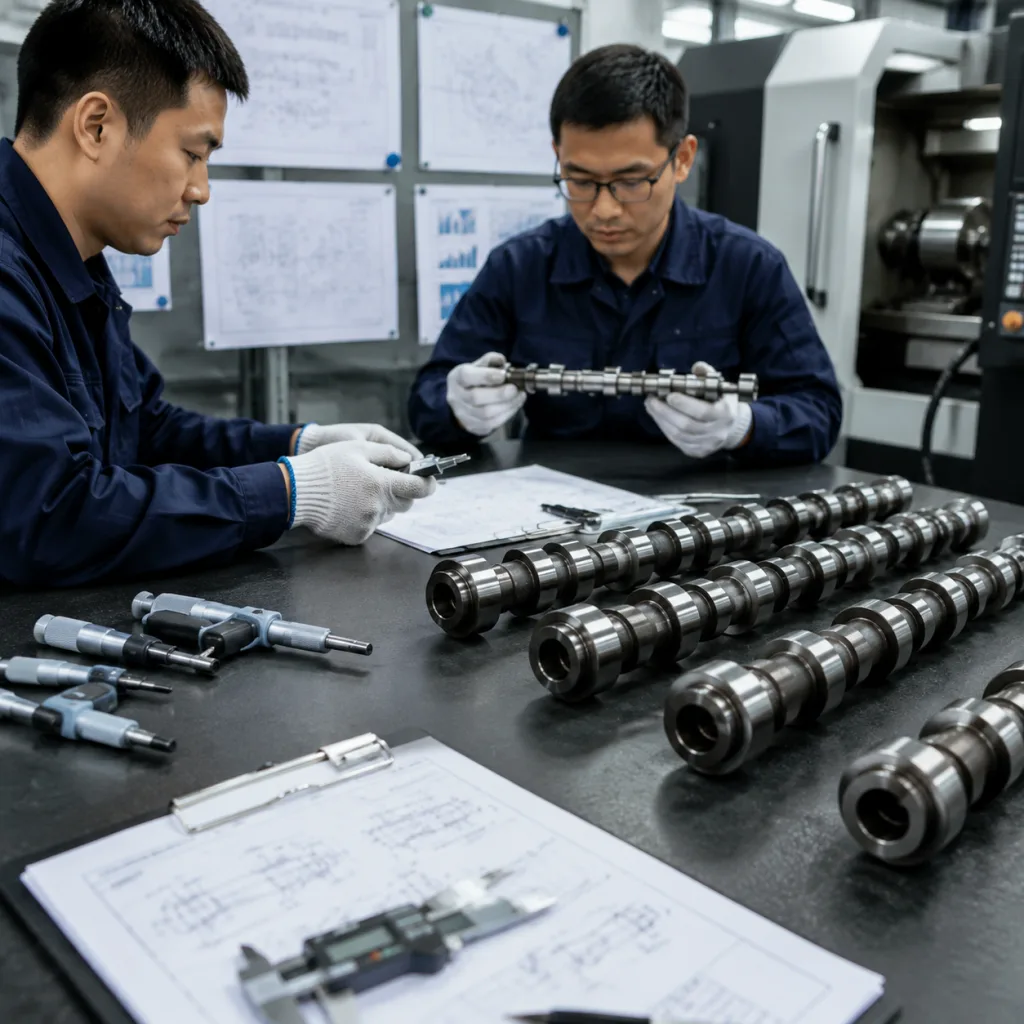
Receiving inspection should be specific. Use 100% visual checks, sampling dimensional checks by lot and hardness verification on loaded surfaces instead of random cosmetic areas. Driventus applies incoming material checks, controlled machining, heat-treatment verification and final inspection records through its quality system. The relevant management standards are IATF 16949:2016 and ISO 9001:2015. For EU and UK buyers, material declarations may also be requested to support compliance screening under REACH (EC) No 1907/2006.
A Sample-Approval Sequence That Reduces Warranty Risk
For a camshaft for Toyota Land Cruiser replacement, validation should prove three things: the part fits the head, the timing features are correct, and the loaded surfaces can survive the intended service.
A practical approval sequence looks like this:
1. Confirm application data: engine code, market, OE cross-reference, sample or drawing basis. 2. Inspect first articles against the approved sample or drawing, usually with 3–5 pieces checked before release. 3. Verify metallurgy and heat-treatment condition, including hardness mapping on lobes, journals and drive-end areas. 4. Measure lobe lift, base circle, journal diameter, dowel or keyway position, thrust face and runout. 5. Trial-assemble in a representative cylinder head where available, checking rotation torque, end float and oil-feed alignment. 6. Review rust-prevention and packaging performance for the expected freight route and warehouse time. 7. Freeze the inspection report format, label file and batch traceability method before mass production.
For repeat production, traceability matters as much as the first sample. Each lot should connect to the material heat, machining route, heat-treatment record, inspection result and packing date. This lets importers investigate a claim by batch instead of quarantining an entire product range.
A useful batch file includes the material certificate or heat record, hardness report, key dimensions, photos of labels, carton count and inspector approval. Buyers should also define the AQL or sampling plan before ordering. Critical dimensions such as journal diameter, lobe lift, dowel position and runout may require tighter sampling or 100% checks on early batches; carton appearance can usually follow a normal packing inspection plan.
After two or three shipments pass without corrective action, inspection intensity can be adjusted by agreement. Do not remove the controls entirely. Camshafts are not forgiving parts, and a small upstream drift can produce expensive downstream diagnosis.
Commercial Sourcing: What Changes MOQ, Price and Lead Time
A sourcing file should separate technical approval from commercial planning. Mixing the two creates avoidable delays: the sample is ready but the label is not approved, or the price is agreed but the inspection scope has changed.
Use this checklist before placing a production order:
Vehicle platform, engine code and production-year coverage
Market region and any regional engine variation
OE part-number cross-reference format, such as buyer-supplied OE 13501… or OE 13502… references
Sample comparison or drawing approval status
Material grade and heat-treatment route
Hardness range, surface roughness target and runout limit
Packaging specification, label language and barcode requirement
MOQ, lead time, carton quantity and pallet configuration
Inspection report format and batch traceability method
Warranty handling process and claim evidence requirements
Import documentation, HS code confirmation and country-of-origin marking
For development, 1–3 sample pieces per part number may be enough for dimensional review and trial assembly. For the first production order, 50–100 pieces per SKU may be realistic where tooling, fixtures or packaging are already available. Mixed-SKU consolidation can support lower individual volumes when the total order value and packing efficiency make sense.
Final MOQ depends on raw material availability, machining setup time, heat-treatment batch size and packaging type. Price usually moves with material route, machining complexity, lobe count, heat treatment, inspection level, packaging and annual volume. A low-volume private-label order with custom cartons and full inspection reporting will normally cost more per unit than a repeat catalogue order in neutral cartons.
Compare quotations only when the assumptions match: Incoterm, currency, annual volume, sample cost, tooling or fixture charge, packaging standard, inspection document scope and validity period.
Lead time should also be staged. If a standard part and packaging are available, sample dispatch may take about 7–15 days and production may take about 30–45 days after deposit and artwork approval. New or reverse-engineered parts may require 45–75 days or more for drawing confirmation, fixture preparation, sample machining, heat-treatment validation and buyer approval before mass production.
For mixed Land Cruiser fleets, confirm regional specification carefully. GCC, Australian, European, African and Latin American market vehicles may not always share the same engine configuration. Where standard catalogue parts are not enough, Driventus supports custom manufacturing based on drawings, OE samples or validated buyer specifications.
Export Scenario: The Part Passed Inspection, Then Failed in Transit
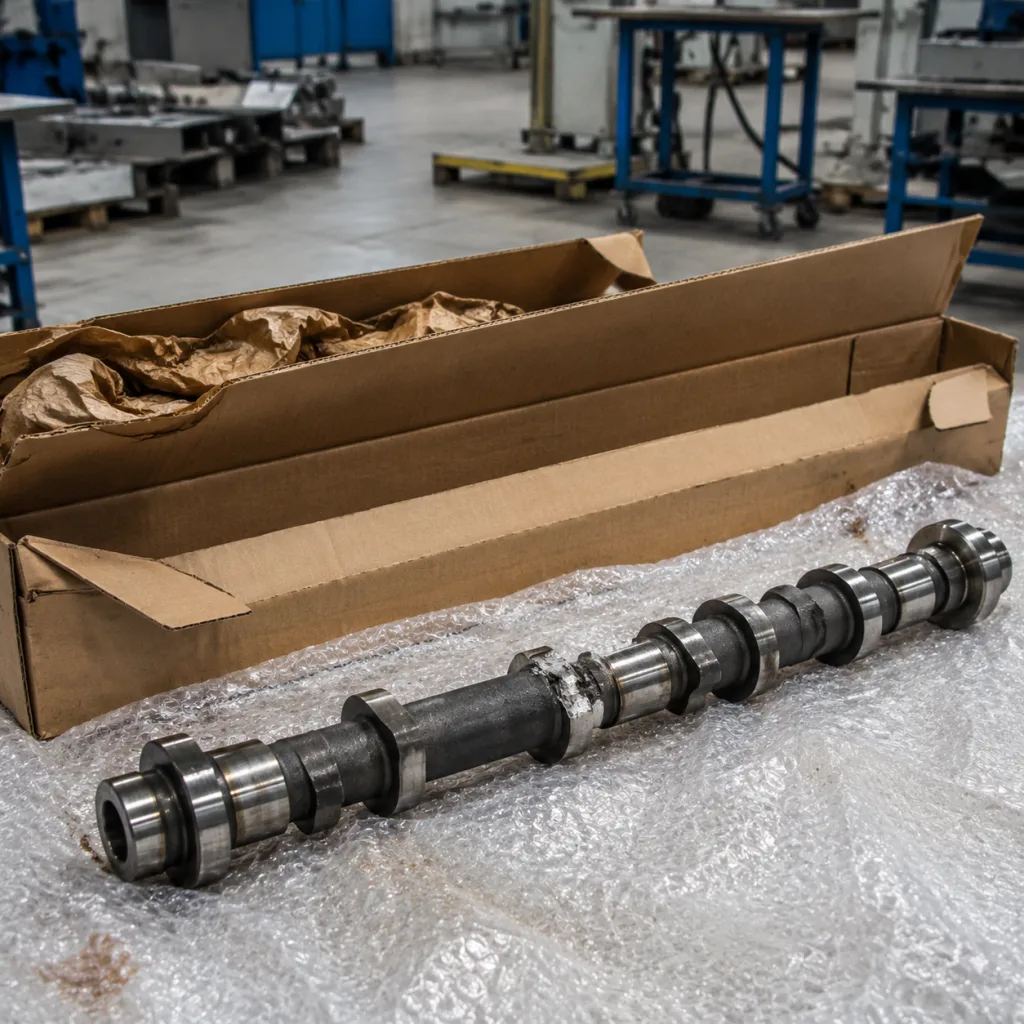
Camshafts are long, precision-machined parts with exposed bearing and lobe surfaces. A part can leave final inspection correctly and still arrive with corrosion, dents, bent shafts or surface marks if packaging is treated as an afterthought.
A realistic export specification should answer four questions:
How is the machined surface protected from rust?
How is the shaft supported along its length?
How is movement inside the carton prevented?
How will the importer identify the batch on arrival?
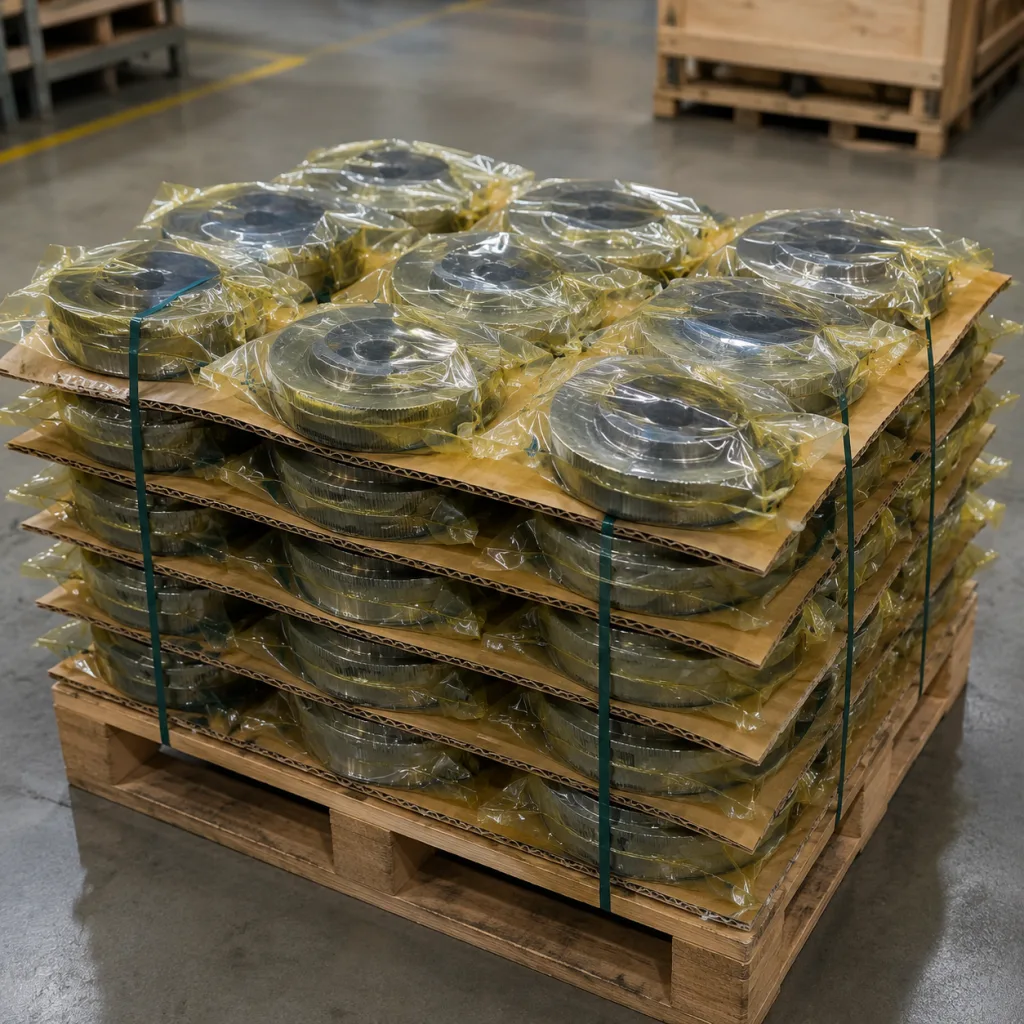
For export programmes, Driventus can align packaging with buyer requirements, including neutral cartons, private-label cartons, rust-preventive wrapping, desiccants, reinforced inner supports and palletised loading. The packaging method should be agreed before quotation because it affects unit cost, carton size, pallet pattern and container loading.
A practical specification may include VCI bag or anti-rust oil, plastic end caps, foam or moulded pulp supports at both ends and centre, a single-piece inner box, 5-ply master carton and stretch-wrapped pallet. For long sea freight routes, buyers commonly request 6–12 months of corrosion protection under normal dry storage.
Do not use a loose oversized box. Camshafts should not shift inside the carton; a 2–5 mm controlled clearance with firm supports is safer. Importers should confirm gross weight limits for manual handling, carton drop-test expectations, pallet height, label position, barcode type and whether mixed SKUs are allowed on one pallet.
Professional importers usually request:
Commercial invoice and packing list
Certificate of origin, where required
Batch inspection report
Material or process declaration, when agreed
Product photos and label file for inbound checking
Quality management certificates, including IATF 16949:2016 and ISO 9001:2015
Supply stability needs the same discipline. Buyers should share 3–6 month rolling demand where possible, especially for slow-moving Land Cruiser applications requiring special blanks or dedicated machining fixtures. For private-label programmes, agreed safety stock or quarterly forecast ordering can reduce urgent air-freight costs and stockout risk.
Q&A for Repair Chains: Replace the Camshaft Alone?
When is camshaft replacement usually triggered?
Replacement demand often starts with visible lobe wear, abnormal valve-train noise, low cylinder performance, oil starvation damage or engine rebuild work. Field teams may also report pitted lobes, scored journals, blueing from heat, measurable lobe-height loss, excessive end float, cracked drive features or repeated valve-clearance changes after adjustment.
Is the camshaft always the root cause?
No. Camshaft damage is often part of a wider valve-train or lubrication problem. A new camshaft installed with worn followers, blocked oil galleries, contaminated oil or incorrect lubricant can fail even when the replacement part is dimensionally correct.
What related parts should be inspected or sourced together?
Followers, tappets, rocker arms or buckets
Cam bearings or cylinder-head bearing surfaces
Timing chain, belt, gears, guides and tensioners
Oil pump output and oil gallery cleanliness
Valve springs, retainers and seals
Cylinder head alignment and lubrication condition
Why does this matter for distributors?
Kit-based procurement reduces incomplete repairs and lowers the chance of repeat labour claims. Offering related valve-train components with the camshaft also improves application coverage and helps reduce returns caused by system-level faults rather than part defects.
What should a warranty claim file include?
A practical claim file should include installer invoice, vehicle application, mileage at installation and failure, oil grade, photos of all lobes and journals, follower photos, timing-drive condition and batch label. Without this evidence, it is difficult to separate dimensional mismatch, surface distress, oil starvation, abrasive contamination and incorrect companion parts.
A replacement camshaft should restore OE-equivalent function without implying vehicle-manufacturer approval. Driventus is an independent aftermarket manufacturer; brand names are referenced for fitment identification only.
Frequently asked questions
Provide the engine code, model-year range, market region, photos of the original part, sample or drawing if available, target quantity, packaging requirement and any OE cross-reference used in your system. Add expected annual volume, first-order quantity, label rules and required inspection documents so pricing, MOQ and lead time can be calculated accurately.
Yes. Driventus supports neutral and private-label packaging for qualified B2B orders. Label format, carton strength, corrosion protection, barcode rules and pallet configuration should be confirmed before quotation and sample approval. Custom packaging may affect MOQ, unit cost and production lead time.
No. Driventus does not claim approval or endorsement by any vehicle manufacturer. Driventus is an independent aftermarket manufacturer; brand names are referenced for fitment identification only. Parts are developed for replacement fitment based on samples, drawings and buyer specifications.
For pricing, samples, validation documents or application review, send your engine code, OE reference, target quantity, packaging requirement and delivery market to Driventus. You can [request a quote](/contact.html).