Buying a clutch kit for Jaguar applications from China is a sourcing decision, not a catalogue exercise. The first question is simple: does the supplier prove fit, control variation, and document what leaves the factory? For aftermarket distribution, repair chains, and OE-aligned supply, the key checks are the same: correct vehicle coverage, stable friction performance, release-bearing fit, and packaging that survives transit. Driventus is an independent aftermarket manufacturer; brand names are referenced for fitment only. Our plant in Taizhou, Zhejiang supplies clutch-related components under `IATF 16949:2016` and `ISO 9001:2015` controls, with export documentation for the EU, UK, US, Canada, Australia, and Brazil. The sections below focus on the decisions buyers actually make: what to verify first, where programs fail, how suppliers compare, and when samples are ready to scale.
Start with fitment, not price
For a `clutch kit jaguar manufacturer china` search, price is the last filter. Start with evidence that the kit matches the vehicle family, gearbox, and clutch architecture you actually buy.
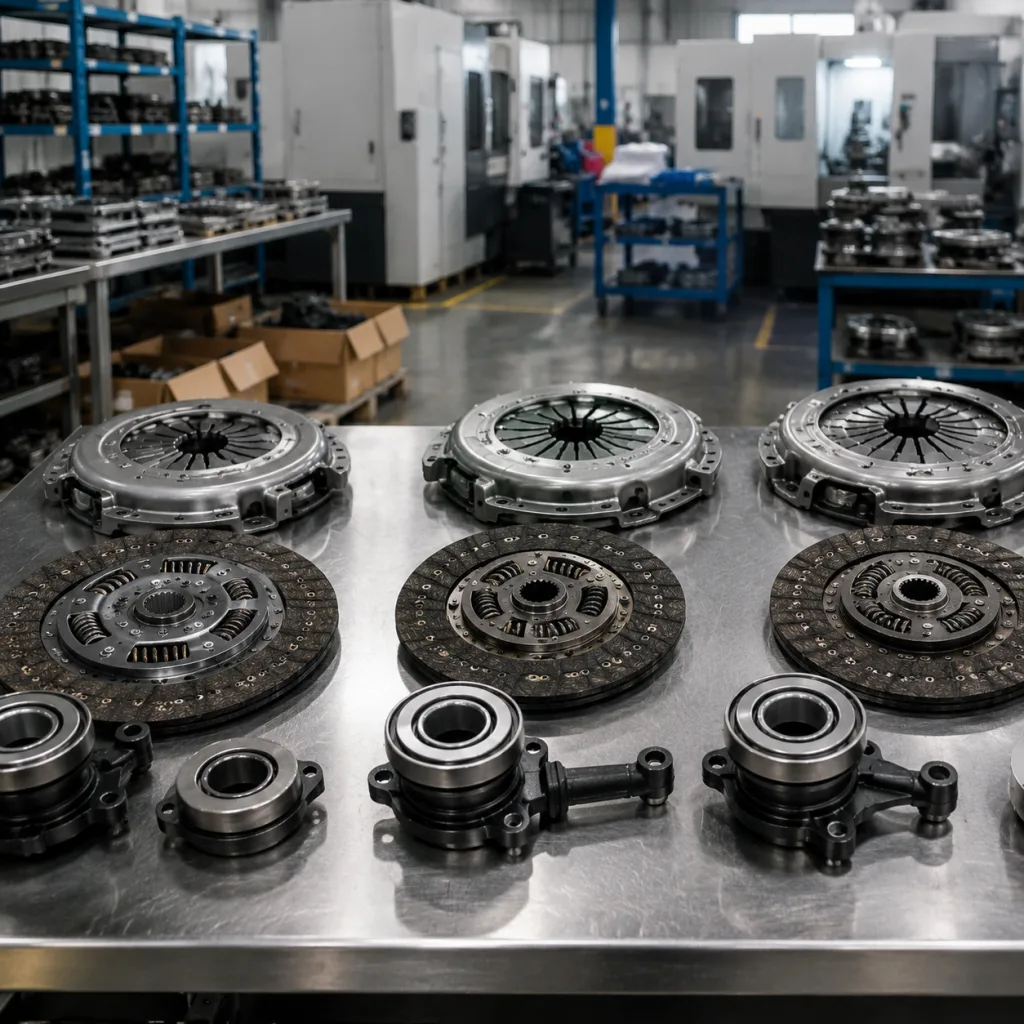
Ask for the application list, OE cross-reference where available, and the full kit bill of materials. A complete kit normally includes the pressure plate, driven plate, release bearing, and any alignment hardware specified for the application.
Minimum fitment checks
Vehicle range by engine code, transmission, and model year
OE cross-reference format, for example `OE 06A107065` when that style is already in use
Spline count, disc diameter, cover bolt pattern, and release-bearing geometry
Friction lining material, rivet pattern, and hub damper specification
Packaging method, corrosion protection, and shelf-life expectation
Traceability back to batch, press line, and inspection record
If the supplier cannot provide dimensional data and sample traceability, the offer is not ready for purchasing review.
Buyer-ready spec request
Disc outer diameter: nominal size in mm and allowable tolerance, for example `215.0 mm ±0.30 mm`
Disc thickness: new-part thickness and wear limit, with measured lot variation stated
Hub spline: spline count, major/minor diameter, and fit class
Cover spring load: force curve or pull-test range, not just a pass/fail claim
Release bearing: radial play, noise test method, and grease specification
Balance: assembly balance limit for higher-speed applications
A supplier should also state the sample basis: one-off prototype, pre-production sample, or production-representative sample. Those are not interchangeable in purchasing decisions.
Where clutch programs usually fail
Most sourcing problems do not come from the headline spec. They come from small drifts that only show up after installation: disc runout, cover load variation, bearing fit, or a lining change that was never announced.
Clutch performance is defined by measurable tolerances. A low quote is not useful if the disc runout varies, the cover load drifts, or the bearing fit changes across lots. Buyers should focus on repeatability from incoming material through final inspection.
Control point
What to request
Typical buyer acceptance target
Driven plate thickness
Nominal value and tolerance
`±0.20 mm` to `±0.30 mm`, depending on application
Disc runout
Measured value at inspection
`≤0.20 mm` is a useful procurement target for many kits
Hub spline fit
Spline class and check method
100% go/no-go check on fit-critical dimensions
Pressure plate load
Load curve or force range
Lot-to-lot variation within agreed engineering window
Release bearing noise
Test method and result
No abnormal noise at defined RPM and load cycle
Surface treatment
Coating or anti-corrosion spec
Packaging and storage protection for 6–12 months
</tr></thead><tbody> </tbody></table>For Jaguar coverage, dimensional match must be confirmed against the transmission input shaft and flywheel interface, not just the model badge. A strong RFQ should ask for the gearbox family, clutch diameter, spline count, cover bolt circle, and release travel data in one document.
Practical tolerance logic buyers can use
Use tighter tolerances on disc runout and hub fit than on packaging cosmetics
Accept cosmetic variation only if functional dimensions stay inside the drawing window
Require a first-article report for all fit-critical dimensions before PO release
Ask for Cpk or process capability data when annual volume exceeds the trial stage
Reconfirm the same dimensional set after any tooling, lining, or bearing-source change
Compare suppliers on evidence, not claims
A serious sourcing program should include factory audit evidence. Ask for current certificates, scope, and issue dates, then compare what the plant can document against what it says it can do.
At minimum, the plant should show `IATF 16949:2016` and `ISO 9001:2015` coverage for the relevant process scope. For export markets, material declarations and conformity files should be available where required. Driventus maintains a documented quality system with incoming inspection, in-process checks, final inspection, and lot traceability. Buyers can review our quality system before moving to sampling.
For EU and UK supply, confirm material-compliance documentation linked to `REACH (EC) No 1907/2006` where applicable. If your program includes friction testing requests, define the method in advance instead of relying on a generic claim. Request the test route, load profile, duration, and acceptance criteria in writing.
Audit evidence to request before quotation approval
Certificate copies with scope covering clutch assembly or relevant machining and assembly processes
Organization chart for quality, production, and export control
Internal control plan or inspection flow for incoming, in-process, and final checks
Calibration list for gauges used on disc, cover, and bearing dimensions
Sample traceability record showing batch number, date code, and inspector ID
Complaint or corrective-action summary for the last 12 months, if the supplier will share it
If a supplier only offers a certificate scan without process evidence, treat that as a screening document, not as qualification.
Use lead time and MOQ as a stress test
Chinese clutch-kit sourcing is strongest when the buyer balances forecast volume with production scheduling. Lead time depends on whether the kit is a catalogued part or a new build that needs tooling, validation, or packaging changes.
Typical sourcing ranges
Catalogue item: `15–25 days` after sample approval for repeat production, depending on stock position
Private label: `20–35 days` after artwork and pack confirmation
New application: `30–60 days` when tooling, lining validation, or bearing sourcing is required
MOQ: often `50–200 sets` for catalogue items, `200–500 sets` for private-label programs, and higher for custom packaging or new tooling
For import managers, the useful question is not only MOQ. It is whether the supplier can sustain repeat orders without changing friction material, bearing source, or surface treatment. If your program needs branded pack inserts, regional language labels, or kit configuration changes, review custom manufacturing early.
Pricing logic to request in the RFQ
Ex-works unit price at 100, 500, and 1,000 sets
Tooling or setup cost stated separately from unit price
Packaging surcharge, if any, for printed cartons or inserts
Sample charge and whether it is refundable after PO conversion
Price validity period, ideally `30–90 days` for active sourcing rounds
Reorder price policy for repeat annual volume
A buyer-friendly quote should show the exact commercial breakpoints. If the 100-set price is much higher than 500 sets, ask what cost driver changes: raw lining, bearing procurement, manual assembly time, or carton decoration. That is the fastest way to spot a quote that cannot scale.
Driventus serves aftermarket distributors, OEM and Tier-1 supply chains, and multi-location repair groups. We can support trial orders, batch consolidation, and export packing plans for container or mixed-pallet shipment. For planning, ask us to quote against one of three lanes: sample-only, pilot run, or recurring production.
Validate samples before volume release
Before moving from samples to volume, run a validation plan that checks fit, function, and durability. It should be written against the actual vehicle population you will sell into, not a generic bench target.
Recommended checks:
Installation fit on the intended gearbox and flywheel combination
Pedal effort and disengagement behaviour
Engagement smoothness under hot and cold conditions
Noise, vibration, and chatter during launch
Visual inspection after teardown for lining wear and heat marking
If your application requires correlation with published test methods, align the program to the customer’s internal standard or to a recognized durability route such as `SAE J2527` where relevant to the validation scope. For emissions-related fitment discussions, confirm whether any market-specific requirements reference `ECE R-83` for the vehicle platform, but do not assume that a clutch kit itself carries that approval. A supplier should state only what it can document.
A practical validation sequence 1. Inspect first samples against the drawing and kit BOM 2. Measure disc runout, thickness, spline fit, and cover load on all sample pieces 3. Install on the target vehicle or gearbox family from your actual sales mix 4. Run stop-start and hill-launch checks under cold and hot conditions 5. Tear down after the road or dyno cycle and photograph wear patterns 6. Approve volume only after the supplier closes any deviation report
For fleet or distributor programs, ask for a revalidation trigger in writing. Common triggers include lining formula change, bearing vendor change, tooling repair, or packaging source change.
When Driventus fits the sourcing model
Driventus manufactures engine and powertrain components in Taizhou, Zhejiang, and exports to more than 60 countries. For clutch-related programs, we support fitment verification, batch traceability, and export-ready packing. Buyers can start from our catalog and, when the program covers adjacent engine parts, also review engine components.
We do not claim vehicle-maker approval or endorsement. Driventus is an independent aftermarket manufacturer; brand names are referenced for fitment only.
If you need a private-label or application-specific program, our engineering team can review drawings, samples, and target tolerances before quotation. That is often the fastest route to avoiding returns and claim costs in the field.
What we can quote against
Application list with engine code and transmission family
Sample set with measured dimensions and photos
Target order quantity by lane: trial, quarterly, or annual volume
Packaging requirement, including carton count per master carton and pallet standard
Required lead time and ship window
That process keeps the commercial offer tied to the technical requirement, which is what buyers need from a `clutch kit jaguar manufacturer china` search.
Frequently asked questions
Yes. We supply independent aftermarket clutch-related programs with fitment verification, traceability, and export documentation. Brand names are used for application reference only.
Confirm the application list, OE cross-reference if available, kit contents, spline and diameter data, and the supplier’s quality certificates. Ask for batch traceability and test records.
Yes. Custom packaging, label changes, and program-specific configuration can be handled through our OEM workflow after drawing and sample review.
If you are sourcing a Jaguar-fit clutch program from China, send the application list, target volume, and sample request details. Use our contact form to request a quote: /contact.html