A clutch kit Honda replacement programme fails most often in the details that a catalogue line does not show: release bearing height, spline interface, diaphragm position, friction stability, missing hardware, or a label that sends the right part to the wrong bay. For distributors, repair-chain buyers, and sourcing engineers, the goal is not simply to buy a kit that appears to fit a Honda application. The goal is to launch a repeatable aftermarket SKU that installs without machining changes, releases cleanly, holds the intended torque load, and creates few workshop disputes.
Before a production PO, buyers should lock the disc OD, spline count, spline major diameter, cover bolt pattern, diaphragm finger height, release bearing stack height, kit contents, carton data, and AQL method. Driventus supplies clutch kits for independent aftermarket channels with controlled friction disc assemblies, pressure plates, release bearings, pilot bearings where applicable, alignment tools, and buyer-specific packaging or documentation when required.
This article is structured as a practical sourcing review rather than a generic catalogue guide: what can go wrong, which dimensions matter, how to validate samples, how to protect the SKU in packaging, and how to compare offers without confusing low unit price with low landed cost. Driventus is an independent aftermarket manufacturer; vehicle brand names are referenced for fitment identification only.
Start With the Fitment Decision: Which Variant Are You Actually Buying?
For Honda-fit replacement programmes, the first decision is not price. It is variant control. Many sourcing problems begin when a buyer approves a broad application description such as model and year range, then discovers that the market includes different transmissions, flywheel depths, release systems, or bearing stack heights.
A usable fitment file should define the application by engine code, transmission type, model year range, disc outside diameter, spline count, spline major diameter, pilot bearing requirement, and release system type. If two variants share a vehicle name but differ in any release-system or flywheel-interface dimension, treat them as separate SKUs. Do not hide the difference inside a note.
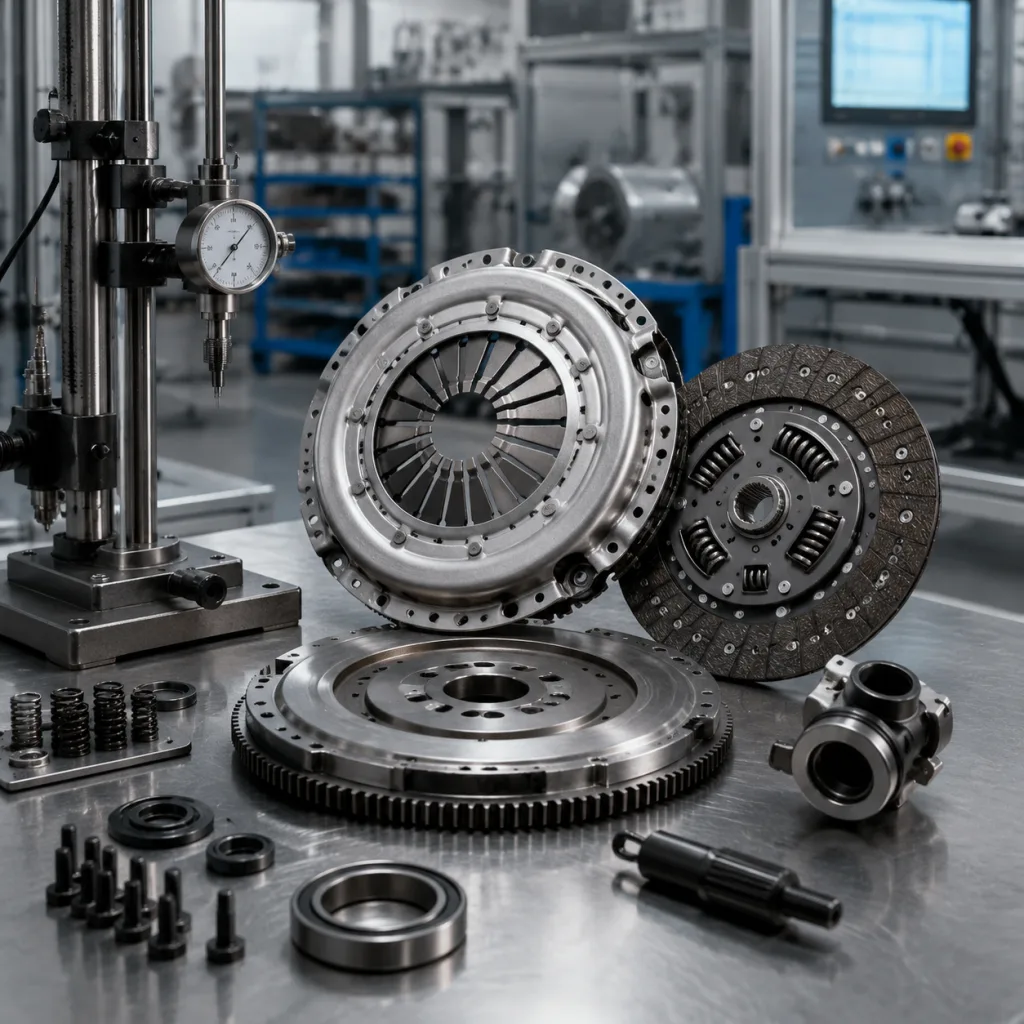
For B2B sourcing, OE-equivalence means the kit matches the functional interface and service performance expected from the original equipment design. It does not mean approval, supply relationship, or endorsement by the vehicle manufacturer. A typical clutch kit Honda replacement SKU may include:
Friction disc with matched spline hub, commonly in the 200-240 mm OD range depending on application
Diaphragm spring pressure plate with matching cover bolt pattern and register diameter
Release bearing or concentric slave cylinder, depending on application
Pilot bearing or bushing where required by the transmission design
Alignment tool and installation hardware where specified
Printed fitment label, EAN/UPC or buyer barcode, and traceable batch code
Use a simple decision rule before PO release: if a dimension affects installation, release travel, clamp load, or kit identity, it must be locked in the technical file. That includes disc diameter, cover bolt circle, pressure plate register diameter, flywheel step compatibility, input shaft spline count and major/minor diameters, clutch cover overall height, diaphragm finger height, and release bearing working height.
A kit can look correct and still fail. A release bearing height error of only 2-3 mm may cause incomplete disengagement, abnormal pedal travel, bearing preload, or clutch slip after installation. A matching disc OD does not rescue the programme if the spline fit is loose, the pressure plate sits at the wrong height, or the release bearing contact face is wrong.
For each SKU, Driventus recommends a locked fitment file with at least one approved sample, a dimension report, and a component bill of materials. Where one catalogue family covers cable-release and hydraulic-release versions, different flywheel depths, or regional transmission variations, use separate suffixes rather than broad model-year descriptions.
Spec Deep-Dive: Dimensions, Materials, and the Tolerances That Drive Returns
A clutch kit specification is a dispute-prevention tool. Without one, both sides end up arguing from memory, photos, or an old sample that was never formally approved. Driventus recommends that importers maintain a master drawing, inspection sheet, or approved reference file for each high-volume part number, with tolerances agreed before mass shipment. Where the buyer does not have an OE drawing, the approved golden sample and first-article inspection report should become the commercial reference.
Specification item
Procurement check
Typical acceptance focus
Friction disc outside diameter
Vernier or fixture check
Nominal OD by SKU, often 200-240 mm; typical control ±0.30 mm unless otherwise agreed
Spline count and profile
Go/no-go gauge
Correct tooth count; smooth fit on input shaft without binding or excess backlash
Spline major diameter
Micrometer/gauge
Match input shaft interface; typical control within ±0.05-0.10 mm by drawing
Disc runout
Dial indicator
Common target ≤0.50 mm TIR to reduce judder and uneven release
Facing thickness variation
Micrometer at indexed points
Typical control ≤0.15 mm across measured points
Pressure plate cover height
Height gauge
Compatible with release bearing travel; controlled against approved sample
Diaphragm finger height variation
Fixture measurement
Common target ≤0.50 mm across fingers for stable pedal load and release point
Clamp load
Static load test
Must meet application target; production tolerance normally agreed as a percentage band
Release bearing height and ID/OD
Height gauge/caliper
Correct stack height, bore, and contact face geometry
Friction facing material
Material declaration and sample test
Stable coefficient of friction under heat, low odour, controlled wear
Rivet setting and hub spring retention
Visual and pull check
No loose rivets, cracked springs, burrs, or hub distortion
</tr></thead><tbody> </tbody></table>Friction facing choice should follow the vehicle segment and warranty profile. Organic facings are common for passenger car replacement because they balance smooth engagement, flywheel wear, pedal comfort, and noise control. A typical organic aftermarket facing may target a working coefficient of friction around 0.30-0.40, but the accepted band should be defined by the validation method, not by a catalogue claim.
Avoid unnecessary “upgrades” unless the application requires them. Higher-torque or severe-use facing structures can help in specific cases, but they may also increase pedal effort, alter engagement feel, and raise complaint rates in general repair channels.
Pressure plate flatness, diaphragm spring heat treatment, cover stamping accuracy, and bearing grease specification are commercial issues as much as engineering issues. Weak control creates intermittent returns: judder on one batch, noisy bearings on the next, then a carton of kits with perfect labels but variable pedal feel.
Buyers should ask direct questions. Are pressure plates 100% visually inspected for diaphragm finger damage? Are release bearings checked for rotational smoothness, abnormal noise, seal damage, and correct grease fill? Are rivets checked for setting quality and hub spring retention?
Material documentation should also support destination-market compliance. For EU and UK buyers, REACH (EC) No 1907/2006 is relevant to chemical compliance review. If friction material composition, adhesive systems, bearing suppliers, grease, plating, or facing suppliers change, the supplier should give notice and provide updated validation evidence when the change affects performance or compliance records.
Failure Modes to Test Before You Buy in Volume
Do not validate a replacement clutch kit only by opening the box and checking that the parts look complete. The expensive failures appear later: a technician cannot bleed the system, the release point is wrong, the disc judders after heat exposure, or the bearing becomes noisy after short service.
A practical validation plan should test the kit as components and as an assembly. For repair-chain supply, it should also reflect real workshop conditions because unclear instructions, fragile packaging, or small hardware omissions can quickly become warranty noise.
Recommended validation steps include:
Incoming comparison against the approved OE-equivalent reference sample, with photos and measured dimensions recorded
First-article inspection of at least 3-5 complete kits per new SKU or tooling condition
Static clamp load measurement of the pressure plate against the agreed target and tolerance band
Disc torsional damper function check through the designed travel range, including spring seating and end-stop condition
Release bearing noise and rotation smoothness inspection before and after handling simulation
Hot engagement and fade-resistance testing on a clutch dynamometer where programme value justifies it
Vehicle or bench installation trial to confirm release point, pedal feel, and absence of interference
Post-test inspection for glazing, cracked facings, spring displacement, rivet issues, oil contamination sensitivity, and uneven wear
For production shipment inspection, many importers use ANSI/ASQ Z1.4 or ISO 2859-1 sampling. A common commercial setup is General Inspection Level II with AQL 1.0 or 1.5 for major defects and AQL 2.5 or 4.0 for minor visual defects. Fitment-critical or safety-critical characteristics may need tighter checks or 100% inspection depending on risk.
Define critical defects before shipment. Wrong bearing. Wrong spline. Missing component. Cracked facing. Damaged diaphragm. Incorrect label. These are not cosmetic problems, and they should normally trigger rejection or sorting rather than a simple concession.
Published quality management standards do not define a clutch kit’s torque capacity, but they do show whether the supplier manages process discipline consistently. Driventus operates under IATF 16949:2016 and ISO 9001:2015 aligned controls for document management, traceability, corrective action, and production monitoring. Buyers can review our quality system when qualifying replacement programmes.
For high-volume SKUs, Driventus can provide PPAP-style files, control plans, inspection records, batch traceability, and corrective-action reporting when included in the sourcing agreement.
The Box Can Break the Programme: Packaging and Cross-Reference Controls
A technically correct clutch kit can still become a commercial failure. The usual causes are basic: mixed bearings, missing alignment tools, incorrect barcodes, weak cartons, or application ranges that are too vague for warehouse and counter staff.
A clutch kit Honda replacement SKU should have controlled packaging data with the following fields:
Buyer part number and supplier part number
Application range by model, engine, production year, and transmission type
Kit component list and quantity, including bearing, pilot bearing, alignment tool, bolts, and instructions where applicable
Country of origin marking where required
Batch or lot number for traceability to production date and component batch
Barcode format agreed by the importer, such as EAN-13, UPC-A, Code 128, or GS1-128
Gross weight, net weight, carton dimensions, and pallet quantity
Installation notes, including flywheel inspection, hydraulic system bleeding, release fork inspection, and torque procedure reminder
OE part-number cross-references may be used for fitment matching only when supplied by the buyer or established in the approved programme data. They should not be presented as evidence of vehicle manufacturer approval. Driventus does not claim vehicle manufacturer approval; brand names, model names, and part references are used only to identify fitment.
For distributors building private-label lines, artwork control needs a formal approval file. Version number. Approval date. Barcode proof. Fitment text. Carton code. Without these controls, old labels can be mixed with new fitment data during replenishment.
Export packaging should protect the pressure plate fingers from point loading, keep the friction disc flat, isolate the release bearing from contamination, and prevent metal-to-metal impact during vibration. For ocean freight, buyers commonly specify 5-ply export cartons, desiccant or VCI protection where corrosion risk exists, pallet stretch-wrap, and outer labels on at least two sides.
Run a small packaging pilot before mass printing. Driventus recommends 10-30 cartons for scan verification, drop/handling review, carton fit, and warehouse readability. It is cheaper to find a barcode problem in a pilot carton than after the container reaches a regional distribution centre.
Compare Supply Models by Buyer Scenario, Not by Unit Price Alone
Different buyers need different clutch kit supply models. A national distributor may prioritise broad coverage, warehouse-ready labelling, and stable replenishment. A repair-chain buyer may care more about low return rates, installation consistency, and technician feedback. OEM and Tier-1 sourcing teams usually require tighter drawing control, process documentation, and formal change management.
Driventus can support replacement clutch kit programmes through standard catalogue sourcing or buyer-specific development. Buyers can review our catalog for available engine and powertrain categories, or discuss custom manufacturing for controlled specifications, packaging, inspection plans, and documentation packages.
Commercial qualification normally covers:
Annual forecast and SKU mix, separated into fast-moving, medium-moving, and long-tail references
MOQ by reference and packaging type
Sample approval route and inspection records
Lead time for first order and repeat orders
Private-label, neutral, or Driventus packaging requirements
Claims handling process and evidence requirements
Destination market compliance documents
Incoterms, consolidation plan, pallet requirements, and shipment inspection method
MOQ should reflect production reality. A standard catalogue SKU in neutral packaging may work at lower quantities because components and cartons are already controlled. Private-label cartons, buyer-specific instructions, or special bearings usually require higher MOQ because printing, setup, and component batching create fixed costs.
As a practical planning range, buyers should expect sample lots to be quoted separately, pilot orders to carry higher unit cost, and mass-production pricing to improve once forecasts support full carton printing and component batch purchasing. For many aftermarket programmes, initial MOQs are set by SKU value, component availability, and packaging type rather than by one fixed number.
Lead time also depends on the approval route. Existing catalogue items with available components can move faster after artwork approval. New or modified SKUs require sample build, inspection, trial installation, and sometimes tooling or fixture adjustment. A realistic launch plan separates engineering approval time from production lead time so neither side treats unapproved samples as a shipment commitment.
When comparing quotations, look beyond unit price. A lower offer may mean simplified bearing specification, reduced facing quality, thinner cartons, limited inspection, or weak traceability. Landed cost should include warranty handling, technician labour claims, repacking work, delayed launches, inventory disruption, and customer credits caused by avoidable returns.
Pre-PO Q&A: What Must Be Locked Before Release?
Before releasing a purchase order, procurement teams should turn the approval file into a short Q&A. If a question cannot be answered with a document, sample number, or agreed tolerance, the programme is not fully locked.
Which vehicle and transmission variant is covered? Confirm application data by engine code, transmission, production year range, and market region.
What is the physical reference? Approve a reference sample and retain it for dispute resolution.
Which dimensions are frozen? Check disc diameter, spline count, spline major diameter, cover height, diaphragm finger height, and release bearing height.
What material and component substitutions are allowed? Define friction facing material, bearing source level, grease specification, and acceptable alternatives.
What exactly is inside the box? Confirm kit contents for each SKU and decide whether bolts, pilot bearing, alignment tool, or instructions are mandatory.
Is the packaging approved? Review packaging artwork, barcode, carton size, label data, and pallet pattern.
How will quality be proven? Request quality certificates, inspection records, and batch traceability format.
What evidence is required for a claim? Define installation photos, mileage, vehicle data, returned parts, and failure description.
Does the destination market require compliance review? Confirm REACH (EC) No 1907/2006 review where applicable.
How will shipments be inspected? Agree shipment inspection method, sample size, AQL levels, and critical-defect list if used by the buyer.
What are the commercial limits? Confirm MOQ, price breaks, payment terms, tooling or artwork charges, and first-order lead time.
What changes require notice? Confirm change-notification rules for friction material, bearing supplier, diaphragm spring, cover tooling, or packaging artwork.
For high-volume programmes, first-article inspection should be repeated when tooling, friction facing material, bearing source, release system components, or major process parameters change. This reduces silent variation across replenishment orders.
A strong purchase order should reference the approved sample number, revision level, packing version, Incoterms, inspection requirement, and delivery schedule. If the programme covers multiple Honda-fit SKUs, attach a matrix showing part number, disc OD, spline count, bearing type, kit contents, carton code, MOQ, and agreed price tier. That matrix prevents the most common launch problems: correct part in wrong box, wrong bearing in correct kit, old artwork used for new fitment, or pricing applied to an unapproved component mix.
Frequently asked questions
Verify disc diameter, spline count and major diameter, pressure plate cover height, diaphragm finger height, release bearing stack height, kit contents, application range, and packaging data. A physical reference sample, first-article report, and installation trial are recommended before volume orders.
No. OE-equivalent means the replacement kit is designed to match the functional dimensions and performance requirements of the original design. Driventus is an independent aftermarket manufacturer; brand names are referenced for fitment only.
Yes. Driventus can support buyer-specific packaging, labelling, inspection plans, controlled specifications, MOQ planning, batch traceability, and documentation packages for distributors, wholesalers, repair chains, and OEM/Tier-1 projects.
For clutch kit samples, fitment files, MOQ/lead-time review, or programme pricing, contact Driventus to [request a quote](/contact.html).