Change Engine Belt: B2B Replacement Criteria
Engine belt replacement is a high-volume aftermarket category, but familiar parts can still carry significant procurement risk. A belt that appears dimensionally close may create noise, heat build-up, pulley wear, tension loss, or early cracking if cord layout, rubber compound, rib geometry, and packaging controls are inconsistent. For distributors, repair chains, importers, and sourcing teams, the goal is to buy belts that install like OE service parts, run quietly through temperature cycles, and remain traceable by production batch. This article turns a **change engine belt** requirement into a practical sourcing checklist covering cross-reference discipline, material selection, validation testing, marking, packaging, and supplier qualification. Driventus manufactures engine and powertrain components in Taizhou, Zhejiang, under IATF 16949:2016 and ISO 9001:2015 systems, supplying B2B aftermarket and OEM/Tier-1 customers in 60+ countries. Driventus is an independent aftermarket manufacturer; brand names are referenced for fitment only.
Replacement Intent: OE-Equivalent Fit, Not Guesswork
For procurement teams, the phrase change engine belt should signal a controlled replacement programme, not a generic commodity purchase. Many service failures start when catalogue matching is treated as proof of suitability. A belt must match effective length, rib count, profile, cord modulus, compound behaviour, and pulley compatibility.
Buyers should require each SKU to be mapped against application data and OE part-number cross-references where available. If a programme uses references such as OE 06A… or OE 11251…, the supplier should show the data source, fitment scope, supersession logic, and exclusions. A private-label cross-reference table without revision control is not enough.
Key replacement requirements include:
- Dimensional match: length, top width, rib pitch, tooth pitch where applicable, and profile form.
- Functional match: stable tension retention, low noise, and resistance to glazing.
- Material match: EPDM, HNBR, chloroprene, or other specified compounds according to belt type, heat exposure, and duty cycle.
- Installation match: packaging, labels, and instructions that support repair-chain workflow.
- Traceability: batch number, production date, and inspection record retained by SKU.
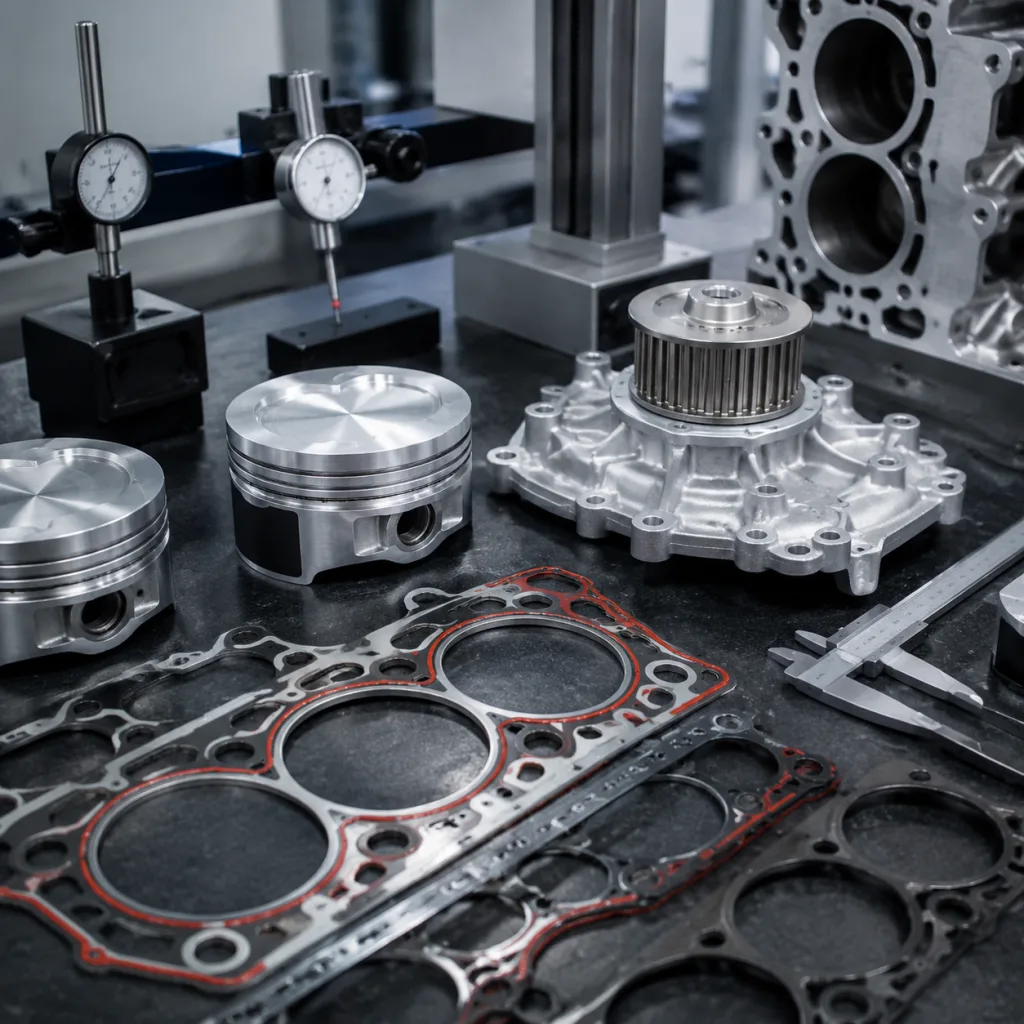
For engine parts sourced alongside pistons, gaskets, water pumps, and tensioner kits, buyers can review our catalog and engine-related ranges at /products/engine-components.html.
Belt Types and Sourcing Differences
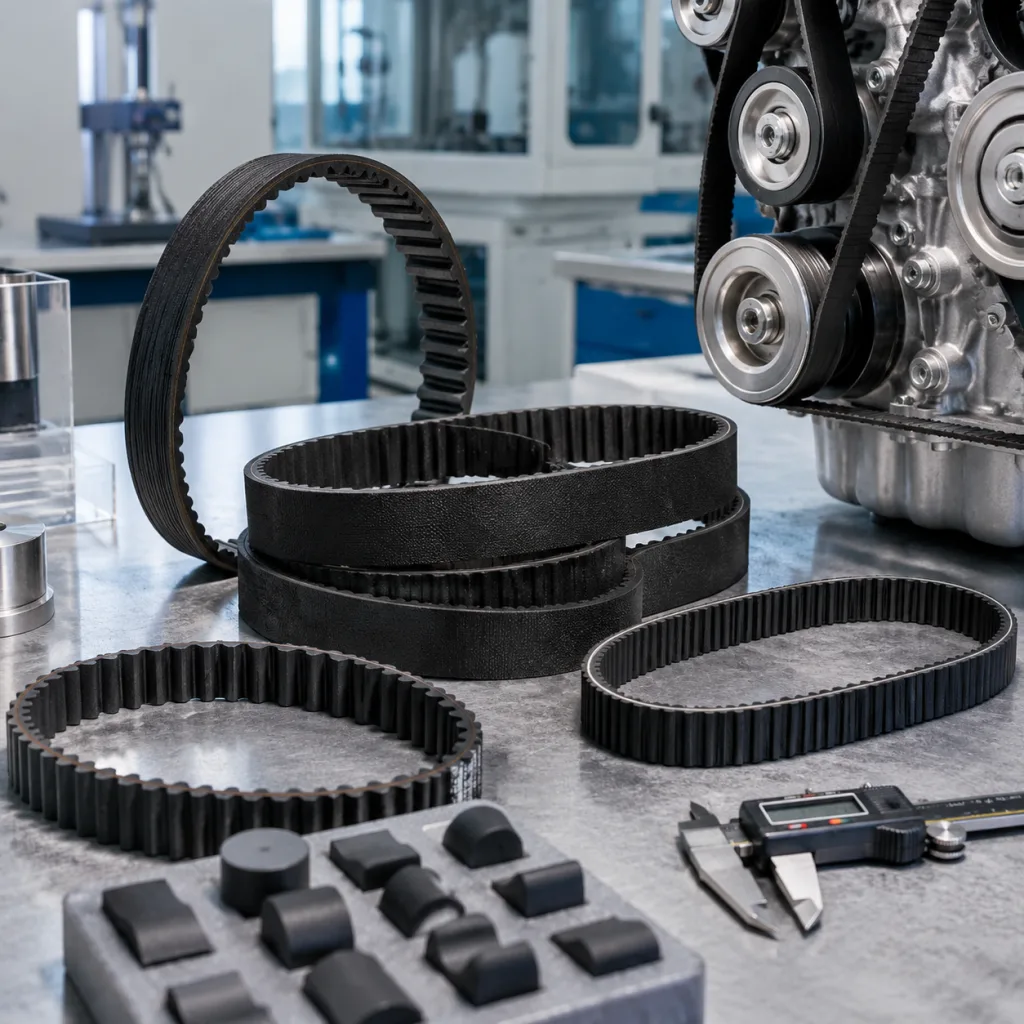
Accessory drive belts, timing belts, and balance shaft belts have different risk profiles. A serpentine belt failure may cause loss of alternator charging, power steering on some older hydraulic systems, coolant circulation on certain layouts, or air-conditioning function. A timing belt failure can cause valve-train damage in interference engines. Procurement specifications should separate these families rather than applying one generic belt standard.
| Belt family | Typical function | Critical dimensions | Common material focus | Procurement risk |
|---|---|---|---|---|
| Serpentine / multi-rib | Accessory drive | Effective length, rib count, rib pitch, top width | EPDM, polyester or aramid cord | Noise, slip, cracking, poor tension retention |
| V-belt | Older accessory drive | Datum length, top width, angle, height | Chloroprene or EPDM compound | Glazing, heat ageing, pulley mismatch |
| Timing belt | Camshaft synchronisation | Tooth count, pitch, width, tooth profile | HNBR or high-grade rubber, glass fibre cord | Tooth shear, elongation, engine damage |
| Balance shaft belt | NVH control / shaft drive | Tooth count, pitch, width | Heat-resistant rubber and stable cord | Vibration, tooth wear, misalignment |
| Test area | What it verifies | Typical evidence to request | Buyer action |
|---|---|---|---|
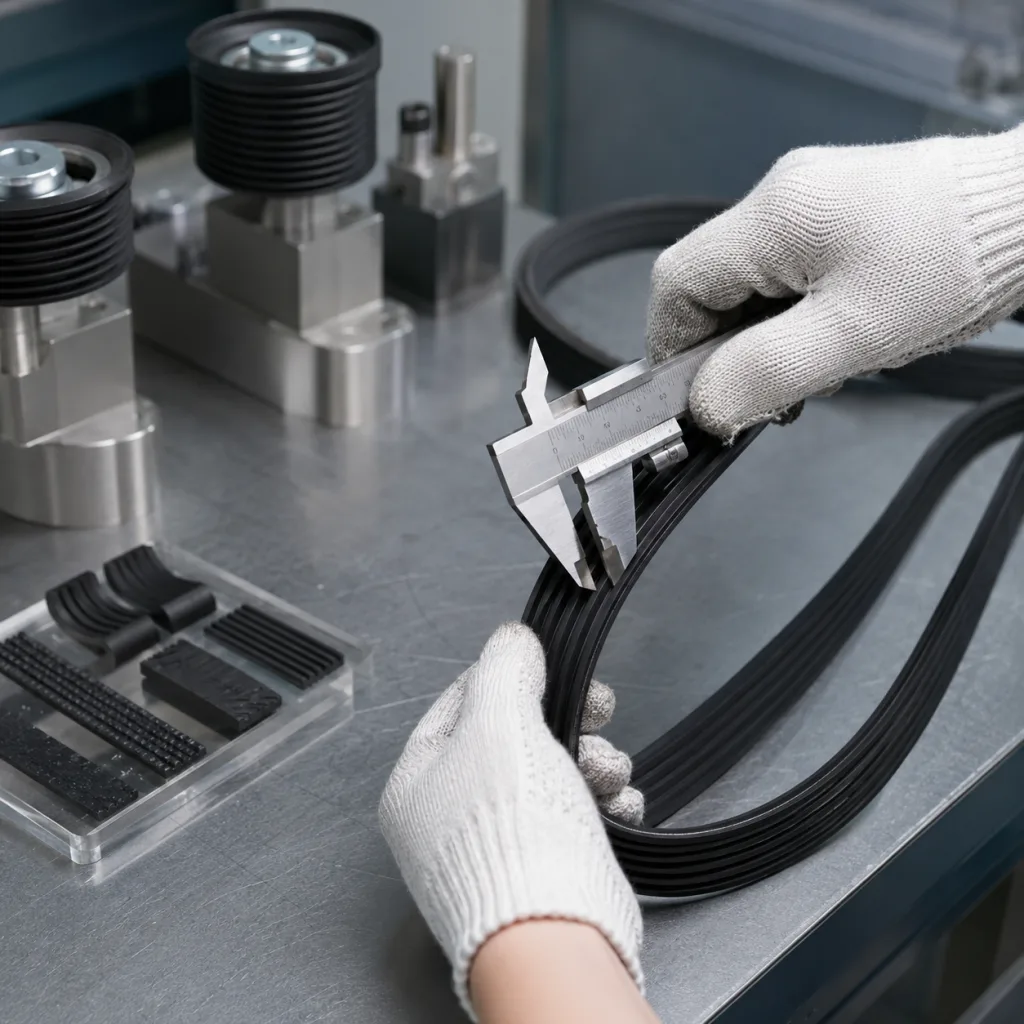
| Dimensional inspection | Length, width, rib count, pitch, tooth profile | First article inspection report, drawing revision | Approve only by controlled revision |
| Tensile / elongation | Cord stability under load | Tensile test record and batch data | Compare lots, not only one sample |
| Heat ageing | Rubber stability after temperature exposure | Ageing test summary, crack inspection | Define acceptance limit |
| Flex fatigue | Resistance to repeated bending | Cycle test result, visual and dimensional check | Match severity to application |
| Noise / running check | Pulley contact and NVH behaviour | Bench or vehicle fitment report | Prioritise high-volume SKUs |
| Packaging check | Deformation and label durability | Drop, storage, and barcode scan check | Verify warehouse handling suitability |