Belt Serpentine Replacement for Aftermarket Programs
Belt serpentine replacement is a high-volume aftermarket category because a single multi-rib belt can drive the alternator, water pump, power steering pump, air-conditioning compressor, and other accessory loads. For distributors, repair chains, and importers, the commercial risk extends beyond belt breakage. Poor dimensional control can cause chirp, squeal, slip, heat build-up, tensioner misalignment, pulley wear, and warranty returns across many vehicle applications. Procurement teams should evaluate serpentine belts by fitment accuracy, construction, length control, rib profile, rubber compound, batch traceability, and validation evidence. This article outlines practical criteria for OE-equivalent aftermarket programs, including cross-reference control, material selection, inspection points, compliance documentation, and supplier audit checks. Driventus supplies engine and powertrain components to B2B customers in 60+ countries from Taizhou, Zhejiang, under IATF 16949:2016 and ISO 9001:2015 systems. Driventus is an independent aftermarket manufacturer; brand names are referenced for fitment only.
What Buyers Should Specify for OE-Equivalent Fit
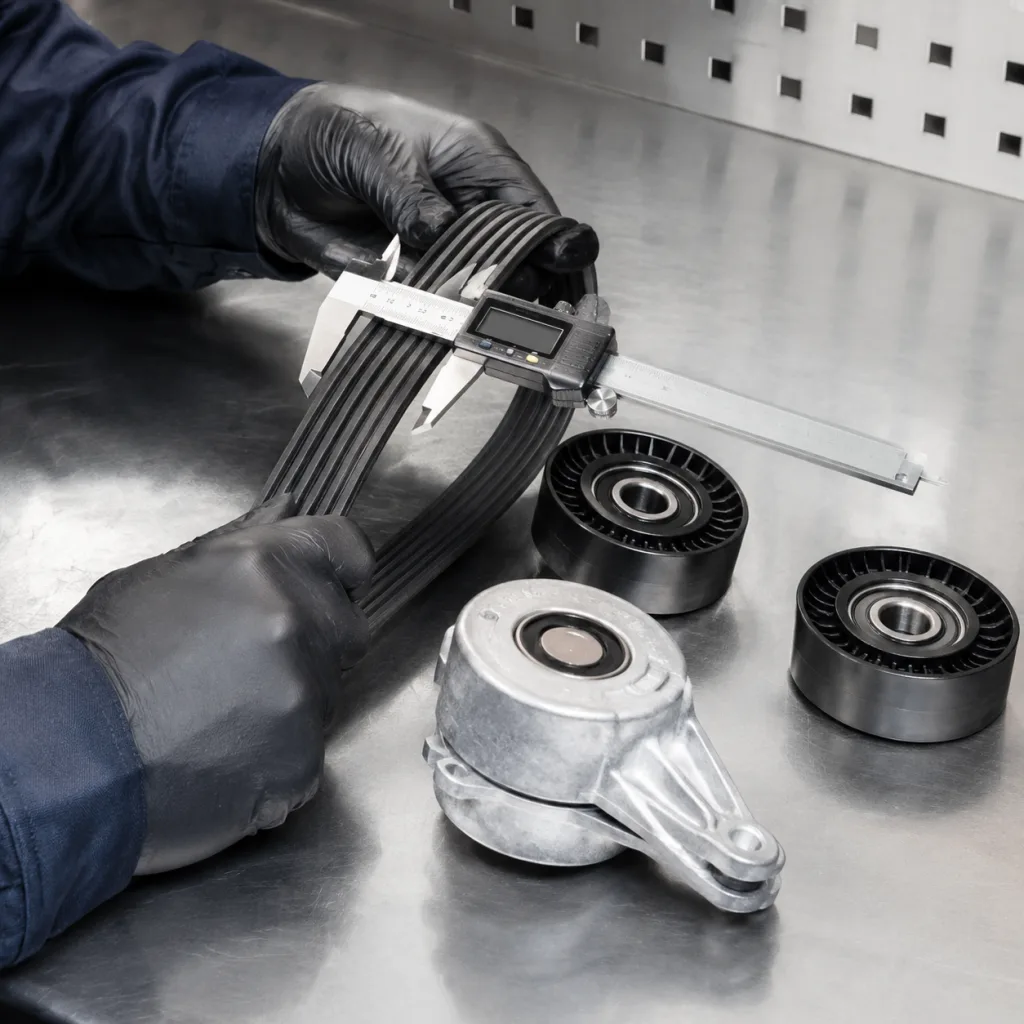
A serpentine belt is a dimensional component before it is a brand component. The first sourcing requirement is a controlled match to the intended OE application: effective length, rib count, rib pitch, section geometry, and pulley contact area. Even a small length deviation can place the automatic tensioner outside its preferred working range, increasing noise, vibration, heat, and premature wear.
For aftermarket programs, buyers should maintain an application matrix that links vehicle model, engine code, accessory layout, belt length, rib count, and cross-reference number. Where an OE part-number reference is used, keep it generic unless the sourcing file includes the verified reference, for example OE 06A… or OE 11251…. Driventus does not claim approval or endorsement by any vehicle manufacturer.
Key purchasing data should include:
- Effective belt length, measured under defined tension
- Rib count, such as 4PK, 5PK, 6PK, 7PK, or 8PK
- Rib pitch and V-rib angle consistency
- Backing thickness and total belt height
- EPDM or equivalent rubber compound specification
- Cord material and tensile strength target
- Date code, batch code, and carton-level traceability
Buyers can review related rotating and engine drive components in our catalog, including linked demand for tensioners, idlers, and water pumps where applicable.
Construction, Materials, and Dimensional Controls
Most modern serpentine belts use EPDM rubber because it resists heat, ozone, cracking, and ageing better than older neoprene formulations. The construction must also preserve rib geometry after thermal cycling, high-speed flexing, and repeated bending around small-diameter pulleys. For buyers in the EU, UK, US, Canada, Australia, Brazil, and other regulated markets, material declarations and restricted-substance controls should be part of supplier qualification. REACH (EC) No 1907/2006 is commonly requested for EU import documentation.
| Specification item | Typical procurement requirement | Why it matters |
|---|---|---|
| Rib profile | PK multi-rib geometry | Controls pulley seating, load transfer, and noise |
| Length tolerance | Application-specific, commonly controlled within a low millimetre range | Maintains tensioner operating position |
| Rubber compound | EPDM-based formulation | Improves heat, ozone, and ageing resistance |
| Tensile member | Polyester, aramid, or specified cord type | Controls stretch and load capacity |
| Operating environment | High temperature, oil mist, humidity, dust, and road splash exposure | Reduces field failure risk |
| Marking | Part number, size, production date, batch code | Supports traceability and claims analysis |
| Test or inspection | Typical evidence requested | Procurement relevance |
|---|---|---|
| Dynamic durability | Bench running under defined pulley layout, speed, tension, and temperature | Confirms flex fatigue resistance |
| Heat ageing | Exposure to elevated temperature for defined hours | Checks rubber hardening, embrittlement, and cracking |
| Ozone resistance | Controlled ozone exposure | Reduces surface cracking risk |
| Tensile test | Cord strength and elongation data | Controls stretch and load transfer |
| Rib wear inspection | Profile measurement before and after running | Supports noise, slip, and seating control |
| Noise evaluation | Drive system test under load variation | Reduces customer returns and workshop complaints |