Car Belt Replacement: Sourcing OE-Equivalent Belts
Car belt replacement is a high-volume aftermarket category where small fitment errors can quickly become warranty costs. A belt that is a few millimetres short, carries the wrong rib profile, or uses a compound unsuited to the local climate may cause noise, slip, premature wear, or installer complaints. For procurement teams, the objective is not simply to buy a belt that fits once. It is to source OE-equivalent parts with repeatable dimensions, stable rubber performance, accurate catalogue data, compliant packaging, and documented production control. Driventus supplies aftermarket engine and powertrain components from Taizhou, Zhejiang, including belt-related engine service parts for B2B programs. This article outlines practical sourcing criteria for serpentine belts, V-belts, stretch belts, and timing belts, with emphasis on dimensional match, validation testing, supplier documentation, and buyer-level controls. Driventus is an independent aftermarket manufacturer; brand names are referenced for fitment only.
Replacement Fitment Starts With Belt Type
Many sourcing mistakes begin with an incomplete belt description. A service belt, air-conditioning belt, alternator belt, stretch belt, or timing belt may all appear under a broad replacement category, yet each design has different construction, installation, and validation requirements.
</tr></thead><tbody> </tbody></table>Each aftermarket SKU should be linked to an application table rather than a nominal belt length alone. Buyers should confirm engine code, model-year range, drive layout, pulley count, tensioner type, and regional engine variant before catalogue release. For timing belt programs, the commercial scope may also include tensioners, idlers, water pumps, gaskets, and fasteners. Related engine service items can be reviewed in our catalog, including broader engine components at /products/engine-components.html.
Dimensional Match and Materials to Specify
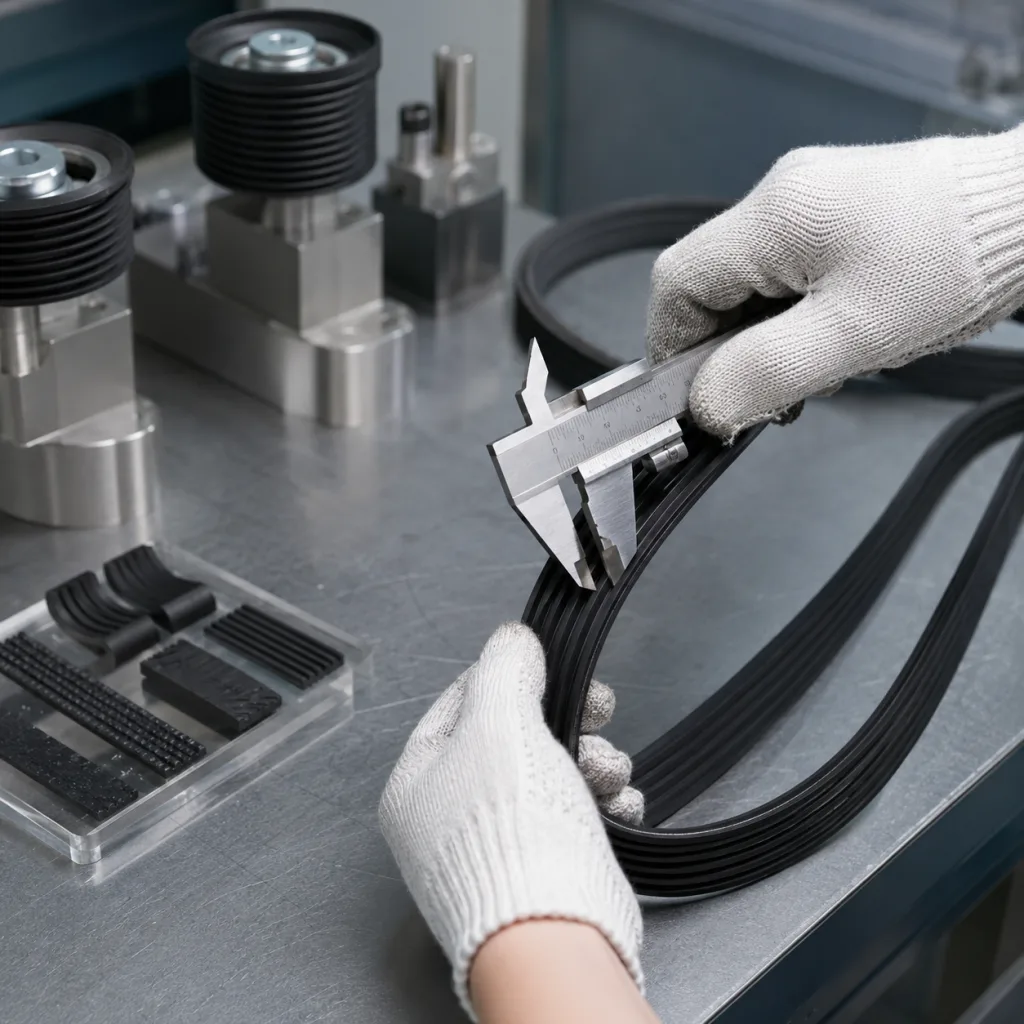
A replacement belt must match OE geometry closely enough to maintain correct tension, pulley contact, tracking, and service life. Procurement specifications should define both the target measurement and the method used to verify it. Length stated without measuring load, fixture type, or reference standard leaves too much room for interpretation.
Key parameters to include in RFQs and PPAP-style submissions:
Effective length: measured on calibrated equipment under defined load.
Rib profile: PK, PJ, PL, or other applicable profile for multi-rib belts.
Rib count: verified against pulley grooves and application data.
Belt width: controlled to prevent side contact and edge fraying.
Tooth profile: trapezoidal, curvilinear, or application-specific profile for timing belts.
Tooth count and pitch: confirmed against crankshaft and camshaft pulley design.
Cord material: polyester, aramid, glass fibre, or equivalent as specified by application.
Rubber compound: EPDM is common for modern auxiliary belts; HNBR may be used in timing belt applications.
Back fabric or tooth fabric: checked for adhesion, wear resistance, and oil resistance where required.
Dimensional tolerances should be agreed by drawing, reference sample, or validated cross-reference. When an OE part-number cross-reference is supplied by the buyer, it may be recorded in generic form such as OE 06A… or OE 11251… for fitment identification only. Such references do not imply vehicle manufacturer approval.
For high-volume import programs, Driventus recommends first-article inspection before carton artwork and barcode files are released. This prevents avoidable rework when one belt family covers several similar applications that are not fully interchangeable.
Validation Tests for Aftermarket Programs
Replacement belt validation should combine dimensional inspection, material testing, and endurance checks. The test depth should match the risk of the application. A commodity alternator belt for an older platform may need batch-level dimensional, hardness, and visual checks. A timing belt kit for an interference engine requires stronger evidence because failure can cause serious engine damage.
Test or control
What it verifies
Typical evidence requested by buyers
Length and profile inspection
Correct fit on pulley path
First-article report, batch inspection sheet
Shore hardness
Compound consistency
Incoming rubber and finished-goods report
Tensile strength
Cord integrity and load capacity
Laboratory test report
Tooth shear or rib adhesion
Bond between rubber, fabric, and cord
Validation report by SKU family
Heat ageing
Resistance to cracking and hardening
Ageing test data at defined temperature and time
Oil and coolant exposure
Resistance to contamination in engine bay
Comparative material test data
Noise and slip assessment
NVH behaviour under load
Bench or vehicle-fitment record where applicable
</tr></thead><tbody> </tbody></table>Published quality standards support the process but do not replace part-specific validation. IATF 16949:2016 is relevant to automotive process control, traceability, change management, risk-based thinking, and defect prevention. ISO 9001:2015 supports document control, corrective action, and management review discipline. Chemical compliance may require REACH (EC) No 1907/2006 declarations for EU-bound shipments. Depending on market and customer type, buyers may also request material declarations, IMDS-style data, RoHS statements, or packaging compliance documents.
Driventus operates under IATF 16949:2016 and ISO 9001:2015 certified management systems. Buyers can review our quality system when assessing factory controls, incoming inspection, production routing, traceability, and nonconforming product handling.
Sourcing Checklist for Distributors and Repair Chains
A belt program is profitable only when fitment coverage, stock rotation, installer confidence, and warranty rates are managed together. The sourcing file should therefore combine technical, commercial, catalogue, and logistics data instead of treating the belt as a simple commodity purchase.
A practical buyer checklist includes:
Application coverage: vehicles, engine codes, model years, and regional variants.
Cross-reference table: buyer-approved interchange numbers, with no claim of OE endorsement.
Drawing or sample basis: master sample, CAD drawing, or verified belt measurement.
Validation records: material, dimensional, and endurance data by belt family.
Batch traceability: production date, compound batch, cord batch, and final inspection lot.
Packaging: neutral, private label, or customer artwork with barcode and country-of-origin marking.
MOQ and forecast: minimum order quantity by SKU and consolidated shipment volume.
Service kit logic: belt-only, belt-and-tensioner, or full kit with idlers and water pump.
Warranty process: claim photos, mileage, installation notes, and returned-part analysis.
Repair chains should also plan installer communication. Many premature belt failures are caused by worn pulleys, seized idlers, oil leakage, misalignment, incorrect tensioner installation, or installation without the required stretch-belt tool. Packaging inserts and catalogue notes can reduce false product claims and help workshops identify related system faults before replacement.
For distributors building a new line, Driventus can support SKU rationalisation from sample sets, application lists, or existing interchange data. For private-label programs or non-standard belt kits, our custom manufacturing team can review drawings, target packaging, and inspection requirements.
Common Failure Modes and Buyer-Level Controls
Field failure analysis helps buyers write stronger specifications and fairer warranty rules. A failed belt is not always a defective belt, but the supplier should be able to distinguish manufacturing variation from installation errors, ageing, contamination, or faults elsewhere in the drive system.
Frequent symptoms and sourcing implications:
Cracks across ribs: ageing compound, excessive heat, ozone exposure, or long storage period.
Glazing: belt slip, insufficient tension, pulley wear, or incorrect compound friction.
Edge fraying: pulley misalignment, incorrect width, or damaged pulley flange.
Missing teeth on timing belt: overload, seized component, contamination, or poor tooth adhesion.
Squeal at start-up: low tension, wrong effective length, worn tensioner, or rib profile mismatch.
Cord separation: poor bonding, excessive flex fatigue, or contamination during production.
Procurement controls should include shelf-life rules and storage conditions. Belts should be stored away from ozone sources, direct sunlight, oil, solvents, and high humidity. Carton labelling should show part number, production batch, and manufacturing date in a format that warehouse teams can read without opening inner packs.
For importers, the warranty analysis process should be agreed before launch. Returned belts should be checked for installation marks, pulley imprint, contamination, fracture pattern, storage age, and mileage. A supplier with stable process control can provide structured 8D corrective action when evidence points to a production issue.
How to Compare Quotes Without Reducing to Unit Price
Unit price matters, but belt sourcing decisions should include technical risk and operational cost. A low-cost belt with weak catalogue data, unclear materials, or inconsistent packaging can create returns, slow-moving inventory, and customer-support expenses that exceed the initial saving.
When comparing suppliers, ask for the same evidence from each bidder:
1. Current business licence, export record, and production scope. 2. IATF 16949:2016 and ISO 9001:2015 certificate copies from recognised certification bodies. 3. Material specification for rubber, cord, and fabric. 4. Dimensional report from production samples, not only laboratory samples. 5. Test plan for serpentine belts, V-belts, stretch belts, timing belts, or kits. 6. Packaging specification, barcode format, palletisation plan, and carton drop-test approach where required. 7. Lead time for samples, first order, repeat order, and mixed-container shipment. 8. Change notification procedure for compound, tooling, cord supplier, or production site.
For buyers in the EU, UK, US, Canada, Australia, and Brazil, documentation should also support customs classification, country-of-origin marking, and local chemical or packaging rules. REACH (EC) No 1907/2006 is especially relevant for EU chemical substance obligations. Driventus can align inspection plans and shipping documentation to the buyer’s internal sourcing procedure before mass production.
Driventus is an independent aftermarket manufacturer; brand names are referenced for fitment only.
Frequently asked questions
Provide belt type, effective length, rib or tooth profile, width, application list, annual volume, packaging requirement, and any approved cross-references such as OE 06A… or OE 11251… where relevant. Samples or drawings improve quotation accuracy.
Yes, but length alone is not enough. The belt must also match rib count, profile, pulley layout, tensioner range, installation method, and regional engine variant. Application validation should be completed before catalogue release.
For automotive aftermarket programs, buyers commonly request IATF 16949:2016 and ISO 9001:2015 certificates, batch inspection records, material test reports, and REACH (EC) No 1907/2006 declarations for EU-bound shipments.
If you are building or reviewing a car belt replacement sourcing program, Driventus can assess drawings, samples, packaging, and validation requirements. To discuss fitment data and commercial terms, [request a quote](/contact.html).