Camshaft for Volvo S60 Replacement: Sourcing Guide
A camshaft for Volvo S60 replacement should be sourced as a precision valvetrain component, not as a generic casting. The part must match the original valve-event geometry, journal alignment, oil-feed features, surface hardness, drive interface, and cam sensor reference used by the target engine family. For distributors, repair chains, and importers, the largest risk is rarely the piece price. It is warranty exposure from premature lobe wear, timing correlation faults, oil-clearance problems, or incorrect fitment across similar-looking S60 variants.
This guide sets out the technical and procurement checks B2B buyers should complete before adding a Volvo S60 replacement camshaft line to stock. It covers application definition, material and machining controls, validation, packaging, MOQ and lead-time logic, and supplier documentation for European and North American aftermarket programmes. Driventus is an independent aftermarket manufacturer; vehicle brand names and OE references are used only to identify fitment.
Fitment scope and OE-equivalent requirements
The Volvo S60 has been produced with multiple petrol and diesel engine families, including inline-four and inline-five layouts, naturally aspirated and turbocharged variants, and engines with different valve timing systems depending on year and market. A camshaft that looks similar at the warehouse level may still be wrong for the engine. Intake and exhaust positions are not interchangeable unless the profile, drive end, trigger pattern, journal sizes, oil passages, and variable valve timing interface match the intended application.
For sourcing files, define each part by:
Vehicle generation, model-year range, fuel type, market, transmission where relevant, and engine code from the VIN/application database
Intake or exhaust position, with clear warehouse and carton identification; do not rely on visual lobe count only
Camshaft drive interface, dowel-pin/bolt pattern, sprocket or gear mounting face, phaser oil feed, and VVT compatibility where applicable
Number of lobes, journal count, bearing journal nominal diameter, thrust-control design, overall length, and seal-diameter location
Cam sensor trigger geometry or reference feature orientation, indexed to a defined datum rather than marked by eye
Oil-feed holes, annular grooves, cross-drillings, end plugs, and plug-retention method where they affect lubrication
OE part-number cross-reference format, used only where the data has already been verified against engine code and position
Packaging unit, carton quantity, barcode format, and traceability label requirements
A replacement camshaft should be dimensionally matched to the original design. It should not require machining, slot modification, cap rework, non-standard seals, or improvised timing procedures during installation. A correct replacement allows the technician to use normal timing tools, published torque procedures, and the correct mating parts without modifying the cylinder head, cam caps, gears, sensors, or seals.
For RFQ comparison, ask suppliers to state the fitment boundary in measurable terms. Typical buyer-side checks include journal diameter class, seal land diameter, overall length, thrust-face width, drive-end bolt thread, dowel or key location, cam sensor target angle, and whether the camshaft is supplied bare, with pressed gear, with target wheel, or with end plug installed. If the sample and production part differ by more than drawing allowance on a critical feature, the quotation should be treated as a new part number rather than a running change.
For buyers consolidating multiple engine lines, Driventus lists camshafts and related valvetrain items in our catalog and engine product group pages such as engine components.
Material, heat treatment, and machining controls
Camshaft durability depends on the controlled relationship between base material, heat treatment, straightness, surface finish, and final grinding accuracy. The lobe nose and opening ramp carry high contact stress, especially during boundary lubrication at start-up. The journals need stable oil film behaviour, correct clearance, and low runout so the shaft rotates without binding or creating localised wear. For a camshaft for Volvo S60 replacement programme, procurement teams should request an inspection plan or drawing-based specification rather than relying on a sample photo.
Control item
Typical sourcing target or review range
Why it matters
Base material
Chilled cast iron, ductile iron, or forged/alloy steel to OE process; chemistry verified per batch or heat
Maintains the intended balance of wear resistance, stiffness, machinability, and core strength
Lobe surface hardness
Common aftermarket target: 50–60 HRC or equivalent, depending on material/process; verify at nose and flank
Reduces scuffing, pitting, and premature wear under high contact load
Case depth or hardened layer
Typically confirmed by cut sample or process record where induction/nitriding is used; define minimum effective depth
Helps prevent lobe wear after initial surface material is removed in service
Journal diameter
Machined to drawing; many programmes control critical journals within ±0.01–0.02 mm
Maintains oil clearance, oil pressure stability, and bearing life
Total indicated runout
Check at all journals and drive end; common sourcing target ≤0.03–0.05 mm unless drawing states otherwise
Prevents binding, abnormal noise, and timing variation
Lobe lift and angular position
Lift commonly controlled within ±0.02–0.05 mm; angle commonly controlled within ±0.5°–1.0° cam angle
Preserves valve lift, valve timing, idle quality, and emissions behaviour
Surface roughness
Journals often Ra 0.2–0.4 µm; lobes often Ra 0.4–0.8 µm, subject to follower design
Supports oil film formation and protects followers or lifters
Trigger feature position
Indexed to datum surfaces; treat as a critical characteristic with 100% or high-frequency inspection
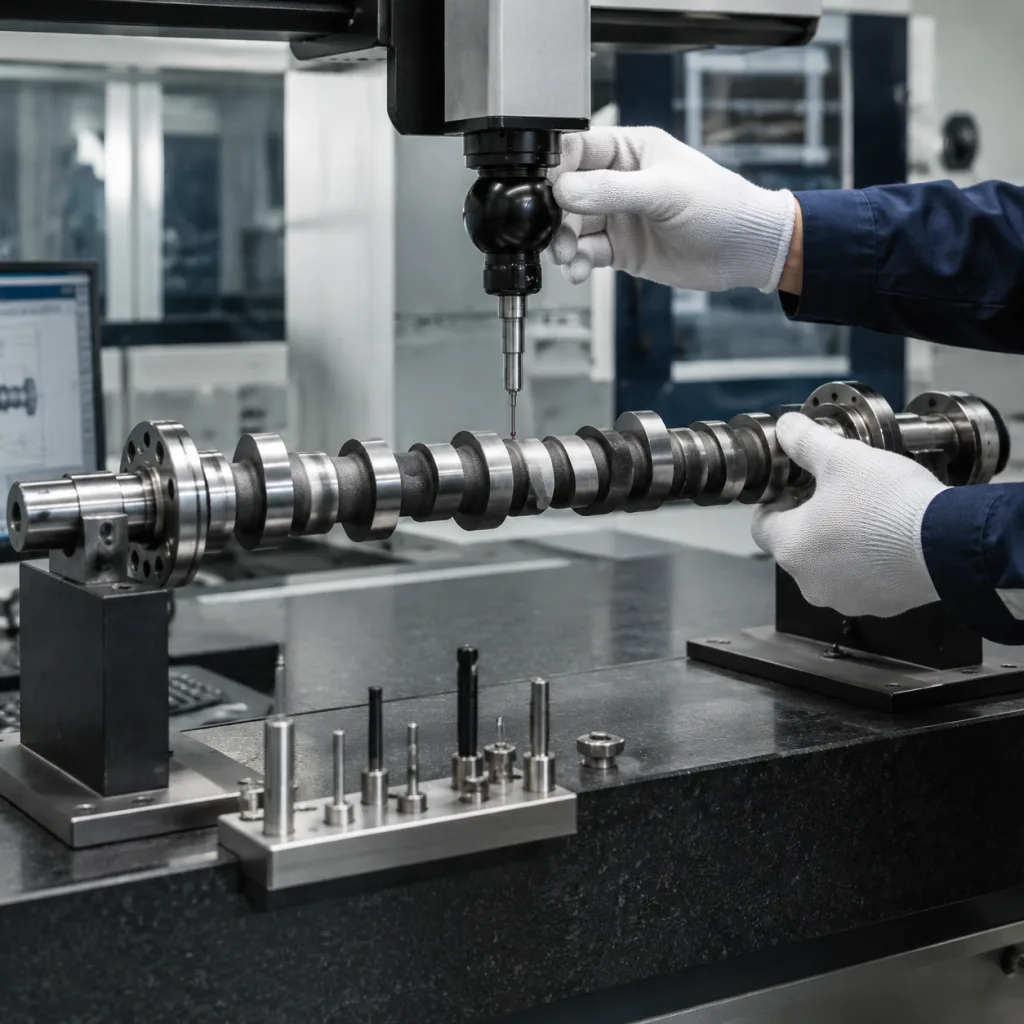
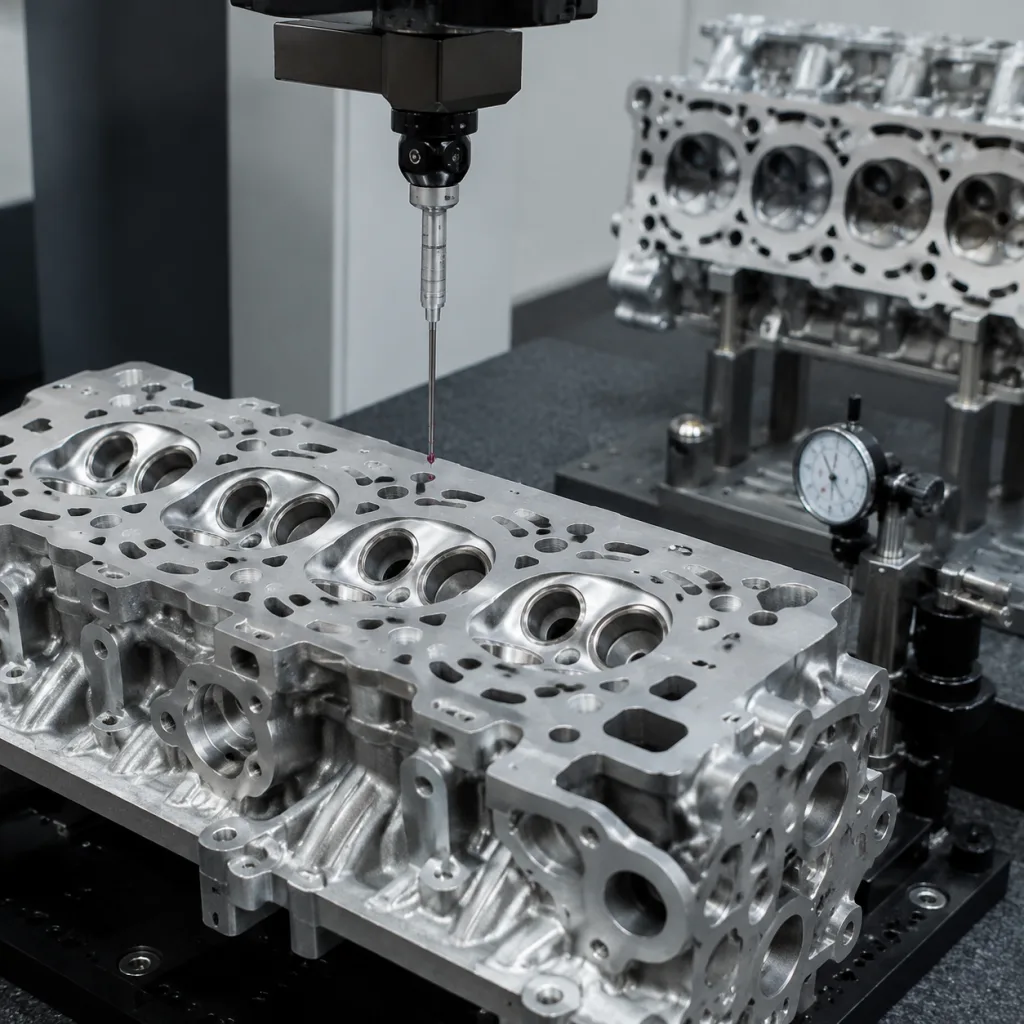
</tr></thead><tbody> </tbody></table>A credible supplier should maintain calibrated gauges and measurement routines for journal diameter, lobe lift, base-circle size, angular position, concentricity, straightness, hardness, and surface roughness. Inspection records should be linked to batch numbers, production dates, and operator or machine records. For higher-volume programmes, buyers can also request capability data for critical dimensions such as journal diameter, lobe lift, and trigger-feature position.
In production, the process normally follows raw casting or forging receipt, shot blasting or cleaning, rough turning, centre drilling, rough grinding, heat treatment or chilled-surface verification, straightening where permitted, finish grinding of journals and lobes, drilling or machining of oil passages, deburring, washing, rust prevention, final inspection, and protected packing. Buyers should confirm which steps are in-house and which are outsourced. Outsourced heat treatment, plug installation, target-wheel pressing, or coating operations should still be covered by lot traceability, incoming inspection, and nonconformance control.
Validation testing for replacement confidence
A camshaft for Volvo S60 replacement programme should be validated before launch and monitored after mass production starts. Sample approval is useful, but it is not enough by itself. Casting variation, forging variation, heat-treatment drift, grinding wheel wear, fixture wear, or packaging changes can alter lobe geometry and surface condition over time.
Common validation checks include:
Dimensional first article inspection against an approved drawing or master sample, with all critical features reported in millimetres and degrees
Material verification by spectrometer analysis, certified mill report, or agreed equivalent record for each melt, heat, or supplier batch
Hardness mapping on lobes and journals at defined inspection points, including lobe nose, opening flank, closing flank, and base-circle reference where applicable
Metallographic inspection where the hardening process or material specification requires it, including case depth, carbide distribution, or nitrided layer review
Surface roughness measurement on lobes, journals, thrust faces, and seal land with calibrated profilometer records
Runout and straightness inspection after final machining and before packing; re-check after any straightening process
Lobe lift, base-circle, and angular index checks against datum references using cam measuring equipment rather than manual comparison only
Trial assembly with cam caps, seals, sensor target, timing drive parts, and phaser where applicable, including rotation torque or free-rotation check
Packaging drop, vibration, and handling review for export shipments, especially for LCL and mixed-pallet distribution
Engine bench, road, or durability testing where programme volume and risk justify it, with oil grade, oil-change interval, follower condition, and break-in procedure recorded
For a new SKU, a practical approval sequence is 3–5 sample pieces for dimensional and material checks, then a pilot batch of 20–50 pieces for packaging, installation feedback, and warehouse identification before a larger blanket order. For established SKUs, buyers commonly ask for at least one full inspection report per production lot plus 100% visual inspection of polished surfaces, plugs, threads, drive interfaces, and trigger features. Critical dimensions can be sampled by AQL or by customer control plan, but trigger angle, severe dents, blocked oil holes, and incorrect part marking should be treated as zero-acceptance defects.
For quality management, Driventus operates under IATF 16949:2016 and ISO 9001:2015 process controls. These standards do not certify that a part fits a specific Volvo S60 engine. They define requirements for quality planning, risk control, traceability, corrective action, production monitoring, and continual improvement. Buyers can review our quality system for audit preparation and supplier qualification.
Where market access requires chemical or material compliance documentation, procurement files may also need references to REACH (EC) No 1907/2006 for substances in articles, plus packaging-related material declarations or customer-specific restricted-substance lists. Requirements vary by importer, sales channel, and destination market, so compliance expectations should be confirmed before quotation and packaging approval.
Procurement checklist for distributors and repair chains
Replacement parts buyers usually need stable coverage, low return rates, and clear identification from receiving inspection through workshop installation. A camshaft can pass laboratory checks and still create commercial problems if the application table is ambiguous, the intake/exhaust position is not obvious, or the carton label cannot be matched to the warehouse system.
Before purchase order release, verify the following:
Application list by model year, engine code, fuel type, powertrain variant, and camshaft position
OE cross-reference policy, fitment disclaimer language, and data source ownership
Inspection plan for lobe lift, angular position, journal diameter, runout, hardness, roughness, oil holes, plugs, and drive features
Lot traceability from raw material through heat treatment, machining, inspection, rust prevention, and packing
Anti-corrosion protection suitable for sea freight, air freight, and warehouse storage duration; specify target protection period, commonly 6–12 months for export inventory
Individual packaging that protects lobes, journals, thrust faces, threaded ends, and sensor reference features from impact
Barcode, neutral label, customer label, QR code, batch label, or private-label artwork requirements
Carton strength, pallet configuration, mixed-pallet rules, gross-weight limit, desiccant or VCI paper use, and export marking requirements
Warranty return analysis process, evidence requirements, response time, credit policy, and corrective-action format
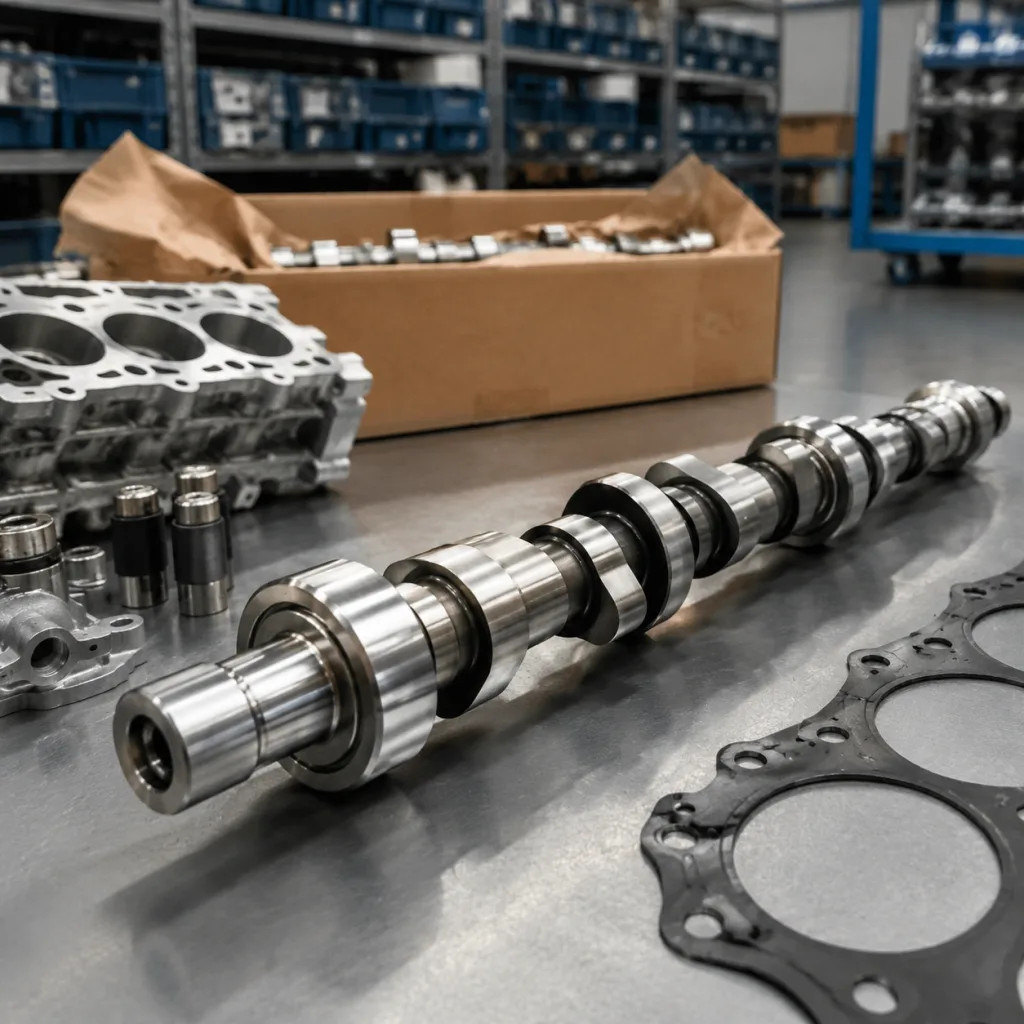
Availability of related components, such as valve lifters, followers, timing components, seals, gaskets, phaser bolts, oil-system service parts, and installation notes
MOQ and price logic should be discussed early because camshafts carry fixture, grinding, heat-treatment, and packaging costs that do not scale evenly at low volumes. For a standard stocked replacement camshaft, a realistic first purchase may be 20–100 pieces per SKU depending on demand and current inventory. For a new development, private-label carton, or drawing-controlled variant, MOQ may move to 100–300 pieces per SKU, or a higher annual forecast may be needed to justify tooling, gauges, master samples, and validation. Unit price should be compared against the total landed cost: sample charge, tooling or fixture cost, inspection documentation, packaging, inland freight, sea or air freight, duties, warranty reserve, and slow-moving stock risk.
Lead time also depends on the approval route. Typical timing is 3–7 working days for feasibility review after receiving engine code, OE reference, sample photos, and volume; 10–25 days for available samples or inspection confirmation; 30–60 days for a first production batch using existing tooling; and 60–90 days or longer for a new casting/forging, special heat-treatment setup, private label, or extended durability validation. Buyers with seasonal demand should use blanket POs or rolling forecasts so raw material, heat-treatment slots, and packaging materials are reserved before stock-out pressure forces air freight.
For importers building a regional camshaft range, a supplier should be able to support a controlled pilot order before scaling to container, LCL, or mixed-pallet shipments. Pilot orders help verify fitment data, label clarity, corrosion protection, and workshop feedback before broad distribution. If your programme requires a drawing-controlled variant, private label, or application-specific engineering changes, Driventus can review custom manufacturing requirements.
Common replacement risks and how to reduce them
Most field issues linked to camshaft replacement fall into four categories: wrong application, lubrication failure, installation error, or manufacturing deviation. Procurement teams cannot control every workshop procedure, but they can reduce avoidable claims through clearer product definition, stronger packaging, and practical technical documentation.
Wrong application selection
The S60 model name covers several engines, production periods, and regional specifications. Intake and exhaust camshafts may also look similar when viewed quickly during picking or installation. Use distinct part numbers, labels, and application notes for each position. Include engine code data where available, and avoid broad listings that imply one camshaft fits all S60 engines. Where the same carton family is used for several SKUs, print the intake/exhaust position in large type and add a scannable barcode tied to the ERP part number.
Early lobe or follower wear
Lobe wear can result from insufficient surface hardness, poor surface finish, inadequate lubrication, contaminated oil, blocked oil passages, incorrect break-in practice, or worn mating parts. Replacement instructions should state that followers, lifters, rocker arms, oil supply condition, and related wear parts must be inspected. A new camshaft installed with damaged followers or dirty oil can fail prematurely even when the camshaft itself is within specification. For warranty screening, request photos of the oil filter, followers, journals, and all lobes; uneven blueing, debris scoring, dry-start marks, or one-lobe-only damage can point to installation or lubrication causes rather than batch-wide machining error.
Timing and sensor faults
If the trigger wheel, slot, reluctor feature, or machined reference point is out of angular position, the engine control unit may record cam/crank correlation faults or variable valve timing faults. For camshafts with phaser interfaces, the mounting geometry and oil-control features must be controlled as critical dimensions. These features should be included in final inspection rather than treated as secondary details. A useful incoming check for high-risk SKUs is to compare the drive-end datum and trigger reference with a master sample using a fixture or coordinate measurement report before releasing stock.
Oil passage and plug defects
Blocked cross-drillings, burrs inside oil holes, loose end plugs, or machining chips trapped after washing can cause rapid journal or lobe damage. Specify deburring, ultrasonic or high-pressure washing where suitable, air-blow verification, and plug-retention inspection. For production lots, random section checks or borescope inspection of oil passages can be justified when the part has multiple internal drillings.
Freight and handling damage
Small dents on lobe edges, journal surfaces, or thrust faces can become warranty claims after installation. Camshafts should be packed with rigid supports, corrosion protection, and separation from heavy components in mixed cartons. Export packaging should also prevent movement inside the inner box, because polished surfaces can be damaged by repeated vibration during sea freight and local distribution. A practical packaging standard is an oiled or VCI-wrapped camshaft, end protection, molded pulp or foam supports at the journals, no metal-to-metal contact, and outer cartons sized so the shaft cannot punch through the end wall during handling.
Why source Volvo S60 replacement camshafts from Driventus
Driventus manufactures engine and powertrain components in Taizhou, Zhejiang, with export supply to more than 60 countries. For a camshaft for Volvo S60 replacement line, our role is to help B2B buyers define the correct specification, validate the part before launch, and maintain repeatable production quality across future orders.
Our supply model supports customers that need:
OE-equivalent dimensional matching for defined applications, including engine-code and intake/exhaust position confirmation
Drawing, sample, or reverse-development review before quotation, with critical-feature measurement rather than catalogue matching only
Batch traceability and inspection documentation for sourcing and warranty files
Neutral, distributor, or private-label packaging options, including carton artwork, barcode labels, and export pallet requirements
Mixed engine-component shipments for consolidated procurement, with pilot, LCL, and scheduled replenishment options
Engineering review for drawings, samples, and application-specific changes
Coordination with sourcing, quality, packaging, and logistics teams before mass release
For active RFQs, the fastest route is to send engine code, target OE reference if verified, intake/exhaust position, annual forecast, first-order quantity, destination market, packaging format, and whether samples or drawings are available. We can then confirm whether the item is existing, sample-based, or development-based; define sample timing; and provide quotation assumptions such as MOQ, lead time, inspection records, and packaging cost. If the project involves a private label or new variant, we will separate one-time tooling or fixture costs from the unit price so landed-cost comparison is clear.
Driventus is an independent aftermarket manufacturer; brand names are referenced for fitment only. We do not claim approval, sponsorship, or endorsement by any vehicle manufacturer. For active projects, buyers can share application data, annual volume, target market, packaging needs, and any existing cross-reference list. Our team can then confirm feasibility and provide sampling, quotation, and validation planning. To start a sourcing review, request a quote.
Frequently asked questions
Provide the model-year range, engine code, intake or exhaust position, target market, estimated annual volume, first-order quantity, packaging requirement, and any verified OE cross-reference data. A sample, drawing, or detailed photos with measurements of journals, drive end, trigger feature, and oil holes can speed up feasibility review and validation planning.
No. The S60 has used different engine families and valvetrain designs. Camshafts must be selected by engine code, position, timing interface, journal dimensions, lobe profile, oil-feed design, drive interface, and sensor reference geometry.
Worn followers, lifters, seals, timing parts, or oil supply issues can damage a new camshaft. Repair instructions should require inspection of mating parts, oil passages, filter condition, and lubrication condition before installation, with replacement of worn components where needed.
If you are building a Volvo S60 replacement camshaft programme, Driventus can review fitment data, samples, inspection plans, MOQ, lead time, and packaging requirements. Contact our sourcing team at /contact.html