Camshaft Renault OE Equivalent: Replacement Buyer Guide
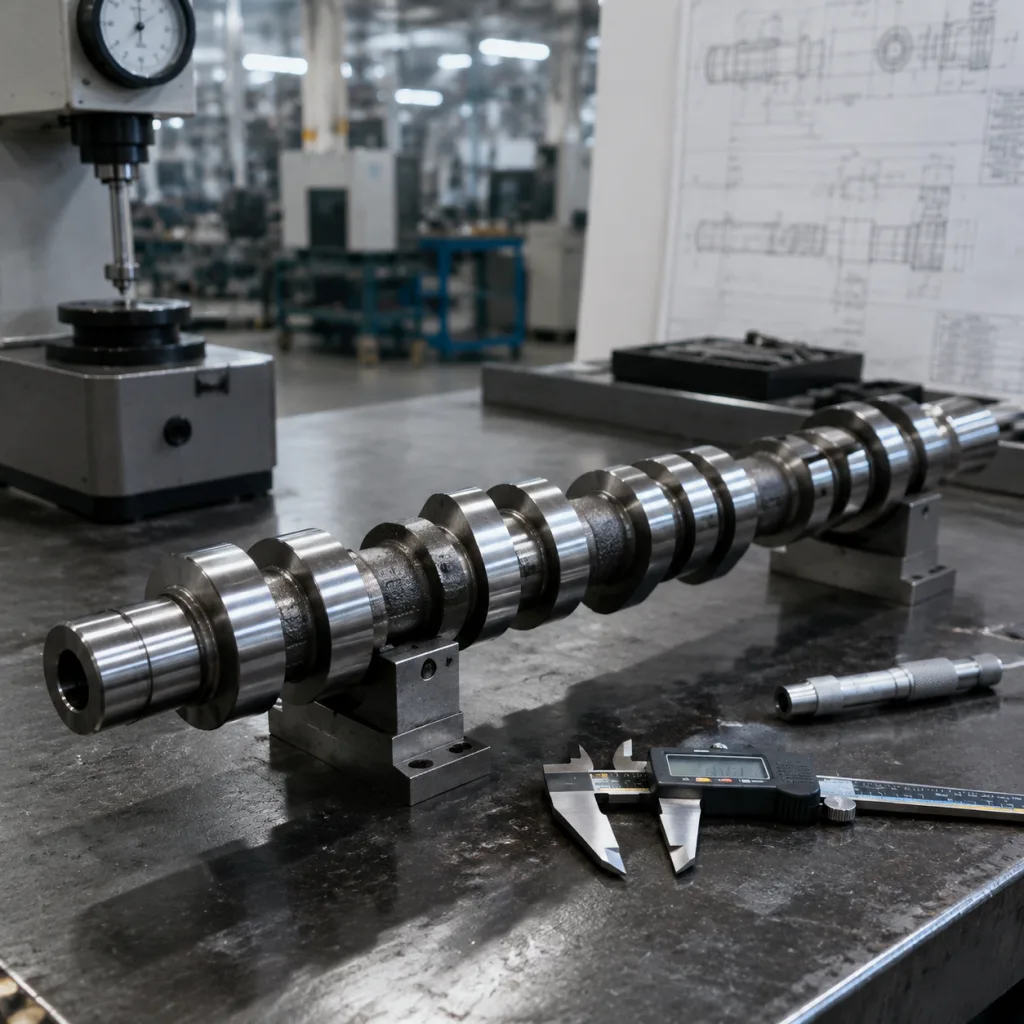
Procurement teams sourcing a camshaft Renault OE equivalent need more than a matching part number. The real decision is whether the replacement preserves valve timing, oil control, emissions behavior, and durability under the target engine code. A camshaft can look correct and still fail on lobe phasing, journal finish, runout, or heat-treatment consistency. Driventus supplies replacement camshafts for Renault applications with dimensional control and production traceability for B2B buyers in aftermarket and repair networks. Driventus is an independent aftermarket manufacturer; brand names are referenced for fitment only. The practical sourcing question is simple: does the part cross-reference correctly, and can the supplier prove it with print-level data, not generic fitment language?
Decision framework: what makes a Renault camshaft truly OE-equivalent
For replacement purchasing, OE equivalent means the camshaft matches the original part’s functional and dimensional requirements for the listed engine code and application. It does not mean vehicle manufacturer approval or OEM branding.
Use the print, not the product title, to judge equivalence. The comparison should cover:
Check item
What to verify
Journal diameter
Must hold bearing clearance and oil film requirements within the engine’s bearing spec
Overall length
Must fit the head and thrust system without changing end float outside the OE window
Base circle and lift
Must preserve valve event geometry and advertised lift at the correct lobe centerline
Lobe phasing
Must keep open/close events within calibration limits
Drive end
Must match belt, chain, or gear interface, including keyway, sprocket register, and sensor trigger features
Surface hardness
Must support wear resistance under boundary lubrication
</tr></thead><tbody> </tbody></table>For Renault replacement work, buyers should confirm OE part-number cross-references such as `OE 06A107065` only where the application listing shows that number. The right OE-equivalent camshaft is the one that keeps airflow, timing, and durability inside the engine’s original envelope. If the supplier cannot tie the part back to the actual engine code, cylinder head revision, and drive system, the match is only superficial.
Where replacements go wrong: the failure modes buyers should screen out
The most common sourcing error is a camshaft that fits physically but shifts timing or valve lift outside tolerance. That kind of mismatch is expensive because it often appears only after installation.
Typical failure modes include:
Wrong lobe phasing, which changes valve timing even when the part bolts in cleanly.
Incorrect journal diameter, which alters oil clearance and wear behavior.
Drive-end mismatch, especially on trigger wheels, keyways, or sprocket registers.
Excessive runout, which creates vibration and timing variation.
Weak heat treatment, which can cause lobe wear or scuffing in service.
A useful buyer workflow is to start with the OE number, then validate the engine code, then compare the physical sample to the master part or approved drawing. If a supplier only offers a visual match, the risk moves to purchasing. For distributors and repair chains, this is usually where warranty exposure begins. For OEM and Tier-1 sourcing, it also prevents PPAP rework because the sample package already reflects the print-level requirements.
Step-by-step buying check before the purchase order
Approve the order only after the sample or drawing has been compared against the OE reference. A fast sequence keeps the review focused:
1. Confirm engine family, cylinder count, and intake or exhaust position. 2. Match journal count, cam lobe count, and thrust face geometry. 3. Check timing drive style: belt, chain, or gear. 4. Verify hardening method and minimum surface hardness. 5. Request a dimensional report with critical dimensions and tolerances. 6. Ask for packaging traceability, lot code, and inspection record. 7. Confirm sample quantity, approval timing, and expected production lead time.
For a camshaft Renault OE equivalent, the key dimensions are journal diameter, overall length, lobe lift, lobe separation, end float allowance, and drive-end features. If those numbers are missing, the part is not ready for controlled procurement. This approach also helps sourcing teams compare suppliers on measurable criteria instead of appearance, which is where many replacement errors start.
Spec deep-dive: materials, heat treatment, and wear control
Camshaft life depends on material selection and finishing as much as on geometry. A replacement camshaft usually uses chilled cast iron, nodular iron, or alloy steel depending on the engine platform and duty cycle.
The core controls are:
Core material for fatigue resistance
Lobe surface hardness for follower wear control
Journal finish for oil film stability
Runout to limit vibration and timing variation
Case integrity after grinding and polishing
Procurement teams should ask for measurable limits, not general claims. That means lobe hardness to the drawing spec, journal roughness at the OE Ra requirement, and total indicator runout within the approved tolerance band. If the supplier cannot provide actual numbers, repeatability is still unproven. Driventus production follows IATF 16949:2016 and ISO 9001:2015 process controls, with incoming material verification and in-process dimensional checks. Where applications require emissions-related durability, buyers may also specify REACH (EC) No 1907/2006 and local market chemical compliance. For thermal and wear benchmarking, request test data aligned to relevant engine-duty protocols such as SAE J2527 where applicable. In practice, camshaft wear usually starts as a surface problem and ends as a timing problem later in service.
Validation package: evidence to request before approval
A reliable replacement part is supported by test evidence, not only by fitment claims. For a Renault camshaft programme, the minimum buyer package should include:
Dimensional inspection report for critical features
Surface hardness results at defined test points
Concentricity and runout measurement
Metallurgical confirmation of the base material
Packaging and traceability record by batch
Sample installation confirmation on the target engine family
Acceptance criteria showing the measured target and allowable tolerance for each critical feature
If the camshaft is used in emissions-sensitive or high-mileage service, ask for durability data from dyno or fleet validation. A useful report states what was tested, how many cycles were run, what oil specification was used, what load and speed profile was applied, and what acceptance criteria were used. It should also show pre- and post-test wear checks and whether valve timing stayed inside the allowable window. That is the difference between a generic aftermarket part and a controlled replacement component. Corrective-action data is often more valuable than a simple pass result, because it shows how the supplier handles failure modes instead of just describing success.
Sourcing scenarios: which buying route fits your programme
Buyers usually source through three routes: catalogue stock, engineered replacement, or custom programme support. Each route suits a different purchasing model.
Engineered replacement suits multi-location repair chains that need dependable OE matching.
Custom manufacturing suits programmes with unique timing, material, or packaging requirements.
Commercial terms should be defined before sampling so the approval path does not stall the order. Low-MOQ catalogue items may be suitable for fast replenishment, while engineered or custom camshafts often require a higher MOQ to cover setup, first-article validation, and packaging configuration. Lead time depends on whether the part is stocked, needs revalidation, or is a new build, so ask for sample lead time and ex-works lead time separately. A useful RFQ should request unit price by volume tier, MOQ, tooling or setup cost if applicable, sample charge, packing specification, and Incoterms so landed cost can be compared fairly. You can review our catalog, check the quality system, or discuss custom manufacturing for platform-specific demand. If your team sources broader engine hardware, the related range is listed on engine components. For lead-time planning, MOQ, and export terms, ask for a quote early so sample approval does not delay replenishment.
Frequently asked questions
No. OE-equivalent means the part matches the original specification for fitment and function, but it is not an OEM-branded part. Driventus is an independent aftermarket manufacturer; brand names are referenced for fitment only.
Check journal diameter, overall length, lobe lift, base circle, phasing, runout, hardness, and timing-drive interface. A dimensional report and inspection record should accompany the sample, and the report should state the actual measured values and tolerance limits for each critical feature.
Yes. For platform-specific demand, Driventus can support drawing review, material selection, validation planning, and packaging requirements through custom manufacturing and controlled production.
If you need a Renault camshaft cross-reference, validation sample, or sourcing review, send your target OE number and engine details through /contact.html.