Camshaft for Volkswagen Beetle Replacement Sourcing
A camshaft for Volkswagen Beetle replacement is typically sourced by repair chains, engine rebuilders, importers, and distributors that need OE-equivalent valvetrain function without relying on dealer-channel supply. For B2B buyers, the key question is not simply whether the part fits the vehicle. It is whether lobe geometry, journal diameter, surface hardness, oil-feed compatibility, timing interface, and packaging control remain consistent across production batches.
Beetle applications cover very different engine families, from classic air-cooled engines to later water-cooled petrol and diesel platforms sold under the Beetle name. Procurement teams should therefore confirm engine code, production year, destination market, fuel type, cam layout, and tappet configuration before requesting samples or quotations. This guide explains the technical checks Driventus uses when developing replacement camshafts, including fitment control, material selection, machining verification, validation testing, and documentation. Driventus is an independent aftermarket manufacturer; Volkswagen and Beetle names are referenced for fitment identification only.
Application Scope and Fitment Control
A replacement camshaft should be specified against the engine family, not only the vehicle model name. Volkswagen Beetle applications may use different camshaft layouts depending on market, model year, and engine architecture. Classic air-cooled units, later petrol engines, and diesel variants do not share the same camshaft requirements, and parts that look similar can differ in drive interface, lobe profile, thrust control, or sensor features.
For purchasing teams, the first filter is fitment evidence. A supplier should provide controlled cross-reference data rather than broad claims such as “fits all Beetle engines”. Where OE part-number references are used, they should be recorded in a traceable format and matched to the buyer’s application data. An OE 06A… style reference, for example, may be relevant to certain later Volkswagen engine families but should not be applied across unrelated Beetle platforms without verification.
Key fitment inputs include:
Engine code and displacement
Model year and destination market
Petrol or diesel configuration
Air-cooled or water-cooled engine family
SOHC, DOHC, or cam-in-block layout
Hydraulic or mechanical tappet type
Timing belt, chain, or gear-drive interface
Sensor trigger profile where applicable
Required kit content: camshaft only, camshaft with followers, or full timing-related set
Driventus supports sourcing teams through our catalog and engine-component program data at /products/engine-components.html. Application data should be confirmed before sampling, especially where aftermarket catalogues list overlapping Beetle, Golf, Jetta, and New Beetle engine families.
OE-Equivalent Geometry: What Buyers Should Verify
The main risk in camshaft for Volkswagen Beetle replacement sourcing is small geometric variation that changes valve timing, tappet contact, oil-film stability, or idle quality. A camshaft can appear correct visually but still create warranty exposure if base-circle diameter, lobe lift, phasing, runout, or journal alignment falls outside the required control range.
Procurement specifications should define measurable features, not only vehicle fitment. Typical incoming inspection points are listed below.
Feature
Procurement check
Why it matters
Journal diameter
Match drawing tolerance or approved sample
Controls oil film and bearing clearance
Lobe lift
Measured from base circle to nose
Affects airflow, torque, and emissions behaviour
Lobe phasing
Degree position against reference feature
Controls valve timing and cylinder balance
Base-circle diameter
Compared with approved profile data
Supports correct tappet preload or lash setting
Surface hardness
Verified after heat treatment
Reduces scuffing against tappets or followers
Runout
Checked between centres
Prevents bearing load concentration
Thrust face width
Matched to engine design
Controls axial movement
Trigger or slot feature
Confirmed by profile measurement
Supports sensor signal accuracy where fitted
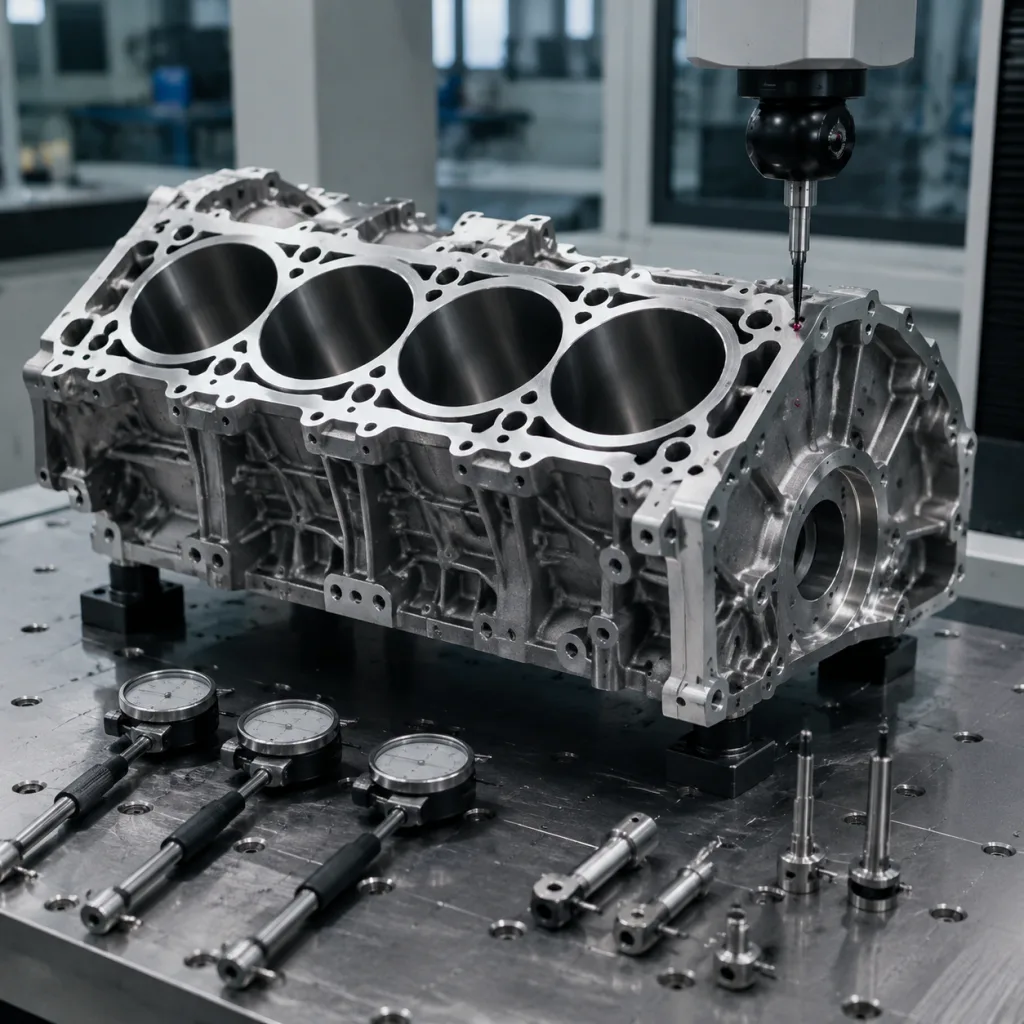
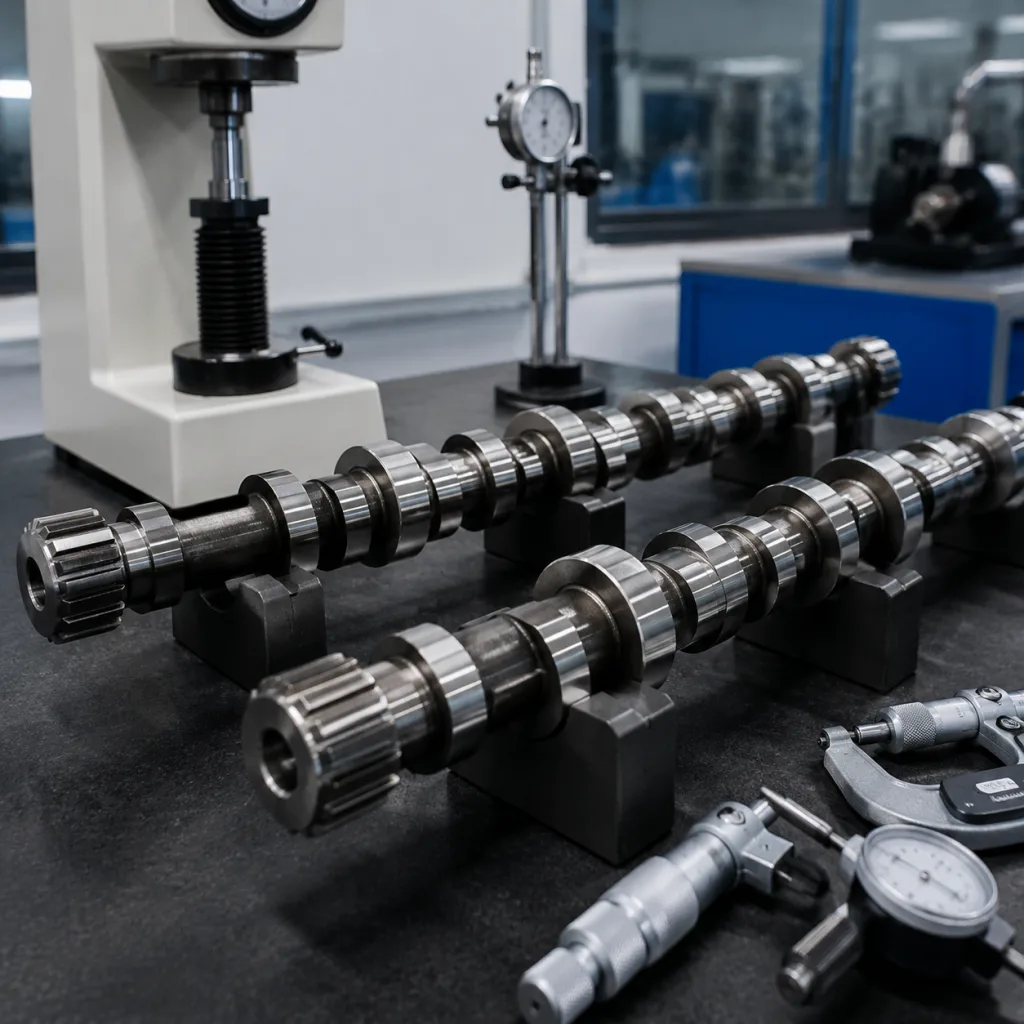
</tr></thead><tbody> </tbody></table>For replacement programs, Driventus normally works from customer-approved samples, drawings, or controlled catalogue data. Dimensional inspection may use calibrated gauges, profilometers, hardness testers, and coordinate measuring equipment where required. The objective is repeatability across production lots, not only a good first sample.
Buyers should also define packaging and corrosion protection at the specification stage. Cam lobes and journals need clean, oiled, abrasion-resistant packing because minor surface damage can become tappet noise, accelerated wear, or a warranty claim after installation.
Material, Heat Treatment, and Surface Finish
Camshaft material selection depends on engine load, follower design, lubrication conditions, and the original part architecture. Common aftermarket replacement designs may use chilled cast iron, alloy cast iron, or forged steel, depending on the application and customer specification. The material must support the required lobe hardness while maintaining core toughness, machinability, and dimensional stability after grinding.
A typical B2B specification should define:
Material grade or approved equivalent
Casting or forging route
Heat-treatment method and hardness range
Lobe and journal surface roughness targets
Straightness and runout limits after machining
Cleanliness requirements after grinding and washing
Rust-prevention method and shelf-life expectation
Preservation oil, sleeve, carton, and pallet requirements
Surface finish is a functional feature, not a cosmetic detail. Excessive roughness accelerates follower wear, while an unsuitable finish can reduce oil retention during start-up. For flat-tappet or high-contact-load designs, lobe metallurgy, tappet compatibility, break-in conditions, and lubricant suitability should be reviewed together.
Driventus production control is managed under IATF 16949:2016 and ISO 9001:2015. These standards do not approve a specific part number, but they define process discipline for documentation, traceability, corrective action, and continual improvement. Buyers can review our quality system when assessing supplier controls for replacement camshaft programs.
Where chemical compliance is required for EU and UK supply chains, buyers may request documentation aligned with REACH (EC) No 1907/2006. Packaging, rust-prevention oils, labels, and preservation materials should also be checked against destination-market requirements.
Validation Testing for Replacement Programs
A camshaft replacement program should not rely only on dimensional inspection. Validation testing helps confirm that the part can survive transport, storage, installation, initial start-up, and normal service loads. It also gives buyers a documented baseline for future batch comparison and warranty review.
Driventus uses a staged validation approach depending on application risk and customer requirements. This can include sample dimensional reports, hardness mapping, metallographic inspection, surface roughness checks, torsional feature checks, packaging assessment, and bench or engine-related durability evaluation. For large distributor programs, first-article approval can be followed by production part approval documentation agreed with the buyer.
Typical validation evidence includes:
First-article dimensional inspection report
Material certificate or internal material verification
Heat-treatment record and hardness report
Lobe profile measurement report
Surface roughness report for lobes and journals
Runout and straightness inspection
Metallographic or microstructure check where specified
Salt-spray or corrosion-resistance check for packaging validation where required
Batch traceability record linked to production date and inspection lot
For emissions-sensitive vehicles, replacement parts should preserve the original valve-timing intent. Standards such as ECE R-83 relate to vehicle emissions type approval, not aftermarket camshaft approval. However, buyers should avoid altered lift, duration, or timing unless the program is explicitly for performance or motorsport use. For repair-chain and wholesale replacement supply, OE-equivalent function is usually the correct requirement.
Procurement Specification and Supplier Audit Points
A clear purchase specification reduces dispute risk between importer, distributor, repair chain, and manufacturer. The document should define application scope, technical characteristics, inspection requirements, packing, labelling, traceability, and warranty handling process. It should also identify which documents are required at sample stage and which records must accompany routine production batches.
Recommended supplier audit points:
IATF 16949:2016 or ISO 9001:2015 certificate validity and scope
Incoming material inspection records
Heat-treatment control records and furnace traceability
Grinding process capability for lobes and journals
Gauge calibration records
Nonconforming-product control process
Final inspection sampling plan
Packaging drop-test or transport validation where required
Batch traceability and recall-support procedure
Export documentation experience for EU, UK, US, Canada, Australia, and Brazil
Driventus operates as a vertically integrated manufacturer in Taizhou, Zhejiang, with engine and powertrain component lines covering pistons, crankshafts, gaskets, water pumps, turbochargers, and camshaft-related programs. For importers and repair-chain buyers, this structure can simplify technical communication and reduce handover errors between casting, machining, inspection, packing, and export coordination.
For non-standard engine families, discontinued applications, or private-label requirements, buyers can review custom manufacturing. Tooling, samples, MOQ, and lead time depend on the camshaft type, annual forecast, target market, packaging format, and validation package.
Ordering Workflow for Distributors and Repair Chains
A practical ordering workflow starts with application confirmation and ends with repeatable batch supply. For a camshaft for Volkswagen Beetle replacement, the most common avoidable errors are incomplete engine identification, mixed catalogue references, unclear kit content, and packaging instructions that are added too late in the sourcing process.
A controlled workflow should follow this sequence:
1. Provide engine code, year range, market, and any OE 06A… style cross-reference already used in the buyer’s system. 2. Confirm whether the requirement is camshaft only or a kit including followers, seals, bolts, or timing-related parts. 3. Review sample, drawing, or catalogue match with the supplier. 4. Approve first samples with dimensional, material, hardness, and surface-finish reports. 5. Confirm packaging, labelling, barcode, carton, and pallet requirements. 6. Place a pilot order before full stocking release where the market or application is new. 7. Track warranty feedback by batch number, installation context, mileage, and related components.
For multi-location repair chains, consistent labelling and installation notes reduce returns caused by misapplication. For wholesalers, carton strength and corrosion protection are important because stock may remain in warehouse rotation for months before installation.
Driventus is an independent aftermarket manufacturer; brand names are referenced for fitment only. We do not claim approval or endorsement by any vehicle manufacturer.
Frequently asked questions
Confirm the engine code, model year, market, fuel type, engine family, cam layout, and tappet design. Vehicle model name alone is not enough because Beetle applications span different air-cooled and water-cooled platforms. Existing catalogue references or OE 06A… style references can help when they are already used in the buyer’s system, but they should still be checked against the exact application.
Typical sample documentation includes dimensional inspection, material verification, hardness results, lobe profile checks, surface roughness data, and batch traceability. For larger programs, buyers may also request first-article approval, packaging validation, corrosion-protection checks, and agreed production inspection plans.
Yes, private-label supply can be reviewed for qualified B2B buyers. Feasibility depends on the application, annual volume, tooling needs, packaging specification, validation requirements, and destination market. Driventus can also assess custom manufacturing projects where standard catalogue coverage is not sufficient.
If you are building a replacement camshaft program for Beetle or related engine platforms, send the application list, forecast, target market, and documentation requirements to [request a quote](/contact.html).