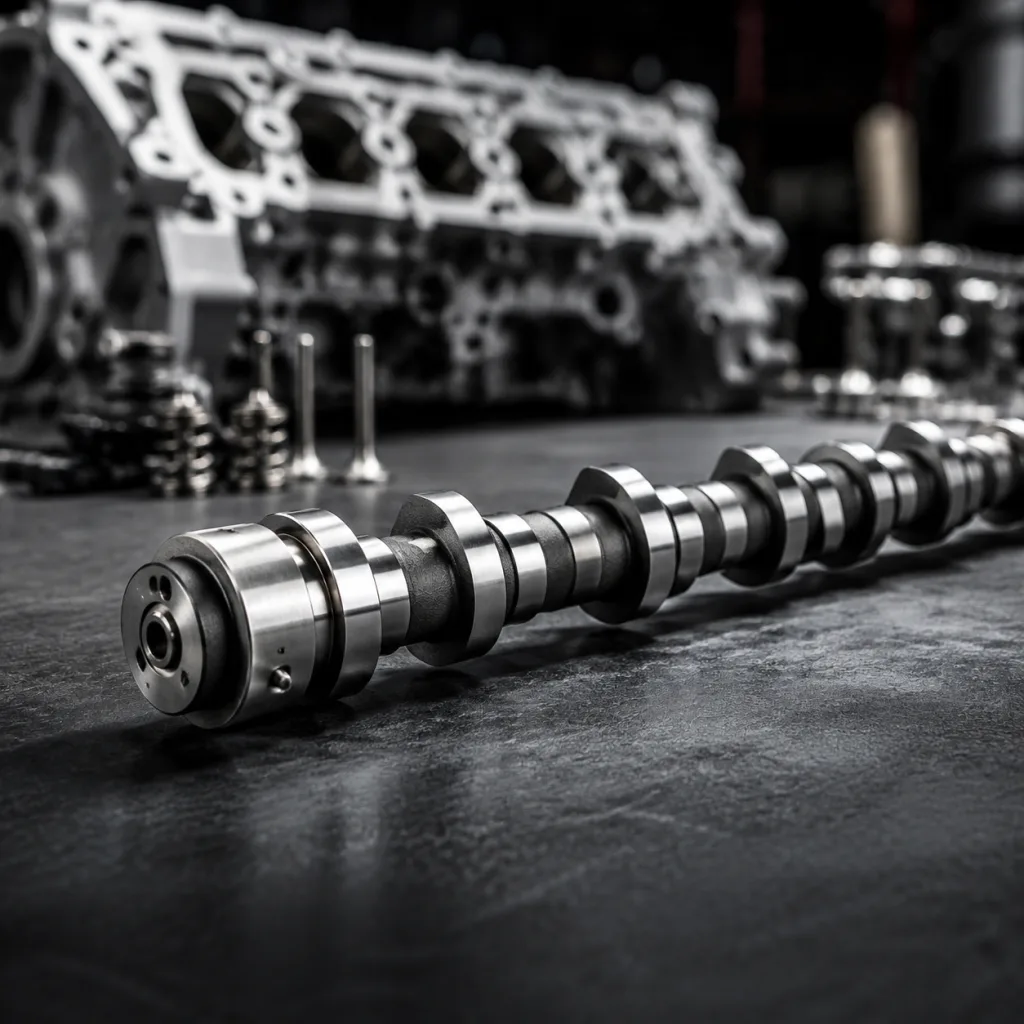
Camshaft vs Federal-Mogul Alternative: Sourcing Guide
Procurement teams comparing a camshaft vs Federal-Mogul alternative usually need two things: dimensional compatibility and supply continuity. The right choice depends on engine code, valve train geometry, heat treatment, and the validation standard the buyer must meet. For aftermarket distributors, the main concern is coverage and fill rate. For OEM and Tier-1 sourcing, the focus shifts to repeatable machining, material traceability, and test data.
Driventus is an independent aftermarket manufacturer; brand names are referenced for fitment only. We produce engine and powertrain components in Taizhou, Zhejiang, with IATF 16949:2016 and ISO 9001:2015 systems in place. This article compares a generic camshaft supply route with a Federal-Mogul replacement alternative, and outlines what buyers should verify before placing a production or replenishment order.
How to decide whether a replacement really fits
When a buyer searches for a camshaft vs Federal-Mogul alternative, the decision is rarely about brand loyalty. It is about whether the part lands inside the engine’s timing window, clears the installation envelope, and survives the intended duty cycle.
Start with the dimensions that actually move the needle:
Overall length, journal positions, and thrust-face location within ±0.05 mm on critical fit dimensions
Base circle, lobe lift, and lobe separation matched to the target OE drawing or a verified sample
Nose hardness in the range typically specified at HRC 50–60, depending on the application and hardening route
Cam phasing, sensor trigger features, and drive-end geometry, including keyway or spline alignment
Packaging tolerance for OEM and aftermarket assemblies, especially when lifters, bearings, or timing sets ship as a kit
If those points are vague, the sourcing decision is already risky. Ask for drawings, material declarations, and inspection reports before commercial terms are fixed. For reman or service parts, also confirm that the supplier can hold the same datum scheme across repeat orders. Otherwise, incoming inspection changes from lot to lot, and the “equivalent” part becomes an operational headache.
Where generic supply beats a branded substitute—and where it fails
Decision point
Generic camshaft supply
Federal-Mogul alternative source
Fitment data
Often limited to catalog references
Strongest when backed by OE cross-reference, drawings, and sample checks
Lead time
Can swing from 4–8 weeks to unpredictable spot-buy delays
More stable when the supplier quotes a fixed production window and keeps buffer stock
Traceability
Varies by supplier
Stronger when tied to heat number, batch code, and in-process inspection records
Validation
May rely on basic dimensional checks
Should include hardness, runout, profile check, and dynamic verification
Commercial risk
Lower entry cost, higher mismatch risk
Better for controlled supply and repeat orders
MOQ logic
Often low for catalog stock, but price rises sharply below 100–200 pcs
Can be structured at 200–500 pcs with tiered pricing for 1,000+ pcs
</tr></thead><tbody> </tbody></table>For planning purposes, pricing usually follows quantity bands, not a single flat rate. A practical RFQ should ask for 100 pcs sample buy, 500 pcs pilot lot, and 1,000 pcs production pricing so landed cost, tooling amortization, and inspection effort are visible before award. Driventus supports OE-style cross-reference work using part numbers such as OE 06A107065 when the application data is already defined by the buyer. We do not claim OEM approval or endorsement.
Spec sheet checks that prevent a bad buy
A camshaft is sensitive to material quality and process control, so buyers should ask for a specification pack rather than only a price.
Typical spec items to confirm
Material grade and heat-treatment route, such as chilled cast iron, forged steel, or billet steel depending on the program
Journal diameter tolerance, commonly controlled at ±0.01 to ±0.02 mm on critical journals
Lobe lift and profile repeatability, usually requiring a profile tolerance band agreed in the drawing pack
Straightness and total indicated runout, often specified at 0.03 mm or tighter for precision applications
Surface hardness and case depth, where applicable, with a defined measurement location and acceptance method
Nitriding or induction hardening parameters, including soak time, hardness range, and allowed decarburization
Final cleaning and anti-corrosion packaging, especially when the part is warehoused for more than 90 days
For regulated markets, material declarations should support REACH (EC) No 1907/2006 where applicable, and test methods should be defined in the purchase order. If the application is emissions-sensitive, buyers may also request validation aligned to ECE R-83 or durability methods such as SAE J2527, depending on the assembly and vehicle segment. For purchase control, include acceptance thresholds in the PO itself: for example, surface roughness Ra ≤ 0.8 μm on bearing journals, hardness records for every heat lot, and 100% visual inspection for burrs, nicks, and coating defects.
Validation steps before you release the PO
Dimensional equivalence is necessary, but it is not enough. A camshaft alternative should be validated under the same operating conditions as the target application.
Follow this sequence:
1. Confirm OE cross-reference, engine code, and model year range, then verify that the supplier’s reference matches the exact variant and not just the family. 2. Compare drawing revisions, journal spacing, drive-end geometry, and trigger-wheel details; require a signed dimensional comparison sheet if the part is being re-sourced. 3. Measure runout, lobe lift, and surface finish on sample parts; a normal pilot plan is 3–5 pcs per lot, with tighter programs asking for first-article + capability data. 4. Review metallurgical results, including hardness and microstructure; ask for a hardness map if the part has localized hardening. 5. Run fitment verification with matched lifters, bearings, springs, and timing components; set cold clearance and endplay targets before assembly. 6. For fleet or aftermarket programmes, track noise, wear, oiling, and magnet/debris findings after installation over the first 1,000–3,000 km or an agreed equivalent test cycle.
Release production only after the supplier passes the drawing check, first article inspection, and functional fitment on the same sample set. That sequence reduces returns and protects import margins. It matters most when the part is sold as a private-label replacement or supports a multi-country catalog. If the supplier cannot provide a sample lead time, ask for a staged quote: samples in 10–15 days, pilot lot in 25–35 days, and stable production in 30–45 days depending on tooling status and heat-treatment capacity.
What manufacturing control does to landed cost
A lower unit price can still create a higher landed cost if the camshaft fails inspection or triggers warranty claims downstream. The real cost drivers are stable machining, reliable heat treatment, and controlled final inspection.
Driventus manufactures in a vertically integrated plant environment, which helps with batch traceability and scheduling. Buyers can align commercial terms with their own supplier scorecards and audit requirements. Our quality system is built around IATF 16949:2016 and ISO 9001:2015, and our OEM services can support custom manufacturing when a standard catalog part is not enough.
For sourcing teams managing multiple engine families, the practical move is to shortlist the part in our catalog, review the quality system, and then move to application-specific confirmation before order release. A workable commercial structure is to tie 30% of the award to sample approval, 40% to first production delivery, and the balance to on-time delivery and defect-rate performance. That keeps cost, lead time, and quality visible without over-committing inventory.
When custom manufacturing is the smarter path
A catalog match is not always available, especially for older engines, regional variants, or low-volume repair programmes. In those cases, custom manufacturing is often the cleaner route.
A specific OE 06A…-style cross-reference supported by customer drawings and sample verification
A revised lobe profile for a controlled engine variant, with lift and duration targets locked in the specification sheet
Packaged supply with private label requirements, including barcode, carton count, and palletization standards
Stable replenishment for distributor programmes, with MOQ and reorder points aligned to sell-through
If the programme also includes related engine components, it may be efficient to source through our catalog and engine components together so the bill of materials stays aligned across the supply chain. For custom quotes, buyers should send the target annual volume, expected quarterly call-off, requested finish standard, and any mandatory test reports so lead time and price can be quoted realistically rather than as a placeholder estimate.
Frequently asked questions
No. Interchangeability depends on engine code, cam timing, lobe profile, drive-end geometry, and installation clearances. Verify drawings and sample measurements before confirming commercial supply. If the part controls valve timing closely, require at least one matched sample build and one dimensional report before PO release.
Ask for dimensional drawings, material and heat-treatment data, batch traceability, inspection reports, and any application cross-reference. For regulated markets, include REACH-related declarations where relevant. Buyers should also request sample photos, measurement method details, and the supplier’s acceptance limits for runout, hardness, and surface finish.
Yes. We support custom manufacturing for defined applications and drawing-based programmes. Send the target OE reference, volume, and validation requirements through the contact page. For faster quoting, include annual demand, pilot quantity, requested lead time, packaging spec, and any target hardness or runout limits.
If you are comparing supply options for a camshaft programme, send your fitment data, target volume, and required inspection limits for review. Request a quote at /contact.html.