Camshaft for Renault Kadjar Replacement Sourcing Guide
A camshaft for Renault Kadjar replacement programme should start with the engine code, not the badge. The same model name can hide different fuel systems, emissions packages, cam layouts, and trigger geometries, so a fast catalogue match can still create a costly misbuild. For importers, repair-chain buyers, and aftermarket distributors, the real risk is not just a wrong-fit part; it is a part that fits on paper but fails in service because of weak lobe geometry control, inconsistent surface hardening, poor corrosion protection, or incomplete batch records.
Driventus supplies camshafts and related engine components from Taizhou, Zhejiang, for B2B buyers in Europe, the UK, North America, Australia, and Brazil. Production is managed under IATF 16949:2016 and ISO 9001:2015 procedures, with inspection records available for batch review. Driventus is an independent aftermarket manufacturer; brand names are referenced for fitment identification only. This guide focuses on how to verify fitment, read the specification sheet, and spot the failure modes that matter before a Renault Kadjar camshaft enters your replacement range.
Start with the Engine Code, Not the Badge
Renault Kadjar camshaft sourcing is a fitment decision, a quality decision, and a commercial risk decision all at once. The vehicle name alone is too broad. Year range, fuel type, displacement, emissions level, intake or exhaust position, and engine code can all change the required camshaft.
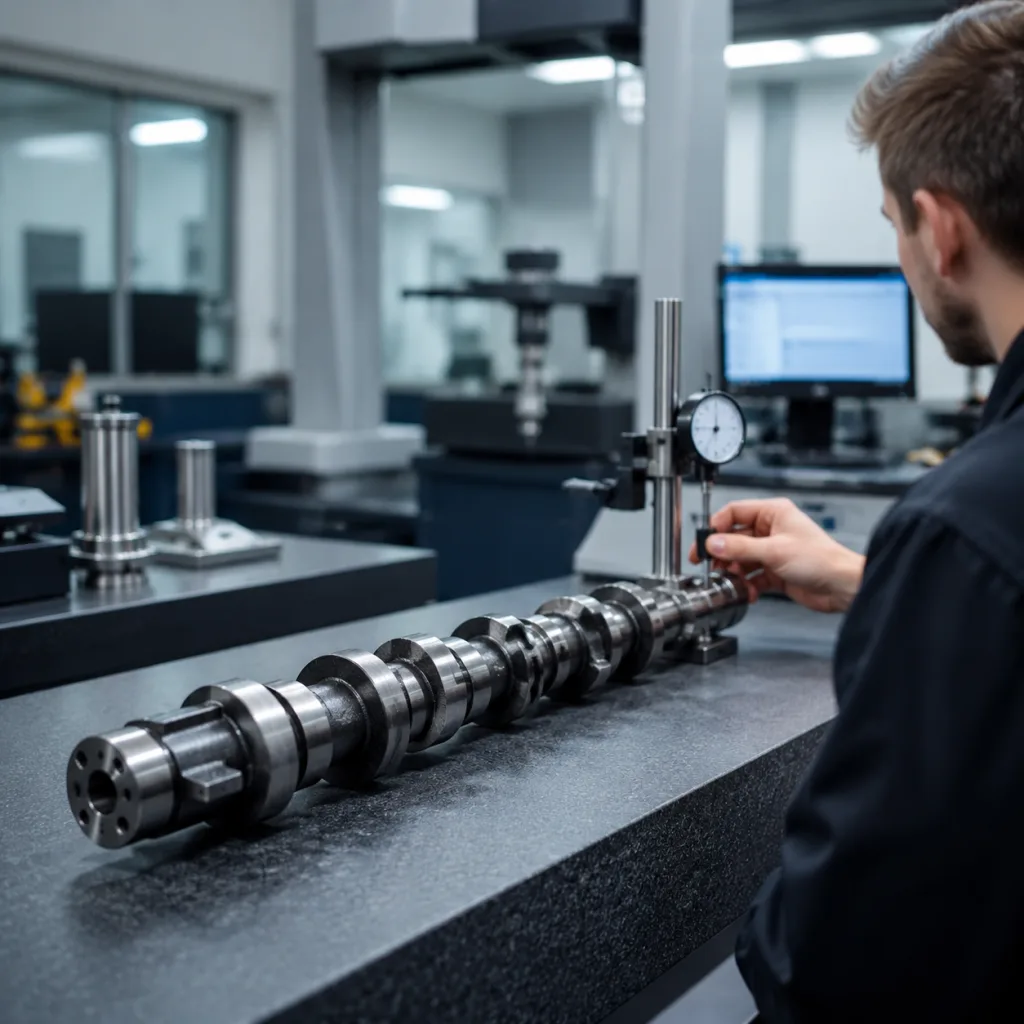
A disciplined application file should capture: engine code, VIN range, model year, displacement, cylinder count, emission standard, cam position, OE reference, and drawing revision. It should also record the dimensions that actually control interchangeability: journal diameter, lobe lift, overall length, thrust face location, drive-end geometry, and trigger wheel tooth count where used. For final machining, tolerances on bearing-critical features are often held to tight bands such as ±0.01 mm to ±0.03 mm, while lobe lift, phase angle, and runout must match the approved drawing and master sample.
OE cross-references help narrow the target, but they are not approval by themselves. Visual similarity is not enough. Two shafts can share a catalogue reference and still differ in lobe position, seal surface, sensor pattern, or oil-feed detail. For programme planning, buyers can review our catalog, engine components, or use custom manufacturing to lock drawings, inspection plans, and export packaging before launch.
What the Spec Sheet Must Prove
A camshaft for Renault Kadjar replacement should be backed by measured evidence, not a generic compatibility statement. The spec sheet needs to answer one question clearly: does this part match the intended engine in fit, function, and service life?
Specification item
What to check
Typical control value / tolerance
Camshaft type
Intake, exhaust, or combined shaft
Must match exact application
Base material
Chilled cast iron, ductile iron, or specified steel grade
Must match approved material route
Journal diameter
Drawing value with tolerance band
Commonly held to ±0.01 mm to ±0.02 mm
Lobe lift
Drawing value with tolerance band
Verify against CAD and master sample
Lobe phase angle
Verified against timing datum
Hold to drawing-controlled phase window
Surface hardness
Controlled after heat treatment or chilling process
Often specified at HRC 52 to 60, application dependent
Runout
Checked between centres
Commonly ≤0.03 mm to ≤0.05 mm TIR
Sensor or trigger feature
Matched to application
Must prevent fault codes and no-start conditions
Surface finish
Journal and seal areas
Typically Ra 0.2 to 0.8 μm where specified
Packaging
Rust protection and separated contact surfaces
VCI or oiled wrap, plus partitioned carton
</tr></thead><tbody> </tbody></table>The most useful document is a first-article inspection report that ties those values to one drawing revision and one approved sample. For repeat orders, the control plan should define how often the supplier checks lobe lift, journal diameter, straightness, hardness, surface condition, and visible defects. That is far more useful to a buyer than a vague statement that the part is “high quality.”
How to Confirm OE-Equivalence Without Approval Claims
OE-equivalence means the aftermarket part is designed to match the stated original application. It does not mean the vehicle maker has approved, authorised, or endorsed the part. Driventus is an independent aftermarket manufacturer; brand names are referenced for fitment identification only.
For Kadjar camshafts, OE-equivalence should be proven through measurable checks:
Dimensional comparison against an approved drawing or buyer-supplied master sample.
Lobe profile inspection using a cam profile measuring system.
Journal diameter and roundness checks using calibrated gauges.
Hardness and metallographic review where required by the material route.
Runout inspection between centres after final machining.
Functional confirmation of timing datum, drive end, and sensor trigger features.
Batch identification linked to raw material heat and machining lot numbers.
A complete procurement file should hold the drawing revision, inspection report format, approved sample record, packaging specification, and batch traceability method together. That reduces disputes later, especially when the same part number moves through multiple warehouses, distributors, or repair-chain branches.
Validation Evidence Buyers Should Ask For
Replacement camshafts are critical engine parts. If the geometry drifts, the impact can show up in valve timing, combustion quality, emissions behaviour, or durability. Buyers should ask how the supplier validates each application before shipment and how repeat production is controlled after the first approved sample.
Driventus manages engine component production within a documented quality system aligned with IATF 16949:2016 and ISO 9001:2015. Relevant records may include incoming material inspection, heat-treatment verification, machining inspection, gauge calibration, nonconforming-product control, and final release checks. For exported aftermarket products, buyers should also define material and substance compliance expectations where applicable, including REACH (EC) No 1907/2006 for EU markets.
Typical validation and release checks include:
Material certificate review against the agreed specification.
Hardness testing at defined positions on lobes or journals.
Lobe profile and lift measurement against CAD or drawing data.
Straightness and runout measurement after machining.
Surface finish checks on journals and sealing areas.
Corrosion-resistance or packaging validation when required by the buyer.
Lot traceability from raw material to finished export carton.
Dimensional sampling at AQL 1.0 or tighter for critical features, if the buyer specifies statistical acceptance.
For launch control, request a sample pack with at least 3 to 5 measured pieces per lot for critical-feature confirmation, plus one retained master sample sealed against the approved drawing revision. For higher-volume programmes, a PPAP-style dossier is useful even when formal PPAP is not contractually required. That file should include the process flow, control plan, dimensional results, material reports, packaging approval, and traceability sample.
Where Replacement Programmes Usually Fail
Most camshaft warranty issues do not start with one dramatic defect. They usually start with small mismatches that compound after installation.
Risk
Likely cause
Buyer control
Engine fault code after installation
Incorrect trigger feature or timing datum
Confirm application-specific sensor geometry
Early lobe wear
Poor hardness, follower wear, or oil starvation
Require hardness data and installation notes
Oil leakage at seal area
Surface finish or diameter mismatch
Inspect sealing journal dimensions
Noisy valvetrain
Lobe profile variation or worn mating parts
Use profile inspection and service guidance
Mixed stock
Intake and exhaust parts packed incorrectly
Require part labels and barcode control
Corrosion on arrival
Weak rust prevention or damaged packaging
Define VCI, oiling, and carton separation
</tr></thead><tbody> </tbody></table>The fastest way to reduce claims is to control the full chain, not just the part. Confirm engine oil specification. Replace contaminated oil and filters where needed. Inspect lifters, followers, and rocker components if the failure mode suggests secondary damage. Separate manufacturing defects from installation errors and pre-existing engine wear in the return-analysis process. That keeps warranty review technical instead of argumentative.
Commercial Controls for Importers and Repair Chains
A Renault Kadjar camshaft programme should be run like a small supply chain, not like a one-off part purchase. Buyers need confidence that the supplier can maintain fitment data, protect parts in transit, support delivery schedules, and handle warranty feedback with evidence.
Recommended procurement checklist:
Confirm engine code, model year range, fuel type, and intake or exhaust position.
Request drawings or controlled inspection dimensions before sampling.
Approve a labelled master sample before the first production order.
Define carton quantity, corrosion protection, palletisation, and barcode format.
Agree AQL or inspection frequency for critical dimensions.
Confirm HS code, country-of-origin marking, and documentation requirements.
Set warranty analysis rules for returned parts, including oil starvation and installation-error review.
Establish target lead time, reorder point, and safety stock before launch.
For import programmes, MOQ should match carton configuration and forecast accuracy. A common launch structure is 50 to 100 pcs MOQ for each confirmed application, with 30 to 45 days production lead time after sample approval and artwork sign-off. Slower-moving references can be consolidated across models, but only if part numbers, labels, and inserts stay fully separated at pick-pack stage. High-volume distributors should also lock a price ladder tied to annual volume bands so forecast growth reduces unit cost without changing the approved technical file.
For repair chains, installation guidance matters as much as the part. Standardise start-up lubrication, correct timing tool use, and replacement of worn followers or related valvetrain parts where the service procedure requires them. Otherwise, a good camshaft can still return as a warranty claim.
Buyer Q&A on Renault Kadjar Camshafts
What information is needed to source a Renault Kadjar camshaft? Provide the engine code, model year, fuel type, intake or exhaust position, and any OE cross-reference available in your system. A sample, drawing, or measured critical dimensions also helps confirm the lobe profile, journals, timing datum, drive end, and trigger features before production.
Can Driventus supply private-label camshafts for distributors? Yes. Driventus can support private-label packaging, barcode labels, carton specifications, and controlled inspection plans for B2B buyers. Packaging artwork, country-specific compliance wording, carton marking requirements, MOQ, and lead time should be confirmed by the importer before mass production.
Does OE-equivalent mean approved by Renault? No. OE-equivalent means the aftermarket part is designed to match fit and function for the stated application. It does not imply approval or endorsement by the vehicle manufacturer.
Frequently asked questions
Provide the engine code, model year, fuel type, intake or exhaust position, and any OE cross-reference available in your system. A sample, drawing, or measured critical dimensions also helps confirm the lobe profile, journals, timing datum, drive end, and trigger features before production.
Yes. Driventus can support private-label packaging, barcode labels, carton specifications, and controlled inspection plans for B2B buyers. Packaging artwork, country-specific compliance wording, carton marking requirements, MOQ, and lead time should be confirmed by the importer before mass production.
No. OE-equivalent means the aftermarket part is designed to match fit and function for the stated application. It does not imply approval or endorsement by the vehicle manufacturer. Driventus is an independent aftermarket manufacturer; brand names are referenced for fitment identification only.
For drawings, sample review, MOQ, and lead-time details for camshaft for Renault Kadjar replacement programmes, [request a quote](/contact.html).