Camshaft Porsche OE Equivalent: Buyer Checklist
Buyers sourcing a Porsche camshaft replacement need more than a matching model name. The part has to match valve timing, journal geometry, drive interface, heat treatment, and surface finish, then pass the same inspection logic used on the original program. That is what OE-equivalent should mean in procurement terms. Driventus is an independent aftermarket manufacturer; brand names are referenced for fitment only. For procurement teams, the practical test is simple: can the supplier prove dimensional conformity, material consistency, and traceable validation data before shipment? This article sets out the checks that matter for replacement programs, including drawing control, hardness, runout, and documentation for EU, UK, US, Canada, Australia, and Brazil imports.
What OE-equivalent should mean for a camshaft
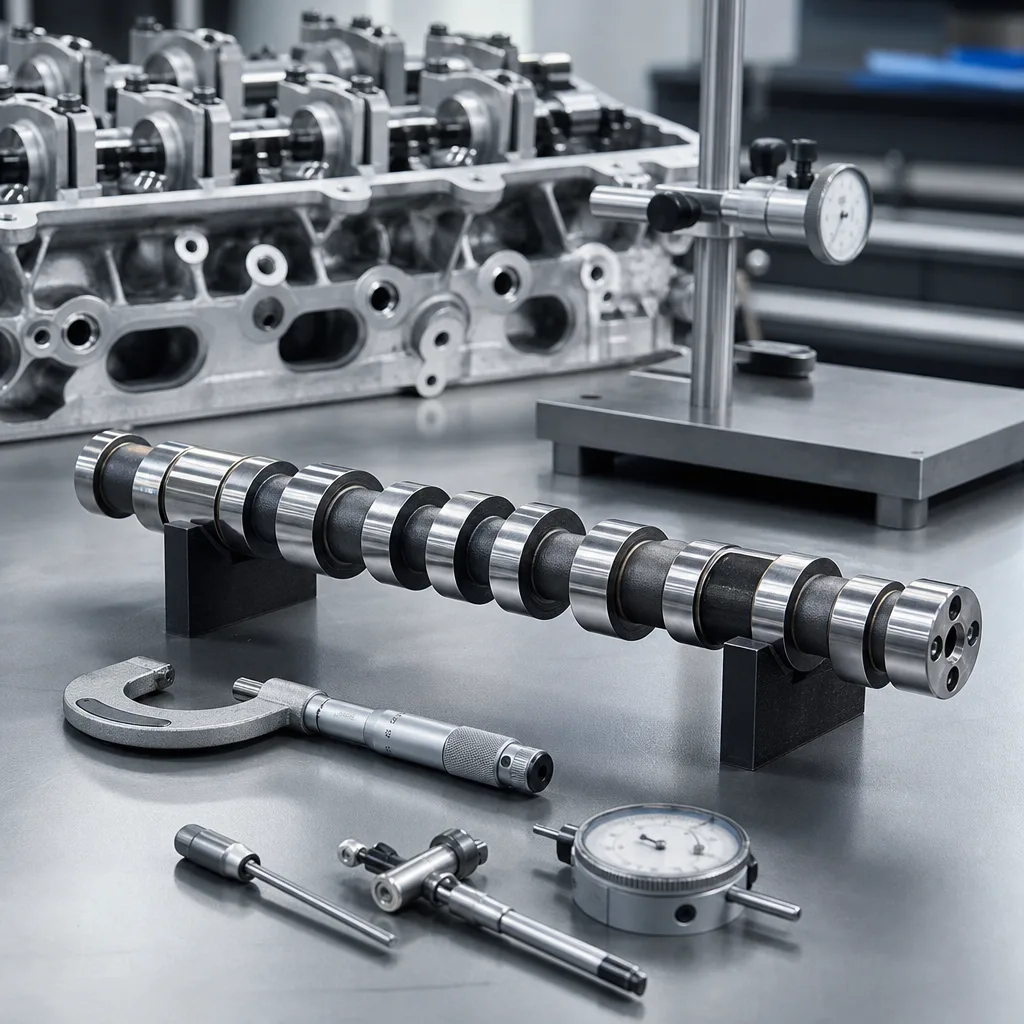
An OE-equivalent camshaft is not defined by the casting finish or the presence of a label. It is defined by whether the replacement reproduces the original valve event and fits the same head, drive, and sensor architecture.
Require evidence for:
- Lobe lift and duration at the same measuring convention
- Lobe phasing and centreline position
- Base circle diameter
- Journal diameter and spacing
- Thrust face width and axial control
- Cam drive type, keyway, gear, or chain interface
- Trigger wheel geometry, if applicable
For Porsche applications, engine family and revision level matter more than model name. Intake and exhaust profiles can differ, and a small change in phasing can alter idle quality, emissions, and high-load performance. A supplier should confirm the exact engine code, the valvetrain type, and the production revision before treating a part as interchangeable.
Dimensional checks buyers should request
A practical purchasing spec starts with metrology, not marketing language. Ask for the drawing revision used for production, then compare the replacement against the original sample or the accepted OE reference.
| Check | Typical buyer expectation | Why it matters |
|---|---|---|
| Journal runout | Within the agreed drawing tolerance, often around 0.03 mm or tighter on critical journals | Controls bearing load and noise |
| Bearing surface finish | Ra 0.8 μm or better on running surfaces, if required by the program | Reduces wear and oil film disruption |
| Lobe hardness | Commonly 55-62 HRC on hardened lobes, where the design calls for it | Supports wear resistance |
| Overall length and thrust width | Match the approved drawing exactly | Prevents endplay and assembly issues |
| Sensor trigger geometry | Match tooth count, timing window, and index position | Protects signal accuracy |
| Item | Unverified replacement | OE-equivalent source |
|---|---|---|
| Fitment data | Model-level claim only | Engine code, revision, and drawing-backed match |
| Measurement proof | None or partial | Full inspection report with traceability |
| Material evidence | Generic statement | Heat, chemistry, and hardness records |
| Launch support | Limited | Sample approval and corrective-action loop |
| Change control | Unclear | Revision-controlled production |