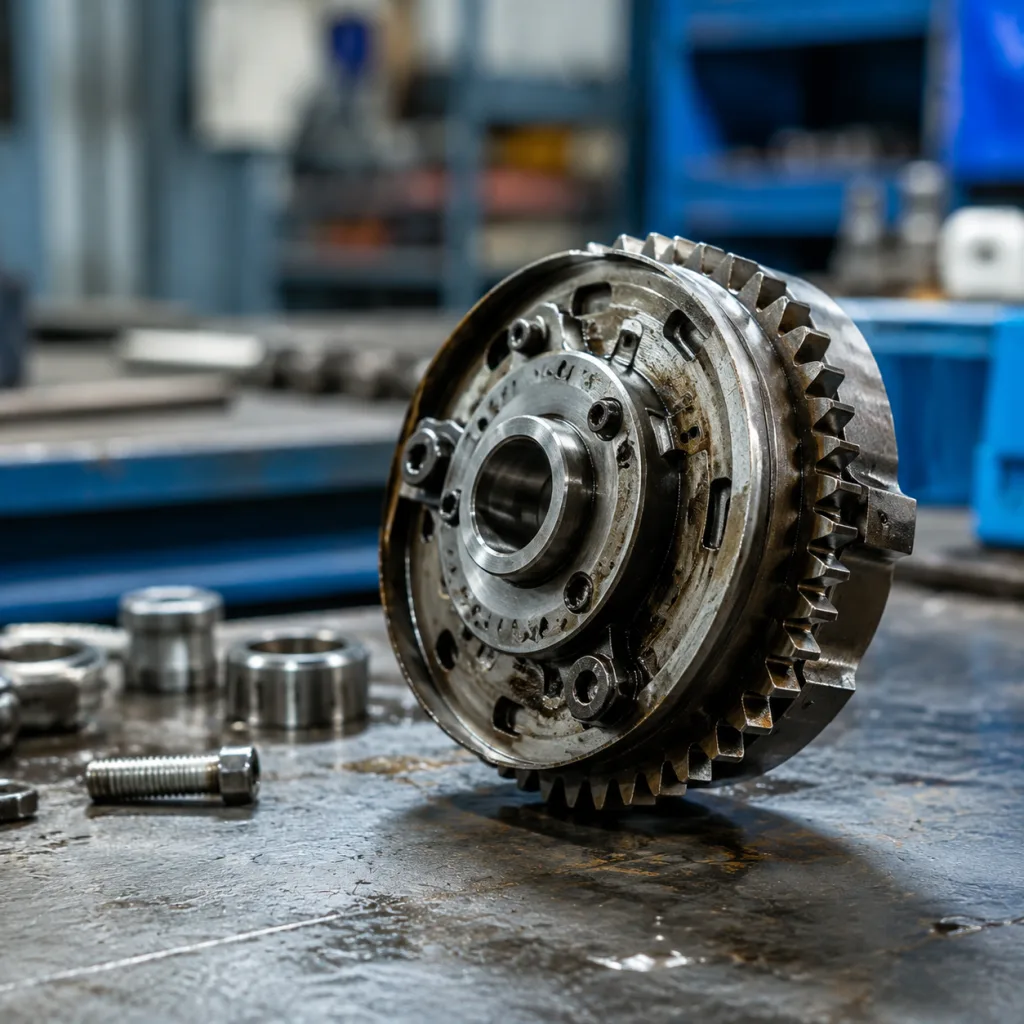
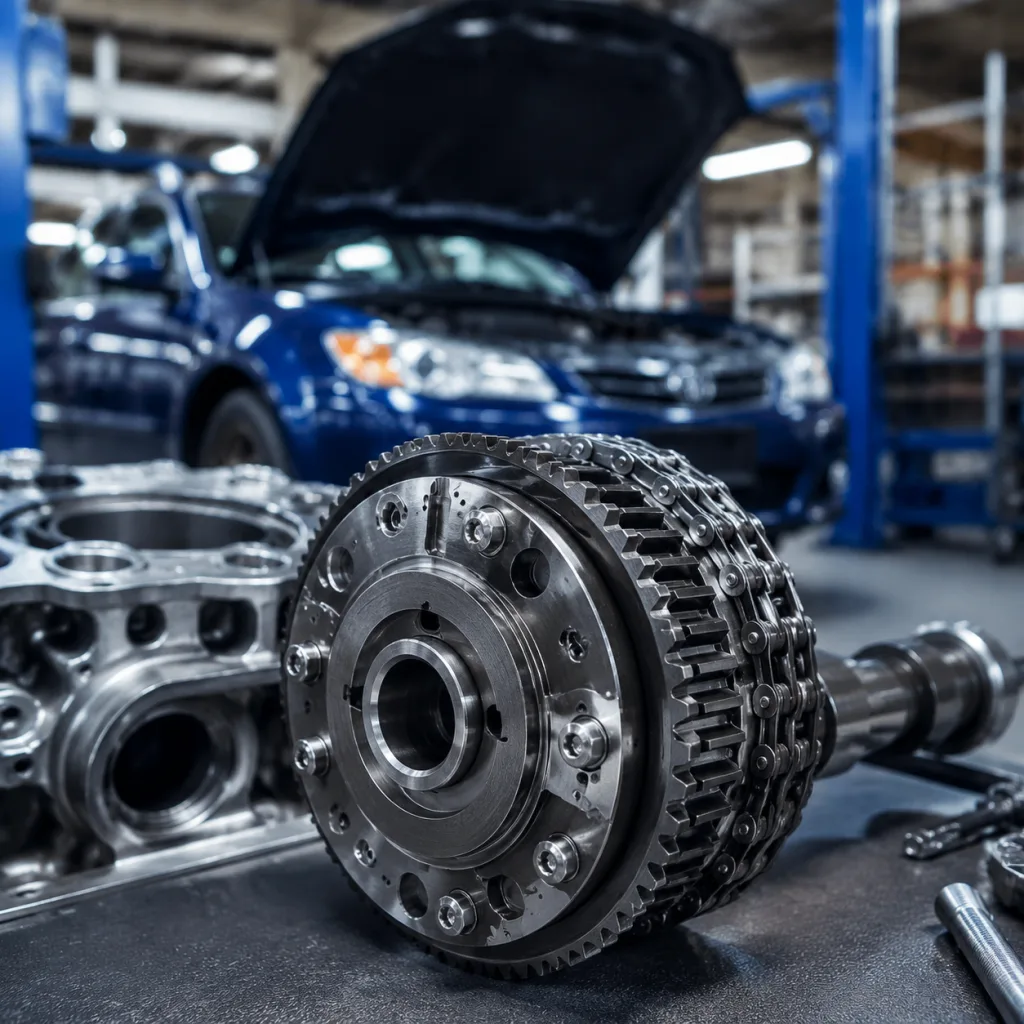
Buying a Subaru camshaft phaser is a sourcing decision, not a catalog search. The right supplier has to prove fitment, control the build, and document enough detail for procurement, quality, and service teams to sign off. That matters because a part can look correct and still miss on oil control, timing response, or lock position. Driventus manufactures engine and powertrain components in Taizhou, Zhejiang, and supplies B2B buyers in more than 60 countries. We operate under IATF 16949:2016 and ISO 9001:2015 systems, with materials and process controls aligned to export-market requirements. Driventus is an independent aftermarket manufacturer; brand names are referenced for fitment only.
Start with fitment, not price
For a camshaft phaser Subaru supplier search, the first filter is fitment evidence. Price matters, but only after the part is tied to the engine code, intake or exhaust position, OE cross-reference, connector type if present, and mounting geometry.
The minimum data set buyers should request is straightforward:
Engine family and OE reference, for example `OE 06A107065` when applicable
Intake or exhaust phaser type
Lobe count, indexing, and stop angle
Housing and rotor material specification
Oil passage dimensions and seal interface
Packaging, label, and traceability format
Test evidence for cold-start behavior, oil-pressure response, and phasing stability
Then check the control points that make the part actually install and function. Common targets include mounting-hole positional tolerance within `±0.10 mm`, locating-feature position within `±0.05 mm`, and installed end-play typically held to `0.03–0.10 mm` depending on the design. For sealing faces, buyers often specify flatness within `0.03 mm` and surface roughness around `Ra 0.8–1.6 µm`, because timing complaints often start at leakage, not at the visible outside diameter.
If a supplier cannot explain those details clearly, the risk is already high. Subaru applications are sensitive to oil control and timing accuracy, so procurement teams should ask for engine code, OE number, installed orientation, sample photos of the OE part, and the exact build revision when a platform has multiple phaser variants.
When the supply model is the real decision
The best supply model depends on how the SKU will be used. A distributor running high-turn repair stock needs something different from a private-label program with stable quarterly call-offs. Driventus supports stocked supply and program-based production through custom manufacturing.
Supply model
Typical use
Buyer priority
Stocked aftermarket
High-rotation repair SKUs
Fast dispatch, low MOQ
Program production
Multi-SKU distributor ranges
Stable lead time, batch traceability
OEM / Tier-1 supply
Controlled release volumes
PPAP-style documentation, process discipline
</tr></thead><tbody> </tbody></table>For most importers, landed cost is more important than headline unit price. MOQ on stocked or near-stocked phaser programs is often 50–100 units per SKU, while engineered or private-label programs commonly start at 200–500 units depending on tooling, packaging, and test scope. Prototype samples are often available in 7–15 days when a matched unit exists, pre-production samples in 15–30 days for controlled runs, and mass-production lead times are commonly 25–45 days after deposit and approved sample.
Buyers should also separate sample pricing, first-batch pricing, and repeat-order pricing. That distinction matters. A quote that excludes corrosion protection, final test, barcode label, inner or outer carton, or export palletizing can look attractive and still raise landed cost by 5–15% later. If you need adjacent engine parts, see our catalog and engine components.
Where quality failures usually start
A credible supplier should be able to describe material control, machining tolerance control, assembly cleanliness, and validation testing. Driventus operates under a quality system aligned with IATF 16949:2016 and ISO 9001:2015. For export markets, we also consider REACH (EC) No 1907/2006 requirements where applicable to material declarations and restricted substances.
Typical inspection points
Rotor-to-housing clearance
Locking and return-position accuracy
Oil flow-path cleanliness
Surface finish on mating faces
End-play and rotational smoothness
Seal integrity after pressure cycling
In production, those checks need measurable limits. Buyers commonly request 100% functional testing on critical phaser moves, with pass/fail limits for lock and unlock response time, plus sampling inspection for dimensions at AQL levels that match the commercial risk. A supplier may hold key shaft diameters to `±0.01 mm`, critical bore diameters to `±0.015 mm`, and runout to `≤0.02 mm`, while also confirming 360° rotational freedom without binding or torque spikes.
Lot traceability matters as much as inspection. Incoming verification for springs, pins, seals, and actuator interfaces reduces line stops and shortens claim handling when a field issue appears. It also lets buyers isolate failed lots by date code, shift, and component batch instead of quarantining full stock.
What test data is worth asking for
A supplier should be able to show how the phaser was checked before shipment and during production release. The exact package varies, but the goal is the same: prove the part was evaluated under relevant functional conditions.
Useful request items include:
Dimensional report against the drawing or agreed master sample
Leak and pressure-response results
Phasing response curve or actuation verification
Noise and free-play inspection criteria
Corrosion protection specification
Packaging drop and transit checks
Ask for the actual numbers, not just a pass/fail stamp. A useful report includes measured values, tolerance bands, and the acceptance rule used for the build. Buyers often ask for leak testing at `0.3–0.5 MPa` for short-duration hold checks, response verification at the oil-viscosity range used in the target market, and cycle testing in the thousands of events rather than a single bench actuation. For corrosion exposure, a salt-spray result tied to `ASTM B117` or a program-specific equivalent helps compare suppliers, but the buyer still has to confirm that the test duration and failure criterion match the vehicle duty cycle.
If the application is exposed to hot oil and long service intervals, buyers may also want endurance evidence tied to relevant published methods such as SAE J2527 for durability-related environmental exposure or ECE R-83 where emissions-related system context applies. The supplier should not invent approvals. Part number, sample quantity, fixture, acceptance limit, and date code all need to line up with the quoted item.
Why OE-equivalent fitment matters in Subaru programs
Subaru engine platforms are sensitive to timing control because cam phaser performance affects idle quality, torque delivery, and fault-code frequency. That is why a part that only resembles the original unit externally is not enough. The replacement must match the critical interfaces:
Bolt pattern and flange geometry
Oil feed and drain routing
Rotor travel range
Lock pin behavior
Sensor-triggering features, if present
Installed height and timing reference position
The practical rule is simple: if the part does not match the OE interface within the same installation envelope, it may fit physically but fail functionally. Buyers should verify the number of teeth or vane positions, the allowable phasing angle, and the lock position at rest. Even a small mismatch can create cold-start noise, limp-mode faults, or early wear. In many programs, the acceptable phasing window is only a few crankshaft degrees.
For aftermarket supply, the goal is dimensional compatibility and repeatable function. Driventus is an independent aftermarket manufacturer; brand names are referenced for fitment only. If a program needs a revised design, alternate material, or private-label packaging, we can support custom manufacturing with controlled documentation and export packing. Buyers can also request packaging details such as barcode labels, language sets, or carton counts matched to warehouse workflows.
How to qualify a supplier without overcomplicating it
A useful supplier audit should be short, direct, and evidence-based. The point is to confirm whether the factory can support repeatable production and problem resolution.
1. Confirm application coverage by engine code and OE cross-reference. 2. Review IATF 16949:2016 and ISO 9001:2015 certificates. 3. Check sample dimensions and key functional tolerances. 4. Ask for test records, traceability format, and packaging spec. 5. Review MOQ, lead time, and replenishment terms. 6. Validate communication speed for claim and engineering issues.
Then move into commercial terms. Ask for the quotation basis, including currency, Incoterms, sample charge, payment terms, and whether MOQ applies per SKU or per order family. A buyer may accept a higher first-order price if the supplier commits to repeat-order discounts or can hold a 90-day buffer stock for fast call-offs. It also helps to split lead time into engineering approval, production, and packing so the schedule risk is visible.
If the supplier answers clearly, the part can be treated as a production option. If the answers stay vague, it is still a development item. For active sourcing, use request a quote and share the engine code, target market, annual volume, forecast by quarter, and sample requirements.
Frequently asked questions
Yes, for aftermarket and programme-based B2B supply. Share the engine code, OE cross-reference, target quantity, and annual volume so we can confirm fitment, MOQ, and production options.
Yes. We offer private-label packaging and programme-specific production through our custom manufacturing capability, subject to technical review, order volume, and pack configuration.
We can provide quality certificates, dimensional data, inspection records, test results, and packing details aligned to the ordered part and commercial terms, including the tolerance and acceptance criteria used for the build.
If you are sourcing a Subaru camshaft phaser and need a controlled supply path, send your application details, volume target, and required lead time through /contact.html.