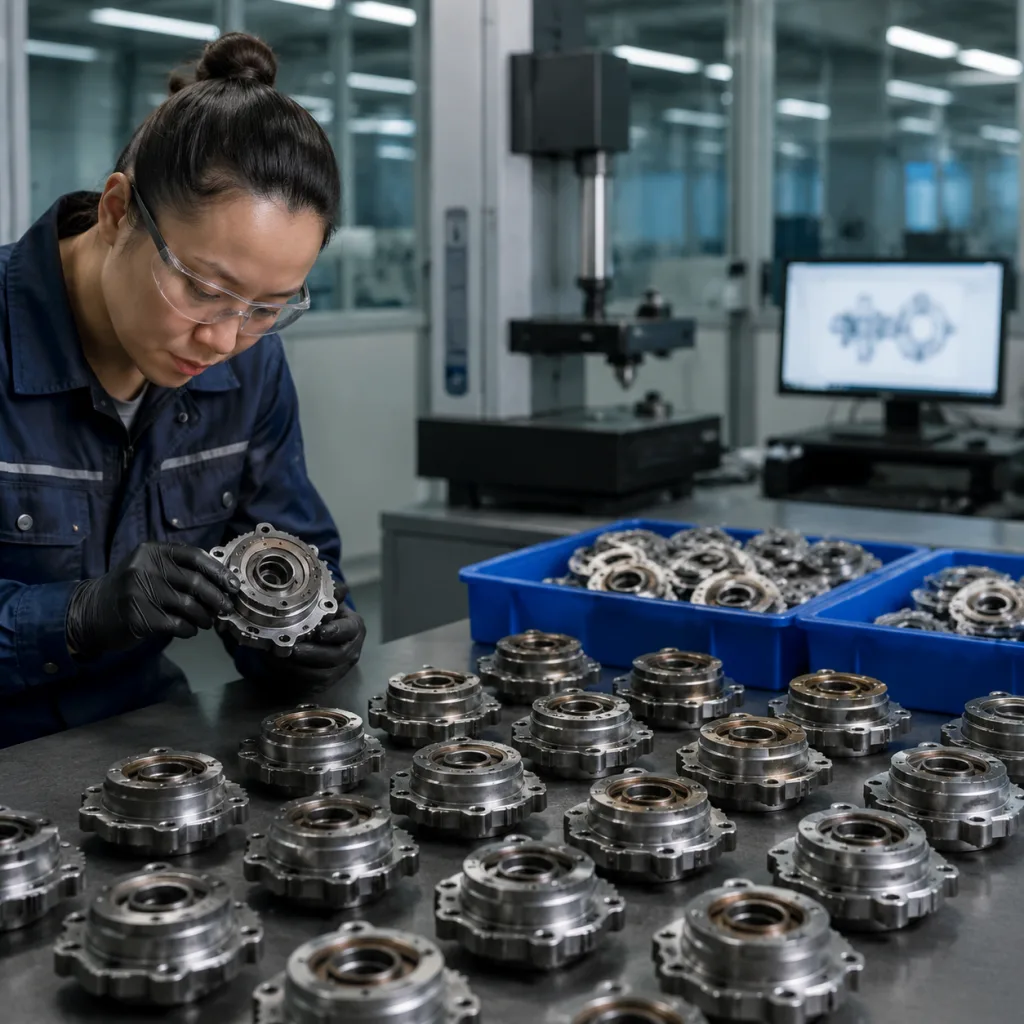
Camshaft phaser replacement demand usually starts with a pattern: 0.5–3.0 seconds of start-up timing noise, cam/crank correlation codes, oil-control faults, or planned engine repair work. For distributors, repair chains, and sourcing teams, the real cost risk is not the quoted unit price. A USD 2–4 saving disappears fast if 2–3% of inventory comes back for wrong fitment, slow response, oil leakage, or batch variation across closely related engine applications.
The part must match the original timing range, locking position, oil-gallery layout, rotor-vane design, and mounting interface. It also has to keep working after heat cycles, contaminated-oil exposure, and repeated hydraulic actuation. In RFQ terms, that means defining the engine code, intake/exhaust position, annual volume, inspection level, required dossier, and release schedule before price comparison begins. Driventus manufactures engine and powertrain components in Taizhou, Zhejiang, supplying B2B customers in 60+ countries. This guide shows how procurement teams can qualify camshaft phasers for aftermarket replacement programs without treating them like ordinary sprockets. Driventus is an independent aftermarket manufacturer; brand names are referenced for fitment only.
Decision Gate: Is the Phaser Truly Equivalent?
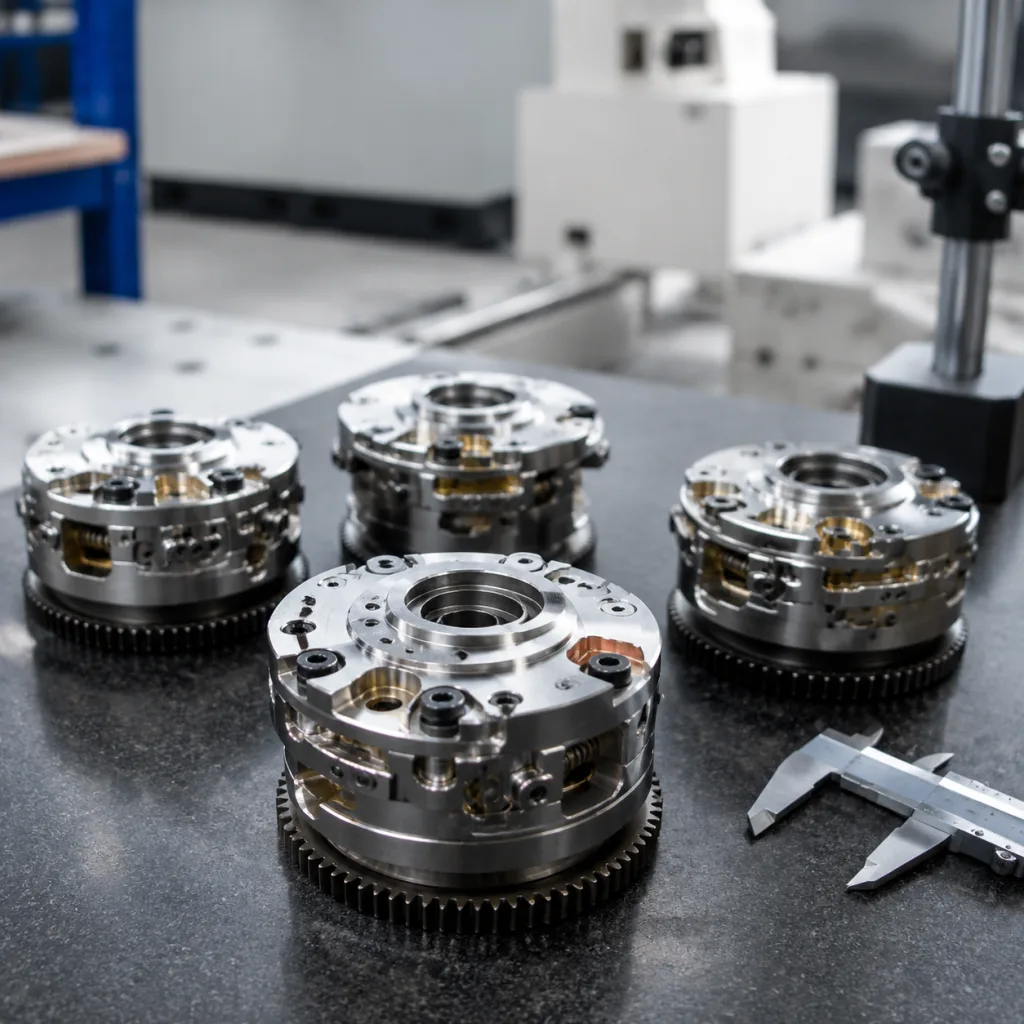
A camshaft phaser is a hydraulic-mechanical timing device. Fitment data opens the conversation, but it does not approve the SKU. The replacement unit has to reproduce the original working angle, advance/retard response, lock-pin behavior, and oil-pressure characteristics expected by the engine control strategy.
Before purchase order release, check the part against these decision points:
Application coverage by engine code, production year, emissions version, and camshaft position
OE part-number cross-reference format, where applicable, such as OE 06A… or OE 11251… only when provided by the customer database
Rotor-vane configuration and nominal angular travel, commonly 20–60 crankshaft degrees depending on engine design
Lock-pin engagement position at low oil pressure and release behavior at the agreed bench pressure, for example 1.0–2.5 bar oil supply where specified
Oil feed-hole position, groove geometry, and filter-screen specification where used
Surface treatment, hardness range, and corrosion protection, such as 48–58 HRC on selected wear faces when required by drawing
Packaging format, traceability code, and carton labelling for warehouse scanning
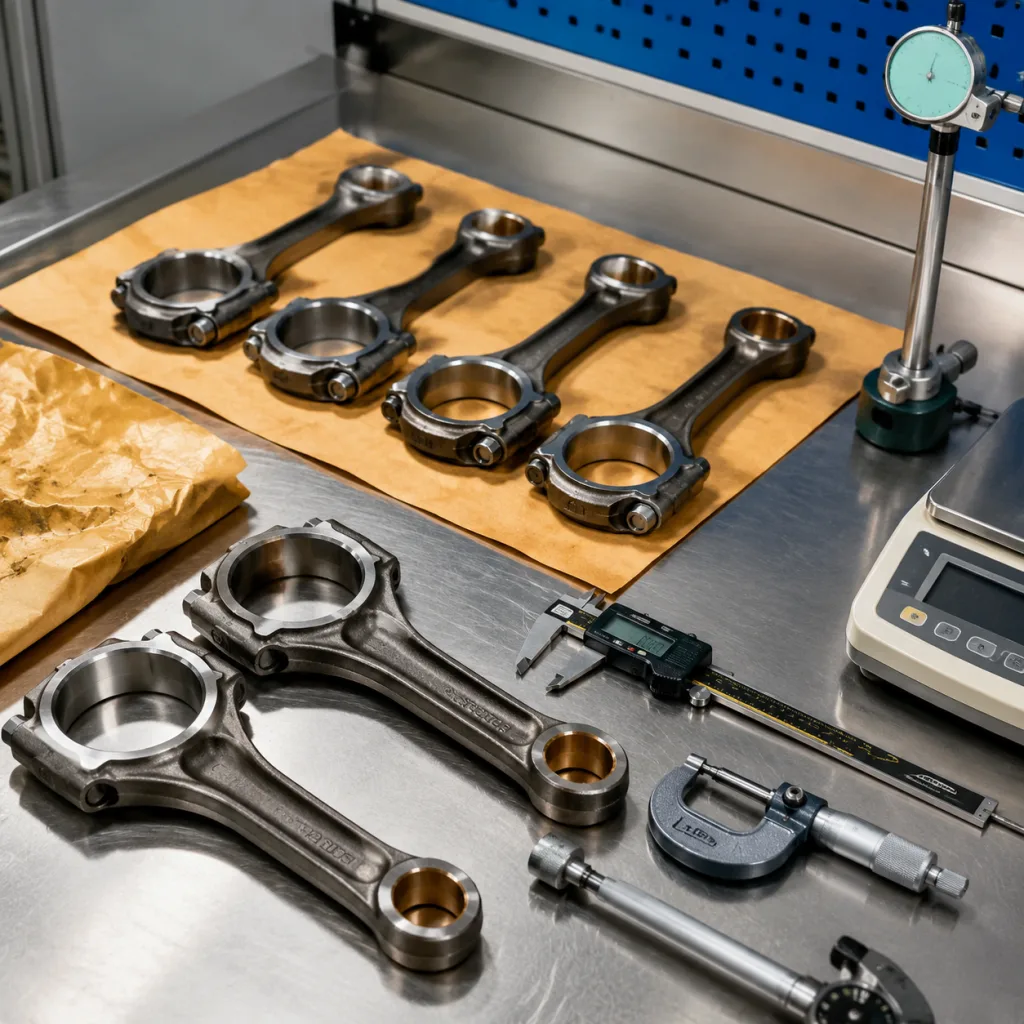
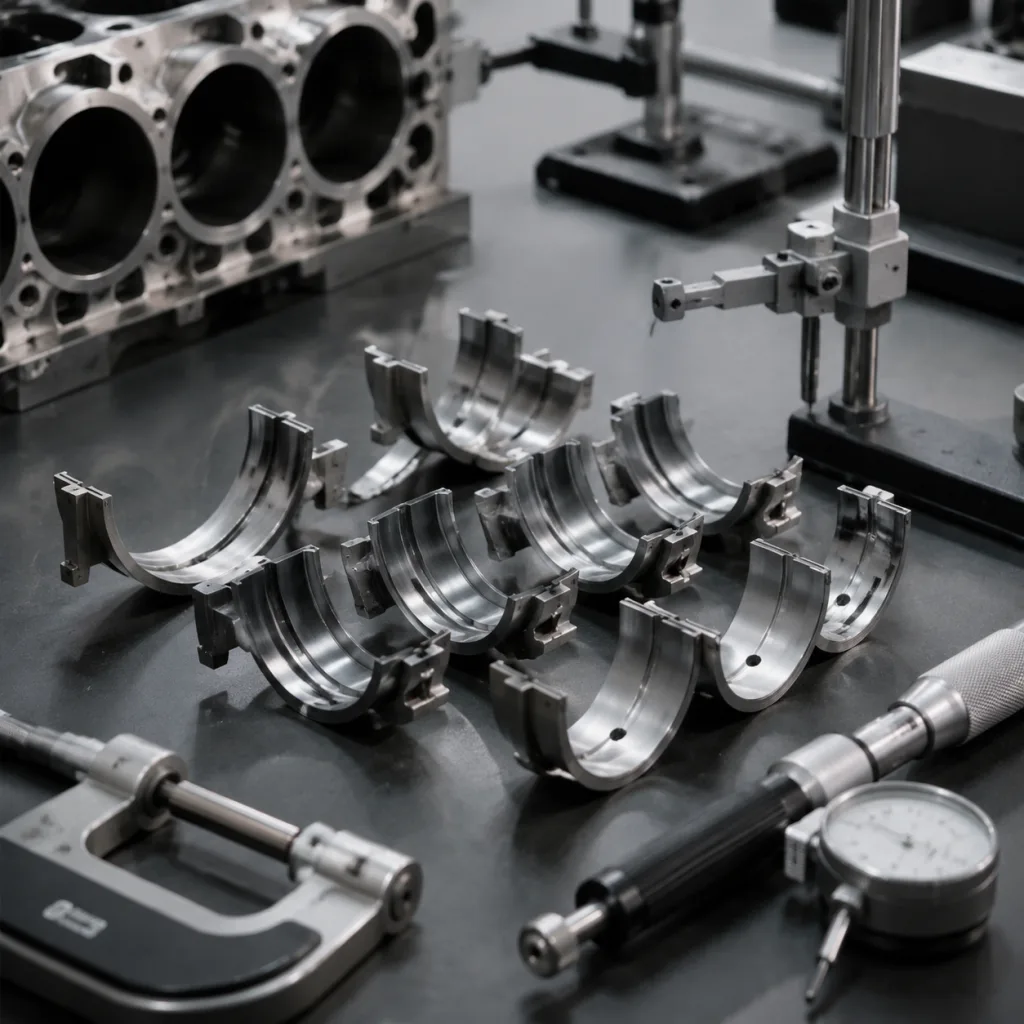
For first-sample approval, do not accept “same as OE” as the only evidence. Ask the supplier to mark critical-to-fit dimensions on the drawing or sample report. Practical control points include mounting-face flatness, cam bore tolerance, dowel-hole location, sprocket runout, oil-port diameter, and angular stop position. If no controlled drawing exists, approve against a sealed master sample and define which measured values may vary in mass production.
Driventus supports distributors and repair chains with application mapping through our catalog, including related engine timing and engine components when program consolidation is required.
Spec Deep-Dive: Geometry, Oil Flow, and Timing Response
Most phaser sourcing problems start when geometry, oil control, and dynamic response are reviewed separately. They should be approved as one package. A cam bore that is slightly loose, an oil groove that is slightly restricted, or a stop angle that is slightly off can create the same field symptoms: chain misalignment, start-up rattle, cam/crank correlation codes, or oil leakage at the camshaft interface.
Checkpoint
Procurement requirement
Typical verification method
Cam bore and mounting face
Drawing/sample tolerance, often ±0.01–0.03 mm on critical fits
CMM, plug gauge, surface plate
Sprocket concentricity
Application drawing limit, commonly ≤0.05–0.10 mm TIR
Runout inspection
Angular travel
Same functional range as OE design, typically within ±1 crank degree of target
Rotary fixture and stop-angle test
Lock-pin operation
Positive lock and release at defined oil pressure and temperature
Hydraulic bench test
Oil gallery alignment
No restriction, burr, or leakage path across feed grooves
Section review, air/oil flow test
Surface hardness
Within material and heat-treatment plan, recorded by batch
Rockwell or microhardness test
Dynamic response
Stable advance/retard under test pressure, flow, and oil viscosity
Functional actuation bench
</tr></thead><tbody> </tbody></table>For camshaft phaser replacement programs, request a production part approval file or equivalent technical dossier. At minimum, it should include a control plan, critical dimensions, material certificate, heat-treatment record, functional test method, and batch traceability process. Full PPAP terminology may be required by OEM or Tier-1 customers, but aftermarket programs still need measurable acceptance criteria before approval.
Separate “quote price” from “approved production price.” Prototype samples may include manual inspection and short pilot runs. Mass-production pricing should be based on agreed inspection frequency, packaging, annual volume, and lot size. Low-volume SKUs may need a higher unit price or a shared MOQ across related intake/exhaust variants. High-volume SKUs are better negotiated through annual blanket orders and scheduled releases, not one-time spot buys.
Process Audit: Where Batch Variation Enters
Camshaft phasers typically combine sintered, forged, cast, or machined steel components depending on engine design. Internal rotors, stators, and locking parts must resist wear under boundary lubrication and variable oil quality. The sprocket or chain interface must also hold profile accuracy to reduce timing-chain noise and premature wear.
Driventus controls camshaft phaser production through incoming material inspection, CNC machining, deburring, cleaning, heat treatment, assembly, and end-of-line testing. Critical process controls normally include:
Chemical composition verification against the approved material specification, with heat number or batch record retained
Heat-treatment monitoring for hardness depth, case depth where applicable, and distortion control
CNC capability checks for bore, face, groove, and oil-hole dimensions, with Cpk targets commonly set at ≥1.33 for stable critical characteristics when volume supports SPC
Burr control on oil galleries and locking-pin channels, especially drilled intersections and vane slots
Ultrasonic or high-pressure cleaning for internal contamination control before assembly
Torque-controlled assembly and staking or fastening verification, with tool calibration records
Functional testing before packing, including lock, release, travel, and leakage checks where specified
Mixed parts are a common preventable failure in visually similar SKUs. Ask how the supplier separates variants during machining, assembly, inspection, and packing. Strong controls include dedicated fixture codes, barcode traveler cards, first-off/last-off inspection, color-coded WIP trays, and lot-level separation for rotors, stators, springs, pins, and covers. The same discipline should continue into inner boxes and master cartons so one intake phaser cannot be shipped as the exhaust variant.
For regulated export markets, the quality framework matters as much as the drawing. Driventus operates under IATF 16949:2016 and ISO 9001:2015 principles, with documented process control, nonconforming-material handling, and corrective action procedures. Buyers can review the quality system during supplier qualification or remote audit preparation.
Check environmental and chemical obligations early. EU importers may need material declarations for REACH (EC) No 1907/2006 review. Packaging materials should follow customer-specific recycling and labelling rules where applicable.
Validation Sequence: From Bench Data to Launch Approval
A replacement phaser should be validated against the operating conditions of the target engine family, not just compared with a physical sample. Bench testing usually comes first. Engine or vehicle validation follows when the customer program requires it. The plan should reflect oil viscosity, pressure range, temperature range, and duty cycle.
A practical approval sequence looks like this:
1. Dimensional layout: confirm all critical-to-fit and critical-to-function dimensions against drawing or master sample. 2. Leakage test: measure internal leakage at defined oil pressure and temperature, for example at 1, 2, and 4 bar using the agreed oil grade. 3. Actuation test: verify response time and angular movement under controlled oil flow, temperature, and commanded advance/retard direction. 4. Lock-pin durability: cycle start-up locking and release to confirm repeatability, commonly thousands of cycles for aftermarket approval and higher counts for severe programs. 5. Thermal cycling: expose the assembly to hot/cold conditions such as -30°C to 120°C to check clearance stability, seal condition, and lock release. 6. Contamination resistance: evaluate performance with controlled particle exposure where required, especially for markets with inconsistent oil-change intervals. 7. Noise screening: check for abnormal rattle or impact under low-pressure and hot-soak restart conditions. 8. Endurance cycling: confirm wear resistance over repeated advance/retard operation, then inspect vanes, stops, pin bore, and sprocket teeth.
Management standards such as IATF 16949:2016 and ISO 9001:2015 do not define the timing range for a specific engine phaser. They define how the manufacturing and quality system should control risk. Product-specific limits must come from drawings, approved samples, customer specifications, or agreed validation plans.
For approval, specify the acceptance table: maximum leakage, minimum lock holding force, response-time window, full-travel angle, visual wear limit, and post-test dimensional change. If the buyer cannot provide OE limits, Driventus can benchmark approved samples and propose a control plan, but the buyer should still sign off target values before mass production.
For OEM, Tier-1, or private-label programs, Driventus can support custom manufacturing based on drawings, samples, or application targets. This includes feasibility review, tooling assessment, pilot build, dimensional reporting, and phased production ramp-up.
Buying Scenario: Moving From Listed SKU to Bulk Order
A supplier may list the application and still be unready for stable production. Catalogue coverage does not prove tooling condition, calibrated test fixtures, current-production data, or lot traceability. Before approving bulk camshaft phaser replacement stock, treat the order as a launch project.
Use this buying sequence:
1. Confirm engine application data and camshaft position: intake, exhaust, or dual phaser. 2. Verify the OE cross-reference format supplied by your database, without assuming vehicle manufacturer approval. 3. Review drawings, sample reports, or reverse-engineering measurement records. 4. Request functional bench-test data from current production, not only prototype samples. 5. Confirm batch marking, date code, and carton traceability. 6. Define packaging for sea freight, air freight, and regional warehouse handling. 7. Check warranty return procedure and failure-analysis response time, commonly 5–10 working days for the initial report after receipt. 8. Align minimum order quantity, lead time, and safety stock plan.
MOQ and price should follow real production economics. Lower-volume phaser SKUs are often best purchased in 100–300 piece lots or combined with related timing components to absorb setup and inspection cost. Mature fast-moving SKUs may support 500–1,000+ piece release quantities, tiered pricing, and annual blanket orders. If private-label cartons, laser marking, or special test reports are required, separate tooling, artwork, and setup costs from the unit price so landed-cost comparisons stay clean.
Lead time also needs stages. A new replacement program may require 2–4 weeks for sample preparation if tooling exists, 1–2 weeks for dimensional and functional reporting, and 4–8 weeks for first production depending on material, heat treatment, and packaging approval. Repeat orders can be shorter when safety stock and forecast releases are agreed. Buyers serving repair chains should calculate reorder points from monthly sales, inbound freight time, inspection time, and warranty reserve—not only from supplier production time.
For aftermarket distribution, mixed-SKU programs usually need stable replenishment more than one-off low prices. Evaluate supplier capacity, inspection frequency, and change-control discipline. Any change to material, heat treatment, tooling, oil-control geometry, or assembly process should require notification before shipment.
Driventus is an independent aftermarket manufacturer; brand names are referenced for fitment only. No vehicle manufacturer approval or endorsement is implied.
Failure-Mode Review: When Returns Are Not a Part Defect
Return analysis should separate manufacturing defects from engine-system problems. Camshaft phasers operate inside an oil-controlled timing system, so field issues can come from oil sludge, blocked control valves, low pressure, chain elongation, incorrect installation torque, or ECU calibration issues.
Common observed conditions include:
Start-up rattle linked to lock-pin wear, delayed oil pressure, or chain tensioner issues
Cam/crank correlation codes linked to phaser response delay, chain stretch, or sensor faults
Poor idle stability linked to restricted oil flow or incorrect angular position
Oil leakage at the camshaft interface linked to surface damage, wrong seal condition, or mounting-face contamination
Noisy operation after installation linked to debris in oil passages, unflushed lubrication systems, or incorrect oil viscosity
A useful supplier supports structured warranty review. Returned parts should be inspected for installation marks, oil contamination, abnormal wear, lock-pin condition, angular-stop damage, and oil-gallery blockage. The return file should record mileage or running hours, oil grade, DTCs, installation date, batch code, photos, and whether the oil control valve, timing chain, and tensioner were replaced. Without these fields, distributors cannot reliably separate part defects from engine-system causes.
Set a return threshold before launch. Investigate immediately if one lot shows repeated complaints, if return rate exceeds the agreed target, or if the same failure mode appears across multiple installers. When a manufacturing cause is confirmed, connect findings to corrective action: fixture correction, cleaning-process change, heat-treatment adjustment, additional leakage screening, or packaging revision. That discipline reduces repeated claims and gives technical teams clearer installation guidance for repair networks.
Frequently asked questions
Provide engine code, application years, camshaft position, annual volume, target market, packaging requirements, inspection documents and any OE cross-reference already used in your system, such as OE 06A… where applicable. Drawings or samples improve quotation accuracy. For price breaks, also state expected release quantity, for example 100, 300, 500 or 1,000 pieces per shipment.
Yes. Driventus supports private-label and customer packaging programs for qualified B2B buyers. Requirements normally include artwork, carton specification, traceability format, order volume, market compliance needs and whether special laser marking, labels or pallet configuration are required.
Verification normally includes dimensional inspection, material and hardness checks, hydraulic actuation testing, leakage testing, lock-pin function checks and endurance validation against agreed acceptance criteria. The process is controlled under IATF 16949:2016 and ISO 9001:2015 systems, but product limits must still be defined by drawing, approved sample or signed validation plan.
For application review, validation documents or program pricing, send your target references, annual demand, release quantity and packaging requirements to [request a quote](/contact.html).