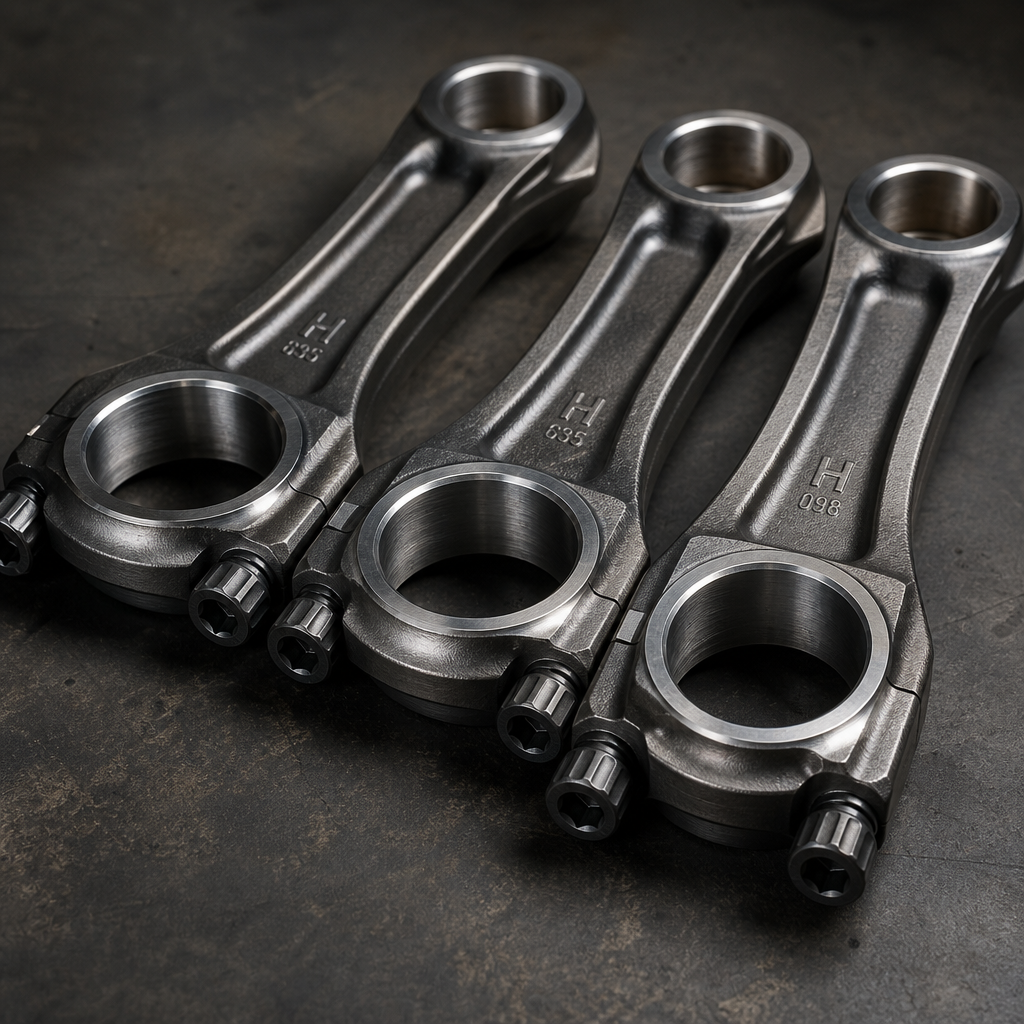
Connecting Rod for Jeep Grand Cherokee Replacement
Selecting a connecting rod for Jeep Grand Cherokee replacement is not a catalog exercise. For procurement teams, importers, and engine rebuild buyers, the real question is whether the rod will reproduce the original assembly under load, at speed, and across repeat batches. That means checking centre-to-centre length, big-end and small-end geometry, weight class, material integrity, and bolt specification with measured data, not generic fitment claims.
This category also punishes small errors. A slight deviation can affect bearing crush, piston deck height, oil clearance, balance, and long-block durability. In aftermarket replacement programmes, buyers usually need OE-equivalent dimensional control, traceable metallurgy, and repeatable batch quality. They should also review bushing finish, cap alignment, bore roundness, and compatibility with the exact engine family used in the Jeep Grand Cherokee application.
In practical sourcing terms, the useful questions are precise: centre-to-centre length to drawing tolerance, big-end housing bore size after bolt tightening, small-end ID or bushing finish, bore roundness and cylindricity, piece weight, hardness range, and bolt grade. For many replacement programmes, acceptable limits are measured in hundredths or thousandths of a millimetre.
A typical approval pack for a forged steel replacement rod may include centre distance control within about ±0.02-0.05 mm, big-end bore roundness within 0.005-0.01 mm after the specified bolt torque, pin-end bush ID finished to the required clearance band for the wrist pin, and piece-to-piece weight spread controlled tightly enough for set matching. Commercial terms need to tie back to the same specification: MOQ, tooling status, sample timing, and batch lead time should be clear before release. Driventus supplies engine components for global B2B customers under an IATF 16949:2016 and ISO 9001:2015 certified management framework. This article breaks down how to evaluate connecting rod for Jeep Grand Cherokee replacement supply from a buyer's point of view: what decides suitability, where failure risk enters, and what documents should back each shipment lot.
Start with the decision criteria, not the vehicle listing
A replacement rod has to reproduce the working geometry of the original part, not simply resemble it. That is the first filter. Vehicle model data and cross-reference listings are useful, but they are not enough to approve supply.
For a connecting rod for Jeep Grand Cherokee replacement, buyers should confirm these points first:
Centre-to-centre length: controls piston position, compression relationship, and deck height consistency; approval should be based on an actual measured value and tolerance band such as ±0.02-0.05 mm depending on design and process capability
Big-end bore diameter: affects bearing fit, oil film stability, and crush; this must be checked after cap installation and bolt tightening to the specified torque or stretch condition
Small-end bore or bushing ID: must suit the wrist pin specification and lubrication regime; finished size often needs control within a few microns
Beam profile and section thickness: influence stiffness and fatigue performance; sample section measurements should be compared to drawing or OE sample data
Cap-to-rod joint accuracy: critical for bore alignment after bolt torque; serration fit, joint face condition, or fracture-split interface has to be stable and repeatable
Rod bolt specification: thread, tensile grade, under-head geometry, and clamp load consistency must match the design requirement
Total weight and weight spread: important for balancing and vibration control in rebuilt engines
Surface finish and shot blasting/peening condition: relevant to fatigue life depending on the design route
A practical buying mistake is to treat fitment as a yes-or-no catalogue field. Grand Cherokee replacement demand may span several engine families, so part numbers should only be accepted when backed by a documented fitment source. If a sourcing request already references an OE code such as OE 06A107065, that reference still needs to be checked against drawing data, measured samples, and confirmed application records before production release.
Commercially, ask one more question early: is the offered rod from existing production tooling, or does it require new fixtures, gauges, or re-machining of a semi-finished forging? That answer changes sample timing and MOQ.
Typical aftermarket logic is:
Existing tooling + stable fitment: lower MOQ, often starting around 100-300 pieces per item
Private label with standard part: MOQ may rise to 300-500 pieces depending on box design and marking
Drawing-based modification or new rod bolt spec: MOQ can move to 500-1,000+ pieces because of setup, validation, and packaging segregation
Spec deep-dive: the measurements that actually decide approval
A rod can pass visual review and still create field failures. The approval work happens in the numbers: bore geometry, bolt seat flatness, hardness distribution, alignment, and traceable material control.
Recommended validation points
Inspection item
Why it matters
Typical control method
Centre distance
Maintains compression geometry
CMM or dedicated fixture
Big-end bore roundness
Supports bearing life
Bore gauge after bolt torque
Small-end bore/ bush ID
Controls pin fit and scuff risk
Plug gauge or bore gauge
Parallelism and twist
Prevents side load and uneven wear
Rod alignment fixture
Weight tolerance
Reduces balancing variation
Calibrated scale
Hardness
Confirms heat-treatment consistency
Rockwell or Brinell test
Metallographic structure
Verifies forging and heat-treatment quality
Lab section analysis
Surface crack inspection
Screens process defects
Magnetic particle inspection where applicable
</tr></thead><tbody> </tbody></table>For actual approval, buyers should request numerical acceptance criteria on the control plan. Common examples in aftermarket programmes include:
Centre-to-centre length: target to drawing, often controlled within ±0.02-0.05 mm
Big-end bore size: measured with cap assembled and bolts tightened, often held within ±0.005-0.015 mm of target depending on design
Big-end bore roundness/cylindricity: typically limited to 0.005-0.01 mm
Small-end bushing ID: commonly controlled within ±0.005-0.01 mm with the required surface finish for pin movement
Twist and bend/parallelism: often limited to around 0.05-0.10 mm per 100 mm or equivalent fixture criterion
Weight spread: many rebuild buyers ask for ±2-5 g per piece and a matched-set spread no greater than an agreed limit
Hardness: should match the specified material and heat-treatment route, with no local soft spots around the bolt seat or split line
Material matters, but only when tied to process evidence. Common connecting rod materials include forged carbon steel and alloy steel grades chosen for fatigue resistance, machinability, and process stability. Depending on the design, buyers may see grades such as C70/C70S6 fracture-split steel, 45# forged steel, or alloy routes comparable to 40Cr/42CrMo for higher-strength applications.
Procurement teams should ask for:
Material certificate by heat or batch
Heat-treatment route summary, such as normalizing, quench and temper, or controlled cooling after forging
Dimensional inspection report
Bore measurement data after cap bolt tightening
Traceability marking method
If bushed, bushing material specification and press-fit control record
A sound validation routine usually includes rough machining, stress relief or heat-treatment where required, semi-finish boring, cap assembly with specified bolts, finish honing of the big-end, finish sizing of the small-end or bushing, 100% visual check, and final audit measurement by sampling plan. For critical programmes, buyers may also request capability evidence such as Cp/Cpk ≥1.33 on centre distance and big-end bore.
Where customer projects require private-label supply, special marking, or modified machining allowances, Driventus can support this through custom manufacturing.
How the manufacturing route changes supply risk
Not every acceptable sample comes from an acceptable process. For rotating parts, process discipline is what determines whether lot 2 matches lot 1.
Connecting rods for the replacement market are typically produced through forging, machining, cap separation or cap machining, bushing installation where required, final boring or honing, cleaning, and inspection. Each step can introduce variation if the factory is weak on datum control, bolt tightening method, or bore finishing sequence.
A credible production route should control:
Forging integrity: fibre flow, flash removal, die fill, and prevention of laps, folds, or gross inclusions
Machining datum strategy: repeatable location across big-end and pin-end features so centre distance and bore relationship stay within tolerance lot after lot
Cap fit accuracy: serration or fracture/joint interface stability, depending on design
Bore finishing: final size, cylindricity, and surface condition under defined bolt torque
Fastener control: incoming verification, thread gauge checks, hardness where specified, and torque method validation
Final cleanliness: debris left in oil feed passages or bores can damage rebuilt engines immediately after start-up
In practical factory terms, buyers should understand whether the rod is made from a net or near-net forging, whether the cap is saw cut, machined, or fracture split, and whether the pin end uses a solid bore or a pressed bushing followed by finish honing.
Typical process flow for a forged replacement rod is:
1. Steel bar or billet incoming verification by heat number 2. Hot forging and trimming 3. Shot blasting and visual surface check 4. Heat treatment or controlled cooling route 5. Crack detection if required by product plan 6. Rough machining of reference faces and bores 7. Cap splitting or cap machining 8. Bolt seat and thread-seat machining 9. Bushing press-fit at small end where required 10. Finish boring/honing of big end with bolts tightened to specification 11. Finish sizing of small end or bushing 12. Deburring, washing, rust prevention, marking, and final inspection
Under IATF 16949:2016, process control should connect directly to traceability, nonconforming product management, corrective action, and record retention. ISO 9001:2015 adds broader requirements for documented control, calibration, supplier management, and monitoring of process effectiveness. Buyers evaluating a new source for a connecting rod for Jeep Grand Cherokee replacement should review the factory's quality system with attention to:
Control plans and process flow charts
MSA and gauge calibration records
PPAP-style documentation when requested
Lot identification and recall traceability capability
Incoming raw material verification
Commercial process detail matters too. Typical lead-time logic in this category is:
Existing part, no packaging change: samples in about 2-4 weeks, production in 30-45 days after order confirmation
Existing part with private box/label: usually 35-50 days depending on artwork approval and carton procurement
New sample development from customer core or drawing: often 4-8 weeks for sample plus 45-60+ days for first batch after approval
Pricing usually moves with volume and process complexity rather than weight alone. Standard bolts, standard oil protection, and shared export packaging reduce unit cost. Separate inner boxes, custom laser marking, or 100% MPI increase it.
If packaging and surface protection are part of ocean freight supply, the anti-corrosion method should also be specified in the purchase agreement, including material type, protection duration, and carton or pallet conditions. Typical export requirements include VCI bag or paper, light anti-rust oil, sealed inner pack, desiccant where needed, and pallet stretch-wrap suitable for 60-90 days sea transit.
Where Grand Cherokee rebuild programmes usually go wrong
This is where many claims begin: the rod looks close, the catalogue says it fits, and nobody checks the one dimension or bolt detail that actually separates one engine family from another.
Replacement demand for the Jeep Grand Cherokee can involve more than one engine family across multiple model years and markets. That makes incomplete catalogue data a recurring source of avoidable risk.
Typical sourcing errors
Mixing rods between similar displacement engines with different pin diameters, where the visual profile is close but the small-end size differs by only a fraction of a millimetre
Assuming visual interchangeability without checking centre length, which can alter deck height and compression relationship
Ignoring rod bolt differences between production revisions, including shank length, under-head radius, or specified tightening method
Accepting excessive lot-to-lot weight variation, which complicates engine balancing in reman programmes
Using incomplete cross-reference data from secondary catalogues without sample verification
For importers, rebuild parts distributors, and remanufacturing programmes, the safer method is to link each item to a controlled fitment record containing engine code, model year range, core dimensions, and sample verification notes. When a buyer provides an original sample, dimensional mapping should be completed before mass-production approval, especially if the programme will serve more than one regional market.
A practical fitment file for each approved rod should contain at minimum:
Engine family and displacement
Model year coverage and market notes
OE and aftermarket cross-references used in the review
Measured centre distance
Big-end bore and bearing width data
Small-end ID or pin diameter match
Beam width and overall width at the crank end
Bolt specification and tightening instruction reference
Weight of sample and approved replacement sample
This level of detail matters because many field complaints originate from small but critical differences. A centre distance error of only 0.05-0.10 mm, an incorrect bushing finish, or a mismatched bolt can still result in noise, bearing distress, or shortened fatigue life even if the part passes a basic visual fit check. Buyers serving engine rebuilders should therefore insist on sample-based signoff rather than catalogue-only approval.
Where market access requires chemical compliance, packaging and component materials may also need review against REACH (EC) No 1907/2006 for the EU. This is particularly relevant for coatings, rust preventives, oils, and packaging materials shipped with the part.
Driventus is an independent aftermarket manufacturer; brand names are referenced for fitment only.
Supplier comparison: the questions that separate a low quote from a usable quote
When comparing offers, the cheapest number is usually the least complete answer. A structured RFQ for connecting rod for Jeep Grand Cherokee replacement should force suppliers to quote against the same technical and commercial baseline.
Suggested RFQ checklist:
Application and engine code coverage
Material grade and forging route
Rod bolt specification and source control
Dimensional tolerances for bores, length, twist, and parallelism
Weight tolerance per piece and per set
Inspection report format supplied with each batch
Certification status: IATF 16949:2016 and ISO 9001:2015
Corrosion protection and export packaging method
MOQ, lead time, and sample policy
Label, barcode, and private packaging options
To make supplier offers comparable, buyers should request numbers rather than open wording. The RFQ can ask the supplier to fill in:
Centre distance tolerance: actual capability and guaranteed shipment limit
Big-end housing bore tolerance: measured after torque, with roundness/cylindricity limit
Small-end or bush ID tolerance and target surface finish
Weight tolerance per piece and max spread per engine set
Bolt specification: grade, source, torque or stretch method, replacement policy
Sampling plan: AQL or internal batch audit frequency
MOQ by packaging mode: bulk, neutral box, or private box
Lead time by order type: repeat order, new label, or first article
Commercially, aftermarket buyers often evaluate the following logic:
Item
Typical market logic
Sample policy
Existing item sample may be free or charged at piece cost plus freight; new development sample usually charged with possible rebate against mass order
MOQ
Commonly 100-300 pcs for standard items, 300-500 pcs for private label, higher for drawing changes or dedicated packaging
Lead time
Around 30-45 days for repeat items; 45-60+ days when new packaging or first-batch validation is required
Price breaks
Better unit price at 500 pcs and 1,000+ pcs as setup, inspection, and packaging costs are spread over more parts
Tooling
Existing tooling usually avoids tooling charge; special gauges, fixtures, or modified machining may require one-time cost
</tr></thead><tbody> </tbody></table>For larger replacement programmes, it is useful to request pilot-lot data from the first production run, including bore measurements, hardness distribution, and crack inspection results where applicable. That gives category buyers and quality teams a factual basis for supplier approval rather than relying on declarations alone. It is also sensible to ask for retained sample period, claim response time, and whether the supplier can trace each carton back to production lot and steel heat.
If you are reviewing supply options for this part category, use request a quote to share drawings, samples, or fitment lists.
Step-by-step approval path from sample to mass release
For most distributors and engine rebuild buyers, a staged approval path is easier to defend internally and cheaper than learning through warranty claims.
A practical sequence is:
1. Application review: confirm the exact engine family, model year range, and target market 2. Sample comparison: measure the original sample against the proposed replacement rod 3. Material and hardness check: verify batch conformity with the agreed specification 4. Pilot build: install into a controlled engine rebuild and inspect oil clearances 5. Run validation: monitor noise, oil pressure, and teardown condition where feasible 6. Mass production release: lock drawing, packaging, inspection plan, and traceability rules
Each stage should produce a usable record, not just a verbal approval:
Sample comparison output: dimensional report covering centre distance, big-end bore, small-end ID, width, twist/bend, and weight
Material review output: mill certificate, hardness results, and heat-treatment summary
Pilot build output: assembly notes, bearing clearance check, bolt tightening record, and any run-in observations
Run validation output: teardown photos, bearing pattern, pin-end condition, and any abnormal wear comments
Mass production release output: signed control plan, final packaging spec, label format, and batch traceability method
Buyers should also define the commercial gate at each step. A workable example is:
Prototype/sample stage: 2-10 pieces for dimensional review
Pilot lot: 30-100 pieces to confirm repeatability and support trial builds
First production lot: MOQ level agreed for the programme, often 100-500 pieces depending on whether the item is standard or private label
Ongoing supply: forecast-linked releases with fixed inspection and packaging standard
This process is especially important for rotating parts because small dimensional drift can create field failures that are expensive to diagnose after shipment. Buyers should also define claim handling expectations in advance, including retained sample policy, lot traceability, and the timing for corrective-action feedback if nonconformance is found. Many importers ask for an initial containment response within 24-72 hours of claim notice and a formal corrective-action report within 7-10 working days.
Driventus supports B2B customers with catalogue development, drawing-based review, and export supply for engine hard parts. For broader part families beyond rods, see our catalog or discuss programme requirements through custom manufacturing.
Frequently asked questions
At minimum, buyers should ask for a packing list, batch traceability, dimensional inspection data, and material or heat-treatment records where specified. For approved programmes, additional first article, pilot-lot, or PPAP-style documents may also be required. In practice, the most useful shipment file includes the lot number, production date, heat or batch reference, key bore measurements taken after bolt tightening, hardness results, and carton or pallet identification.
It is important for rotating assembly balance, NVH control, and consistency across rebuilt engines. Procurement specifications should define per-piece tolerance and acceptable spread within a matched set, especially for rebuild kits supplied to engine remanufacturers. Many buyers set a per-piece control such as ±2-5 g and also limit the total spread within one engine set so installers do not need excessive correction work.
Yes, provided the supplier has stable process control, documented dimensional validation, and traceable batch management. Private packaging, part marking, and drawing-based changes should be locked before production release to avoid fitment drift between batches. Buyers should also confirm the MOQ impact, sample lead time, and whether new gauges, fixtures, or packaging artwork approvals are needed before the first order.
If you are qualifying a replacement rod supplier or need sample-based fitment review, contact Driventus with your application data, target dimensions, MOQ expectations, and sourcing targets at /contact.html