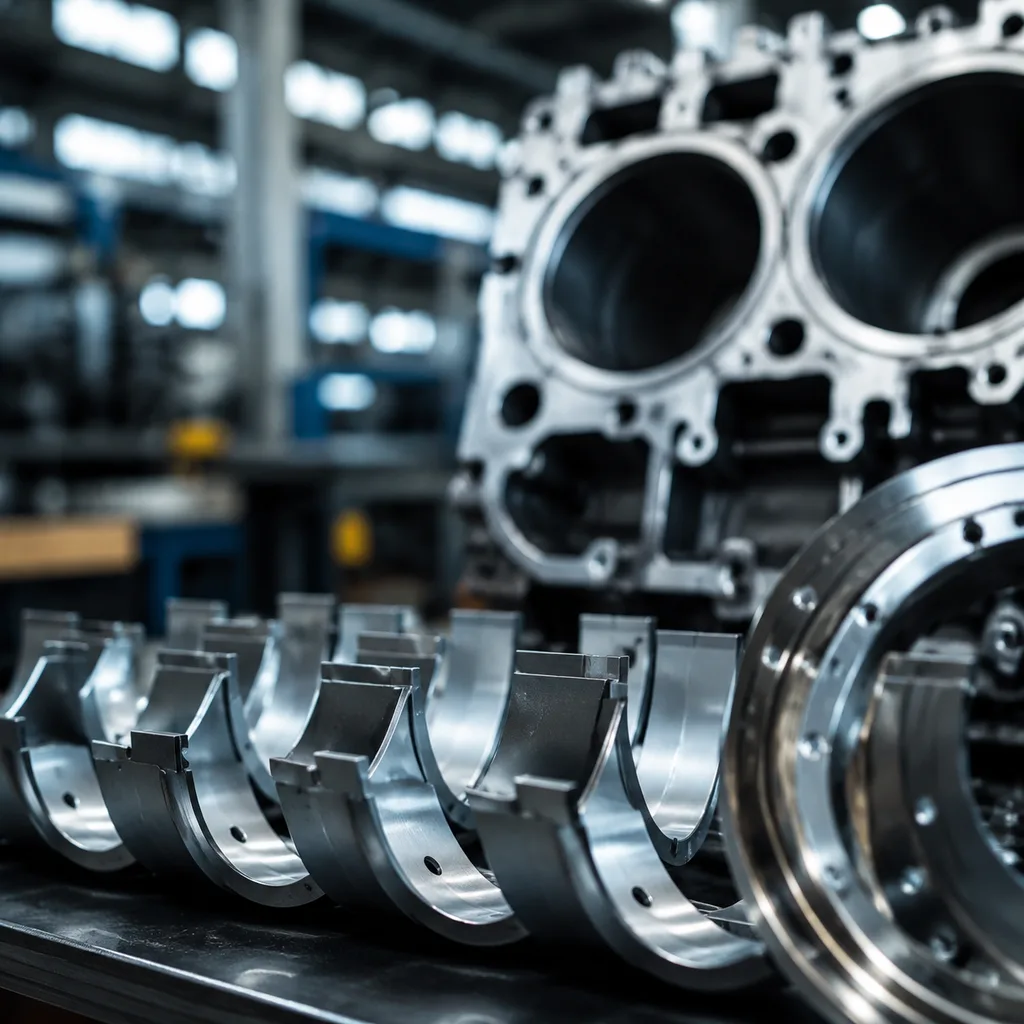
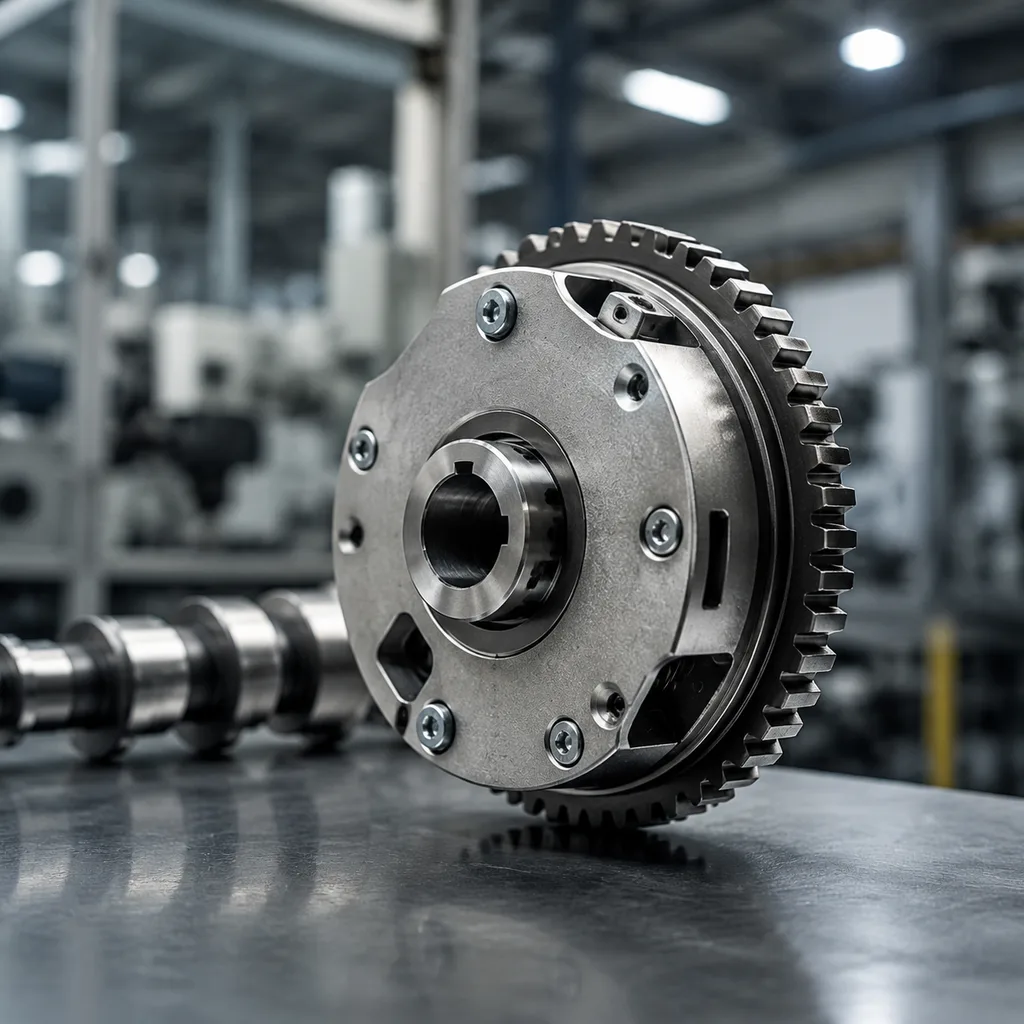
A camshaft phaser controls valve timing by rotating the camshaft relative to the crankshaft under oil pressure and ECU command. For Jeep engine service programmes, replacement demand usually starts with timing noise, diagnostic trouble codes, unstable idle, or oil contamination. For distributors and repair-chain buyers, the sourcing question is not only price. The part must match the OE envelope, oil-flow behaviour, locking-pin function, timing chain interface, and installation hardware expectations across the target engine family.
This guide takes a practical route: how to separate a usable replacement programme from a risky one, what to verify before you buy, and where phaser failures tend to show up in the field. Driventus manufactures engine and powertrain components in Taizhou, Zhejiang, under IATF 16949:2016 and ISO 9001:2015 systems for export customers in more than 60 countries.
When a Jeep Phaser Replacement Program Is Worth Stocking
Jeep applications using variable valve timing usually need phaser replacement when the internal rotor, vane sealing, return spring, or locking pin can no longer hold commanded position. A bad oil control valve or contaminated oil can create similar symptoms, so repair networks usually replace related components only after diagnosis.
The question for procurement is not just whether the part fits. It is whether the failure pattern justifies inventory. Common triggers include:
Cold-start rattle from the timing cover area
DTCs tied to cam/crank correlation or over-advanced and over-retarded cam timing
Rough idle after warm-up
Reduced low-speed torque or inconsistent acceleration
Metal debris or sludge in the oil-control circuit
Excessive free play between the phaser body and rotor
That mix of symptoms helps define which SKUs deserve stock. Intake and exhaust phasers may not be interchangeable, and left-bank and right-bank units can vary by trigger wheel position, bolt pattern, or oil-gallery design. A replacement line should therefore be built from verified application data, not visual resemblance. Buyers should also set a service-life target up front: many repair programmes aim for 30,000 to 50,000 km on budget lines and 80,000 km or more on premium lines, with consistent locking-pin engagement at low oil pressure and controlled hot-idle leakage.
What OE-Equivalent Fit Means in Practice
A credible replacement phaser should match the functional geometry and timing behaviour of the original design without claiming approval from any vehicle manufacturer. Driventus is an independent aftermarket manufacturer; brand names are referenced for fitment only.
For a camshaft phaser Jeep replacement, buyers should verify the following before approving a supplier:
Check point
What to confirm
Why it matters
Camshaft interface
Dowel, spline, or bolt-location geometry within ±0.05 mm on locating features
Prevents timing offset and assembly damage
Chain sprocket profile
Tooth count, pitch, width, and runout typically held to ≤0.10 mm TIR on critical rotation surfaces
Maintains chain engagement and NVH control
Trigger pattern
Window position and sensor alignment, with angular location held within ±1° of the approved sample
Avoids cam/crank correlation faults
Locking pin
Engagement position and release oil pressure, verified across the specified pressure band
Reduces start-up rattle and timing drift
Oil passages
Port position, diameter, and cleanliness, usually controlled within ±0.05 mm on metered bores
Supports stable advance/retard response
Bolt and torque interface
Thread type, seating face, washer design, and thread gauge acceptance
Prevents loosening or distortion
Rotation authority
Angular travel range, commonly checked against the OE-equivalent span and stop points
Ensures ECU command range is met
</tr></thead><tbody> </tbody></table>Request dimensional reports against approved samples, not just drawings. For legacy applications, buyers may use generic OE-style references such as OE 06A… or OE 11251… only where the purchasing file already includes those references. Specific brand-owned part numbers should stay in the buyer’s internal cross-reference system. In RFQs, it helps to state the tolerance class up front — for example bore size ±0.02 mm, concentricity 0.03 mm max, and surface roughness Ra 0.8-1.6 μm on oil-wetted sealing faces — so suppliers quote on the same basis.
Failure Modes That Validation Must Catch
Replacement phasers are dynamic hydraulic devices, so static inspection is not enough. Buyers should expect test evidence covering function, durability, cleanliness, and packaging integrity — and the sequence matters, because some failures only appear after repeated actuation.
Typical validation scope includes:
Dimensional inspection: coordinate measurement of mounting features, sprocket geometry, oil ports, and trigger features.
Material and heat-treatment checks: confirmation of steel grade, hardness range, and case depth where applicable.
Hydraulic actuation test: advance and retard response under controlled oil pressure and temperature.
Locking-pin test: repeat engagement and release at specified pressure thresholds.
Leakage test: internal leakage limits for vane chambers and sealing surfaces.
Rotational backlash and end-play measurement: control of rattle risk and timing accuracy.
Endurance cycling: repeated advance/retard operation to assess wear and response drift.
Cleanliness control: washing and particle checks for oil-fed components.
Salt-spray or corrosion review: where requested for inventory held in humid routes.
The most useful data are the actual numbers. A practical validation pack should show test oil temperature, pressure ramp rate, cycle count, and pass/fail criteria, such as lock-pin release within the approved pressure window, leakage below the agreed cc/min limit, and response time within the target seconds range. For endurance, many B2B programmes ask for at least 50,000 cycles on development parts and 100,000 cycles on volume parts, plus post-test recheck of angular travel, backlash, and lock position. Driventus applies process controls aligned with IATF 16949:2016 and ISO 9001:2015. Material declarations can be prepared to support customer compliance reviews under REACH (EC) No 1907/2006 where applicable to the market and product scope. Buyers can review our quality system when preparing supplier approval documents.
RFQ Checklist for Faster Supplier Comparison
An RFQ for camshaft phasers should give the supplier enough information to avoid wrong-side, wrong-bank, or wrong-revision quotations. The easiest way to speed comparison is to separate application data, packaging requirements, and commercial assumptions.
Recommended RFQ data:
Engine family, displacement, model year range, and sales region
Intake, exhaust, left-bank, or right-bank position
Existing internal SKU and cross-reference list
Annual forecast by SKU and launch quantity
Required packaging: neutral box, customer brand box, bulk tray, or repair-kit set
Required accessories: centre bolt, seal, oil-control valve, gasket, or installation leaflet
Labelling: barcode, country-of-origin statement, lot number, and date code
PPAP or sample submission level, if required by the buyer
Required inspection report format
Target Incoterms and destination port
Shelf-life or anti-corrosion requirement for long-distance export storage
Target tolerance notes, such as critical bore, face runout, and trigger-window limits
Requested unit test criteria, including lock-pin pressure, leakage limit, and response-time window
MOQ target, forecast split, and acceptable price breaks by volume band
Commercial logic works best when the buyer specifies a volume ladder. For example, a pilot batch may be 20 to 50 pieces for fitment validation, a first commercial PO may be 100 to 300 pieces by SKU, and annual call-offs may be negotiated at 500+, 1,000+, or 3,000+ units depending on application breadth. Buyers should also state whether mixed-SKU cartons are acceptable, whether samples can be charged at production price or free of charge, and whether lead time is required at 15 to 25 days for stocked items or 35 to 55 days for custom-packed programme builds.
For buyers consolidating engine components, camshaft phasers can be sourced together with timing kits, gaskets, oil pumps, and related valvetrain parts through our catalog and the engine range at /products/engine-components.html.
How Manufacturing Controls Cut Return Risk
Field returns for phasers usually come from four issues: timing mismatch, oil contamination, locking-pin noise, or incorrect application selection. A supplier cannot control engine maintenance history, but it can control machining accuracy, washing, assembly verification, and traceability.
At Driventus, replacement engine components move through controlled production routes including incoming material checks, machining inspection, assembly process parameters, final functional testing, and batch traceability. For camshaft phasers, control plans normally focus on sprocket geometry, rotor-to-housing clearance, oil-passage cleanliness, trigger feature accuracy, and torque-related surfaces.
For private-label or programme-specific supply, buyers may request:
Customer drawing control or reverse-engineered sample approval
Special marking and traceability format
Additional leakage or actuation sampling
Packaging drop-test review for export cartons
AQL inspection before shipment
Engineering change notification rules
Where a distributor needs a unique assortment, kit configuration, or adapted packaging for a repair-chain contract, Driventus can discuss custom manufacturing based on sample evaluation and agreed technical files. To make the control plan actionable, buyers should ask for the inspection frequency on key characteristics: for example, 100% check of critical interfaces, 1-in-5 or 1-in-10 sampling of actuation performance, and first-article approval before each tooling or process change. A practical return-risk clause also defines what happens if packaging damage, corrosion, or traceability failure is found on arrival, including photo evidence within 7 days and lot-level quarantine support.
Scenario: Choosing Between Lowest Price and Lowest Risk
For replacement programmes, the lowest unit price may not be the lowest total cost. A phaser failure can cause labour claims, repeat repairs, and inventory quarantine across multiple branches. Procurement teams should compare landed cost against warranty exposure and evidence of process capability.
A useful way to decide is to compare the supplier offer in the same order every time:
1. Fitment confidence: Does the part match the engine family, bank position, trigger design, and lock-pin behaviour? 2. Validation depth: Are you getting actual pressure, leakage, cycle, and response data? 3. Supply stability: Can the supplier hold lead time, MOQ, and replenishment consistency? 4. Packaging resilience: Will the part survive export storage, handling, and barcode scanning? 5. Commercial clarity: Are tooling, gauges, labels, and special packaging already included in the quote?
That framework is useful because a quote that looks cheap can still create hidden cost. For example, a unit price of $18.50 may be less attractive than $19.20 if the latter includes approved packaging, barcode setup, and a 30-day lead time. Buyers should also define the reorder trigger level and safety stock target; for fast movers, 1.5 to 2.0 months of forecast coverage is common, while slow movers may only justify a single PO of 200 to 400 pieces. Where seasonality or fleet contracts apply, ask the supplier to state how they will hold raw material, assembled stock, and finished-goods buffer against a 2- to 4-week demand spike.
A typical new-programme sequence is:
Buyer submits application list, samples, drawings, or existing SKU references.
Supplier checks feasibility, tooling status, and validation requirements.
Samples are produced or selected from an existing range.
Buyer completes fitment, functional, and packaging approval.
Pilot order is released with lot traceability and inspection reports.
Forecast-based production begins after commercial approval.
This staged approach suits distributors, OEM/Tier-1 service channels, and multi-location repair chains that need repeatable quality rather than one-time spot purchasing.
Frequently asked questions
Yes. Driventus can evaluate camshaft phaser Jeep replacement requirements using samples, drawings, application lists, and buyer cross-references. Availability depends on the engine family, position, validation scope, and order forecast. Buyers can usually expect feasibility feedback within 2 to 5 working days after sending the target SKU list, and sample or pilot lead times depend on whether the part is already in the tooling library or needs a new build.
No. Driventus is an independent aftermarket manufacturer; brand names are referenced for fitment only. Replacement parts are developed for dimensional and functional equivalence, not as manufacturer-approved components. Buyers should validate the part against the approved sample, then lock the cross-reference in their own catalogue and service documentation.
Buyers can request dimensional reports, material information, functional test summaries, packaging specifications, traceability details, and quality-system documents aligned with IATF 16949:2016 and ISO 9001:2015. For procurement approval, it is also reasonable to ask for sample inspection records, lock-pin pressure results, leakage-test data, and the agreed MOQ/lead-time quotation before placing the first commercial order.
For application review, sample development, or distributor pricing, send your target SKU list and forecast to [request a quote](/contact.html).