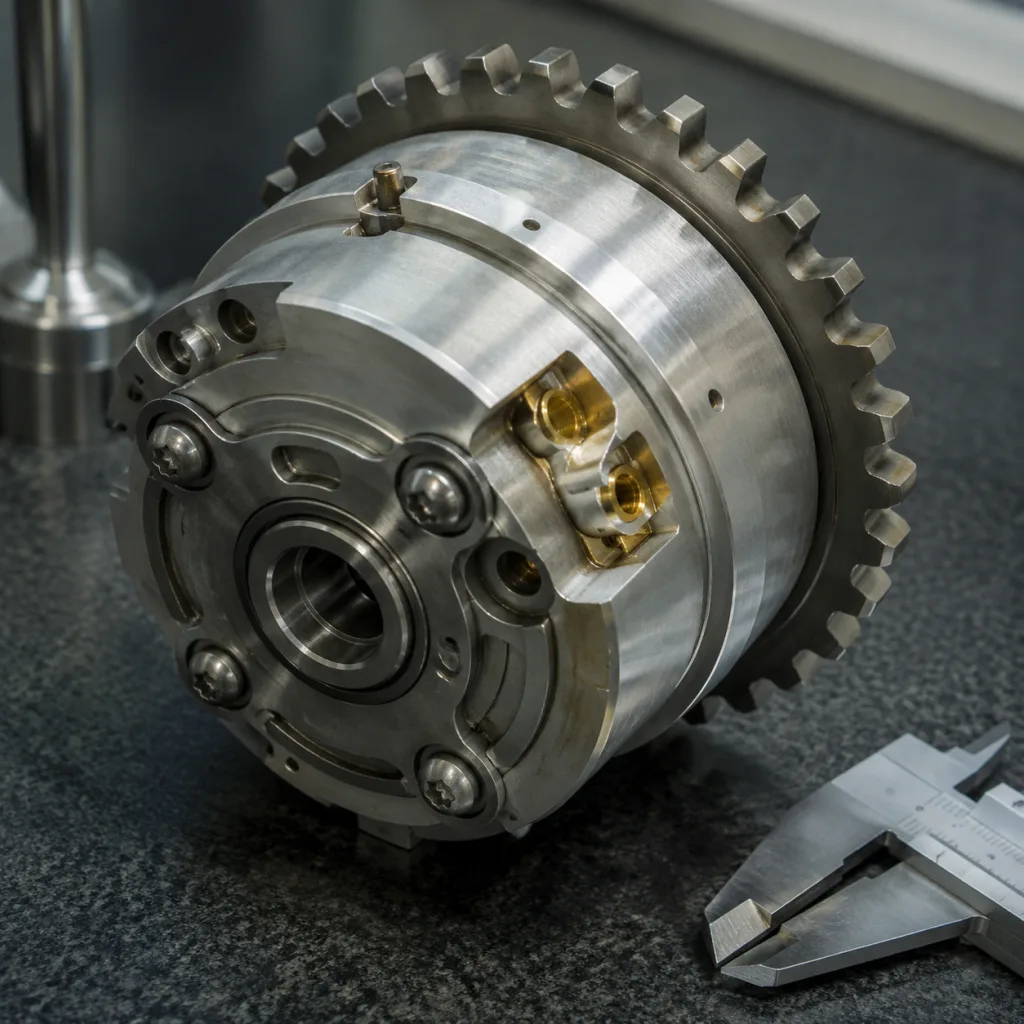
Sourcing a camshaft phaser for Citroen engine applications is not just a casting-match exercise. Procurement teams need stable dimensional control, verified oil-pressure response, accurate part-number cross-reference data and documentation that can stand up to an OEM, Tier-1, distributor or repair-chain audit. This guide explains how to evaluate a camshaft phaser Citroen OEM supplier for aftermarket sourcing and contract manufacturing programmes, with practical checkpoints for manufacturing controls, commercial terms, validation evidence, compliance records and RFQ preparation. Driventus manufactures engine and powertrain components in Taizhou, Zhejiang, and exports to distributors, wholesalers, repair-chain sourcing teams and OEM/Tier-1 customers in more than 60 countries. Driventus is an independent aftermarket manufacturer; Citroen and other brand names are referenced for fitment identification only.
What Procurement Teams Should Verify First
A camshaft phaser is a hydraulic and mechanical timing-control component, so sourcing risk is tied to repeatability as much as material strength. For Citroen-fitment engines, buyers should look closely at performance under different oil viscosities, temperatures and duty cycles. Request evidence for vane sealing, rotor-to-stator clearance, lock-pin engagement, return spring force and timing-angle repeatability before moving into price comparison.
Start by defining the sourcing scope in operational terms:
Demand profile: annual volume, first order quantity, call-off schedule and destination ports.
Required file: PPAP-style package, inspection report, material certificate, packing specification and compliance declaration.
Do not approve a source from sample appearance alone. Two phasers can look identical externally while differing in oil-control groove geometry, rotor hardening depth, surface finish, vane sealing or internal leakage rate. Those details influence cold-start noise, timing response, diagnostic fault frequency and warranty exposure.
Manufacturing Controls for Citroen-Fitment Phasers
Driventus produces camshaft phasers under process controls aligned with IATF 16949:2016 and ISO 9001:2015. For a buyer, the certificate is only the starting point. The real evidence is the control plan, measurement method, inspection frequency and corrective-action history behind each shipment.
Key manufacturing controls normally include:
Control point
Procurement relevance
Typical record requested
Rotor and stator machining
Controls timing-angle accuracy and internal leakage
CNC inspection sheet
Vane slot width and flatness
Supports oil sealing and response stability
CMM or gauge report
Lock-pin bore position
Affects start-up locking and noise control
In-process inspection record
Heat treatment
Supports wear resistance and fatigue margin
Hardness and process record
Surface cleanliness
Reduces contamination risk in oil galleries
Final cleaning and audit record
Functional oil test
Confirms actuation response before release
End-of-line test report
</tr></thead><tbody> </tbody></table>For higher-volume programmes, ask how the factory separates trial parts, engineering-change samples, quarantined stock and released mass-production inventory. Traceability should connect the batch code, production date, inspection status, operator or line record, and nonconformance disposition. This is especially important for distributors serving multiple markets, where warranty analysis depends on identifying the exact production lot rather than a broad shipment window.
MOQ, Lead Time and Commercial Sourcing Terms
A capable camshaft phaser Citroen OEM supplier should quote the complete supply condition, not only the unit price. A usable quotation defines tooling status, sample timing, MOQ, packing method, payment terms, incoterms and document availability so the buyer can compare suppliers on the same basis.
For existing Driventus tooling, typical sourcing parameters are structured as follows:
Sample order: available after cross-reference confirmation and drawing or sample review.
MOQ: generally lower for active catalogued parts and higher for new development or private-label programmes.
Lead time: commonly 30 to 60 days after deposit for stocked tooling, depending on order quantity, testing scope and packaging requirements.
Shipping: FOB Ningbo or Shanghai is common; CIF and DDP can be reviewed by market and shipment profile.
Documents: commercial invoice, packing list, certificate of origin where applicable and inspection summary.
Buyers can review related engine timing and valvetrain items in our catalog, including engine components with established application coverage. For non-standard requirements, custom manufacturing supports private specifications, dedicated packaging, reverse engineering and part-family expansion.
Validation, Compliance and Audit Evidence
Camshaft phaser validation should combine dimensional, material and functional checks. The final test plan depends on the application, buyer risk level, order volume and whether the programme is an aftermarket replacement supply or a contract manufacturing project. Driventus can support audit preparation with process-flow charts, control plans and inspection records for agreed part numbers.
Common validation evidence includes:
Incoming material verification for steel or aluminium alloy grade.
Hardness testing after heat treatment.
CMM checks for critical rotor, stator, mounting and oil-control features.
Functional actuation testing under controlled oil pressure and temperature conditions.
Leak-rate or pressure-holding checks where required by the application.
Salt spray or surface-protection review for externally exposed features.
Packaging drop or transport-resistance checks for export cartons.
Compliance expectations vary by market. For EU and UK buyers, material declarations may reference REACH (EC) No 1907/2006 where relevant to substances of very high concern. Quality management evidence should refer to IATF 16949:2016 and ISO 9001:2015 rather than broad, unsupported quality claims. Because camshaft phasers influence valve timing, buyers may also consider the vehicle-level emissions context of ECE R-83, while recognising that component suppliers do not certify complete vehicle emissions.
Driventus does not claim approval, authorisation or endorsement by Citroen or any vehicle manufacturer. Driventus is an independent aftermarket manufacturer; brand names are used only to identify fitment.
How to Shortlist a Supplier
A sourcing engineer or category buyer can reduce risk by using a structured supplier questionnaire before issuing a purchase order. The aim is to confirm whether the supplier controls the manufacturing process, measurement system and traceability flow, or simply trades finished goods.
Recommended audit questions:
1. Is the camshaft phaser produced in-house or purchased from another factory? 2. Can the supplier provide a process-flow chart from raw material to final packing? 3. Which dimensions are treated as critical-to-function characteristics? 4. Is functional testing applied to every unit, or is release based on sampling? 5. How are oil passages cleaned, dried and protected before packing? 6. What is the standard response time for 8D corrective action after a field claim? 7. Can private-label packing be managed without mixing customer stock? 8. Are inspection records retained by batch, shipment and customer order?
A strong supplier answers these questions with records, not general assurances. For buyers managing a camshaft phaser Citroen OEM supplier shortlist, the factory audit should focus on measurement capability, cleanliness discipline, functional-test control, traceability and engineering response. Unit price matters, but timing-system warranty claims can quickly erase the saving from an uncontrolled low-cost source.
Driventus maintains a documented quality system and supports distributor, Tier-1 and repair-chain sourcing teams with technical files, inspection records and export documentation on request.
Information to Send With an RFQ
A complete RFQ shortens review time and reduces the chance of an incorrect cross-reference. If the buyer does not have a full drawing, a physical sample, application list and OE-style reference convention can still help engineering confirm the correct fitment and development route.
For active references, Driventus can usually confirm availability, MOQ and sample timing after application review. For new development, the workflow may include sample reverse engineering, drawing confirmation, prototype testing, functional validation and buyer approval before serial production. Buyers can request a quote with part references, drawings or samples to begin the review.
Frequently asked questions
Yes. Driventus supplies camshaft phasers and related engine components for selected Citroen-fitment applications, subject to reference confirmation, sample review or application data. Driventus is an independent aftermarket manufacturer; brand names are referenced for fitment identification only.
Depending on the programme, Driventus can provide inspection reports, process-flow charts, control plans, material records, packing specifications and quality-system evidence referencing IATF 16949:2016 and ISO 9001:2015.
MOQ and lead time depend on tooling status, annual forecast, packaging type, test requirements, document scope and whether the part is catalogued or newly developed. Existing-tooling programmes are normally faster than private-specification developments.
If you are evaluating a camshaft phaser Citroen OEM supplier for distribution, repair-chain supply or contract manufacturing, send your application list, target references and forecast for review. Start a technical RFQ at /contact.html