Camshaft Phaser Citroen Manufacturer China | Supplier Guide
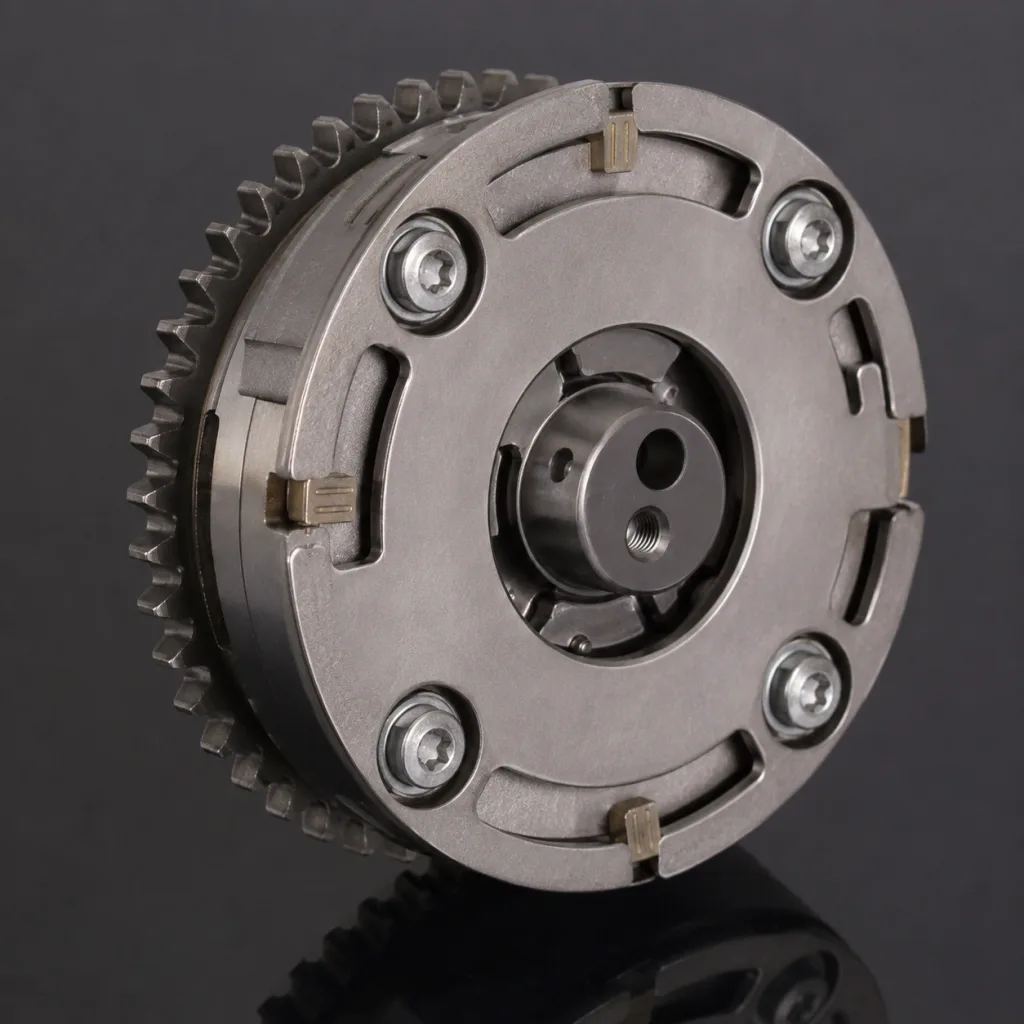
Buying a camshaft phaser for Citroen applications is a fitment decision first and a price decision second. The part has to match the engine family, oil-control strategy, locking behavior, and phase window; otherwise it may install cleanly and still fail in service. For procurement teams, the real test is whether the supplier can prove geometry, repeatability, traceability, and release control at batch level.
Driventus manufactures engine and powertrain components in Taizhou, Zhejiang, and supplies B2B customers in more than 60 countries. We support Citroen fitments through OE cross-reference control, controlled machining, and documented inspection. Driventus is an independent aftermarket manufacturer; brand names are referenced for fitment only. If you are sourcing for distributors, repair networks, or Tier-1 programmes, compare technical fit, commercial terms, and auditability before you place volume orders.
Start with fitment, not price
A `camshaft phaser citroen manufacturer china` search only becomes useful when the application is pinned down. The same platform family can hide different engine codes, side positions, connector styles, and phase ranges. If any one of those is wrong, the part becomes a costly return.
Use this as the minimum RFQ filter:
OE reference and engine code match exactly
Intake or exhaust side is specified
Locking method and stop angle are confirmed
Oil-control solenoid interface is compatible
Rotational travel is stated in the correct units
Label, packaging, and traceability format are defined
Do not accept vague “fits Citroen” language unless the supplier ties the part to a specific engine code and revision. Exact cross-reference matters; for example, a known OE number such as `OE 06A107065` should be quoted precisely, not approximated. Ask for tolerance evidence too, not just nominal dimensions. If the supplier cannot state the control window for critical diameters, end play, and travel, they are not ready for volume sourcing.
Where phasers fail in service
Camshaft phasers usually fail for predictable reasons, and most of them start in manufacturing or qualification. The common weak points are concentricity drift, vane clearance variation, pin engagement instability, and leakage that grows under heat and oil contamination.
Typical failure modes buyers should ask about:
Slow phasing response after warm-up
Noisy operation at idle or cold start
Lock pin sticking in the wrong position
Drift at the end stop under load
Excessive leakage across internal clearances
Wear from poor surface hardness or finish
A serious supplier should explain how each risk is controlled at production and test. Driventus operates under `IATF 16949:2016` and `ISO 9001:2015`, with incoming inspection, in-process checks, and final release records. Where requested, material compliance can also be supported against `REACH (EC) No 1907/2006` for export markets.
For buyers, the useful question is simple: which characteristics are monitored on every lot, and which are sampled? If the answer is unclear, the process capability is probably unclear too. Many sourcing teams use `1.33` as the minimum Cp/Cpk benchmark on critical dimensions, with tighter limits for launch parts or safety-sensitive programmes.
What a credible production spec should show
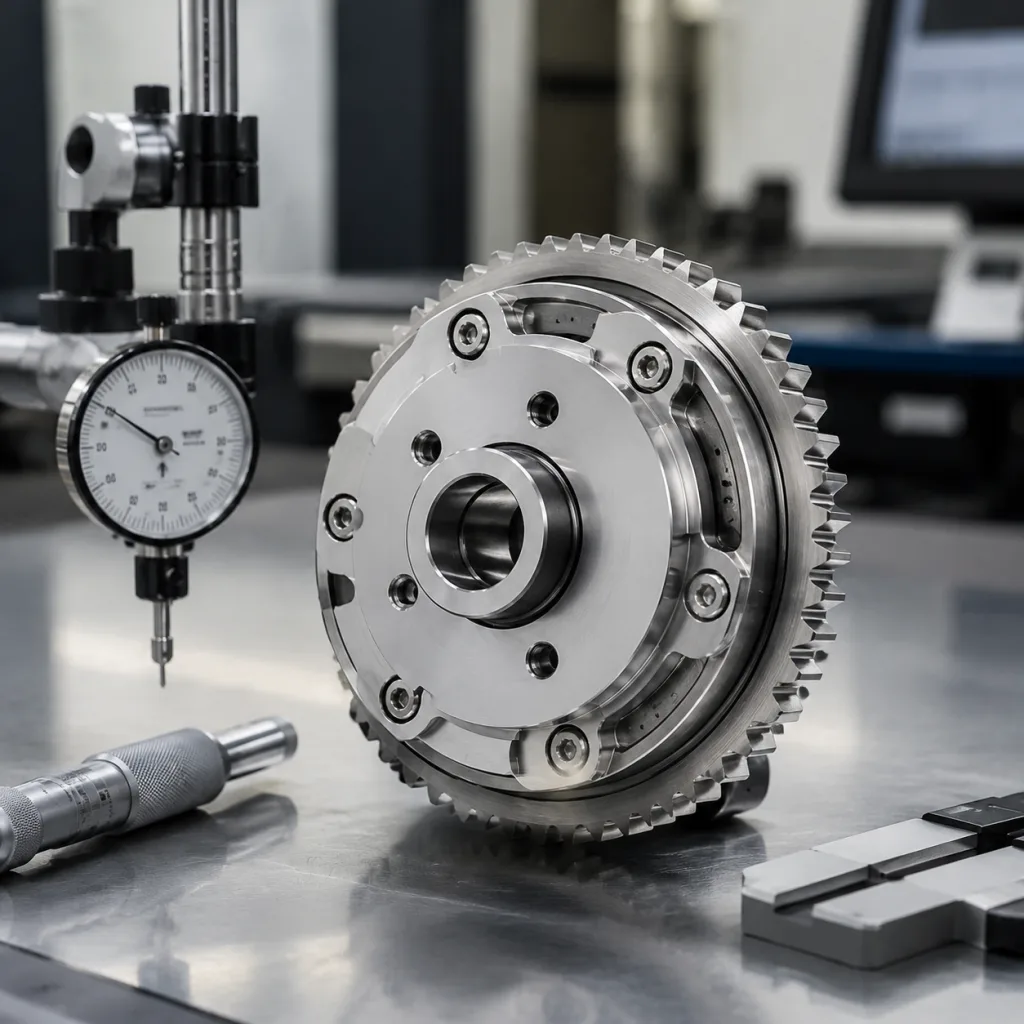
A phaser is a hydraulic precision assembly, so the spec has to go beyond dimensions. It should show how the part is machined, assembled, checked, and released. Without that detail, two units with the same drawing can still behave differently in the engine.
Control item
Why it matters
Typical target
Bore and journal concentricity
Reduces drag and noise
Often held within `0.01-0.02 mm`, per drawing
Vane clearance
Stabilises phasing response
Commonly `0.02-0.06 mm`, design dependent
Lock pin engagement
Ensures cold-start position
Verified at assembly and release test
End-stop angle
Preserves timing accuracy
Typically controlled within `±1.0°` or drawing limit
Surface hardness
Improves wear resistance
Material and heat-treatment controlled
Leakage rate
Prevents slow phasing drift
Bench-tested against functional limit
</tr></thead><tbody> </tbody></table>A buyer-ready quality file should include first-article dimensions, hardness reports, runout and concentricity results, functional travel data, and lot traceability. For volume programmes, ask for evidence of process capability on key characteristics, plus the release method for any deviation. That is the difference between a part that samples well and a part that keeps performing after repeated heat cycles.
How we handle sampling to production
Most buyers do not need a generic supplier pitch. They need to know how the source transitions from sample to repeat supply without losing control.
Driventus supports three common models:
Replacement demand, where exact fit and consistency matter most
Distributor stocking, where packaging and traceability matter most
Programme supply, where documentation and change control matter most
The launch path is usually straightforward. Sample builds often start at `1-5 pcs`, pilot validation runs at `20-50 pcs`, and production MOQs may sit in the `100-300 pcs` range depending on complexity, packing, and marking requirements. Larger repeat orders usually unlock better pricing once forecast volume and release cadence are stable.
We also support private-label packing, customer-specific marking, multi-language carton requirements, and pallet-level traceability. If your team sources related engine parts, our catalog at our catalog and engine components can help consolidate purchasing across pistons, gaskets, water pumps, and turbocharger parts.
How validation should be written
Validation is where many sourcing projects become vague. A phaser should be checked in a way that proves both fit and function. Bench testing is necessary, but not enough on its own.
Ask for a test record that covers:
Static dimensional inspection on critical bores, journals, and mounting faces
Rotation or phase travel across the full working range
Lock and unlock behavior at defined oil pressure and temperature
Leak or bleed-down performance after a fixed dwell period
Noise or stick-slip screening where the design is sensitive
Packaging drop or transit checks for export cartons
Where applicable, the test plan may reference `ECE R-83` for emissions-related vehicle context, `SAE J2527` for durability and environmental exposure methods, or OEM-specific timing response criteria. The important part is not the label on the test; it is the acceptance window. Ask the supplier to state the exact limits for phase deviation, pressure response, and leakage. Some buyers require response within `0.5-1.5 seconds` under specified conditions; others care more about drift after `30` minutes at temperature. Either way, the limits should be written, repeatable, and signed off before volume release. Our quality system outlines the controls used to manage that process.
Commercial terms that avoid surprises
China sourcing works best when the commercial structure is defined early. Buyers should confirm MOQ by part number, annual volume, sample timing, production lead time, and export packing details before they ask for final pricing. For new programmes, tooling ownership and revision control should sit in the supply agreement.
A practical lead-time framework is usually:
Sample builds: `7-15 days` after confirmation, depending on stock and test scope
Pilot orders: `2-4 weeks` for controlled small batches
Mass production: `30-45 days` for standard schedules after deposit and release
Special packaging or private label: add `3-7 days` for artwork approval
Evaluate price on landed cost, not only unit quote. Compare EXW, FOB, and DDP options, then factor in carton quantity, inner protection, inspection scope, and claim handling. For annual contracts, ask for tiered pricing at breakpoints such as `500`, `1,000`, and `3,000` pieces, plus a separate sample price if engineering validation is still ongoing.
If the Citroen application needs a variant outside standard production, Driventus can evaluate custom manufacturing for revised dimensions, locking features, or customer-specific packaging. For direct sourcing discussions, use request a quote and share the OE reference, engine code, target annual demand, destination market, and required launch date.
Frequently asked questions
Yes, provided the OE number and engine application are clear. We verify the cross-reference against fitment data, interface geometry, side designation, and functional requirements before quoting.
Production is managed under `IATF 16949:2016` and `ISO 9001:2015`. Material and export compliance can be aligned with `REACH (EC) No 1907/2006` where required.
Send the OE number, engine code, intake or exhaust side, annual demand, target market, required sample quantity, and packaging requirements. Photos or a sample help if the reference is unclear.
Send your OE reference, engine code, annual demand, and target lead time for a technical review and quotation. Use our contact form here: /contact.html