Camshaft Phaser Chevrolet Replacement: OE Fitment Guide
For procurement teams sourcing a camshaft phaser Chevrolet replacement, the priority is not marketing language. It is dimensional compatibility, oil-control performance, timing authority, and repeatable validation. Chevrolet applications vary by engine family, model year, calibration strategy, and oil-control architecture, so replacement parts must be matched to the OE reference, not just the vehicle nameplate. Driventus supplies engine and powertrain components from Taizhou, Zhejiang, under IATF 16949:2016 and ISO 9001:2015 quality systems. Driventus is an independent aftermarket manufacturer; brand names are referenced for fitment only. For buyers, the practical questions are straightforward: does the phaser index correctly, hold commanded position, meet oil-flow and backlash limits, and pass durability and cleanliness requirements after installation? This article explains what to verify before placing a replacement order, which dimensional checks matter, and how to reduce mismatch risk in Chevrolet programs.
Camshaft phaser fitment: what must match first
A Chevrolet camshaft phaser replacement succeeds or fails on fitment details, not vehicle badges. The first screen is the OE reference; the second is the engine code; the third is whether the part is intake or exhaust. A visually similar phaser can still fail if the lock geometry, oil-feed path, or phasing travel changed mid-program.
Match points that control release
OE part number and any supersession chain
Engine family, displacement, and valve-train layout
Intake or exhaust position, plus bank/side where applicable
Housing OD, face depth, and bolt-circle location
Rotor-to-stator clearance and vane count
Oil port location, connector style, and commanded range
Lock-pin behavior when oil pressure drops
If the OE number is known, use that as the anchor and verify every other attribute against the catalog or sample. Model name alone is not enough. Chevrolet platforms often share branding while using different timing hardware. For procurement, the rule is simple: if the OE match is incomplete, the order stays on hold.
Where replacement programs go wrong
Most sourcing mistakes are not obvious at the quote stage. They show up as installation friction, timing faults, or avoidable returns after the vehicle reaches the bay.
Failure mode
What it looks like
Typical cause
Wrong phaser family
Part bolts up, but timing control is unstable
Engine code or revision not verified
Intake/exhaust swap
Mechanical fit is close, but commanded timing is wrong
Position not confirmed from VIN or service data
Oil-response lag
Slow phasing, cold-start noise, or fault codes
Oil gallery mismatch or clearance issue
Lock-pin inconsistency
Rattle at start-up or incomplete lock-up
Internal tolerance drift
Cleanliness defect
Debris, scoring, or premature wear
Poor flushing or packaging control
Spec mismatch
Returns despite correct catalog listing
OE supersession not captured
</tr></thead><tbody> </tbody></table>The fastest way to reduce error is to require application confirmation before purchase order release. Ask for engine code, model year range, OE number, and one photo of the removed part if the program is already in service. That small step usually catches the mismatch before it becomes a warranty problem.
Spec deep-dive: the numbers procurement should ask for
A credible replacement spec is more than a yes/no fitment statement. It should define the control dimensions that affect oil flow, backlash, and phasing authority.
Request these technical values
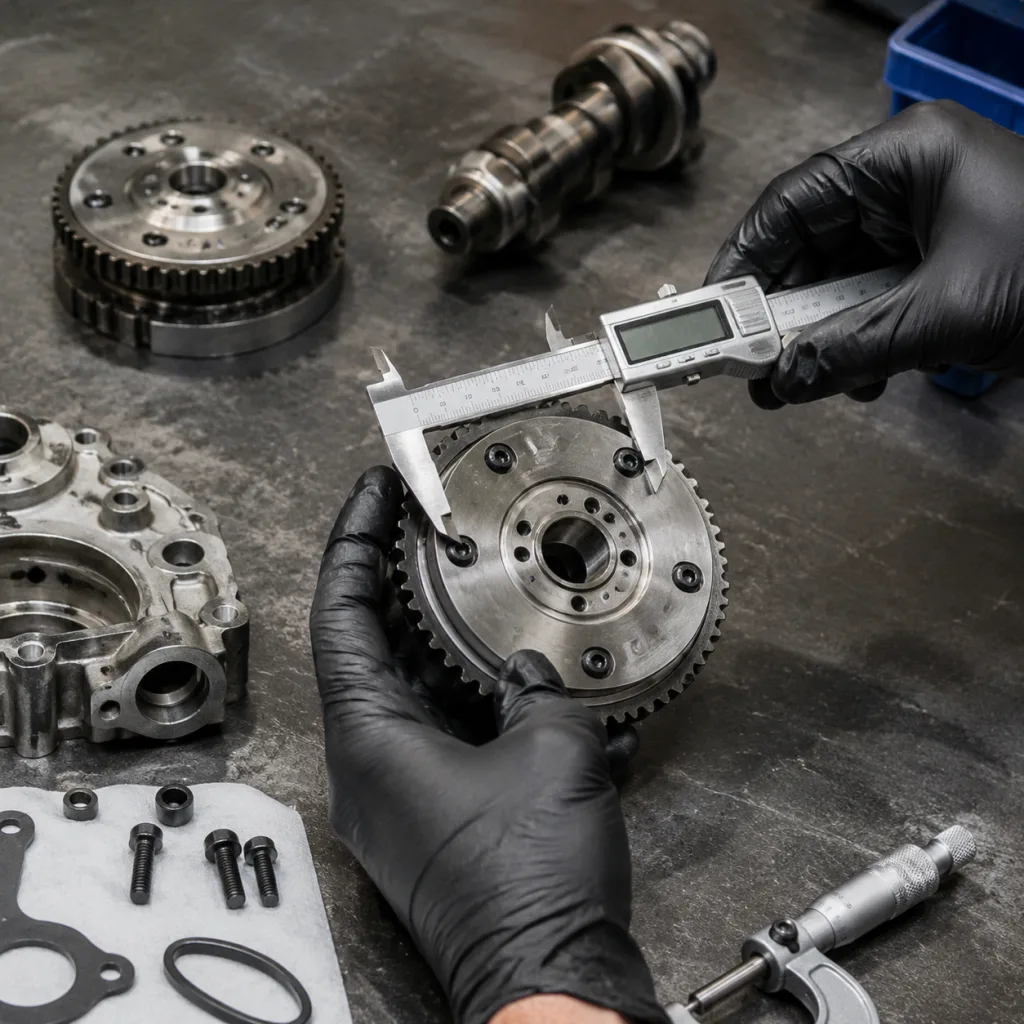
Housing outer diameter within the approved tolerance band
Face depth and bolt-circle position to the drawing reference
Rotor-to-stator clearance, usually held in a narrow control window
Vane count and phasing travel in crank-angle degrees
Oil gallery alignment and inlet port geometry
Lock-pin engagement position and return condition
Torque path, thread-lock requirement, and sealing method
Cleanliness limit and packaging protection standard
For validation, the useful question is not whether the part looks right. It is whether it repeats right. Buyers should ask for sample inspection data, first-article records, and the acceptance criteria used for dimensional and functional checks. Driventus builds under controlled quality systems and can align documentation with project-specific release requirements, including IATF 16949:2016 and ISO 9001:2015-based processes.
Validation sequence before production release
Use a simple step-by-step gate before you approve volume.
1. Confirm the OE number and application data. 2. Verify engine code, model year, and intake/exhaust position. 3. Compare the sample to the OE part for OD, face depth, and port location. 4. Check lock-pin function and full travel under controlled oil pressure. 5. Review cleanliness, packaging, and traceability records. 6. Approve only after first-article data matches the agreed limits.
A practical test plan should include dimensional inspection, rotation and lock tests, oil-passage cleanliness checks, and response checks at the pressure points specified by the program. Where durability evidence is required, the test method should be tied to the buyer’s release criteria rather than a generic catalogue claim. That keeps the approval process focused on the actual Chevrolet application instead of a broad vehicle-family assumption.
Buying logic: price, MOQ, and warranty risk
The cheapest unit is not the cheapest program if returns rise. For cam phaser sourcing, buyers should compare landed cost, incoming yield, and downstream warranty exposure together.
A supplier quote should state the incoterm, packaging basis, lead time, and whether private-label artwork changes MOQ. Trial orders are often smaller, pilot runs usually sit in the middle, and repeat production is where pricing normally improves. The exact numbers depend on the part revision and demand profile, but the purchasing logic stays the same: stable fitment lowers labor loss, and stable phasing lowers comeback risk.
Driventus supports customers with controlled raw material flow, machining, assembly, and final inspection. For programs that need catalog alignment or private label, custom manufacturing can align the part with the buyer’s market structure. For broader sourcing, our catalog and engine components help teams bundle the phaser with adjacent timing parts.
What to send with the RFQ
Use a complete request so engineering can verify fitment before the quote goes out.
Include these fields
OE number and any supersession notes
Vehicle model, engine code, and model year range
Intake or exhaust position
Sample photo, teardown image, or drawing
Target annual volume and forecast split
Target price band and destination country
Packaging, labeling, and barcode requirements
Required inspection limits for dimensions, function, and cleanliness
If the source data is incomplete, the order should pause for review rather than guesswork. Buyers can request a quote with the OE reference, sample photos, and commercial targets so fitment and feasibility are checked before first article approval. For procurement teams, that shortens the cycle and reduces the chance of ordering the wrong Chevrolet replacement twice.
Frequently asked questions
Yes, if the OE reference is provided and the application data is complete. The best results come from matching the OE number, engine code, intake or exhaust position, and model year together. If the program is ambiguous, we recommend using a sample, teardown photo, or VIN-derived application record before release.
No. Driventus is an independent aftermarket manufacturer; brand names are referenced for fitment only. We supply OE-equivalent components, not manufacturer-endorsed parts.
We can support application confirmation, dimensional checks, sample inspection records, and quality documentation aligned with IATF 16949:2016 and ISO 9001:2015-based processes, subject to the specific project scope. Where needed, we can also share packaging details, lead-time assumptions, and MOQ basis for quotation review.
If you are building a Chevrolet timing-system sourcing list, send the OE reference, engine code, annual volume, target price band, and lead-time requirement for review. Start here: /contact.html