Camshaft for Opel Vivaro Aftermarket Replacement: Fitment Guide
Sourcing a camshaft for Opel Vivaro aftermarket replacement starts with fitment discipline, not the vehicle badge. Across the Vivaro range, engine families, timing layouts, sensor interfaces, and valve-train configurations can vary, so the correct part should be confirmed against the engine code, OE reference, and dimensional drawing before purchase. Driventus is an independent aftermarket manufacturer; Opel and Vivaro names are used only to identify vehicle compatibility. For B2B buyers, the stronger procurement decision is based on measurable geometry, consistent metallurgy, traceable inspection records, and packaging that protects journals and lobes through export freight and warehouse handling. Our production and inspection controls are built around IATF 16949:2016 and ISO 9001:2015, with compliance support available for EU and UK supply chains, including REACH (EC) No 1907/2006 where applicable. If your team supplies distributors, workshops, fleet repair programmes, or multi-location service networks, use the checks below to reduce returns and improve repeatability before placing an order.
Fitment starts with engine code, not the model badge
The Vivaro nameplate has been used across different engine generations and market specifications. A replacement camshaft may appear visually similar to another part, yet still be unsuitable if the timing interface, journal layout, lobe indexing, or sensor trigger feature is different. For procurement teams, the safest route is to validate the part against the engine code and OE reference before confirming stock.
What buyers should confirm before ordering:
- Engine code, displacement, fuel type, and production year range
- Intake and exhaust camshaft position, especially on engines with paired shafts
- Belt or chain drive geometry, including sprocket seating, locating features, and keyway or pin style
- Cam sensor trigger pattern, reluctor features, and any variable valve timing or phaser interface
- Journal count, bearing spacing, thrust face position, and end-play control arrangement
- Lobe profile, base circle, lift, and angular position against the OE drawing
- Whether related followers, rockers, bearings, seals, or timing parts should be replaced at the same time
If the part is being purchased for a rebuild programme or distributor stocking plan, request an OE cross-reference review instead of relying only on a vehicle registration lookup. Registration data can be useful, but it may not capture engine swaps, market-specific variants, or mid-year production changes. Confirming the technical envelope upfront reduces branch-level returns and prevents fitment disputes between distributors, workshops, and end customers.
Validation data that matters to procurement teams
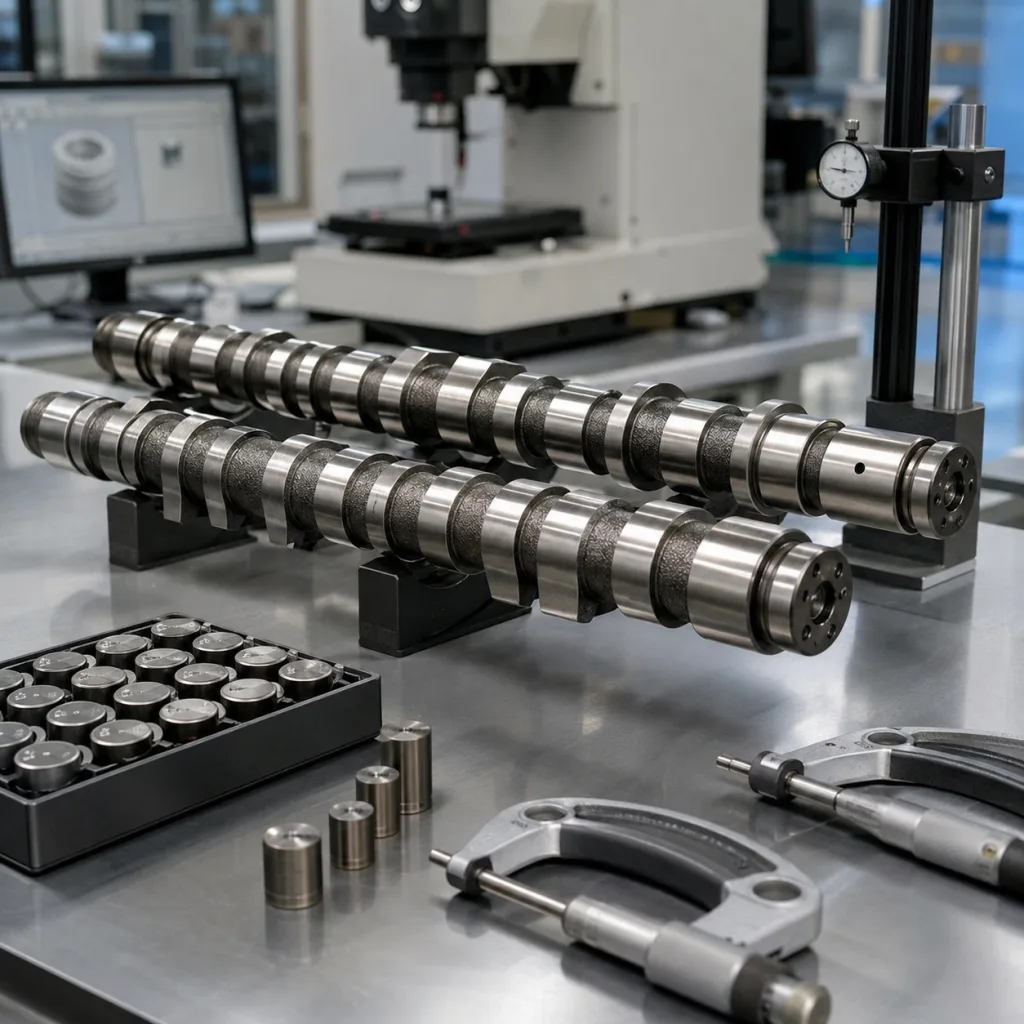
Valve-train components operate under high contact stress, so purchasing decisions should be supported by verifiable data rather than catalogue assumptions. For a camshaft, the most useful evidence is measurable: dimensional inspection, hardness verification, shaft runout, lobe indexing, surface finish, and cleanliness after machining. These checks help confirm that the part is not only correct for the application, but also repeatable from batch to batch.
At Driventus, camshaft inspection is managed within a documented quality system aligned with IATF 16949:2016 and ISO 9001:2015. For customers supplying EU and UK channels, material and compliance files can be prepared to support REACH (EC) No 1907/2006 requests where applicable.
Common inspection points include:
- Journal diameter, roundness, and concentricity
- Cam lobe height, base circle, and angular position
- Shaft runout and end-face squareness
- Surface condition on journals, lobes, and thrust faces
- Heat-treatment consistency, hardness range, and batch traceability
- Oil hole condition, deburring quality, and post-machining cleanliness
- Corrosion protection, separator design, and carton strength for freight handling
For high-volume accounts, batch-level inspection records can be shared so receiving teams can match cartons to production lots without opening every case. This is especially useful for distributors that supply multiple branches or repair networks and need a consistent audit trail when claims, recalls, or warranty reviews occur.
Replacement options compared
The right sourcing route depends on cost target, vehicle downtime, stock availability, warranty exposure, and how much variability the buyer can accept. For Vivaro engine repair programmes, most procurement teams compare OE new parts, verified aftermarket replacements, and remanufactured alternatives.
| Option | What it offers | Main risk | Best use |
|---|---|---|---|
| OE new | Direct match to the original design intent and dealer-channel specification | Higher cost, possible longer lead time, and limited flexibility on packaging or MOQ | Critical repairs, warranty-sensitive work, and low-volume specialist jobs |
| Aftermarket replacement | OE-equivalent geometry, controlled production cost, and scalable supply for trade channels | Supplier quality varies if validation and batch control are weak | Distributors, wholesalers, repair chains, and fleet maintenance programmes |
| Remanufactured | Reused core with reworked surfaces and a lower entry cost when cores are available | Core availability, previous wear history, and possible variation between units | Budget-sensitive repairs with a stable core supply and controlled inspection process |