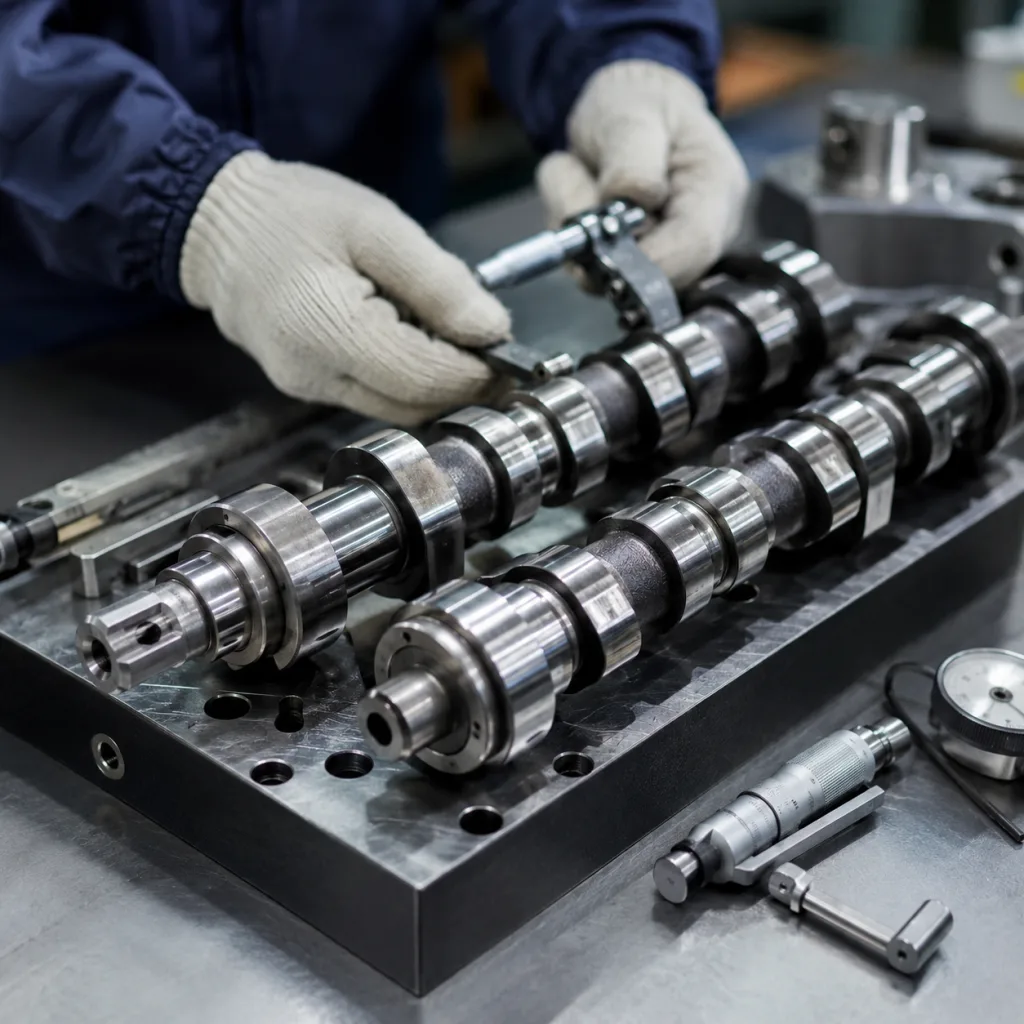
Camshaft for Ford F-150 OE Equivalent Sourcing Guide
A camshaft for Ford F-150 OE equivalent replacement programmes must be specified beyond a catalogue match. For distributors, repair-chain buyers, and engine rebuild suppliers, the part has to fit the intended engine family, preserve valve-timing geometry, withstand repeated load cycles, and arrive with documentation that supports incoming inspection. This guide explains how Driventus specifies and validates aftermarket camshafts for Ford F-150 applications, covering dimensional matching, material control, surface treatment, packaging, and supplier-file review. It is written for procurement teams comparing B2B sources, not for vehicle owners. Driventus is an independent aftermarket manufacturer; brand names are referenced only for fitment identification. Before purchase orders are released, buyers should confirm published fitment data, applicable OE part-number cross-references, sample inspection reports, and agreed drawings.
What OE-equivalence means for F-150 camshafts
OE-equivalence is a controlled replacement target, not a statement of vehicle manufacturer approval. For an F-150 camshaft, procurement teams should confirm that the replacement part matches the intended engine platform in geometry, material performance, timing function, and installation interface.
A practical sourcing file should include:
Engine application and model-year range checked against buyer fitment data
OE-style cross-reference format where applicable, used only when supported by buyer records or catalogue data
Cam lobe lift, base circle, journal diameter, thrust face position, and dowel, gear, or phaser interface dimensions
Material grade, heat-treatment route, and surface-hardness range
Runout, straightness, lobe profile, and surface-finish inspection records
Packing specification for sea, air, or mixed-mode transport
For importers, the risk is rarely a part that is obviously wrong on arrival. The more expensive failures come from small deviations: lobe taper outside tolerance, journal finish that disrupts oil film formation, oil-feed misalignment, or timing-interface variation that leads to noise, diagnostic fault codes, or premature wear after installation. OE-equivalent sourcing therefore depends on measurable controls rather than catalogue wording alone.
Critical dimensions and performance checks
Camshafts operate with limited lubrication during start-up and repeated cyclic loading throughout service life. Replacement parts for Ford F-150 applications should therefore be checked against drawing-level requirements before volume release.
Check area
Typical procurement requirement
Why it matters
Journal diameter
Drawing tolerance agreed before PPAP-style sampling
Controls oil clearance and bearing load
Cam lobe lift
Profile inspection against master sample or CAD data
Maintains valve opening and engine breathing
Base circle
Matched to valve train design
Prevents lash or follower preload errors
Total indicated runout
Controlled across journals
Reduces vibration and uneven bearing wear
Surface hardness
Verified after heat treatment
Protects lobes and journals from scuffing
Surface roughness
Measured on journals and lobes
Supports stable oil film formation
Timing interface
Dowel, slot, gear, or phaser interface verified
Prevents valve-timing deviation
</tr></thead><tbody> </tbody></table>Where buyers require formal submission, Driventus can provide dimensional inspection reports, material certificates, hardness records, and capability data for agreed characteristics. Production controls are managed under IATF 16949:2016 and ISO 9001:2015 frameworks. These standards do not replace part validation, but they define the quality-management structure used for traceability, corrective action, calibration, and process control.
Material, heat treatment, and surface finish requirements
Many camshaft failures in replacement channels are linked to wear, oil-starvation sensitivity, contamination, or incorrect surface condition. Material choice depends on the engine design and camshaft construction. Cast iron, chilled cast iron, forged steel, and assembled camshaft designs each require different process controls.
For OE-equivalent F-150 replacement programmes, buyers should define or request confirmation of:
Material specification and chemical-composition range
Casting, forging, or assembled-shaft process route
Heat-treatment method and case-depth targets where applicable
Lobe and journal hardness range after final processing
Straightening method and final runout inspection
Grinding-wheel control and profile-verification method
Anti-corrosion oil, VCI protection, or sealed packaging for export
Surface finish deserves close review because dimensional conformity alone is not enough. A lobe that is within nominal size but too rough can accelerate follower wear, while a journal with unsuitable finish can affect oil retention and bearing durability. Driventus uses controlled grinding, profile checks, and final cleaning to reduce contamination risk before packing.
Chemical compliance may also matter for importers selling into the EU or UK. For materials, coatings, oils, and packaging inputs, buyers may request declarations aligned with REACH (EC) No 1907/2006 where applicable to the supplied article and destination market.
Validation package for replacement programmes
A camshaft for Ford F-150 OE equivalent supply project should be validated before regular container shipments begin. The required depth depends on order volume, warranty exposure, and whether the buyer supplies wholesale distribution, engine rebuilders, or multi-location repair chains.
Recommended approval sequence
1. Confirm the application list and buyer-provided cross-reference data. 2. Review the 2D drawing, 3D data, or master sample. 3. Produce trial samples from controlled tooling. 4. Complete dimensional inspection across critical features. 5. Verify material, hardness, surface roughness, and runout. 6. Conduct fitment and rotation checks with mating components where available. 7. Approve packaging after drop, vibration, or handling review if required. 8. Release a pilot order before recurring production.
For higher-risk programmes, the buyer may specify endurance testing, engine-bench validation, or additional checks on mating components such as followers, phasers, sprockets, and bearings. Driventus can support project-specific validation planning, including sample retention and lot traceability. The goal is to reduce field variation before the part enters distributor stock.
Driventus is an independent aftermarket manufacturer; brand names are referenced for fitment only.
Sourcing documentation buyers should request
Procurement teams should not source camshafts on price and photo comparison alone. The supplier file should support technical review, compliance review, and receiving inspection so that decisions can be audited after the first order and during repeat supply.
A typical B2B sourcing package can include:
Quotation with application scope, Incoterms, MOQ, and lead time
Part drawing or agreed inspection specification
Initial sample inspection report
Material certificate and heat-treatment record
Surface-hardness and surface-roughness report
Process flow, control plan, and inspection frequency where required
Packaging specification with carton, pallet, and corrosion-protection details
Traceability format for batch, production date, and inspection status
Buyers can review related engine parts in our catalog, including product families listed under engine components. Driventus also provides custom manufacturing for buyers with drawings, private-label requirements, or market-specific packaging. Our quality system is structured around IATF 16949:2016 and ISO 9001:2015, with process controls suitable for export programmes.
No aftermarket supplier should claim endorsement by a vehicle manufacturer unless formal evidence exists. In this context, OE-equivalent means the replacement part is engineered to match fit, function, and performance targets for the stated application.
Commercial checks before purchase order release
For a Ford F-150 camshaft replacement programme, the commercial file should align with the technical file. This reduces disputes when the first shipment reaches the buyer’s warehouse and helps both sides manage repeat orders consistently.
Confirm the following before order release:
Exact application coverage and exclusions by engine family and production range
Unit labelling format, barcode requirements, and private-label artwork approval
Inner protection, carton strength, pallet height, and mixed-SKU packing rules
AQL or agreed receiving-inspection criteria
Warranty return process and evidence required for technical review
Spare stock policy for fast-moving references
Lead time for samples, pilot order, and repeat production
For distributors, the most useful supplier is one that can keep repeat batches consistent. A low initial price has limited value if later lots require rework, repacking, or warranty review. For repair-chain buyers, consistency across branches is equally important because technician time and vehicle downtime are part of the total cost.
If your team is comparing a camshaft for Ford F-150 OE equivalent project, provide the target application list, annual volume, packaging requirements, and any existing inspection data when you request a quote.
Frequently asked questions
Yes. Driventus can support neutral or buyer-specified packaging after artwork, carton strength, labelling, barcode, and pallet requirements are confirmed. Packaging specifications should be approved during sample or pilot-order review.
No. OE-equivalent means the aftermarket part is engineered to match the intended fit, function, and performance requirements. Driventus is an independent aftermarket manufacturer; brand names are referenced for fitment only.
Please provide the application range, target annual volume, delivery market, packaging requirements, any OE cross-reference data, and whether inspection reports, private-label packing, or custom validation documents are required.
For a technical quotation, share your application list, volume forecast, packaging needs, and inspection requirements. Driventus can review the project and respond with sourcing options at /contact.html