cylinder liner · 2026-06-08

Cylinder Liner Subaru Manufacturer China Sourcing Guide

Procurement teams sourcing Subaru-fit cylinder liners need more than a low unit price. They need repeatable bore geometry, stable metallurgy, traceable production records, and a supplier that can support forecast-based ordering across multiple engine families. Driventus Auto Parts manufactures wet and dry cylinder liners in Taizhou, Zhejiang for aftermarket distributors, wholesalers, repair-chain supply programs, and OEM/Tier-1 sourcing projects. This guide explains how to evaluate a cylinder liner Subaru manufacturer China option using practical procurement criteria: material control, machining tolerances, inspection records, packaging, MOQ, lead-time, and audit readiness. Driventus operates under IATF 16949:2016 and ISO 9001:2015 systems and exports engine and powertrain components to 60+ countries. Driventus is an independent aftermarket manufacturer; brand names are referenced for fitment only.

What B2B Buyers Should Verify Before Sourcing

Subaru-fit cylinder liners are usually sourced for boxer engine overhaul programs, remanufacturing operations, and aftermarket engine-component distribution. The key question is not simply whether a liner can be made to fit an application. Buyers also need confidence that bore size, wall thickness, flange geometry, and surface finish will remain consistent across repeat production lots.

For import managers and category buyers, supplier assessment should cover:

  • Engine family coverage: bore size range, liner length, flange configuration, outer diameter, and surface finish matched to the target application.
  • Material grade: cast iron chemistry, hardness range, pearlitic structure control, and wear resistance.
  • Machining capability: CNC turning, internal honing, chamfering, flange machining, and burr control.
  • Quality documentation: dimensional inspection reports, hardness records, material certificates, and batch traceability.
  • Commercial readiness: MOQ, mixed-SKU loading, export packaging, HS code support, and Incoterms handling.

A complete sourcing file should include drawings or measured samples whenever possible. If drawings are not available, buyers should provide application data, target bore, sleeve type, installation requirement, and any OE-style reference format already used in their catalogue system. Driventus can review part families through our catalog and discuss fitment-based development when volume supports tooling, fixtures, or validation work.

Manufacturing Controls for Subaru-Fit Cylinder Liners

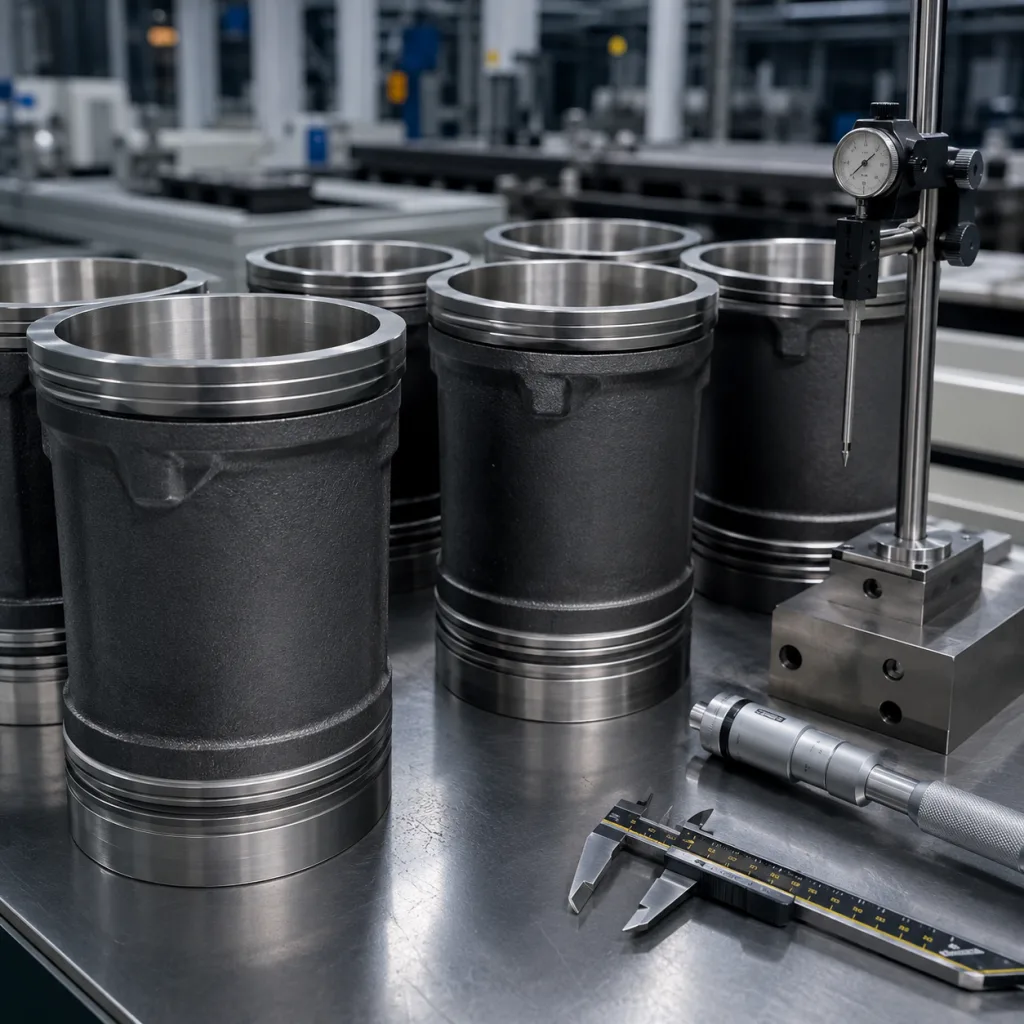
Cylinder liner performance depends on the relationship between metallurgy, bore finish, wall thickness, and installation geometry. In horizontally opposed Subaru-style engines, bore concentricity and finish control are especially important because liner variation can affect ring seating, oil control, heat transfer, and long-term sealing stability.

Driventus production control is built around repeatability across batches, not one-off sample approval. Typical process steps include raw casting inspection, CNC rough machining, stress relief where required by product design, finish turning, honing, final washing, and anti-corrosion packaging.

</tr></thead><tbody> </tbody></table>IATF 16949:2016 and ISO 9001:2015 do not replace part-specific validation, but they do establish the operating discipline expected by professional buyers. They support document control, corrective action, traceability, internal audit, supplier management, and controlled production records. Buyers can review Driventus procedures through our quality system.

Specification Points to Include in an RFQ

A clear RFQ reduces sampling cycles and helps prevent later disputes over acceptable variation. When sourcing from a cylinder liner Subaru manufacturer China supplier, the RFQ should define both product characteristics and commercial requirements before pricing is finalised.

Recommended technical RFQ fields:

  • Application or engine family, stated for fitment reference only
  • Liner type: dry, wet, flanged, or non-flanged
  • Finished bore diameter or semi-finished allowance
  • Outer diameter and press-fit requirement, if applicable
  • Overall length, flange diameter, flange thickness, and chamfer dimensions
  • Material requirement, hardness range, and microstructure expectation
  • Surface roughness target for the honed bore
  • Dimensional tolerance class or buyer drawing requirement
  • Packaging specification: individual wrap, VCI protection, carton, pallet
  • Required documents: inspection report, material certificate, packing list, and certificate of origin if needed

Most aftermarket distribution programs buy either finished liners ready for installation or semi-finished liners for local machining by engine rebuilders. Finished liners require tighter bore and surface-finish control before shipment. Semi-finished liners give regional workshops more freedom to machine to their preferred piston clearance, but stock allowance and wall-thickness control must be specified clearly.

Driventus can support standard catalog supply and custom manufacturing for drawings, private-label ranges, and volume-based development projects. No approval, endorsement, or supply relationship with any vehicle manufacturer is implied.

MOQ, Lead-Time, and Packaging for Import Programs

Commercial fit matters as much as technical fit. A supplier may be able to produce a correct liner but still be unsuitable if MOQ, mixed-model loading, packaging, or lead-time does not match the buyer’s inventory model.

Typical procurement variables to confirm during quotation:

Control point Procurement relevance Typical verification record
Chemical compositionConfirms cast iron consistencyMaterial certificate by batch
HardnessSupports wear resistance and machinabilityHB test record
Bore diameterMaintains piston and ring compatibilityDimensional inspection report
Roundness and cylindricityReduces sealing and oil-control riskGauge or CMM record where specified
Surface roughnessSupports ring bedding and oil retentionRoughness tester report
Flange and shoulder geometrySupports correct seating during installationFinal inspection checklist

</tr></thead><tbody> </tbody></table>For new cylinder liner programs, buyers should expect a first article approval process. This normally includes sample inspection, installation review by the buyer or their technical customer, and feedback before mass production release. For repeat stock orders, blanket forecasts can help stabilise delivery windows, reduce last-minute schedule changes, and limit urgent air-freight costs.

Driventus exports to the EU, UK, US, Canada, Australia, Brazil, and other markets. Packaging can be specified for sea freight, consolidated container loading, or distributor warehouse handling. Compliance questions relating to materials and packaging can be reviewed against market requirements such as REACH (EC) No 1907/2006 where applicable.

Factory Audit and Quality Evidence

A buyer evaluating a Chinese cylinder liner supplier should request evidence that the factory can control the full process, not only ship acceptable samples. One strong sample is useful, but it does not prove repeat production capability.

Useful audit questions include:

  • Is the supplier certified to IATF 16949:2016 and ISO 9001:2015?
  • Are incoming castings traceable by heat or batch?
  • Which gauges are used for bore, OD, flange, roughness, and hardness checks?
  • Are gauges calibrated under a documented schedule?
  • How are nonconforming liners segregated and recorded?
  • Can the supplier provide lot-level inspection reports with shipments?
  • What is the corrective action process for dimensional or packaging claims?

Buyers should also check whether the supplier understands aftermarket cataloguing. Cylinder liners may be ordered by engine code, piston size, distributor SKU, or cross-reference number rather than by a full engineering drawing. The supplier must manage this data carefully, confirm assumptions before production, and avoid unsupported claims of OE approval.

Driventus is an independent aftermarket manufacturer; brand names are referenced for fitment only. Subaru and other brand names, if used in sourcing discussions, identify the intended vehicle application and do not indicate endorsement, supply relationship, or vehicle manufacturer approval.

How Driventus Supports Cylinder Liner Buyers

Driventus manufactures engine and powertrain components including pistons, piston rings, cylinder liners, crankshafts, gaskets, water pumps, and turbochargers. This wider engine-parts base helps distributors consolidate purchasing across related repair categories while keeping separate inspection requirements for each product line.

For Subaru-fit cylinder liner programs, Driventus can support:

  • Existing aftermarket references where samples or drawings are available
  • New SKU development based on buyer drawings or controlled samples
  • Finished and semi-finished liner supply, subject to technical review
  • Lot inspection reports and material documentation
  • Neutral, private-label, or buyer-specified packaging
  • Export documentation for distributor and wholesaler channels

A structured onboarding process usually starts with fitment scope, annual demand estimate, target market, packaging requirement, and any existing cross-reference data. Engineering then reviews dimensional feasibility, tooling or fixture needs, sample timing, and inspection requirements. Commercial teams confirm MOQ, price breaks, lead-time, Incoterms, and shipment plan.

For buyers comparing suppliers, the most useful quotation is not necessarily the lowest single price. It is the offer that defines tolerances, documents the process, and gives a realistic production schedule. That is the basis for fewer receiving disputes, clearer accountability, and more stable long-term supply.

Frequently asked questions

Yes, subject to technical review. A controlled sample can support reverse measurement, but drawings, bore targets, material requirements, and application data improve accuracy. First article samples should be approved before mass production.

Typical documents include packing list, invoice, dimensional inspection report, material certificate, and export documents required for the shipment. Additional reporting should be agreed during RFQ so inspection time and cost are included.

No. Driventus is an independent aftermarket manufacturer; brand names are referenced for fitment only. Any application reference is used to identify compatibility and does not imply approval, endorsement, or supply relationship with a vehicle manufacturer.

If you are building a Subaru-fit cylinder liner sourcing program, share your target SKUs, drawings or samples, annual volume, and packaging requirements. Our team can review feasibility and help you [request a quote](/contact.html)

Request a Quote
Item Common B2B expectation Points to clarify
MOQVaries by SKU and machining routeStandard item or new development
Sample lead-timeUsually shorter for existing toolingNeed for drawing review or reverse engineering
Mass production lead-timeDepends on casting, machining, and order mixConfirm before seasonal rebuild demand
Mixed SKU orderOften possible for distributorsCarton marking and packing separation
Private labelAvailable where volume supports setupArtwork, carton strength, barcode format
Export packagingCarton plus pallet for sea freightAnti-rust protection and drop resistance