Camshaft Mini Wholesale: Sourcing Guide for Buyers
Camshaft mini wholesale is a sourcing topic for buyers who need compact engine camshafts in repeatable batches, not one-off retail supply. For procurement teams, the main questions are MOQ, alloy control, grinding tolerance, heat treatment depth, packaging, and whether the supplier can hold dimensions across production lots. Driventus Auto Parts manufactures engine and powertrain components in Taizhou, Zhejiang, and supplies B2B customers in the aftermarket, OEM/Tier-1 chain, and repair networks. We are an independent aftermarket manufacturer; brand names are referenced for fitment only. Buyers should compare part geometry, lobe lift, journal finish, and OE cross-reference data before placing a trial order. Driventus operates under IATF 16949:2016 and ISO 9001:2015, with material and dimensional controls aligned to buyer audit requirements. For sourcing teams, the right approach is to verify technical fit, confirm commercial terms, and request documented inspection data before shipment.
What buyers mean by mini camshaft wholesale
For procurement teams, “mini” usually refers to compact passenger car, small-displacement, or light-duty engine applications rather than a separate technical standard. The sourcing risk is not size alone; it is whether the camshaft matches the intended valve timing, journal diameter, base circle, and drive interface.
When evaluating a supplier, ask for:
OE cross-reference data, for example OE 06A107065 when the programme calls for it
Material specification and heat-treatment route
Hardness range and case depth after induction or nitriding
Journal runout and lobe profile control
Surface finish on journals and lobes
Packaging method to prevent corrosion and transit damage
Driventus supplies camshafts as part of our catalog and can support programme-level sourcing through custom manufacturing when the buyer needs specific geometry or branded packaging for market distribution.
Technical points to verify before placing a wholesale order
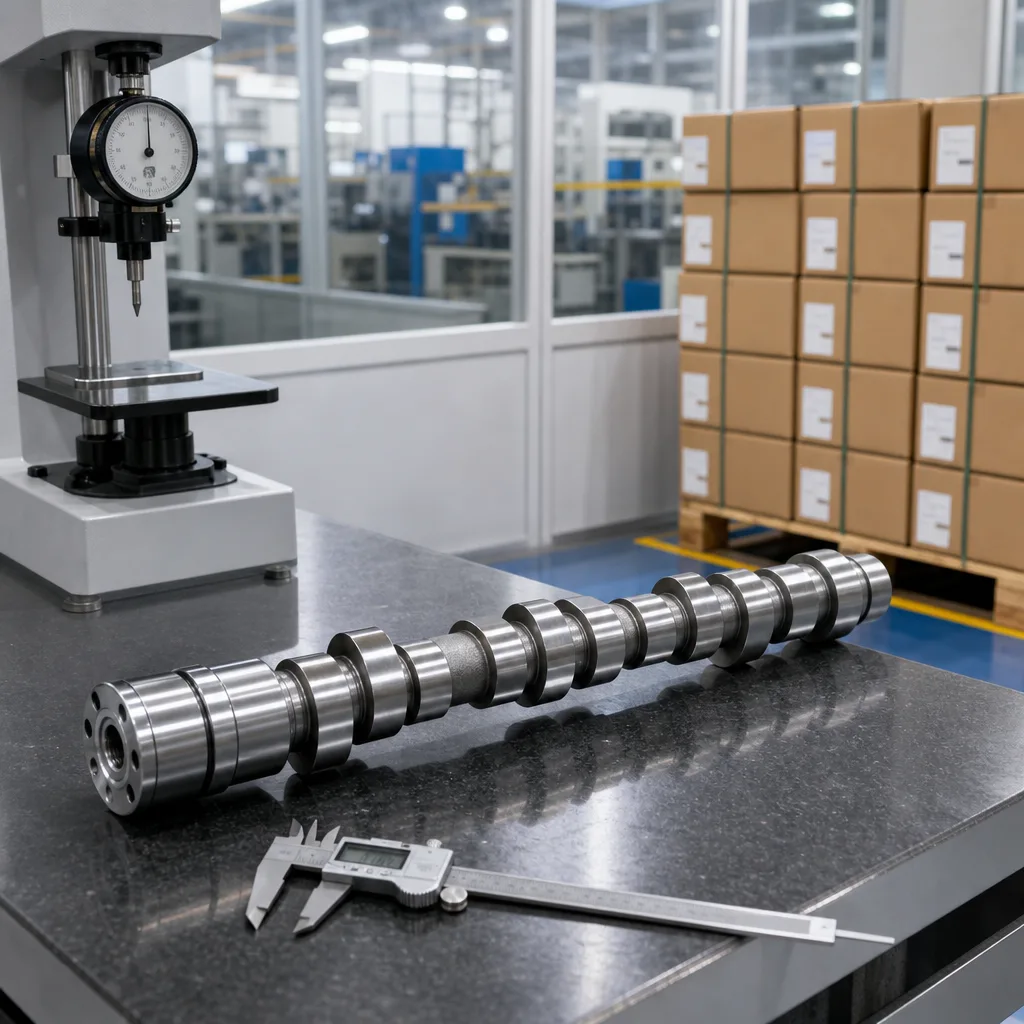
A camshaft is a precision rotating component. Small changes in lobe timing or journal geometry can affect idle stability, emissions performance, and wear rate. Buyers should request dimensional inspection records, not only a sample photo.
Core specification checklist
Item
Typical buyer requirement
Why it matters
Journal diameter
Match OE print within stated tolerance
Controls bearing clearance
Lobe lift
Match application data exactly
Affects valve opening and duration
Runout
Low total indicated runout
Reduces vibration and timing error
Surface hardness
Consistent across working surfaces
Improves wear resistance
Case depth
Defined after heat treatment
Supports long-term profile retention
Surface finish
Smooth, controlled finish
Protects lifter and bearing surfaces
Corrosion protection
Oil, VCI, or coated packing
Prevents storage damage
</tr></thead><tbody> </tbody></table>Published standards that may apply to the finished part or to buyer compliance reviews include IATF 16949:2016, ISO 9001:2015, REACH (EC) No 1907/2006, and customer-specific PPAP or incoming inspection plans. If the programme is emissions-sensitive, buyers may also need supporting validation linked to ECE R-83 or SAE J2527 where relevant to the engine system or testing regime.
MOQ, lead time, and batch planning
Wholesale purchasing is usually decided by stock policy and demand forecast, not by unit price alone. A low MOQ can be useful for market testing, but it should not reduce the level of dimensional control or material traceability.
Typical buyer questions:
What is the minimum order quantity per reference?
Can mixed-reference cartons be supplied for regional distributors?
What is the standard lead time for stocked versus made-to-order items?
Are first articles and batch inspection reports available?
Can cartons, labels, and barcodes be customised for warehouse receiving?
For camshaft programmes, lead time often depends on forging or casting source, machining queue, heat-treatment capacity, and final inspection. Buyers should also clarify whether replenishment is based on finished goods inventory, raw material stock, or a make-to-order schedule. If you need a programme with stable packaging and part numbering, we can discuss our quality system and align it with your receiving controls.
How Driventus supports supplier qualification
Procurement teams often need more than a price sheet. They need evidence that the supplier can hold process control over time.
Driventus supports qualification with:
Documented dimensional inspection by batch
Material traceability where specified by the customer
Controlled production under IATF 16949:2016 and ISO 9001:2015
Visual and packaging checks before export
Engineering review for fitment and interchange questions
For buyers running a formal audit, the most useful evidence is a stable process flow: incoming material verification, machining control, heat-treatment records, and final inspection. If your category review includes alternate references or regional packaging requirements, we can support our quality system review and, where needed, custom manufacturing for non-catalog programmes.
Comparison: stock purchase versus custom sourcing
Sourcing model
Best for
Buyer advantage
Buyer risk
Stock wholesale
Fast replenishment, common references
Shorter lead time, simpler forecast
Limited flexibility on specs
Custom manufacturing
New programme, packaging change, special geometry
Better fit to market requirement
Longer validation cycle
Mixed programme supply
Multi-region distribution
Easier SKU consolidation
Needs stronger document control
</tr></thead><tbody> </tbody></table>For most buyers, stock wholesale is the fastest path when the OE match is clear. Custom sourcing is better when the order requires a specific finish, label format, or part-number strategy. In either case, the order should be approved against dimensional data, sample photos, carton labelling, and agreed inspection criteria before mass shipment. Driventus is an independent aftermarket manufacturer; brand names are referenced for fitment only.
What to ask in a quotation request
A complete RFQ reduces back-and-forth and helps the factory quote the correct process route.
Include these fields:
Engine family or vehicle application
OE reference, if available, such as OE 06A107065
Annual forecast and initial order quantity
Target market and packaging language
Required documents: inspection report, material declaration, photos
Any special coating, rust protection, or label format
If your team is comparing suppliers, ask whether the factory can support repeat orders with the same tooling and control plan. For buyers in the EU and UK, confirm REACH-related material compliance as part of the document set. For North America, ask for any test or durability data that supports your internal approval process. To start the process, use our catalog and then request a quote with the target SKU list.
Frequently asked questions
The OE reference or exact engine application is the most important starting point. After that, confirm journal size, lobe profile, and packaging requirements. Without those details, quotation errors and fitment disputes are more likely.
Yes. For wholesale programmes, we can discuss carton format, barcode labelling, language requirements, and private-label packaging under a custom manufacturing arrangement. Final acceptance should still be based on agreed technical and commercial specifications.
We can provide batch inspection records and other agreed documents for buyer review. Requests may include material declarations, dimensional reports, and export packing details. The exact document set depends on the programme and destination market.
If you are building a camshaft sourcing programme, send your application details, target quantity, and OE reference through /contact.html and we will review the fitment and commercial terms.